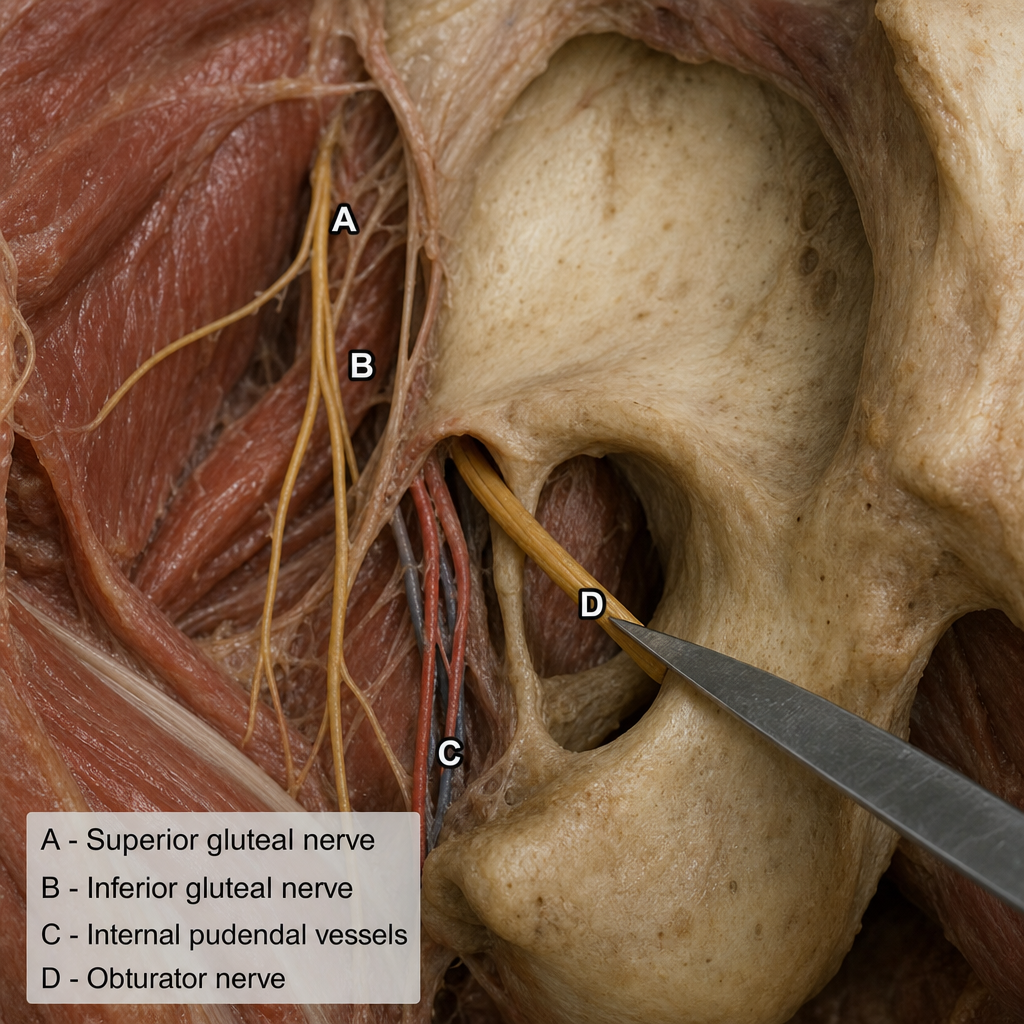
The pelvic diaphragm is composed of which of the following muscles, excluding one?
Which of the following does not form the triradiate ligament of the uterus?
Which of the following muscles attaches to the perineal body?
Which of the following is NOT an anatomical feature of the prostatic urethra?
The urogenital diaphragm is composed of all the following structures, EXCEPT:
What is the typical shape of the nulliparous cervix?
The external anal sphincter is innervated by which spinal nerve levels?
What is the lower limit of the sacroiliac joint in females?
Bartholin glands are related to which wall of the vagina?
The Urogenital Diaphragm is composed of all of the following structures EXCEPT?
Explanation: ### Explanation The **pelvic diaphragm** is a funnel-shaped muscular partition that separates the pelvic cavity above from the perineum below [1]. It provides vital support to the pelvic viscera and maintains fecal and urinary continence [2]. #### Why Ischiocavernous is the Correct Answer: The **Ischiocavernous** muscle is **not** a component of the pelvic diaphragm. Instead, it is a muscle of the **perineum**, specifically located within the **superficial perineal pouch** [3]. Its primary function is to maintain erection of the penis or clitoris by compressing the crus and impeding venous return. #### Analysis of Other Options (Components of the Pelvic Diaphragm): The pelvic diaphragm is formed by two main muscles: the **Levator Ani** and the **Coccygeus (Ischiococcygeus)**. * **Pubococcygeus (Option A):** The main part of the Levator Ani. It originates from the pubis and is further subdivided into the puborectalis and pubovaginalis/puboprostaticus [2]. * **Iliococcygeus (Option B):** The posterior part of the Levator Ani, originating from the tendinous arch of the pelvic fascia (white line) [2]. * **Ischiococcygeus (Option D):** Also known simply as the **Coccygeus**. It completes the posterior part of the pelvic diaphragm, stretching from the ischial spine to the coccyx/sacrum. #### NEET-PG High-Yield Pearls: * **Nerve Supply:** The Levator ani is supplied by the **ventral rami of S3, S4** and the perineal branch of the **pudendal nerve**. * **The Puborectalis Sling:** This part of the pubococcygeus maintains the **anorectal angle** (approx. 80°), which is crucial for fecal continence [2]. * **Clinical Correlation:** Injury to the pelvic diaphragm (often during childbirth) can lead to **stress incontinence** or **pelvic organ prolapse** (cystocele, rectocele, or uterine prolapse).
Explanation: The **triradiate ligament** (also known as the **Mackenrodt’s complex** or the "tripod" of uterine support) refers to the three primary condensations of endopelvic fascia that radiate from the cervix and upper vagina to the pelvic walls [1]. These ligaments provide the essential **active and passive support** to the uterus, maintaining its position within the pelvic cavity [1]. ### **Explanation of Options:** * **Correct Answer (B) Ovarian Ligament:** This is a remnant of the upper part of the gubernaculum. It connects the ovary to the lateral wall of the uterus. While it is a "ligament" of the female reproductive system, it is a **peritoneal fold** (false ligament) and does not provide structural support to the cervix or form part of the triradiate complex. * **Option A (Cardinal Ligament):** Also known as the **Mackenrodt’s** or **Transverse Cervical ligament**. It is the most important support of the uterus, extending from the cervix to the lateral pelvic walls [1]. It forms the lateral limb of the triradiate ligament [1]. * **Option C (Uterosacral Ligament):** These extend from the supravaginal cervix to the 2nd and 3rd sacral vertebrae [1]. They form the posterior limb of the triradiate ligament and help maintain the uterus in an anteverted position. * **Option D (Pubocervical Ligament):** These extend anteriorly from the cervix to the posterior surface of the pubic bones, forming the anterior limb of the triradiate ligament [1]. ### **High-Yield NEET-PG Pearls:** 1. **Primary Support:** The Cardinal (Mackenrodt’s) ligament is the **strongest** and most important ligament preventing uterine prolapse [1]. 2. **Ureter Relation:** The **ureter** passes inferior to the uterine artery ("water under the bridge") within the base of the cardinal ligament—a critical landmark during a hysterectomy [1]. 3. **Round Ligament:** Like the ovarian ligament, it is a derivative of the gubernaculum but maintains the **anteverted** position of the uterus rather than providing vertical support.
Explanation: The **perineal body** (central tendon of the perineum) is a fibromuscular mass located in the midline between the anal canal and the urogenital apparatus [1]. It serves as the "keystone" of the pelvic floor, providing structural integrity. ### **Why Bulbospongiosus is Correct** The perineal body acts as a point of convergence for several muscles. The **bulbospongiosus** muscle originates from the perineal body (and the midline raphe in males). Along with the external anal sphincter and the superficial/deep transverse perineal muscles, it decussates at this central point to stabilize the pelvic floor [1]. ### **Explanation of Incorrect Options** * **A. Pubocervical:** This refers to the pubocervical fascia/ligament, which supports the bladder and vagina. It is a condensation of pelvic fascia, not a muscle that inserts into the perineal body. * **C. Ischiocavernous:** This muscle covers the crura of the penis or clitoris and arises from the ischial tuberosity and ramus. It does **not** attach to the perineal body. * **D. Ischiococcygeus (Coccygeus):** This is a posterior pelvic floor muscle that spans from the ischial spine to the coccyx/sacrum. It is located far posterior to the perineal body. ### **High-Yield NEET-PG Pearls** * **Mnemonic for muscles attaching to the Perineal Body (10 total):** "**B**ulbospongiosus, **E**xternal anal sphincter, **S**uperficial transverse perineal, **D**eep transverse perineal, **L**evator ani (specifically Puborectalis), and **G**rowth of longitudinal muscle of the rectum." (Mnemonic: **B**est **E**xercise **S**tops **D**ownward **L**eakage). * **Clinical Significance:** Damage to the perineal body during childbirth (perineal tears) or via an improperly performed **episiotomy** can lead to pelvic organ prolapse or fecal incontinence [1]. * **Location:** In females, it lies between the vagina and the anal canal; in males, between the bulb of the penis and the anus [1].
Explanation: **Explanation:** The **prostatic urethra** is the widest and most dilatable part of the male urethra, measuring approximately 3 cm in length. Understanding its internal morphology is high-yield for NEET-PG. **1. Why Option A is the Correct Answer:** On cross-section, the prostatic urethra is **crescent-shaped (semilunar)**, not trapezoidal. This shape is due to the presence of the **urethral crest**, a longitudinal mucous fold on the posterior wall that protrudes into the lumen, indenting it. **2. Analysis of Incorrect Options (Features present in the Prostatic Urethra):** * **Urethral Crest (Option B):** This is a prominent vertical ridge on the posterior wall (verumontanum). * **Prostatic Utricle (Option D):** A small, blind-ending sac located at the highest point of the urethral crest (seminal colliculus). It is a developmental remnant of the **Müllerian (paramesonephric) duct**, often called the "male uterus." * **Ejaculatory Ducts (Option C):** The two ejaculatory ducts open into the prostatic urethra on either side of the prostatic utricle. Additionally, the **prostatic sinuses** (grooves on either side of the crest) contain the openings of the prostatic ducts. **Clinical Pearls for NEET-PG:** * **Widest part:** Prostatic urethra. * **Narrowest part:** External urethral meatus (followed by the membranous urethra). * **Least dilatable part:** Membranous urethra (due to the external sphincter). * **Developmental Remnant:** The prostatic utricle is the male homologue of the uterus and vagina. * **Urethral Crest:** The most important landmark for urologists during transurethral resection of the prostate (TURP).
Explanation: The **urogenital diaphragm** is a triangular musculofascial shelf situated in the anterior part of the pelvic outlet. Understanding its layers is crucial for NEET-PG, as it defines the boundaries of the deep perineal pouch [1]. ### Why Colle’s Fascia is the Correct Answer **Colle’s fascia** is the superficial fascia of the perineum (a continuation of Scarpa’s fascia from the abdominal wall). It forms the floor of the **superficial perineal pouch**, not the urogenital diaphragm. The urogenital diaphragm is located deeper than Colle’s fascia. ### Analysis of Other Options The urogenital diaphragm is traditionally described as a "sandwich" consisting of a muscle layer between two fascial layers: * **Perineal Membrane (Option C):** This is the **inferior fascia** of the urogenital diaphragm. It serves as the foundation for the external genitalia. * **Sphincter Urethrae (Option B):** This is one of the two primary muscles located within the deep perineal pouch, forming the muscular core of the diaphragm [1]. * **Deep Transverse Perineal Muscle (Option D):** Along with the sphincter urethrae, this muscle makes up the substance of the urogenital diaphragm, helping to support the pelvic floor [1]. ### High-Yield NEET-PG Pearls * **Contents of Deep Perineal Pouch:** Includes the membranous urethra, Bulbourethral (Cowper’s) glands (in males only), and the internal pudendal artery/nerve. * **Rupture of Urethra:** If the bulbous urethra is ruptured **below** the perineal membrane, urine extravasates into the superficial perineal pouch, limited by Colle’s fascia. It can spread to the scrotum and abdominal wall but not the thighs (due to the attachment of fascia lata). * **Modern Anatomy Note:** Recent anatomical studies suggest the "diaphragm" is not a flat plane but a complex 3D structure, but for exam purposes, the "sandwich" model (Superior fascia + Muscle + Perineal membrane) remains the standard.
Explanation: The cervix is the lower, cylindrical portion of the uterus [1]. In a **nulliparous woman** (one who has never given birth), the vaginal portion of the cervix (ectocervix) is typically **conical** in shape [2]. This is due to the firm, fibrous nature of the cervical stroma that has not yet been stretched or remodeled by the process of labor and delivery [2]. **Analysis of Options:** * **A. Conical (Correct):** The nulliparous cervix is firm and tapers towards the end, resembling a cone. The external os is small, smooth, and circular. * **B. Circular:** While the **external os** (the opening) is circular in a nulliparous woman, the overall **shape** of the cervix itself is conical. * **C. Longitudinal:** This term does not describe the anatomical shape of the cervix. However, after childbirth (multiparous), the external os often appears as a **transverse slit** rather than a circle. * **D. Cylindrical:** While the cervix is generally described as the cylindrical part of the uterus, the specific morphological characteristic that distinguishes a nulliparous cervix from a multiparous one is its conical taper. **High-Yield NEET-PG Pearls:** 1. **Nulliparous vs. Multiparous:** In a multiparous woman, the cervix becomes more **cylindrical** and bulky, and the external os changes from a small circular opening to a **transverse slit** due to lateral lacerations during delivery. 2. **Epithelial Transition:** The ectocervix is lined by **stratified squamous non-keratinized epithelium**, while the endocervix is lined by **simple columnar epithelium**. The "Transformation Zone" where these meet is the most common site for cervical cancer [3]. 3. **Support:** The **Mackenrodt’s ligament** (Cardinal ligament) is the primary support of the cervix and uterus.
Explanation: The **external anal sphincter (EAS)** is a skeletal muscle responsible for the voluntary control of defecation [1]. Its innervation is derived from the **pudendal nerve** and the **perineal branch of the fourth sacral nerve**. 1. **Why S2, S3, S4 is correct:** The pudendal nerve originates from the ventral rami of the **S2, S3, and S4** spinal nerves (often remembered by the mnemonic: *"S2, 3, 4 keeps the poop off the floor"*). Specifically, the EAS is supplied by the **inferior rectal nerve** (a branch of the pudendal nerve) and direct branches from the S4 nerve root. These fibers provide both motor control to the sphincter and sensory feedback from the anal canal below the pectinate line. 2. **Why other options are incorrect:** * **S2, S3:** While these contribute to the pudendal nerve, they are incomplete without S4, which provides the primary motor outflow for the pelvic floor and anal apparatus. * **L5, S1:** These levels primarily contribute to the sciatic nerve and supply muscles of the lower limb (e.g., gluteal muscles and hamstrings), not the pelvic sphincters. * **L2, L3:** These levels contribute to the lumbar plexus (e.g., femoral and obturator nerves) and supply the anterior thigh. **High-Yield Clinical Pearls for NEET-PG:** * **Internal vs. External:** The *internal* anal sphincter is involuntary (autonomic) and supplied by sympathetic (L1-L2) and parasympathetic (S2-S4) fibers [1]. The *external* sphincter is voluntary (somatic). * **Onuf’s Nucleus:** The specialized group of neurons in the anterior horn of the S2-S4 spinal cord that specifically innervates the external anal and urethral sphincters. * **Anal Wink Reflex:** Testing the S2-S4 functional integrity; stroking the perianal skin causes visible contraction of the EAS. [1]
Explanation: **Explanation:** The sacroiliac joint is a complex synovial joint formed between the auricular surfaces of the sacrum and the ilium. In clinical anatomy, particularly concerning the female pelvis, the vertical extent of this joint is a high-yield fact for competitive exams. **1. Why Option B is Correct:** In females, the sacroiliac joint typically extends from the level of the **S1 vertebra down to the middle of the S3 vertebra**. Quantitatively, this corresponds to a vertical span of **2 to 2 ½ sacral segments** [1]. This shorter and narrower joint surface in females (compared to males) allows for greater mobility and hormonal-induced ligamentous laxity during pregnancy and parturition. **2. Why Other Options are Incorrect:** * **Option A (1 to 1 ½):** This is too short and does not account for the full articulation of the auricular surfaces. * **Option C (3 to 3 ½):** This is the characteristic measurement for **males**. In males, the sacroiliac joint is longer and more stable, typically extending from S1 down to the lower border of the S3 vertebra [1]. * **Option D (4 to 4 ½):** This would involve almost the entire sacrum, which is anatomically incorrect as the lower sacral segments (S4-S5) do not articulate with the ilium. **Clinical Pearls for NEET-PG:** * **Joint Type:** It is a **strong synovial joint** (anteriorly) and a **syndesmosis** (posteriorly). * **Stability:** The **posterior sacroiliac ligament** is the strongest ligament in the body, essential for transmitting weight from the axial skeleton to the lower limbs. * **Gender Dimorphism:** The female sacroiliac joint is more mobile, while the male joint is more stable and has more irregular surfaces to resist shear forces [1]. * **Hilton’s Law:** The joint is supplied by the superior gluteal, sacral plexus, and the first two dorsal rami of sacral nerves.
Explanation: The **Bartholin glands** (greater vestibular glands) are the female homologues of the bulbourethral (Cowper’s) glands in males [1]. They are located deep to the posterior third of the **labia majora**, situated within the superficial perineal pouch. 1. **Why the Lateral Wall is Correct:** The ducts of the Bartholin glands are approximately 2 cm long and open into the **vestibule** [1] in the groove between the hymen and the **lateral wall** [2] of the vaginal orifice (specifically at the 4 o'clock and 8 o'clock positions). Anatomically, the glands themselves lie posterolateral to the vaginal opening, making the lateral wall the most accurate anatomical relation among the choices [2]. 2. **Why Other Options are Incorrect:** * **Anterior Wall:** The anterior wall is related to the base of the bladder and the urethra [2]. The female prostate equivalent (Skene’s glands) opens near the external urethral meatus, not the Bartholin glands [1]. * **Posterior Wall:** The posterior wall is related to the pouch of Douglas (rectouterine pouch) and the rectum [2]. While the glands are posterior to the bulb of the vestibule, they are distinctly lateral to the vaginal midline. **High-Yield Clinical Pearls for NEET-PG:** * **Bartholin Cyst/Abscess:** Obstruction of the duct leads to a cyst. If infected (commonly by *E. coli* or *N. gonorrhoeae*), it forms an abscess. * **Nerve Supply:** Pudendal nerve (S2–S4). * **Histology:** The gland is lined by **columnar epithelium**, while the duct is lined by **transitional epithelium** which changes to **stratified squamous epithelium** at its opening [1]. * **Lymphatic Drainage:** Drains into the **superficial inguinal lymph nodes**.
Explanation: The **Urogenital Diaphragm (UGD)** is a triangular musculofascial shelf located in the anterior part of the pelvic outlet. It is traditionally described as a "sandwich" consisting of a layer of skeletal muscle enclosed between two layers of fascia [1]. ### Why Colle’s Fascia is the Correct Answer **Colle’s fascia** is the superficial fascia of the perineum (a continuation of Scarpa’s fascia from the abdominal wall). It forms the floor of the **Superficial Perineal Pouch**, not the Urogenital Diaphragm. The UGD is located deeper than Colle's fascia, separated from it by the superficial perineal space. ### Analysis of Incorrect Options * **Perineal Membrane (Option C):** This is the **inferior fascia** of the UGD. It serves as the foundation for the external genitalia and is a primary component of the diaphragm. * **Sphincter Urethrae (Option B) & Deep Transverse Perineal Muscle (Option D):** These are the skeletal muscles contained within the **Deep Perineal Pouch**. Together with their superior and inferior fascia, they constitute the UGD [1]. ### High-Yield Clinical Pearls for NEET-PG * **Contents of Deep Perineal Pouch:** Includes the Membranous urethra, Sphincter urethrae, Deep transverse perineal muscle, and **Bulbourethral (Cowper's) glands** (in males only) [1]. * **Rupture of Urethra:** If the urethra is ruptured **below** the perineal membrane (superficial pouch), urine extravasates deep to Colle’s fascia, potentially tracking into the scrotum and abdominal wall. * **Modern Anatomy Note:** Recent anatomical studies suggest the UGD is not a flat "diaphragm" but a complex 3D structure; however, for NEET-PG, the traditional "sandwich" model (Superior fascia + Muscle + Perineal membrane) remains the standard for examination.
Pelvic Walls and Floor
Practice Questions
Pelvic Viscera
Practice Questions
Urogenital Organs
Practice Questions
Pelvic Vasculature
Practice Questions
Pelvic Innervation
Practice Questions
Male Perineum
Practice Questions
Female Perineum
Practice Questions
Pelvic Lymphatics
Practice Questions
Applied Anatomy and Clinical Correlations
Practice Questions
Gender Differences in Pelvic Anatomy
Practice Questions
Get full access to all questions, explanations, and performance tracking.
Start For Free