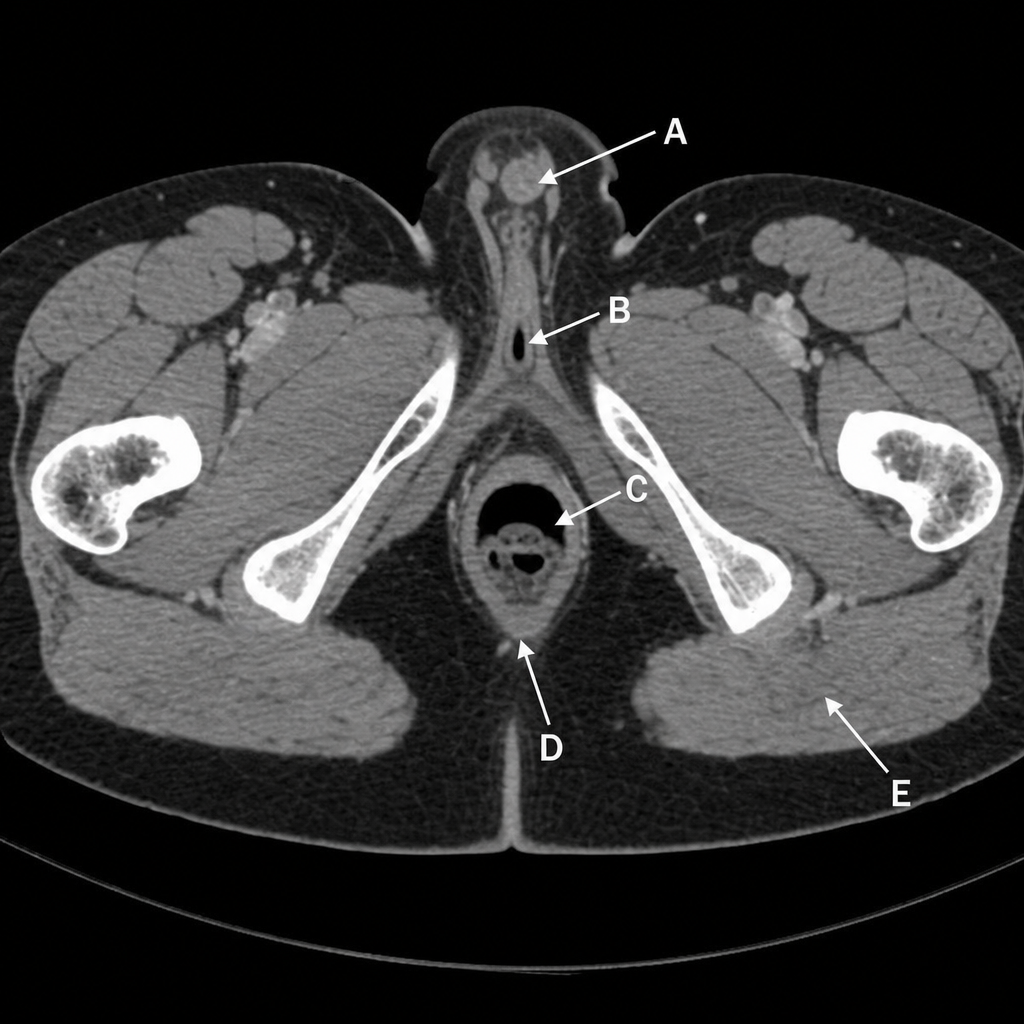
Which of the following is NOT a feature of the typical female pelvis?
Below the pectineal line, lymphatic drainage is to which nodes?
The crura of the penis are supplied by which artery?
Which of the following is a branch of the internal iliac artery?
Rupture of the male urethra immediately inferior to the urogenital diaphragm leads to extravasation of urine into which space?
Which of the following statements regarding the anatomy of the anal canal is true?
Sperm, after formation, are stored in which structure?
True about the ureter?
The sacrospinous ligament is crossed by all of the following structures, EXCEPT?
A 32-year-old patient with multiple fractures of the pelvis has no cutaneous sensation in the urogenital triangle. The function of which of the following nerves is most likely to be spared?
Explanation: The female pelvis (gynecoid) is evolutionarily adapted for childbirth, requiring a wider and shallower cavity compared to the male pelvis (android) [1]. **Explanation of the Correct Answer:** **Option D (Sacrum is long and narrow)** is the correct answer because it describes a **male** pelvic feature. In females, the sacrum is **shorter, wider, and more curved** in its lower half [1]. This configuration increases the anteroposterior diameter of the pelvic outlet, facilitating the passage of the fetal head during labor. **Analysis of Incorrect Options:** * **Option A (Sub-pubic angle is more obtuse):** In females, the sub-pubic angle is wide (typically 80°–90° or more), whereas in males, it is acute (approx. 60°–70°). * **Option B (Pelvic inlet is circular shaped):** The female inlet is typically transversely oval or nearly circular [1]. In contrast, the male inlet is heart-shaped due to the protrusion of the sacral promontory. * **Option C (Obturator foramen is triangular):** This is a classic morphological difference. The female obturator foramen is smaller and triangular, while the male foramen is larger and oval/round. **High-Yield NEET-PG Pearls:** * **Caldwell-Moloy Classification:** Recognizes four types: Gynecoid (most common in females), Android (heart-shaped), Anthropoid (long AP diameter), and Platypelloid (flat/wide) [1]. * **True Pelvis:** The female pelvis has a shallow pelvic cavity [2] with less prominent ischial spines (non-inverted) to prevent obstruction during delivery. * **Greater Sciatic Notch:** It is wider (approx. 75°) in females and narrow (approx. 50°) in males.
Explanation: The lymphatic drainage of the anal canal is divided by the **pectinate (dentate) line**, which serves as a critical embryological and anatomical landmark. [1] ### Why the Correct Answer is Right The area **below the pectinate line** (the anal canal distal to the dentate line) is derived from the **ectoderm** (proctodeum). Its nerve supply is somatic, and its lymphatic drainage follows the cutaneous drainage of the perineum and lower limb. Therefore, lymph from this region drains into the **Superficial Inguinal Lymph Nodes**. This is why a malignancy in the distal anal canal often presents with palpable inguinal lymphadenopathy. [1] ### Why the Other Options are Wrong * **Internal Iliac Nodes:** These drain the area **above the pectinate line**. This region is derived from the endoderm (hindgut), and its lymphatics follow the arterial supply (superior rectal artery) and venous drainage back to the internal iliac and pararectal nodes. [1] * **External Iliac Nodes:** These primarily drain the pelvic viscera (like the upper bladder and body of the uterus) and the deep structures of the lower limb, but not the distal anal canal. * **Para-aortic Nodes:** These receive drainage from the gonads (testes/ovaries) and the kidneys. They are the "terminal" nodes for many pelvic structures but are not the primary site for the sub-pectineal region. ### NEET-PG High-Yield Pearls * **Above Pectinate Line:** Endoderm origin → Autonomic supply → Painless internal hemorrhoids → Drainage to **Internal Iliac Nodes**. * **Below Pectinate Line:** Ectoderm origin → Somatic supply (Inferior rectal nerve) → Painful external hemorrhoids → Drainage to **Superficial Inguinal Nodes**. * **The "Watershed" Rule:** In the pelvis, structures derived from the skin/perineum generally drain to the superficial inguinal nodes, while deep pelvic organs drain to the internal/external iliac nodes.
Explanation: **Explanation:** The blood supply to the penis is primarily derived from the **internal pudendal artery**, which is a branch of the internal iliac artery. As it enters the perineum, it gives off several branches to supply the erectile tissues. **1. Why the Correct Answer is Right:** The **Deep artery of the penis** (also known as the artery to the corpus cavernosum) is the primary vessel responsible for supplying the **crura** and the **corpora cavernosa**. It pierces the perineal membrane and runs centrally within the corpus cavernosum. Its branches, the **helicine arteries**, are crucial for the engorgement of the cavernous spaces during erection. **2. Why the Other Options are Wrong:** * **Dorsal artery of the penis:** This artery runs on the dorsal surface of the penis between the deep fascia (Buck’s fascia) and the tunica albuginea. It primarily supplies the **glans penis** and the skin of the penis, not the crura. * **External pudendal artery:** A branch of the femoral artery, it supplies the skin of the scrotum and the suprapubic region, but does not reach the deep erectile tissues. * **Obturator artery:** This is a branch of the internal iliac artery that supplies the medial compartment of the thigh; it has no role in the blood supply to the penis. **High-Yield Clinical Pearls for NEET-PG:** * **Artery of the Bulb:** Another branch of the internal pudendal artery that supplies the **bulb of the penis** and the **corpus spongiosum**. * **Venous Drainage:** The **Deep dorsal vein** (located in the midline) drains the cavernous spaces and is essential for the "veno-occlusive mechanism" during erection. * **Nerve Supply:** Parasympathetic fibers (S2-S4 via pelvic splanchnic nerves) cause vasodilation of the helicine arteries, leading to erection ("P" for Point/Parasympathetic), while sympathetic fibers (T11-L2) mediate ejaculation ("S" for Shoot/Sympathetic).
Explanation: The **internal iliac artery** is the principal artery of the pelvis, providing blood supply to the pelvic viscera, perineum, and gluteal region. It divides into anterior and posterior divisions at the upper margin of the greater sciatic foramen. ### Why the Correct Answer is Right: **D. Uterine artery:** This is a major branch of the **anterior division** of the internal iliac artery. In females, it runs medially in the base of the broad ligament to reach the cervix. A high-yield anatomical relationship to remember is that the uterine artery crosses **superior** to the ureter ("water under the bridge"). ### Why the Other Options are Wrong: * **A. Inferior epigastric artery:** This is a branch of the **external iliac artery**, arising just proximal to the inguinal ligament [1]. It forms the lateral boundary of Hesselbach’s triangle. * **B. Femoral artery:** This is the direct **continuation of the external iliac artery** after it passes deep to the inguinal ligament. * **C. Renal artery:** This is a paired **visceral branch of the abdominal aorta**, arising at the level of the L1/L2 vertebrae. ### NEET-PG High-Yield Pearls: * **Posterior Division Branches:** Remember the mnemonic **PILS** (Posterior division: **I**liolumbar, **L**ateral sacral, and **S**uperior gluteal arteries). * **Anterior Division Branches:** Includes Umbilical, Obturator, Uterine/Vaginal, Inferior vesical, Middle rectal, Internal pudendal, and Inferior gluteal arteries. * **Clinical Significance:** Ligation of the internal iliac artery is a life-saving procedure used to control massive postpartum hemorrhage (PPH) or pelvic trauma. Pelvic collateral circulation (e.g., lumbar-iliolumbar) maintains viability.
Explanation: ### Explanation The male urethra is divided into four parts: pre-prostatic, prostatic, membranous, and spongy (penile). The **urogenital diaphragm** contains the membranous urethra. Rupture **immediately inferior** to this diaphragm involves the **spongy urethra** (specifically the bulbous portion) [1]. **1. Why Option A is Correct:** The spongy urethra lies within the **superficial perineal space**. This space is bounded superiorly by the perineal membrane and inferiorly by **Colles’ fascia** (the deep layer of superficial fascia). When the bulbous urethra ruptures, urine extravasates into this space. Because Colles’ fascia is continuous with **Scarpa’s fascia** of the abdominal wall, urine can spread into the scrotum, around the penis, and up the anterior abdominal wall. However, it cannot spread into the thighs because Colles' fascia attaches to the fascia lata. **2. Why Other Options are Incorrect:** * **B. Deep perineal space:** This space lies *within* the urogenital diaphragm. Rupture of the **membranous urethra** leads to extravasation here [2]. * **C. Ischiorectal fossa:** This is located lateral to the anal canal and is separated from the urogenital spaces by the fascia of the pelvic floor and the perineal body. * **D. Extraperitoneal space:** This is typically involved in "extraperitoneal bladder rupture" or pelvic fractures causing injury to the **prostatic urethra** (above the urogenital diaphragm) [2]. **Clinical Pearls for NEET-PG:** * **Butterfly Bruising:** Extravasation in the superficial perineal space often presents with a characteristic "butterfly" distribution of swelling/ecchymosis. * **Straddle Injury:** The most common cause of bulbous (spongy) urethral rupture is a fall-astride or straddle injury [1]. * **Membranous Urethra:** Most commonly injured in pelvic fractures; urine accumulates in the deep perineal space and may track extraperitoneally around the bladder [2].
Explanation: **Explanation:** **Correct Option (A):** The **puborectalis muscle**, a component of the levator ani, forms a U-shaped sling around the anorectal junction [1]. Its contraction creates the **anorectal angle** (approximately 80-90 degrees), which acts as a mechanical barrier to the passage of stool [2]. This "sling effect" is the primary mechanism for maintaining **gross fecal continence** [1]. During defecation, the puborectalis relaxes, straightening the angle to allow fecal passage [2]. **Analysis of Incorrect Options:** * **B. The internal anal sphincter is composed of skeletal muscle:** This is incorrect. The internal anal sphincter is a thickening of the circular smooth muscle layer of the rectum and is under **involuntary** autonomic control. * **C. The internal anal sphincter is in a state of tonic contraction:** While this statement is physiologically true (it provides 70-80% of resting anal pressure), in the context of this specific MCQ format, Option A is the "most correct" anatomical landmark regarding continence mechanisms [2]. *Note: In some exams, C might be considered true, but A is the classic anatomical answer for NEET-PG.* * **D. The external anal sphincter is innervated by the gluteal nerve:** This is incorrect. The external anal sphincter (skeletal muscle) is innervated by the **inferior rectal nerve** (a branch of the pudendal nerve) and the perineal branch of the S4 nerve. **High-Yield Clinical Pearls for NEET-PG:** * **Hilton’s White Line:** Represents the intersphincteric groove; it marks the junction between the internal and external anal sphincters. * **Pectinate (Dentate) Line:** A critical landmark. Above it, drainage is to internal iliac nodes (endoderm); below it, drainage is to superficial inguinal nodes (ectoderm). * **Surgical Importance:** The **anorectal ring** (formed by the puborectalis, deep external sphincter, and internal sphincter) must be preserved during surgery to prevent permanent fecal incontinence.
Explanation: The correct answer is **B. Epididymis**. **1. Why Epididymis is correct:** The epididymis is a long, coiled tube (approx. 6 meters) located on the posterior aspect of the testis. While sperm are produced in the testes, they are physiologically immature and non-motile upon leaving [2]. The epididymis serves as the primary site for **sperm maturation** (attaining motility and fertilizing capacity) and **storage** until ejaculation. Sperm can be stored in the tail (cauda) of the epididymis for several weeks. **2. Why other options are incorrect:** * **Seminiferous tubules:** These are the functional units of the testis where **spermatogenesis** (production of sperm) occurs [3], but they do not store mature sperm. * **Rete testis:** This is a network of delicate tubules in the mediastinum testis that carries sperm from the seminiferous tubules to the efferent ductules [2]. It is a **conduit**, not a storage site. * **Seminal vesicle:** A common misconception is that these store sperm. In reality, they are accessory glands that secrete a thick, alkaline fluid (rich in **fructose**) that constitutes about 60-70% of the volume of semen. They do not contain or store sperm. **High-Yield NEET-PG Pearls:** * **Sperm Pathway:** Seminiferous tubules → Rete testis → Efferent ductules → Epididymis → Vas deferens → Ejaculatory duct → Urethra. * **Blood-Testis Barrier:** Formed by the **tight junctions of Sertoli cells** [1]; it protects developing germ cells from the immune system. * **Sertoli Cells:** Provide nutrition and secrete **Inhibin B** and **Androgen Binding Protein (ABP)** [3]. * **Leydig Cells:** Located in the interstitium; they secrete **Testosterone** under the influence of LH.
Explanation: The ureter is a muscular tube that transports urine from the kidney to the bladder. Understanding its course and anatomical relations is high-yield for NEET-PG. **Explanation of Options:** * **A. Stasis at the hilum:** The ureteropelvic junction (UPJ) at the renal hilum is the first of the three physiological constrictions of the ureter. These constrictions are sites of relative stasis where urinary calculi (stones) are most likely to lodge. * **B. Changes its direction at the ischial spine:** In the true pelvis, the ureter runs downwards and backwards along the anterior margin of the greater sciatic notch. At the level of the **ischial spine**, it turns anteromedially to enter the base of the urinary bladder [1]. This change in direction is a crucial landmark in pelvic surgery. * **C. Penetrates the bladder wall without any valve:** The ureter enters the bladder wall obliquely, creating an intramural tunnel (approx. 2 cm) [1]. There is **no anatomical sphincter or valve** at the ureteric orifice. Instead, the pressure of the filling bladder compresses the intramural portion of the ureter, acting as a "physiological valve" to prevent vesicoureteral reflux [1]. **High-Yield Clinical Pearls for NEET-PG:** 1. **Three Constrictions (Sites of Stone Lodgement):** * Ureteropelvic Junction (UPJ). * Pelvic Brim (where it crosses the common/external iliac artery). * Ureterovesical Junction (UVJ) – the narrowest part. 2. **Water Under the Bridge:** In females, the ureter passes **under** the uterine artery. In males, it passes **under** the delivery vas deferens [1]. 3. **Blood Supply:** It receives a segmental blood supply (Renal, Gonadal, Common Iliac, and Internal Iliac arteries). 4. **Nerve Supply:** T10–L1 segments (explaining the "loin to groin" radiation of renal colic).
Explanation: ### Explanation The **sacrospinous ligament** is a key anatomical landmark in the pelvis, extending from the lateral border of the sacrum and coccyx to the ischial spine. It separates the greater sciatic foramen from the lesser sciatic foramen. **Why "None of the above" is correct:** The structures that exit the pelvis through the **greater sciatic foramen** (below the piriformis) and then hook around the sacrospinous ligament/ischial spine to re-enter the pelvis through the **lower sciatic foramen** are collectively known by the mnemonic **PIN**: 1. **P**udendal nerve 2. **I**nternal pudendal vessels (Artery and Vein) 3. **N**erve to obturator internus Since options A, B, and C all describe structures that cross the sacrospinous ligament to reach the perineum, none of them are "exceptions." Therefore, "None of the above" is the correct choice. **Analysis of Options:** * **Internal pudendal artery & vein (Options A & B):** These vessels exit the greater sciatic foramen, cross the dorsal aspect of the sacrospinous ligament, and enter the pudendal (Alcock’s) canal to supply the perineum. * **Nerve to obturator internus (Option C):** This nerve (L5, S1, S2) passes lateral to the pudendal vessels, crosses the base of the ischial spine/sacrospinous ligament, and enters the lesser sciatic foramen to supply the obturator internus muscle. **High-Yield Clinical Pearls for NEET-PG:** * **Pudendal Nerve Block:** The ischial spine and sacrospinous ligament are the primary landmarks for administering a pudendal nerve block during vaginal delivery. * **Sacrospinous Fixation:** This ligament is used surgically to treat vaginal vault prolapse. * **The "PIN" Mnemonic:** Always remember that these three structures exit the greater and enter the lesser sciatic foramen. The **Pudendal nerve** is the most medial, and the **Nerve to obturator internus** is the most lateral.
Explanation: ### Explanation **Core Concept: Cutaneous Innervation of the Perineum** The urogenital triangle (the anterior part of the perineum) receives sensory innervation from several nerves. To identify the "spared" nerve, one must distinguish between nerves that supply the perineum/scrotum/labia and those that supply the abdominal wall or suprapubic region. **Why Iliohypogastric Nerve is Correct:** The **iliohypogastric nerve (L1)** provides cutaneous sensation to the skin **above the pubis** (suprapubic region) and the lateral gluteal area [1]. It does **not** provide sensory branches to the urogenital triangle or the external genitalia. Therefore, its function remains intact (spared) despite the loss of sensation in the urogenital triangle. **Analysis of Incorrect Options:** * **Ilioinguinal nerve (L1):** This nerve passes through the inguinal canal and supplies the skin over the root of the penis and the **anterior 1/3rd of the scrotum/labia majora** (anterior scrotal/labial nerves). * **Posterior cutaneous nerve of the thigh (S1-S3):** While primarily for the thigh, it gives off **perineal branches** that supply the skin of the lateral part of the urogenital triangle and the posterior scrotum/labia. * **Pudendal nerve (S2-S4):** The chief nerve of the perineum. Its branch, the **posterior scrotal/labial nerve**, supplies the **posterior 2/3rds** of the urogenital triangle. * **Genitofemoral nerve (L1-L2):** The genital branch innervates the cremaster muscle and the skin on the lateral side of the scrotum and labia [2]. **NEET-PG High-Yield Pearls:** 1. **Scrotal/Labial Innervation Split:** Remember the "1/3 vs 2/3" rule. Anterior 1/3 is Lumbar (Ilioinguinal, Genitofemoral); Posterior 2/3 is Sacral (Pudendal, Posterior cutaneous nerve of thigh). 2. **Pudendal Nerve Block:** Performed by infiltrating local anesthetic near the **ischial spine** (sacrospinous ligament) to provide anesthesia for the perineum during childbirth. 3. **Iliohypogastric vs. Ilioinguinal:** Both are L1, but only the Ilioinguinal enters the inguinal canal and supplies the urogenital triangle [1].
Pelvic Walls and Floor
Practice Questions
Pelvic Viscera
Practice Questions
Urogenital Organs
Practice Questions
Pelvic Vasculature
Practice Questions
Pelvic Innervation
Practice Questions
Male Perineum
Practice Questions
Female Perineum
Practice Questions
Pelvic Lymphatics
Practice Questions
Applied Anatomy and Clinical Correlations
Practice Questions
Gender Differences in Pelvic Anatomy
Practice Questions
Get full access to all questions, explanations, and performance tracking.
Start For Free