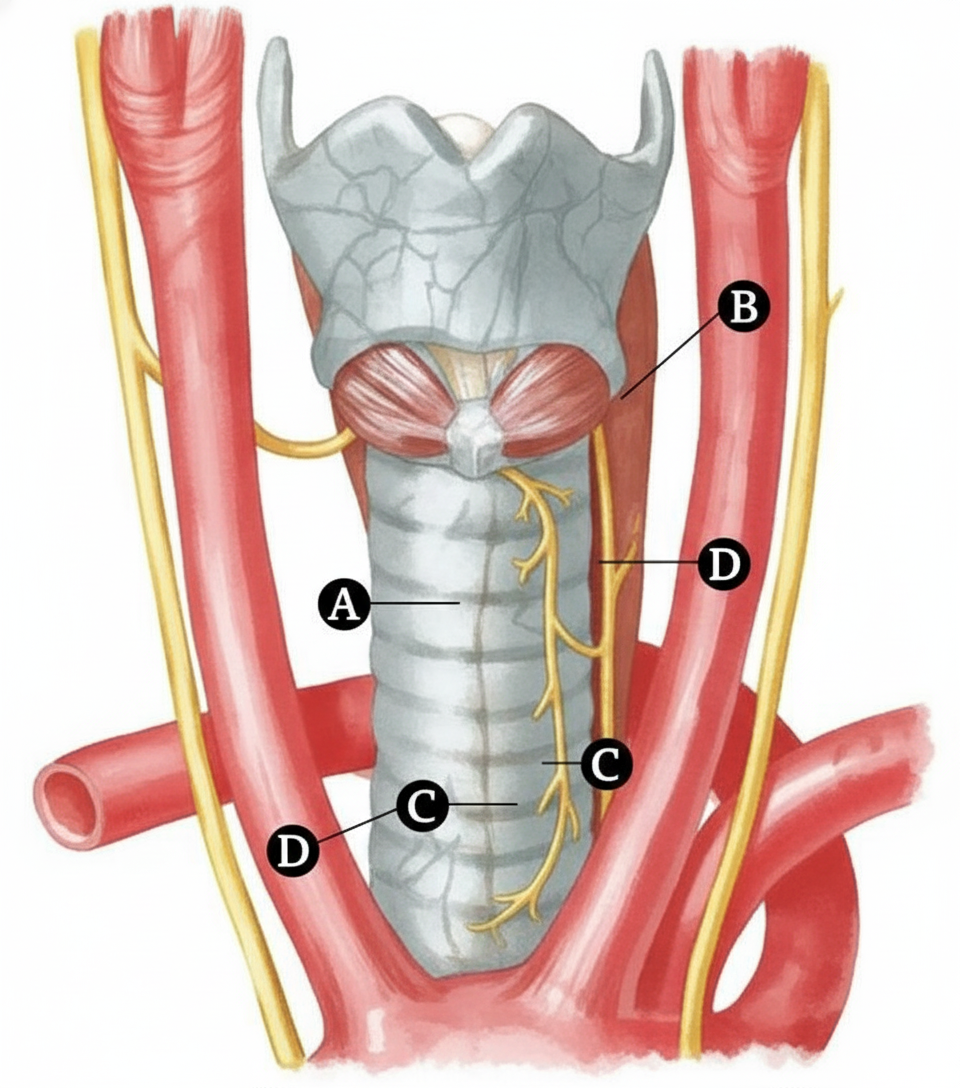
All of the following are true about the phrenic nerve, except?
The suprasternal space contains all of the following structures except which one?
Damage to the recurrent laryngeal nerve results in what?
Which level of lymph nodes are the pretracheal and paratracheal lymph nodes?
Which nerve winds around the subclavian artery?
Which of the following provides innervation to the sternohyoid muscle?
Which of the following actions is performed by the platysma muscle?
A 21-year-old woman presents with a neck swelling, diagnosed as an infection within the carotid sheath. Which of the following structures would be damaged?
The infrahyoid muscles are innervated by which of the following?
Which of the following statements are true about the palatine tonsil?
Explanation: ### Explanation **1. Why Option A is the Correct Answer (The False Statement):** The phrenic nerve is located **deep** to the prevertebral layer of the deep cervical fascia. It is plastered to the anterior surface of the scalenus anterior muscle by this fascia. This is a crucial surgical landmark: during operations on the neck, the nerve is protected as long as the prevertebral fascia remains intact. **2. Analysis of Other Options:** * **Option B (True):** The phrenic nerve provides motor supply to the entire diaphragm and sensory supply to the **central part** of the diaphragmatic pleura and peritoneum [1]. (The peripheral part is supplied by lower intercostal nerves). * **Option C (True):** The phrenic nerve is formed by the ventral rami of **C3, C4, and C5** [2]. It typically forms at the **upper lateral border** of the scalenus anterior muscle before descending vertically across its anterior surface toward the medial border. * **Option D (True):** On the right side, the phrenic nerve crosses **anterior** to the second part of the subclavian artery. On the left side, it crosses anterior to the first part of the subclavian artery. **3. High-Yield Clinical Pearls for NEET-PG:** * **Root Value:** C3, C4, C5 ("C3, 4, 5 keep the diaphragm alive") [2]. * **Referred Pain:** Irritation of the phrenic nerve (e.g., gallbladder disease or subphrenic abscess) causes referred pain to the **tip of the shoulder** (C4 dermatome). * **Relation to Vessels:** It passes **posterior** to the subclavian vein but **anterior** to the subclavian artery. * **Accessory Phrenic Nerve:** Most commonly derived from the nerve to the subclavius (C5); it joins the main phrenic nerve at the root of the neck or in the thorax.
Explanation: ### Explanation The **suprasternal space (Space of Burns)** is a small triangular area located between the two layers of the **investing layer of deep cervical fascia**. This space is formed when the fascia splits into two layers—superficial and deep—which attach to the anterior and posterior borders of the manubrium sterni, respectively. **Why Sternohyoid is the Correct Answer:** The **Sternohyoid** and **Sternothyroid** muscles (infrahyoid muscles) are located **deep** to the investing layer of deep cervical fascia. They are enclosed within their own fascia, the **pretracheal fascia**. Therefore, they do not lie within the suprasternal space but rather form its posterior boundary. **Analysis of Other Options:** * **Jugular venous arch:** This is a high-yield structure found within the space. It connects the two anterior jugular veins. * **Interclavicular ligament:** This ligament crosses the superior notch of the manubrium and is contained within the space. * **Sternal heads of Sternocleidomastoid (SCM):** The investing fascia splits to enclose the SCM. The sternal heads of the right and left SCM muscles are considered contents of this space as they attach to the manubrium. * **Other contents:** The space also contains some fatty tissue and a few deep cervical lymph nodes. **Clinical Pearls for NEET-PG:** 1. **Surgical Importance:** During a tracheostomy, the suprasternal space is opened. Injury to the **jugular venous arch** within this space can lead to significant bleeding. 2. **Boundaries:** Remember that the space is bounded anteriorly by the superficial layer and posteriorly by the deep layer of the investing fascia. 3. **Anterior Jugular Veins:** These veins descend in the superficial fascia but enter the suprasternal space to form the arch before turning laterally to drain into the external jugular or subclavian veins.
Explanation: The **Recurrent Laryngeal Nerve (RLN)** is a branch of the Vagus nerve (CN X) that provides both motor and sensory innervation to the larynx [2]. ### **Why "Anesthesia of the Larynx" is the Correct Answer** While the RLN is primarily known for its motor function, it provides **sensory innervation** to the laryngeal mucosa **below the level of the vocal folds** [2]. Damage to the RLN leads to a loss of sensation (anesthesia) in this specific region. This is a high-yield distinction in anatomy: the Internal Laryngeal Nerve (branch of Superior Laryngeal Nerve) supplies sensation *above* the vocal folds, while the RLN supplies sensation *below* them. ### **Analysis of Incorrect Options** * **A. Hoarseness:** This occurs with **unilateral** RLN injury due to paralysis of the intrinsic muscles (except the cricothyroid), leading to an immobile vocal cord [1]. However, in the context of pure sensory/nerve distribution questions, anesthesia is a direct neurological deficit. * **B. Loss of timbre of voice:** This is specifically associated with damage to the **External Laryngeal Nerve**, which supplies the cricothyroid muscle (the "tuner" of the voice). * **D. Breathing difficulty:** This typically occurs in **bilateral** RLN injury, where both vocal cords assume a paramedian position, potentially obstructing the airway (stridor) [1]. ### **NEET-PG High-Yield Pearls** * **Motor Supply:** RLN supplies all intrinsic muscles of the larynx **except the Cricothyroid** (supplied by the External Laryngeal Nerve) [2]. * **Sensory Supply:** Above vocal folds = Internal Laryngeal Nerve; Below vocal folds = Recurrent Laryngeal Nerve [2]. * **Semon’s Law:** In progressive lesions of the RLN, abductors (Posterior Cricoarytenoid) are paralyzed before adductors. * **Surgery Risk:** The RLN is most commonly injured during **Thyroidectomy** due to its close proximity to the Inferior Thyroid Artery [1].
Explanation: ### Explanation The cervical lymph nodes are divided into six levels (I–VI) based on anatomical boundaries defined by the Memorial Sloan-Kettering Cancer Center and the American Academy of Otolaryngology [1]. **Why Level VI is Correct:** **Level VI** represents the **Anterior Compartment Group**. It is bounded superiorly by the hyoid bone, inferiorly by the suprasternal notch, and laterally by the common carotid arteries. This level specifically contains [1], [2]: * **Pretracheal** lymph nodes * **Paratracheal** lymph nodes * **Prelaryngeal** (Delphian) lymph nodes * **Perithyroidal** lymph nodes These nodes are the primary drainage site for the thyroid gland, subglottic larynx, trachea, and cervical esophagus [1]. **Analysis of Incorrect Options:** * **Level I (Submental & Submandibular):** Located above the hyoid bone and anterior to the posterior belly of the digastric muscle. They drain the lips, oral cavity, and submandibular gland. * **Level II (Upper Jugular):** Located around the upper third of the internal jugular vein (IJV), extending from the skull base to the hyoid bone. * **Level IV (Lower Jugular):** Located around the lower third of the IJV, extending from the omohyoid muscle superiorly to the clavicle inferiorly. **High-Yield Clinical Pearls for NEET-PG:** * **Level VII:** Refers to the superior mediastinal lymph nodes (below the suprasternal notch). * **Delphian Node:** A prelaryngeal node in Level VI; its enlargement often indicates laryngeal or thyroid carcinoma metastasis and carries a poor prognosis [1]. * **Boundary Landmark:** The **sternocleidomastoid muscle** serves as the primary landmark for Levels II, III, and IV (Deep Cervical Nodes). * **Level V:** Represents the Posterior Triangle nodes (Spinal accessory and transverse cervical chains).
Explanation: **Explanation:** The **Right Recurrent Laryngeal Nerve (RLN)** is a branch of the right Vagus nerve (CN X). As the Vagus nerve descends anterior to the first part of the subclavian artery, the right RLN branches off and **loops (winds) inferior and then posterior to the right subclavian artery** before ascending in the tracheoesophageal groove to reach the larynx [2]. **Analysis of Options:** * **Option A (Left RLN):** Unlike the right side, the left RLN branches from the left Vagus nerve as it crosses the **arch of the aorta** [1]. It winds around the **ligamentum arteriosum** and the aortic arch, not the subclavian artery [1]. This asymmetry is due to the embryonic disappearance of the right 6th aortic arch, causing the nerve to "hook" around the next available structure (the 4th arch/subclavian). * **Option C & D (External/Superior Laryngeal Nerves):** These are branches of the Superior Laryngeal Nerve. They arise high in the neck (near the hyoid bone) and descend directly toward the larynx and cricothyroid muscle [4]. They do not descend into the superior mediastinum or wind around major thoracic vessels. **High-Yield Clinical Pearls for NEET-PG:** * **Nerve Injury:** During thyroidectomy, the RLN is at risk near the inferior thyroid artery [1]. Injury leads to hoarseness (unilateral) or airway obstruction (bilateral) [3]. * **Ortner’s Syndrome:** Left atrial enlargement (e.g., mitral stenosis) can compress the **Left RLN** against the aorta, causing hoarseness. * **Non-recurrent RLN:** In rare cases of an anomalous right subclavian artery (Arteria Lusoria), the right RLN may pass directly from the Vagus to the larynx without looping [2].
Explanation: The **sternohyoid muscle** is one of the four infrahyoid (strap) muscles of the neck. These muscles are primarily responsible for depressing the hyoid bone and larynx during swallowing and speech. ### Why Ansa Cervicalis is Correct The **Ansa cervicalis** is a loop of nerves from the cervical plexus (C1–C3). It provides motor innervation to three of the four infrahyoid muscles: 1. **Sternohyoid** 2. **Sternothyroid** 3. **Omohyoid** (both superior and inferior bellies) The loop consists of a superior root (C1 fibers traveling with the hypoglossal nerve) and an inferior root (C2–C3). These roots join to form the "handle" of the loop, from which branches arise to supply the muscles mentioned above. ### Why Other Options are Incorrect * **A. C1 through the hypoglossal nerve:** While C1 fibers do travel with the hypoglossal nerve, they specifically branch off to supply the **Thyrohyoid** (the fourth infrahyoid muscle) and the **Geniohyoid**. They do not supply the sternohyoid directly. * **C. Glossopharyngeal nerve (CN IX):** This nerve provides sensory innervation to the oropharynx and posterior third of the tongue, and motor supply only to the stylopharyngeus muscle. * **D. Hypoglossal nerve (CN XII):** This nerve provides motor supply to all intrinsic and extrinsic muscles of the tongue (except the palatoglossus). It serves only as a "hitchhiking" route for C1 fibers and does not innervate the strap muscles itself. ### NEET-PG High-Yield Pearls * **Mnemonic for Ansa Cervicalis:** "Ansa **S**upplies **S**trap **S**tuff" (**S**ternohyoid, **S**ternothyroid, **S**uperior/inferior omohyoid). * **The Exception:** The **Thyrohyoid** is the only infrahyoid muscle NOT supplied by the Ansa cervicalis; it is supplied by **C1 via the hypoglossal nerve**. * **Location:** The Ansa cervicalis is typically found embedded in the anterior wall of the **carotid sheath**, superficial to the internal jugular vein.
Explanation: **Explanation:** The **platysma** is a broad, thin sheet of muscle located within the superficial fascia of the neck. It is considered a muscle of facial expression and is embryologically derived from the **second branchial arch**. 1. **Why Option B is Correct:** The platysma originates from the fascia covering the pectoralis major and deltoid muscles. It inserts into the inferior border of the mandible and the skin of the lower face, blending with muscles around the mouth (like the depressor anguli oris). When it contracts, it **draws the corners of the mouth inferiorly** and widens the mouth, expressing expressions of sadness, fright, or horror. It also helps release pressure on the superficial veins of the neck by tensing the skin. 2. **Why Other Options are Incorrect:** * **Option A (Compresses the cheeks):** This is the primary action of the **buccinator** muscle, which prevents food from accumulating in the vestibule during chewing. * **Option C (Elevates the mandible):** This is performed by the muscles of mastication, specifically the **masseter, temporalis, and medial pterygoid**. * **Option D (Helps in mastication):** Mastication is primarily handled by the four muscles of mastication (Masseter, Temporalis, Medial, and Lateral Pterygoids), all innervated by the mandibular nerve (V3). **High-Yield NEET-PG Pearls:** * **Innervation:** The platysma is supplied by the **cervical branch of the Facial Nerve (CN VII)**. * **Surgical Importance:** It is the first muscle encountered during a midline neck incision. Surgeons must carefully approximate the platysma during closure to prevent unsightly "stretching" of the scar. * **Clinical Sign:** In cases of facial nerve palsy (Bell’s Palsy), the patient will be unable to actively contract the platysma on the affected side.
Explanation: ### Explanation The **carotid sheath** is a condensation of the deep cervical fascia (contributions from pretracheal, prevertebral, and investing layers) that encloses vital neurovascular structures in the neck. **1. Why Option C is Correct:** The carotid sheath contains four primary structures throughout its length: * **Arteries:** Common carotid artery (inferiorly) and Internal carotid artery (superiorly). * **Vein:** Internal jugular vein (lateral to the artery). * **Nerve:** Vagus nerve (CN X), located posteriorly in the groove between the vessel and the vein. Therefore, an infection within the sheath directly threatens the **Internal jugular vein** and the **Vagus nerve**. **2. Analysis of Incorrect Options:** * **Option A & D:** The **Sympathetic trunk** (including the middle cervical ganglion) is located **posterior** to the carotid sheath, embedded in the prevertebral fascia. It is not contained within the sheath itself. * **Option B:** While the internal carotid artery is inside the sheath, the **Recurrent laryngeal nerve** is not [1]. It ascends in the tracheoesophageal groove, medial to the carotid sheath. **3. NEET-PG High-Yield Pearls:** * **Anatomical Orientation:** In the sheath, the IJV is **lateral**, the Carotid artery is **medial**, and the Vagus nerve is **posterior**. * **Ansa Cervicalis:** The superior belly of the ansa cervicalis is often embedded in the *anterior wall* of the carotid sheath but is technically considered extrinsic to the contents. * **Clinical Significance:** Infections in the "danger space" (behind the esophagus) can spread laterally into the carotid sheath, potentially leading to **Lemierre’s syndrome** (septic thrombophlebitis of the IJV).
Explanation: **Explanation:** The **infrahyoid muscles** (also known as "strap muscles") include the **Omohyoid, Sternohyoid, Sternothyroid, and Thyrohyoid**. These muscles are primarily responsible for depressing the hyoid bone and larynx during swallowing and speech. 1. **Why Ansa Cervicalis is Correct:** The **Ansa cervicalis** is a loop of nerves from the cervical plexus (C1–C3). It provides motor innervation to three of the four strap muscles: the **Sternohyoid, Sternothyroid, and the inferior belly of the Omohyoid**. While the Thyrohyoid is also an infrahyoid muscle, it is specifically supplied by the C1 nerve fibers traveling with the Hypoglossal nerve. 2. **Why Other Options are Incorrect:** * **Hypoglossal nerve (CN XII):** While the nerve to the thyrohyoid and geniohyoid travels *with* CN XII, these are physiologically C1 fibers. CN XII itself primarily supplies the intrinsic and extrinsic muscles of the tongue. * **Tenth cranial nerve (Vagus):** This nerve supplies the muscles of the pharynx (except stylopharyngeus) and larynx, but not the infrahyoid muscles. * **Ansa subclavia:** This is a sympathetic nerve loop connecting the middle and inferior cervical ganglia, wrapping around the subclavian artery. It has no motor function for skeletal muscles. **High-Yield NEET-PG Pearls:** * **The "C1 Exception":** All infrahyoid muscles are supplied by the Ansa cervicalis **EXCEPT the Thyrohyoid**, which is supplied by C1 via the Hypoglossal nerve. * **Ansa Cervicalis Anatomy:** The superior root (descendens hypoglossi) is derived from **C1**, while the inferior root (descendens cervicalis) is derived from **C2 and C3**. * **Surgical Landmark:** The Ansa cervicalis is typically found embedded in the anterior wall of the **carotid sheath**, superficial to the internal jugular vein.
Explanation: The palatine tonsil is a collection of lymphoid tissue located in the lateral wall of the oropharynx, within the tonsillar fossa. **Explanation of the Correct Option:** * **Option B (Correct):** The primary lymphatic drainage of the palatine tonsil is to the **jugulodigastric node** (also known as the "tonsillar node"), located below the angle of the mandible. This node is a member of the deep cervical chain and is frequently enlarged and tender in cases of acute tonsillitis. **Explanation of Incorrect Options:** * **Option A & C:** The palatine tonsil develops from the **second pharyngeal pouch** (not the 4th arch). While the epithelium of the tonsil is **endodermal** in origin (making C technically true in some contexts), the lymphoid tissue is mesenchymal. However, in the context of standard medical exams, the specific developmental origin from the 2nd pouch is the high-yield fact. * **Option D:** The tonsil sits on the **pharyngobasilar fascia**, which separates it from its muscular bed. The muscular bed is formed primarily by the **superior constrictor** and the styloglossus muscles. While it "rests" in that area, the immediate bed is the fascia. **High-Yield Clinical Pearls for NEET-PG:** * **Blood Supply:** The main artery is the **tonsillar branch of the facial artery** (most important). * **Venous Drainage:** The **paratonsillar vein** is the most common cause of primary hemorrhage during tonsillectomy. * **Nerve Supply:** Supplied by the **glossopharyngeal nerve (CN IX)** and lesser palatine nerves. Referred ear pain during tonsillitis occurs via the tympanic branch of CN IX (Jacobson’s nerve). * **Waldeyer’s Ring:** The palatine tonsils form the lateral components of this protective lymphoid ring.
Cervical Fascia
Practice Questions
Triangles of the Neck
Practice Questions
Deep Structures of the Neck
Practice Questions
Thyroid and Parathyroid Glands
Practice Questions
Vasculature of the Neck
Practice Questions
Lymphatic Drainage
Practice Questions
Cervical Plexus
Practice Questions
Root of the Neck
Practice Questions
Applied Anatomy and Clinical Correlations
Practice Questions
Surface Anatomy of the Neck
Practice Questions
Get full access to all questions, explanations, and performance tracking.
Start For Free