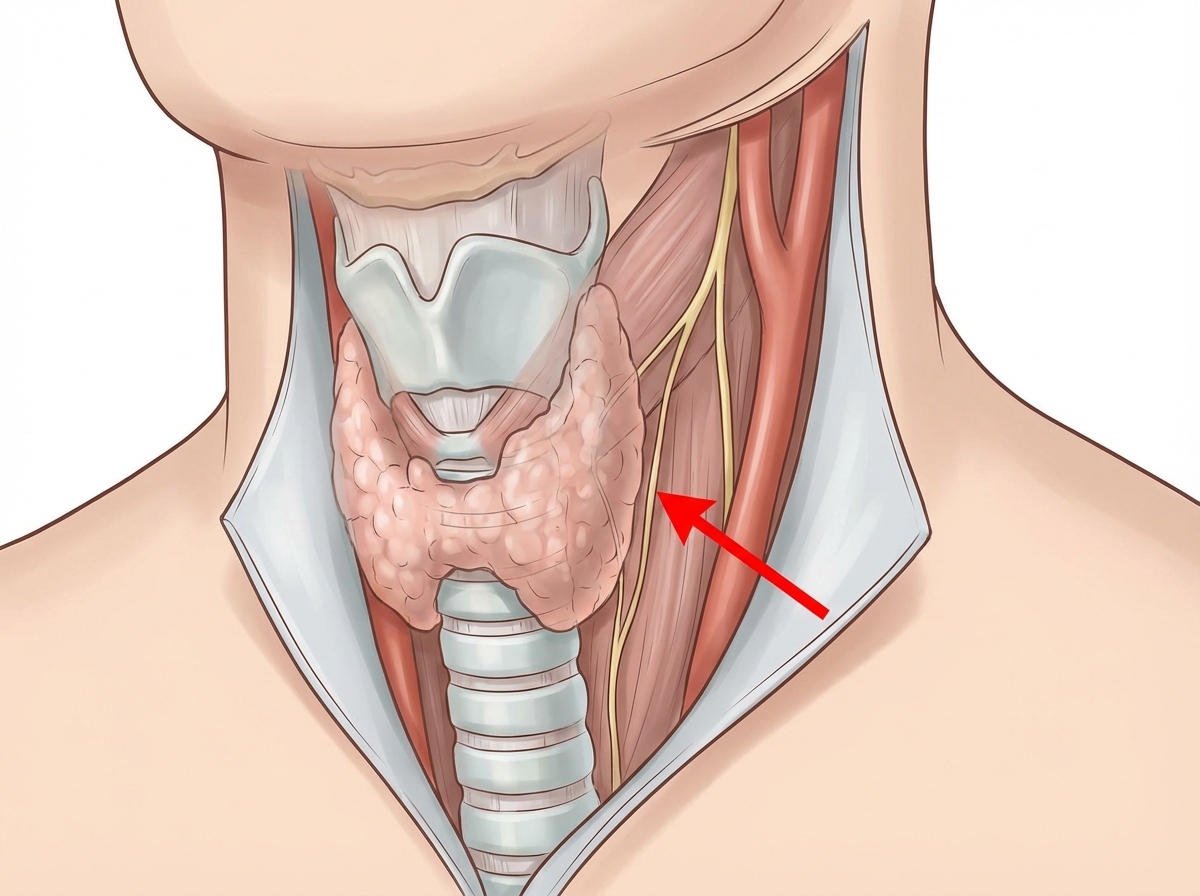
The spinal part of the accessory nerve supplies which of the following muscles?
The common carotid artery divides at the level of which anatomical landmark?
A 31-year-old man sustained a shrapnel wound in the neck. On examination, it was noticed that when he blew his nose or sneezed, the skin above the right clavicle bulged upward. Which of the following best explains this phenomenon?
What is the narrowest part of the pediatric airway?
Which of the following group of lymph nodes are known as 'delphic nodes'?
The submental triangle is bounded laterally on both sides by which muscle?
The recurrent laryngeal nerve has a close anatomical relationship with which of the following structures?
The danger space in front of the prevertebral fascia extends till which anatomical landmark?
Different nerves are marked in the given diagram. Which of the following nerves supplies the posterior cricoarytenoid muscle?

Which muscle of the neck has a dual nerve supply?
Explanation: **Explanation:** The **Spinal Accessory Nerve (CN XI)** is a purely motor nerve that originates from the spinal cord segments C1 to C5/C6. It enters the skull through the foramen magnum and exits via the **jugular foramen**. It is the primary motor supply to two major muscles of the neck and back: the **Sternocleidomastoid (SCM)** and the **Trapezius**. * **Sternocleidomastoid (Correct):** The nerve passes deep to this muscle, supplying it with motor fibers. The SCM is responsible for tilting the head to the same side and rotating it to the opposite side. * **Pectoralis Major & Minor (Incorrect):** These muscles are supplied by the **Medial and Lateral Pectoral nerves**, which arise from the brachial plexus (C5-T1) [1]. * **Deltoid (Incorrect):** This muscle is supplied by the **Axillary nerve** (C5, C6), a branch of the posterior cord of the brachial plexus. **High-Yield Clinical Pearls for NEET-PG:** 1. **Course:** The spinal accessory nerve crosses the **posterior triangle** of the neck, resting on the levator scapulae. This superficial location makes it highly susceptible to injury during lymph node biopsies or radical neck dissections. 2. **Clinical Testing:** Injury to the nerve results in weakness in turning the head to the opposite side (SCM) and **drooping of the shoulder** with an inability to shrug (Trapezius). 3. **Proprioception:** While CN XI provides motor supply, the sensory (proprioceptive) fibers for the SCM and Trapezius are provided by the ventral rami of **C2, C3, and C4**.
Explanation: The common carotid artery (CCA) is a vital structure in the carotid triangle of the neck. It typically bifurcates into the internal and external carotid arteries at the **superior border of the thyroid cartilage**, which corresponds to the **C3-C4 vertebral level**. ### Why Option C is Correct: The bifurcation occurs at the level of the superior border of the thyroid cartilage. At this junction, the **carotid sinus** (a baroreceptor) and the **carotid body** (a chemoreceptor) are located. This landmark is consistent in most individuals and is a critical reference point for vascular surgery and carotid pulse palpation. ### Why Other Options are Incorrect: * **A. Hyoid bone:** This lies at the **C3 level**, slightly above the bifurcation. While the external carotid artery gives off branches near this level, the primary bifurcation happens just below it. * **B. Cricoid cartilage:** This corresponds to the **C6 level**. This is where the CCA begins its course in the neck (on the right) and is the level where the omohyoid muscle crosses the artery. It also marks the junction of the pharynx with the esophagus. * **D. Inferior border of the thyroid cartilage:** This is too low (approximately **C5 level**). The artery is still a single trunk at this point. ### High-Yield Clinical Pearls for NEET-PG: * **Vertebral Level:** Remember the "C3-C4" rule for carotid bifurcation. * **Carotid Sinus:** A dilation at the base of the internal carotid artery; it is innervated by the **Hering’s nerve** (branch of CN IX) and regulates blood pressure. * **Surface Anatomy:** The bifurcation can be found at the level of the angle of the mandible if the neck is extended. * **Internal vs. External:** In the neck, the Internal Carotid Artery (ICA) usually has **no branches**, whereas the External Carotid Artery (ECA) gives off eight branches, starting with the Superior Thyroid Artery.
Explanation: ### Explanation **Concept:** The apex of the lung and the cervical pleura extend into the root of the neck, approximately 2–3 cm above the level of the medial third of the clavicle. This area is protected and held in place by the **suprapleural membrane** (also known as **Sibson’s fascia**). This dense connective tissue layer is attached to the inner border of the first rib and the transverse process of the C7 vertebra. Its primary function is to provide rigidity to the thoracic inlet, preventing the lung from herniating into the neck during changes in intrathoracic pressure. **Why Option B is correct:** When the suprapleural membrane is damaged (e.g., by a shrapnel wound), the structural integrity of the thoracic inlet is compromised. During activities like sneezing or blowing the nose (Valsalva-like maneuvers), intrathoracic pressure rises sharply. Without the restraint of Sibson’s fascia, the cervical pleura and the apex of the lung are pushed upward, causing a visible bulge above the clavicle. **Why other options are incorrect:** * **Option A:** Injury to the cervical pleura itself would typically result in a pneumothorax (collapsed lung) due to air entering the pleural cavity, rather than a controlled bulging of the skin. * **Option B:** While deep fascia provides general support, it is the specialized suprapleural membrane that specifically reinforces the thoracic inlet against pressure changes. * **Option C:** A fracture of the first rib might cause pain or vascular injury, but it would not cause a dynamic bulging of the lung unless the underlying Sibson’s fascia was also torn. **High-Yield Clinical Pearls for NEET-PG:** * **Sibson’s Fascia:** It is a reinforcement of the **prevertebral layer** of deep cervical fascia. * **Muscle Attachment:** The **Scalenus minimus** muscle (when present) inserts into this membrane. * **Relations:** The subclavian vessels and the brachial plexus lie superior to this membrane. * **Clinical Sign:** Herniation of the lung through a weakened suprapleural membrane is known as a **cervical lung hernia**.
Explanation: In pediatric anatomy, the airway is often described as **funnel-shaped**, whereas the adult airway is more cylindrical. ### Why Subglottis is Correct The **subglottis** (specifically at the level of the **cricoid cartilage**) is the narrowest part of the pediatric airway. Unlike other laryngeal structures, the cricoid is a complete cartilaginous ring that cannot expand. In children under the age of 8–10, the diameter of the airway at the cricoid level is smaller than the space between the vocal cords (the glottis). This anatomical bottleneck makes the subglottis the site most susceptible to obstruction from edema (e.g., Croup) or foreign bodies. ### Why Other Options are Incorrect * **Vocal Cords:** In **adults**, the vocal cords (rima glottidis) represent the narrowest point of the airway. In children, however, the subglottic region below the cords is narrower. * **Carina:** This is the point where the trachea bifurcates into the primary bronchi. While it is a site of narrowing relative to the trachea, it is significantly wider than the subglottic lumen. ### NEET-PG High-Yield Clinical Pearls * **Poiseuille’s Law:** Because the subglottis is so narrow, even 1 mm of inflammatory edema can reduce the cross-sectional area by 75%, exponentially increasing airway resistance. * **Intubation:** The narrow subglottis is the reason **uncuffed endotracheal tubes** were traditionally preferred in young children to prevent pressure necrosis and subglottic stenosis. * **Shape Transition:** The pediatric airway is **funnel-shaped** (narrowest at the cricoid), while the adult airway is **cylindrical** (narrowest at the vocal cords).
Explanation: ### Explanation **Correct Option: A. Prelaryngeal** The **prelaryngeal lymph nodes** are famously referred to as the **'Delphic nodes'** [1][2]. They are located on the cricothyroid membrane, anterior to the larynx. The name is derived from the **Oracle of Delphi** in Greek mythology. Just as the Oracle predicted the future, the enlargement of these nodes is considered a "prophetic" sign, often indicating the spread (metastasis) of occult malignancies from the larynx, thyroid gland (especially the isthmus), or pyriform sinus [2]. **Analysis of Incorrect Options:** * **B. Paratracheal Nodes:** These are located along the sides of the trachea and are part of the Level VI cervical nodes [1]. While they are involved in thyroid and esophageal cancers, they are not referred to as Delphic nodes. * **C. Supraclavicular Nodes:** These are Level Vb nodes. A notable node here is the **Virchow’s node** (left side), which indicates metastasis from abdominal malignancies (Troisier’s sign), not laryngeal ones. * **D. Posterior Triangle Nodes:** These represent Level V nodes, bounded by the sternocleidomastoid and trapezius muscles. They primarily drain the nasopharynx and scalp. **High-Yield Clinical Pearls for NEET-PG:** * **Level VI Nodes:** The Delphic nodes belong to **Level VI** (Anterior Compartment) of the cervical lymph nodes [2]. * **Drainage:** They primarily receive lymph from the subglottic larynx and the thyroid gland [2]. * **Surgical Significance:** During a thyroidectomy for cancer, the presence of an enlarged Delphic node often necessitates a formal central neck dissection [1]. * **Other Named Nodes:** * **Jugulodigastric:** Principal node of the tonsil (Level II). * **Jugulo-omohyoid:** Principal node of the tongue (Level III/IV).
Explanation: ### Explanation The **submental triangle** is a unique, unpaired midline suprahyoid space in the neck. Understanding its boundaries is crucial for identifying the spread of submental infections and the location of submental lymph nodes. **Why the Correct Answer is Right:** The submental triangle is defined by the following boundaries: * **Apex:** Symphysis menti (the chin). * **Base:** Body of the hyoid bone. * **Lateral Boundaries (on both sides):** The **Anterior belly of the digastric muscle**. * **Floor:** Formed by the two mylohyoid muscles meeting at the midline raphe. * **Roof:** Investing layer of deep cervical fascia, platysma, and skin. Since the triangle is situated between the two anterior bellies of the digastric muscles, they form its lateral limits. **Analysis of Incorrect Options:** * **A. Hyoid bone:** This forms the **base** (inferior boundary) of the triangle, not the lateral boundary. * **C. Posterior belly of digastric muscle:** This muscle forms the posteroinferior boundary of the **digastric (submandibular) triangle**, not the submental triangle. * **D. Mylohyoid muscle:** This muscle forms the **floor** of the submental triangle. **High-Yield Clinical Pearls for NEET-PG:** * **Contents:** The triangle contains the **submental lymph nodes** (which drain the tip of the tongue, floor of the mouth, and central lower lip) and the **submental veins** (which join to form the anterior jugular vein). * **Surgical Landmark:** The mylohyoid muscle is known as the "diaphragm of the mouth," separating the sublingual space from the submental space. * **Digastric Muscle Nerve Supply:** Remember the dual nerve supply—the **Anterior belly** is supplied by the Nerve to Mylohyoid (CN V3), while the **Posterior belly** is supplied by the Facial Nerve (CN VII).
Explanation: The **Recurrent Laryngeal Nerve (RLN)** is a branch of the Vagus nerve (CN X) that provides motor innervation to all intrinsic muscles of the larynx (except the cricothyroid) and sensory innervation below the vocal cords. **Why Option C is Correct:** In the neck, the RLN ascends in the **tracheoesophageal groove** [2]. As it approaches the lower pole of the thyroid gland, it intimately crosses the **Inferior Thyroid Artery (ITA)** [1]. This relationship is highly variable: the nerve may pass anterior to, posterior to, or between the branches of the artery [1]. Because of this close proximity, the RLN is at high risk of accidental ligation or injury during thyroidectomy or parathyroidectomy when the ITA is being controlled. [4] **Why Other Options are Incorrect:** * **A. Superior Thyroid Artery:** This artery is closely related to the **External Laryngeal Nerve** (a branch of the Superior Laryngeal Nerve) at the upper pole of the thyroid [4]. * **B. Middle Thyroid Vein:** This vein crosses the common carotid artery and is encountered during the mobilization of the thyroid gland, but it does not have a specific intimate relationship with the RLN. * **D. Inferior Parathyroid Gland:** While the RLN is near the parathyroid glands [4], the standard anatomical landmark taught for surgical identification and the most frequent "danger zone" association in exams is the **Inferior Thyroid Artery**. **Clinical Pearls for NEET-PG:** * **Right vs. Left:** The Right RLN loops around the **Subclavian Artery**, while the Left RLN loops around the **Arch of Aorta** [1]. * **Injury:** Unilateral RLN injury causes hoarseness of voice; bilateral injury can cause life-threatening airway obstruction (stridor) [3]. * **Surgical Landmark:** The RLN is often identified in **Beahrs' Triangle** (bounded by the ITA, the RLN, and the common carotid artery/internal jugular vein).
Explanation: ### Explanation The **Danger Space** is a potential space located between the **alar fascia** (anteriorly) and the **prevertebral fascia** (posteriorly). It is clinically significant because it provides a low-resistance pathway for the spread of infections from the pharynx to the mediastinum. **1. Why the Correct Answer is Right:** The danger space extends superiorly from the base of the skull and continues inferiorly through the entire length of the posterior mediastinum, terminating only at the level of the **Diaphragm** [1]. Because it is composed of loose areolar tissue and is not anatomically closed off in the thorax, infections (like a retropharyngeal abscess) can track all the way down to the diaphragm, potentially causing mediastinitis [1]. **2. Why the Incorrect Options are Wrong:** * **A. T4 vertebrae:** This is the lower limit of the **Retropharyngeal space** (proper), where the alar fascia fuses with the buccopharyngeal fascia. * **B. T2 vertebrae:** This level does not correspond to the termination of any major cervical fascial spaces. * **C. Coccyx:** While the **Prevertebral space** (the space *behind* the prevertebral fascia) extends down the entire vertebral column to the coccyx, the *Danger Space* (in front of the fascia) ends at the diaphragm. **3. High-Yield Clinical Pearls for NEET-PG:** * **Retropharyngeal Space:** Located between the buccopharyngeal fascia and alar fascia; ends at **T4**. * **Danger Space:** Located between the alar fascia and prevertebral fascia; ends at the **Diaphragm** [1]. * **Prevertebral Space:** Located between the prevertebral fascia and the vertebral bodies; ends at the **Coccyx**. * **Clinical Sign:** A "Gillette’s sign" or displacement of the posterior pharyngeal wall is seen in retropharyngeal abscesses, which can rapidly spread via the Danger Space.
Explanation: ***C*** - The **posterior cricoarytenoid muscle** is the only **abductor of the vocal cords** and is exclusively supplied by the **recurrent laryngeal nerve** (inferior laryngeal nerve). - **Recurrent laryngeal nerve palsy** leads to loss of vocal cord abduction, causing **hoarseness** and potential **airway obstruction**. *A* - This likely represents the **vagus nerve trunk** which gives rise to laryngeal branches but does not directly supply intrinsic laryngeal muscles. - The vagus nerve provides **motor innervation** through its branches (superior and recurrent laryngeal nerves) rather than directly. *B* - This appears to be the **superior laryngeal nerve** or its **external branch**, which supplies the **cricothyroid muscle** only. - The **internal branch** of the superior laryngeal nerve provides **sensory innervation** to the larynx above the vocal cords. *D* - This likely represents another branch that does not supply the **posterior cricoarytenoid muscle**. - All other **intrinsic laryngeal muscles** except cricothyroid are supplied by the **recurrent laryngeal nerve**, making option C the correct answer.
Explanation: ### Explanation The **Digastric muscle** is the correct answer because it is a composite muscle derived from two different embryological pharyngeal arches, each bringing its own nerve supply. 1. **Anterior Belly:** Derived from the **1st Pharyngeal Arch**. It is supplied by the **nerve to mylohyoid**, a branch of the inferior alveolar nerve (from the Mandibular division of the Trigeminal nerve, CN V3). 2. **Posterior Belly:** Derived from the **2nd Pharyngeal Arch**. It is supplied by the **digastric branch of the Facial nerve (CN VII)**. #### Analysis of Incorrect Options: * **A. Sternohyoid:** An infrahyoid "strap" muscle supplied solely by the **Ansa cervicalis (C1-C3)**. * **B. Thyrohyoid:** An infrahyoid muscle that is unique because it is supplied by **C1 fibers traveling via the Hypoglossal nerve (CN XII)**, but it does not have a dual supply. * **C. Stylohyoid:** Derived from the 2nd pharyngeal arch and supplied only by the **Facial nerve (CN VII)**. #### High-Yield Clinical Pearls for NEET-PG: * **Other Dual Supply Muscles:** In the head and neck, the **Mylohyoid** is often confused with the digastric, but it only has one supply (CN V3). Other famous dual-supply muscles in the body include the **Pectoralis Major**, **Adductor Magnus**, **Brachialis**, and **Flexor Digitorum Profundus**. * **The Intermediate Tendon:** The two bellies of the digastric are connected by an intermediate tendon which pierces the stylohyoid muscle and is held to the hyoid bone by a fibrous pulley. * **Action:** It depresses the mandible (opens the mouth) when the hyoid is fixed and elevates the hyoid bone during swallowing.
Cervical Fascia
Practice Questions
Triangles of the Neck
Practice Questions
Deep Structures of the Neck
Practice Questions
Thyroid and Parathyroid Glands
Practice Questions
Vasculature of the Neck
Practice Questions
Lymphatic Drainage
Practice Questions
Cervical Plexus
Practice Questions
Root of the Neck
Practice Questions
Applied Anatomy and Clinical Correlations
Practice Questions
Surface Anatomy of the Neck
Practice Questions
Get full access to all questions, explanations, and performance tracking.
Start For Free