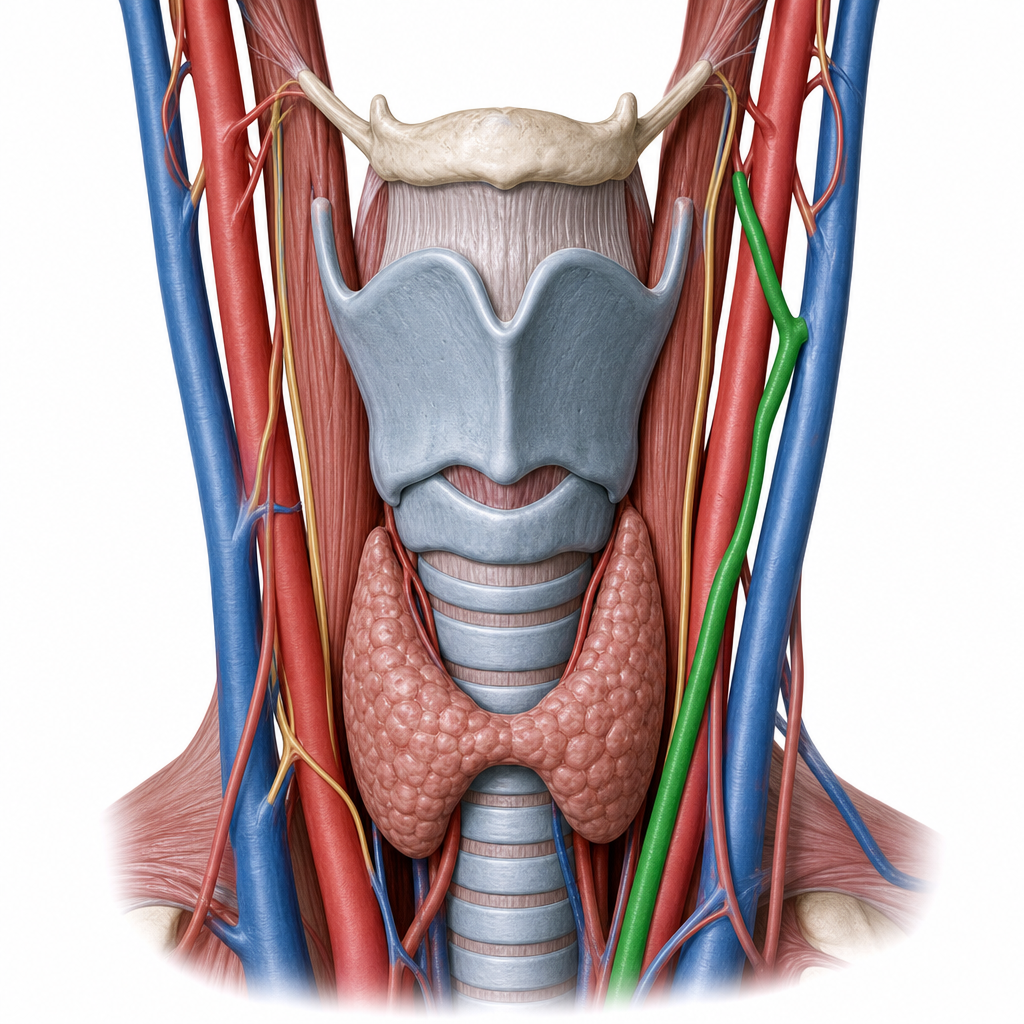
Fascia around the nerve bundles of the brachial plexus is derived from which structure?
Blood supply of the esophagus in the neck is by
Retropharyngeal space extends up to which of the following levels?
All of the following structures are associated with the laryngeal sinus of Morgagni (laryngeal ventricle) except which one?
The arterial supply of the submandibular gland is
Which of the following muscles elevates the larynx?
Explanation: ***Deep cervical fascia*** - The **brachial plexus** is enveloped by a fascial sheath known as the **axillary sheath**, which is a direct continuation of the **prevertebral layer of the deep cervical fascia**. - This fascial extension surrounds the neurovascular structures (subclavian/axillary artery and vein, and brachial plexus) as they exit the neck into the axilla. - The prevertebral fascia extends laterally from the cervical vertebrae to form this protective sheath. *Pretracheal fascia* - The **pretracheal fascia** (middle layer of deep cervical fascia) encloses the trachea, esophagus, and thyroid gland. - It lies anterior to the prevertebral fascia and does not extend laterally to surround the brachial plexus. *Prelaryngeal fascia* - This is not a standard anatomical term for a distinct fascial layer. - The larynx is covered by the investing layer and visceral components of the deep cervical fascia. *Carotid sheath* - The **carotid sheath** is a separate fascial compartment formed by contributions from all three layers of deep cervical fascia. - It encloses the common carotid artery, internal jugular vein, and vagus nerve—not the brachial plexus.
Explanation: The **inferior thyroid artery**, a branch of the **thyrocervical trunk**, is the primary blood supply to the cervical esophagus [1]. It provides numerous small branches that vascularize the upper part of the esophagus. *Ascending cervical artery* - The **ascending cervical artery** primarily supplies muscles in the neck and spinal cord, not the esophagus. It branches from the **inferior thyroid artery** but has a distinct distribution [1]. *Mediastinal artery* - **Mediastinal artery** is not a standard named vessel supplying the esophagus. *Superior thyroid artery* - The **superior thyroid artery** primarily supplies the **thyroid gland** and adjacent larynx and pharynx. It originates from the **external carotid artery** and does not supply the esophagus.
Explanation: ***Base of skull to bifurcation of trachea*** - The **retropharyngeal space** extends superiorly from the **base of the skull**. - Inferiorly, it reaches the level of the **bifurcation of the trachea (T4-T5 vertebral levels)**, where the alar fascia fuses with the visceral fascia. *Base of skull to C6 vertebra* - This description is too restrictive; the retropharyngeal space extends beyond the **C6 vertebra**. - While significant structures are at C6 (e.g., cricoid cartilage), it is not the inferior limit of this space. *Base of skull to the level of diaphragm* - This is an overestimation of the extent of the **retropharyngeal space**. - The space terminates well above the **diaphragm**, near the tracheal bifurcation. *Base of skull to cricoid cartilage* - The **cricoid cartilage** is located at the level of **C6**, which is an insufficient inferior limit for the **retropharyngeal space**. - The space descends further into the mediastinum.
Explanation: ⚠️ **CRITICAL ISSUE: This question is fundamentally flawed and should be reviewed for deletion or complete reconstruction.** **Problem:** ALL four options are equally unassociated with the laryngeal ventricle (sinus of Morgagni). The laryngeal ventricle is an internal laryngeal structure bounded by the vestibular and vocal folds. None of the listed structures (auditory tube, levator veli palatini, stylopharyngeus, ascending palatine artery) have any anatomical association with the laryngeal ventricle - they are all pharyngeal or palatine structures. **Structures actually associated with laryngeal ventricle:** - Laryngeal saccule (extends from ventricle) - Vestibular fold (superior boundary) - Vocal fold (inferior boundary) - Thyroarytenoid muscle - Laryngeal mucous glands ***Stylopharyngeus*** (Currently marked correct) - Pharyngeal muscle originating from styloid process - NOT associated with laryngeal ventricle *Auditory tube* - Nasopharyngeal structure connecting to middle ear - NOT associated with laryngeal ventricle *Levator veli palatini* - Soft palate muscle - NOT associated with laryngeal ventricle *Ascending palatine artery* - Supplies soft palate and tonsils - NOT associated with laryngeal ventricle **Recommendation:** This question requires complete reconstruction with anatomically appropriate options.
Explanation: ***Facial artery*** - The **facial artery** gives off several branches that supply the submandibular gland, including the glandular branches. - It arises from the **external carotid artery** and reaches the gland by looping over the posterior belly of the digastric muscle. *Lingual artery* - The **lingual artery** primarily supplies the tongue and floor of the mouth. - While in close proximity, it does not directly provide the main arterial supply to the submandibular gland. *External carotid artery* - The **external carotid artery** is the parent vessel from which the facial artery (and lingual artery) originate. - It does not directly supply the submandibular gland; rather, its branches do. *Sublingual arteries* - **Sublingual arteries** are branches of the lingual artery and primarily supply the sublingual gland and floor of the mouth. - They do not contribute significantly to the arterial supply of the submandibular gland.
Explanation: ***Thyrohyoid*** - The **thyrohyoid muscle** connects the **thyroid cartilage** of the larynx to the **hyoid bone**. - Its contraction pulls the thyroid cartilage superiorly towards the hyoid bone, thereby **elevating the entire larynx**. *Sternothyroid* - This muscle extends from the **sternum** to the **thyroid cartilage**. - Its primary action is to **depress the larynx** by pulling the thyroid cartilage inferiorly. *Sternohyoid* - The **sternohyoid muscle** originates from the **sternum** and inserts onto the **hyoid bone**. - Its function is to **depress the hyoid bone** and, consequently, the larynx during swallowing or vocalization. *Omohyoid* - The **omohyoid muscle** has superior and inferior bellies connecting the **scapula** to the **hyoid bone**. - Its main roles are to **depress the hyoid bone** and retract it, rather than elevating the larynx.
Cervical Fascia
Practice Questions
Triangles of the Neck
Practice Questions
Deep Structures of the Neck
Practice Questions
Thyroid and Parathyroid Glands
Practice Questions
Vasculature of the Neck
Practice Questions
Lymphatic Drainage
Practice Questions
Cervical Plexus
Practice Questions
Root of the Neck
Practice Questions
Applied Anatomy and Clinical Correlations
Practice Questions
Surface Anatomy of the Neck
Practice Questions
Get full access to all questions, explanations, and performance tracking.
Start For Free