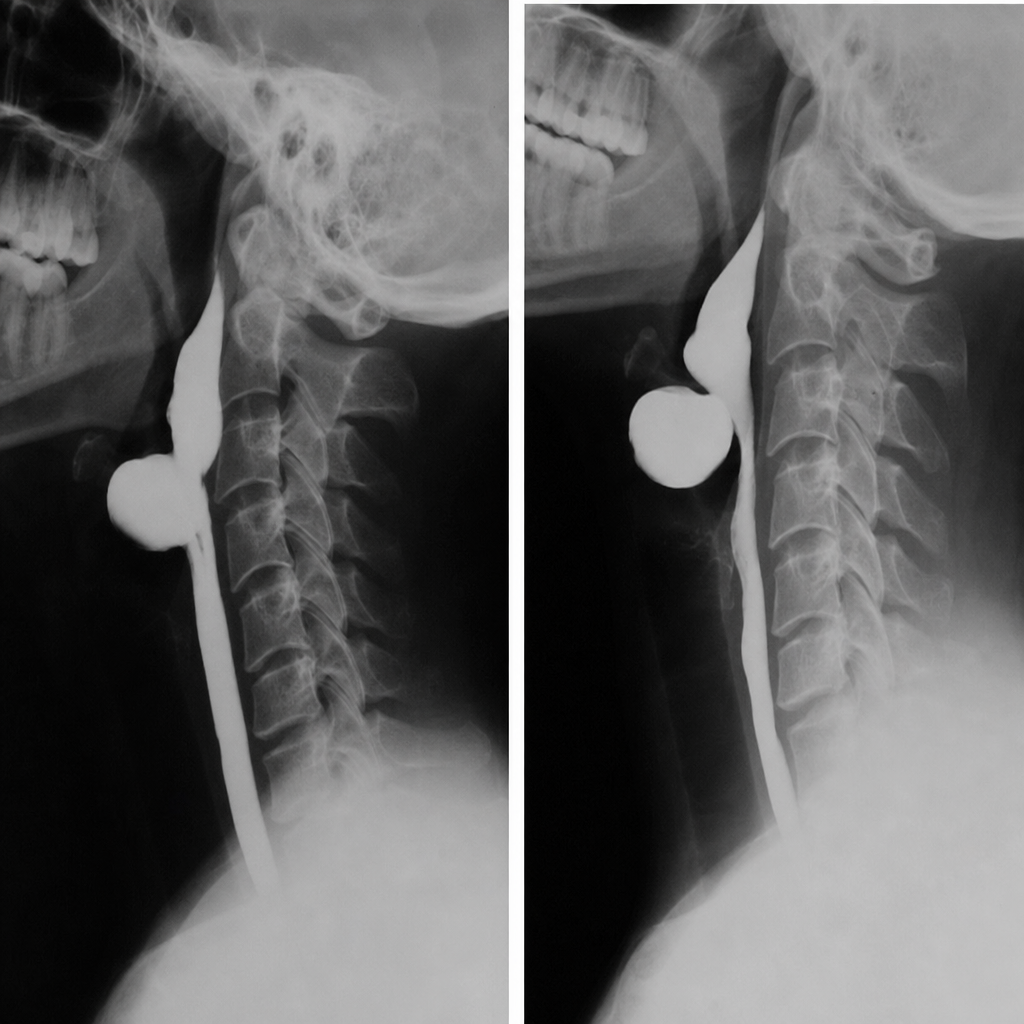
Which of the following is not a suprahyoid space?
Delphian's nodes are not related to which of the following? (ENT)
After a 26-year-old man's car was sideswiped by a large truck, he is brought to the emergency department with multiple fractures of the transverse processes of the cervical and upper thoracic vertebrae. Which of the following muscles might be affected?
Commonest site of branchial cyst:
Which of the following is a potential space located between the pharynx and the prevertebral fascia?
Left-Right movement of skull occurs at:-
The upward extension of thyroid swelling is prevented by which of the following structures
Which nerve passes between the superior and middle pharyngeal constrictor muscles?
Which structure forms the superior (anterior) boundary of the carotid triangle?
Which artery supplies the superficial structures of the head and neck region and is a branch of the common carotid artery?
Explanation: ***Anterior visceral space*** - The **anterior visceral space** is located primarily inferior to the hyoid bone, encompassing structures like the **thyroid gland** and **trachea**. - Its anatomical position makes it an **infrahyoid space**, rather than a suprahyoid space. *Peritonsillar space* - The **peritonsillar space** surrounds the palatine tonsils and is located superior to the hyoid bone. - Infections like **peritonsillar abscesses** occur within this suprahyoid space. *Masticator space* - The **masticator space** contains the muscles of mastication (masseter, temporalis, medial and lateral pterygoids) and is entirely above the hyoid bone. - It is a significant **suprahyoid space** prone to infections and tumors arising from jaw structures. *Parapharyngeal space* - The **parapharyngeal space** is a critical fascial space extending from the skull base to the hyoid bone. - It is classified as a **suprahyoid space** due to its predominant location superior to the hyoid.
Explanation: ***Posterior triangle*** - **Delphian nodes** are part of the deep cervical lymph node chain and are named for their clinical significance in detecting subclinical disease, typically related to recurrent laryngeal cancer. - The posterior triangle of the neck contains lymph nodes, but they are not specifically known as Delphian nodes; these nodes drain different regions and are generally not indicative of laryngeal involvement. *Retropharyngeal* - The **retropharyngeal lymph nodes** are located behind the pharynx and drain the posterior nasal cavity, paranasal sinuses, nasopharynx, and oropharynx. - While they are part of the head and neck lymphatics, they are distinct from Delphian nodes, which are more anterior and midline. *Upper deep cervical* - The **upper deep cervical lymph nodes** are a primary drainage pathway for many head and neck structures, including the larynx. - While Delphian nodes are distinct, their close proximity and shared drainage patterns mean they are functionally related to the larger deep cervical chain in assessing laryngeal cancer spread. *Pre-laryngeal* - **Delphian nodes**, also known as cricothyroid or pre-laryngeal nodes, are located in the prelaryngeal space, anterior to the cricothyroid membrane [1]. - Their involvement is highly suspicious for thyroid or laryngeal carcinoma, making them crucial for early detection of advanced disease [1].
Explanation: ***Levator scapulae*** - The **levator scapulae** muscle originates from the posterior tubercles of the transverse processes of cervical vertebrae C1-C4. - Fractures to these **transverse processes** could directly impact the attachment and function of the levator scapulae. *Serratus Posterior Superior* - The **serratus posterior superior** originates from the nuchal ligament and spinous processes of C7-T3, inserting onto ribs 2-5 - Its origin is primarily from the **spinous processes**, not the transverse processes, of the cervical and upper thoracic vertebrae. *Rhomboid major* - The **rhomboid major** muscle originates from the spinous processes of T2-T5, inserting into the medial border of the scapula. - Its origins are from the **spinous processes** of the upper thoracic vertebrae, not the transverse processes. *Trapezius* - The **trapezius** is a large muscle with a broad origin from the external occipital protuberance, nuchal ligament, and spinous processes of C7-T12. - While it covers a large area, its attachments are primarily to the **occiput** and **spinous processes**, not the transverse processes of the cervical and upper thoracic vertebrae.
Explanation: ***Upper 1/3rd of sternomastoid on anterior border*** - The **second branchial cleft** anomaly (accounting for 90-95% of all branchial cysts) commonly develops along the **anterior border of the sternocleidomastoid muscle** in the upper third of the neck, at the junction of upper and middle thirds [2]. - This location corresponds to the embryological remnants of the **second branchial pouch and cleft**. - The cyst typically presents as a smooth, fluctuant, non-tender mass that may become infected. *Upper 1/3rd of sternomastoid on posterior border* - This location is less common for branchial cysts, which typically originate along the anterior border of the sternocleidomastoid. - Cysts in the posterior triangle of the neck are more often associated with other conditions, such as **cystic hygroma** or lymph node pathology [1]. *Lower 1/3rd of sternomastoid on posterior border* - Branchial cysts usually occur in the **upper third** to junction of upper and middle thirds of the neck due to the developmental anatomy of the **second branchial arch and pouch**. - Cysts found in the lower posterior aspect of the neck are less likely to be branchial cysts. *Lower 1/3rd of sternomastoid on anterior border* - While along the anterior border, branchial cysts are predominantly found in the **upper third** or at the junction of upper and middle thirds of the sternocleidomastoid muscle. - Lesions in this lower, anterior position might suggest alternative diagnoses such as a **thyroglossal duct cyst** if midline, or other cervical masses like **thyroid nodules** or lymphadenopathy.
Explanation: ***Retropharyngeal space*** - This is a potential space in the neck located **behind the pharynx** and in front of the prevertebral fascia. - It is clinically significant as infections here can spread rapidly due to its communication with the **mediastinum**. *Parapharyngeal space* - The parapharyngeal space is located on the **side of the pharynx**, lateral to it, and is bordered by the medial pterygoid muscle, styloid process, and pharyngeal constrictors. - While adjacent, it is a distinct anatomical compartment from the retropharyngeal space. *Not a recognized anatomical space* - The retropharyngeal space is a well-defined and **clinically important anatomical space** in the neck. - Its recognition is crucial for understanding the spread of infections and managing deep neck space pathologies. *Peritonsillar space* - The peritonsillar space is located immediately **lateral to the palatine tonsil**, between the tonsillar capsule and the superior constrictor muscle. - Infections here lead to a **peritonsillar abscess** (quinsy), which is distinct from a retropharyngeal abscess.
Explanation: ***Atlanto-axial joint*** - The **atlanto-axial joint** (between C1 and C2) is primarily responsible for **rotation of the head** (left-right movement), allowing for approximately 50-60 degrees of rotation. - This joint's structure, particularly the **pivot joint** formed by the dens of C2 and the atlas, facilitates this extensive rotational movement. *C6-C7* - The C6-C7 vertebral segment primarily contributes to **flexion, extension**, and some lateral bending of the neck. - It has limited capacity for **rotational movement** compared to the atlanto-axial joint. *C2-C3* - The C2-C3 vertebral segment contributes to general **neck mobility**, including flexion, extension, and lateral bending. - While there is some rotational component, it is significantly **less pronounced** than at the atlanto-axial joint. *Atlanto-occipital joint* - The **atlanto-occipital joint** (between C0 and C1) is primarily responsible for **flexion and extension** of the head, similar to nodding "yes." - It allows for very **limited rotation** of the head.
Explanation: ***Pretracheal fascia*** - The **pretracheal fascia** is a deep cervical fascia layer that **envelops the thyroid gland** and is continuous with the fibrous capsule of the gland. - Due to its attachments, particularly to the **cricoid cartilage** and **recurrent laryngeal nerve sheath**, it anchors the thyroid gland and **restricts its upward movement** during swallowing. *Sternothyroid* - The **sternothyroid muscle** depresses the larynx and thyroid gland, but it does **not inherently prevent upward extension** of a thyroid swelling. - Its action is on the **movement of the larynx** and thyroid, rather than an anatomical barrier to swelling. *Thyrohyoid membrane* - The **thyrohyoid membrane** connects the thyroid cartilage to the hyoid bone and allows for movement between them, but it has no direct role in **preventing upward extension of a thyroid swelling**. - It is mainly involved in **laryngeal elevation** during swallowing. *Ligament of Berry* - The **ligament of Berry** (or lateral suspensory ligament) connects the thyroid gland to the **cricoid cartilage** and **trachea** [1]. - While it offers some stability to the thyroid gland, its primary role is to **anchor the gland posteriorly** rather than prevent the upward extension of a swelling [1].
Explanation: ***Glossopharyngeal nerve*** - The **glossopharyngeal nerve (CN IX)** passes between the **superior and middle pharyngeal constrictor muscles** along with the stylopharyngeus muscle. - After exiting the skull through the **jugular foramen**, it curves forward between these two constrictor muscles to reach the tongue and pharynx. - It provides **motor innervation** to the stylopharyngeus muscle and **sensory innervation** to the posterior third of the tongue and oropharynx. *Stylopharyngeus muscle* - While the **stylopharyngeus muscle** does pass between the superior and middle pharyngeal constrictors, it is a **muscle**, not a nerve. - The question specifically asks for a nerve, making this an incorrect answer despite its correct anatomical position. - This muscle is innervated by the glossopharyngeal nerve and elevates the pharynx during swallowing. *Superior laryngeal artery* - The **superior laryngeal artery** is a blood vessel, not a nerve. - It passes through the **thyrohyoid membrane** alongside the internal branch of the superior laryngeal nerve to supply the upper larynx. - It does not pass between the pharyngeal constrictor muscles. *Pharyngeal branch of vagus nerve* - The **pharyngeal branch of the vagus nerve** contributes to the pharyngeal plexus on the surface of the pharynx. - It typically lies on the **external surface** of the middle pharyngeal constrictor rather than passing between the constrictors. - It provides motor innervation to most pharyngeal muscles (except stylopharyngeus).
Explanation: ***Posterior belly of the digastric muscle*** - This muscle forms the **superior boundary** (also called anterosuperior boundary) of the carotid triangle, defining its upper extent. - The carotid triangle is a key anatomical region in the anterior triangle of the neck containing the carotid sheath and its contents. - The three boundaries of the carotid triangle are: superior - posterior belly of digastric, posterior - anterior border of sternocleidomastoid, and inferior - superior belly of omohyoid. *Anterior belly of the digastric muscle* - The **anterior belly of digastric** forms the boundary of the **submandibular triangle**, not the carotid triangle. - It runs from the digastric fossa of the mandible to the hyoid bone and is located more anteriorly and superiorly in the neck. - This is a common point of confusion between the submandibular and carotid triangles. *Sternocleidomastoid muscle* - The **anterior border of the sternocleidomastoid muscle** forms the **posterior (lateral) boundary** of the carotid triangle. - It is not part of the superior/anterior boundary definition for this specific neck triangle. *Hyoid bone* - The **hyoid bone** is an important landmark in the neck lying at the level of C3 vertebra. - It provides attachment for the digastric muscle via the intermediate tendon but does not form a direct muscular boundary of the carotid triangle. - The actual inferior boundary is formed by the superior belly of the omohyoid muscle.
Explanation: ***External carotid artery*** - This artery is a primary branch of the **common carotid artery** and is responsible for supplying blood to the **superficial structures of the head**, face, and neck, excluding the brain and orbit. - It gives rise to several major branches that supply specific regions, such as the **superior thyroid artery**, facial artery, and maxillary artery. *Vertebral artery* - The vertebral artery typically branches off the **subclavian artery**, not the common carotid artery. - It primarily supplies the **posterior part of the brain** via the basilar artery. *Internal carotid artery* - While a branch of the **common carotid artery**, the internal carotid artery's main role is to supply the **brain** and eyes, not the superficial structures of the head and neck. - It ascends into the skull to form part of the **circle of Willis**. *Subclavian artery* - The subclavian artery arises directly from the **aortic arch** on the left and the brachiocephalic trunk on the right. - It primarily supplies the **upper limbs**, chest wall, and gives rise to the vertebral artery, but not directly the main head and neck structures supplied by the external carotid.
Cervical Fascia
Practice Questions
Triangles of the Neck
Practice Questions
Deep Structures of the Neck
Practice Questions
Thyroid and Parathyroid Glands
Practice Questions
Vasculature of the Neck
Practice Questions
Lymphatic Drainage
Practice Questions
Cervical Plexus
Practice Questions
Root of the Neck
Practice Questions
Applied Anatomy and Clinical Correlations
Practice Questions
Surface Anatomy of the Neck
Practice Questions
Get full access to all questions, explanations, and performance tracking.
Start For Free