The hyoid bone is typically located at the level of which cervical vertebra?
What is the nerve supply to the platysma muscle?
A deep injury of the neck always involves which of the following structures?
All of the following muscles are supplied by the recurrent laryngeal nerve except?
Which cranial nerve is present around the origin of the occipital artery at the lower end of the sternocleidomastoid muscle?
Which of the following arteries supplies the lower two-thirds of the thyroid lobe, trachea, and thymus?
Which of the following muscles adducts the vocal cords?
What is the most common nerve injured during ligation of the superior thyroid artery?
Which of the following muscles does not elevate the larynx?
A cervical rib arises from which vertebra?
Explanation: **Explanation:** The **hyoid bone** is a unique, U-shaped bone that does not articulate directly with any other bone. In a neutral anatomical position, it is located in the anterior midline of the neck at the level of the **C3 cervical vertebra**, specifically at the angle between the floor of the mouth and the upper part of the neck. It serves as a vital anchor point for the suprahyoid and infrahyoid muscles, facilitating tongue movement and swallowing. **Analysis of Options:** * **C1 (Atlas):** This level corresponds to the hard palate and the base of the skull. * **C2 (Axis):** This level corresponds to the dental arch (lower teeth) and the oropharynx. * **C3 (Correct):** The body of the hyoid bone lies at this level. * **C4:** This level marks the upper border of the **thyroid cartilage** and the point where the common carotid artery typically bifurcates into the internal and external carotid arteries. **High-Yield Clinical Pearls for NEET-PG:** * **Vertebral Levels of the Airway:** * **Hyoid Bone:** C3 * **Thyroid Cartilage:** C4–C5 * **Cricoid Cartilage:** C6 (This is a critical landmark marking the junction of the larynx with the trachea and the pharynx with the esophagus). * **Fracture of the Hyoid:** In forensic medicine, a fractured hyoid bone is a pathognomonic sign of **strangulation** or throttling. * **Development:** The hyoid bone develops from the **2nd branchial arch** (lesser cornu and upper body) and the **3rd branchial arch** (greater cornu and lower body).
Explanation: **Explanation:** The **platysma** is a broad, thin sheet of muscle located in the subcutaneous tissue of the neck. It is classified as a muscle of facial expression. **1. Why Facial Nerve is Correct:** The platysma develops from the **second pharyngeal arch**. All muscles derived from this arch are innervated by the **Facial nerve (CN VII)**. Specifically, the platysma is supplied by the **cervical branch** of the facial nerve, which descends behind the angle of the mandible to enter the deep surface of the muscle. **2. Why Other Options are Incorrect:** * **Ansa cervicalis:** This nerve loop (C1-C3) supplies the infrahyoid "strap" muscles (omohyoid, sternohyoid, and sternothyroid), not the superficial muscles of the neck. * **Hypoglossal nerve (CN XII):** This is the motor nerve for all intrinsic and extrinsic modules of the tongue (except the palatoglossus). * **Mandibular nerve (V3):** This nerve supplies muscles derived from the first pharyngeal arch, such as the muscles of mastication, the anterior belly of the digastric, and the mylohyoid. **High-Yield Clinical Pearls for NEET-PG:** * **Location:** It lies within the **superficial fascia** of the neck (not the deep fascia). * **Function:** It depresses the mandible and the angle of the mouth, conveying expressions of horror or fright. * **Surgical Significance:** During neck surgeries, the platysma must be identified and sutured separately to ensure a cosmetic scar and prevent "tenting" of the skin. * **Clinical Sign:** In facial nerve palsy (Bell’s palsy), the patient may lose the ability to voluntarily contract the platysma on the affected side.
Explanation: In surgical and clinical anatomy, the definition of a "penetrating" or "deep" neck injury is strictly based on the integrity of the **Platysma muscle** [1]. 1. **Why Platysma is correct:** The platysma is a thin, wide sheet of muscle located within the superficial fascia of the neck. Anatomically, it serves as the boundary line: any wound that breaches the platysma is classified as a "penetrating neck injury." This is because the platysma lies superficial to the **investing layer of deep cervical fascia**. Once this muscle is pierced, there is a high risk of damage to vital underlying structures (vessels, nerves, trachea, or esophagus), necessitating surgical consultation or exploration [1]. 2. **Why other options are incorrect:** * **Trapezius & Sternocleidomastoid:** These are large muscles enclosed within the investing layer of deep cervical fascia. While they are often involved in neck trauma, an injury can be "deep" (penetrating the platysma) without involving these specific muscles, especially if the injury is midline or localized to the anterior/posterior triangles. * **Longus colli:** This is a prevertebral muscle located deep to the prevertebral fascia, directly against the vertebral column. It is only involved in extremely deep or transfixing injuries. **High-Yield Clinical Pearls for NEET-PG:** * **Zone System:** Penetrating neck injuries are divided into three zones (Zone I: Clavicle to Cricoid; Zone II: Cricoid to Angle of Mandible; Zone III: Angle of Mandible to Base of Skull) [1]. * **Management Rule:** If the platysma is not breached, the wound is considered superficial and can usually be managed with local wound care. If the platysma is breached, the patient requires admission and further imaging (CTA) or surgical exploration. * **Nerve Supply:** The platysma is supplied by the **cervical branch of the Facial Nerve (CN VII)**.
Explanation: The intrinsic muscles of the larynx are responsible for controlling the vocal cords and the laryngeal inlet. Their nerve supply follows a simple "all-but-one" rule, which is a high-yield concept for NEET-PG. ### **Explanation of the Correct Answer** **A. Cricothyroid:** This is the only intrinsic muscle of the larynx **not** supplied by the recurrent laryngeal nerve (RLN). It is supplied by the **External Laryngeal Nerve** (a branch of the Superior Laryngeal Nerve). Anatomically, it acts as a "tensor" of the vocal cords by tilting the thyroid cartilage forward. ### **Explanation of Incorrect Options** * **B. Arytenoid (Transverse and Oblique):** These muscles act as adductors of the vocal cords and are supplied by the RLN. * **C. Cricoarytenoid (Lateral and Posterior):** The Lateral Cricoarytenoid (adductor) and the Posterior Cricoarytenoid (abductor) are both supplied by the RLN [1]. ### **High-Yield Clinical Pearls for NEET-PG** 1. **The "Safety Muscle":** The **Posterior Cricoarytenoid** is known as the "safety muscle of the larynx" because it is the **only abductor** of the vocal cords. Paralysis leads to airway obstruction [1]. 2. **Nerve Injury during Surgery:** * The **External Laryngeal Nerve** is closely related to the **Superior Thyroid Artery**; injury during thyroidectomy leads to a weak, husky voice (inability to tension cords). * The **Recurrent Laryngeal Nerve** is related to the **Inferior Thyroid Artery** [1]; injury leads to hoarseness or respiratory distress. 3. **Sensory Supply:** Above the vocal cords is supplied by the Internal Laryngeal Nerve; below the vocal cords is supplied by the Recurrent Laryngeal Nerve.
Explanation: The correct answer is **Hypoglossal nerve (CN XII)**. ### **Explanation** The **Hypoglossal nerve** descends between the internal carotid artery and internal jugular vein. At the level of the lower border of the posterior belly of the digastric muscle, it curves forward, hooking around the **origin of the occipital artery**. This anatomical relationship is a classic landmark: the occipital artery "pins" the hypoglossal nerve as it crosses the external carotid artery to enter the submandibular region. This occurs deep to the sternocleidomastoid (SCM) muscle. ### **Analysis of Incorrect Options** * **Spinal accessory nerve (CN XI):** While it pierces the SCM, it does so much higher (at the level of the transverse process of the atlas) and passes posteriorly into the posterior triangle. It does not have a close relationship with the origin of the occipital artery. * **Superior laryngeal nerve:** This is a branch of the Vagus nerve (CN X) that passes medial to the internal and external carotid arteries to reach the larynx. It is located deeper and more medially than the hypoglossal nerve. * **Petrosal nerve:** These are branches related to the facial nerve (Greater petrosal) or glossopharyngeal nerve (Lesser petrosal) located within the skull base and middle ear, far from the carotid triangle and SCM. ### **High-Yield Facts for NEET-PG** * **The "Hook" Rule:** The Hypoglossal nerve hooks around the **occipital artery**, whereas the Left Recurrent Laryngeal nerve hooks around the **arch of aorta**, and the Right Recurrent Laryngeal nerve hooks around the **subclavian artery** [1]. * **Carotid Triangle Boundaries:** The hypoglossal nerve is a key content of the carotid triangle, which is bounded by the SCM, superior belly of omohyoid, and posterior belly of digastric. * **Clinical Pearl:** During carotid endarterectomy, the hypoglossal nerve must be identified and protected as it crosses the carotid arteries near the occipital artery origin to avoid tongue deviation (ipsilateral paralysis).
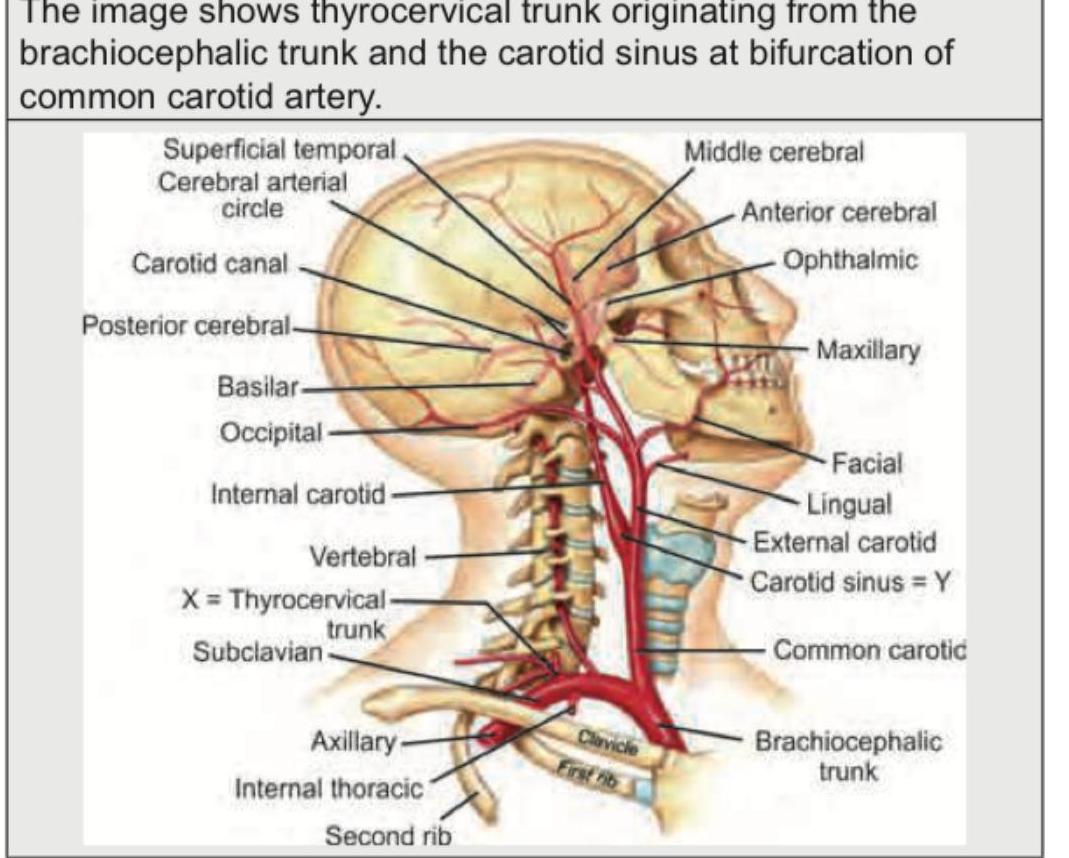
Explanation: The **Inferior Thyroid Artery (ITA)** is a branch of the **thyrocervical trunk**, which arises from the first part of the subclavian artery. It is the primary blood supply to the posterior and inferior aspects of the thyroid gland. 1. **Why Option A is Correct:** The ITA provides extensive vascularization beyond just the thyroid gland. It supplies the **lower two-thirds of the thyroid lobe**, the posterior surface of the gland (including the parathyroid glands), and gives off esophageal, **tracheal**, and **thymic branches** [1]. Its distribution makes it the most comprehensive answer for the structures mentioned. 2. **Why Option B is Incorrect:** The **Superior Thyroid Artery (STA)** is the first branch of the External Carotid Artery. It primarily supplies the upper one-third and the anterior surface of the thyroid lobe. While it has a cricothyroid branch, it does not typically supply the trachea or thymus. 3. **Why Option C is Incorrect:** The **External Carotid Artery** is the parent vessel of the STA, but it does not directly supply the lower thyroid, trachea, or thymus. 4. **Why Option D is Incorrect:** Since the vascular territories of the STA and ITA are distinct and specific, "All of the above" is inaccurate. **High-Yield NEET-PG Pearls:** * **Surgical Anatomy:** During thyroidectomy, the **Inferior Thyroid Artery** is closely related to the **Recurrent Laryngeal Nerve (RLN)** [1], [2]. To avoid nerve injury, the artery should be ligated **far from the gland** (where the nerve is usually posterior to it). * **Parathyroid Supply:** The ITA is the main source of blood for both the superior and inferior parathyroid glands [1]. * **Thyroidea Ima Artery:** In 3-10% of individuals, an accessory artery (Thyroidea Ima) arises from the brachiocephalic trunk or aortic arch to supply the thyroid isthmus.
Explanation: The intrinsic muscles of the larynx are responsible for controlling the tension and position of the vocal cords, thereby regulating phonation and the airway. ### **Explanation of Options** * **A. Lateral cricoarytenoid (Correct):** This muscle originates from the arch of the cricoid cartilage and inserts into the muscular process of the arytenoid. Its contraction pulls the muscular process anteriorly, causing **medial rotation** of the arytenoid cartilages. This action brings the vocal folds together, resulting in **adduction**. * **B. Posterior cricoarytenoid:** This is the **only abductor** of the vocal cords. It rotates the arytenoids laterally, opening the rima glottidis. It is often referred to as the "safety muscle of the larynx" because it maintains the airway. * **C. Cricothyroid:** This muscle tilts the thyroid cartilage forward, which increases the distance between the thyroid and arytenoid cartilages. This action **tenses and elongates** the vocal cords, raising the pitch of the voice. * **D. Vocalis:** This muscle (the medial part of the thyroarytenoid) runs parallel to the vocal ligament. Its primary role is to **relax** the vocal cords by shortening them, which lowers the pitch. ### **NEET-PG High-Yield Pearls** * **Nerve Supply:** All intrinsic muscles of the larynx are supplied by the **Recurrent Laryngeal Nerve (RLN)**, EXCEPT the **Cricothyroid**, which is supplied by the **External Laryngeal Nerve**. * **Key Actions Summary**: * **Abductor:** Posterior cricoarytenoid (Safety muscle). * **Adductors:** Lateral cricoarytenoid, Transverse arytenoid. * **Tensors:** Cricothyroid. * **Relaxers:** Thyroarytenoid and Vocalis. * **Clinical Correlation:** Bilateral RLN injury leads to the vocal cords being fixed in a paramedian position, causing respiratory distress (stridor) because the "safety muscle" (abductor) is paralyzed.
Explanation: The correct answer is **External laryngeal nerve**. **1. Why it is correct:** The **superior thyroid artery (STA)** arises from the external carotid artery and descends toward the upper pole of the thyroid gland. In its course, it is closely related to the **external laryngeal nerve (ELN)**, a branch of the superior laryngeal nerve. The ELN runs deep and medial to the artery but becomes most vulnerable near the upper pole of the gland. To avoid injuring this nerve, which supplies the **cricothyroid muscle** (the only tensor of the vocal cords), the STA must be ligated **as close to the upper pole of the thyroid as possible** [1]. **2. Why other options are incorrect:** * **Recurrent laryngeal nerve (RLN):** This nerve is most commonly injured during ligation of the **inferior thyroid artery** [1]. It lies in the tracheoesophageal groove and is related to the artery's terminal branches [2]. * **Facial nerve:** This is the nerve of the second branchial arch and is primarily related to the parotid gland and muscles of facial expression, not the thyroid region. * **Mandibular nerve:** A branch of the trigeminal nerve (CN V3), it supplies the muscles of mastication and provides sensory innervation to the lower face; it is anatomically distant from the thyroid gland. **High-Yield Clinical Pearls for NEET-PG:** * **Injury to ELN:** Results in the inability to produce high-pitched sounds and easy vocal fatigue (the
Explanation: To understand the movement of the larynx, one must distinguish between the **Suprahyoid** and **Infrahyoid** muscle groups. The larynx generally moves in tandem with the hyoid bone. ### 1. Why Sternohyoid is the Correct Answer The **Sternohyoid** is an infrahyoid muscle (specifically a "strap muscle"). Its origin is the manubrium sterni and its insertion is the lower border of the hyoid bone. Because its fixed point is below the larynx (the sternum), its contraction pulls the hyoid bone and larynx **downward**. Therefore, it is a **depressor**, not an elevator. ### 2. Analysis of Incorrect Options * **Thyrohyoid:** Although it is an infrahyoid muscle, it is the exception to the rule. It originates from the thyroid cartilage and inserts into the hyoid. When the hyoid is fixed by suprahyoid muscles, the thyrohyoid **elevates** the larynx toward the hyoid. * **Mylohyoid:** This is a suprahyoid muscle forming the floor of the mouth. It originates from the mandible and inserts into the hyoid. Its contraction pulls the hyoid bone (and consequently the larynx) **upward and forward** during swallowing. ### 3. High-Yield Clinical Pearls for NEET-PG * **Elevators of the Larynx:** Include the Suprahyoid muscles (Digastric, Stylohyoid, Mylohyoid, Geniohyoid), the Thyrohyoid, and the longitudinal muscles of the pharynx (Stylopharyngeus, Salpingopharyngeus, Palatopharyngeus). * **Depressors of the Larynx:** Include the Sternohyoid, Sternothyroid, and Omohyoid. * **Nerve Supply:** All infrahyoid muscles are supplied by the **Ansa Cervicalis** (C1-C3), except for the **Thyrohyoid**, which is supplied by **C1 via the Hypoglossal nerve**. This is a frequent "except" type question in exams.
Explanation: ### Explanation **Correct Answer: C. C8** **Concept Overview:** A cervical rib is a supernumerary (extra) rib that arises from the **seventh cervical vertebra (C7)**. However, in the context of spinal nerve levels and anatomical relations, it is often described as being associated with the **C8 nerve root** or the **C8 vertebral level** in embryological terms. In standard anatomical nomenclature, while the rib physically attaches to the C7 vertebra, it is located above the first thoracic rib. Because the C8 spinal nerve exits below the C7 vertebra and above the T1 vertebra, a cervical rib typically compresses the **lower trunk of the brachial plexus (C8 and T1 nerve roots)** and the subclavian artery. In many medical examinations, including NEET-PG, "C8" is identified as the level associated with this anomaly due to its clinical impact on the C8 dermatome/myotome. **Analysis of Options:** * **A (C6):** The C6 vertebra has a prominent anterior tubercle (Chassaignac’s tubercle), but it does not typically give rise to accessory ribs. * **B (C7):** While C7 is the *anatomical* bone the rib attaches to, in the context of this specific question's key, C8 is the functional/clinical level targeted. (Note: If C7 and C8 are both present, C7 is the morphological origin, but C8 is the clinical level of the nerve involved). * **D (T1):** T1 is the site of the first "normal" rib. An accessory rib here would be a thoracic rib, not cervical. **Clinical Pearls for NEET-PG:** 1. **Thoracic Outlet Syndrome (TOS):** The cervical rib is a leading cause of TOS, compressing the lower trunk of the brachial plexus and subclavian artery. 2. **Symptoms:** Patients present with wasting of intrinsic hand muscles (Gilliatt-Sumner hand) and paresthesia along the ulnar aspect of the forearm (C8-T1 distribution). 3. **Adson’s Test:** A classic clinical test where the radial pulse disappears when the patient extends the neck and rotates the head toward the affected side while taking a deep breath. 4. **Incidence:** Occurs in approximately 0.5% of the population; it is more common in females and often bilateral.
Cervical Fascia
Practice Questions
Triangles of the Neck
Practice Questions
Deep Structures of the Neck
Practice Questions
Thyroid and Parathyroid Glands
Practice Questions
Vasculature of the Neck
Practice Questions
Lymphatic Drainage
Practice Questions
Cervical Plexus
Practice Questions
Root of the Neck
Practice Questions
Applied Anatomy and Clinical Correlations
Practice Questions
Surface Anatomy of the Neck
Practice Questions
Get full access to all questions, explanations, and performance tracking.
Start For Free