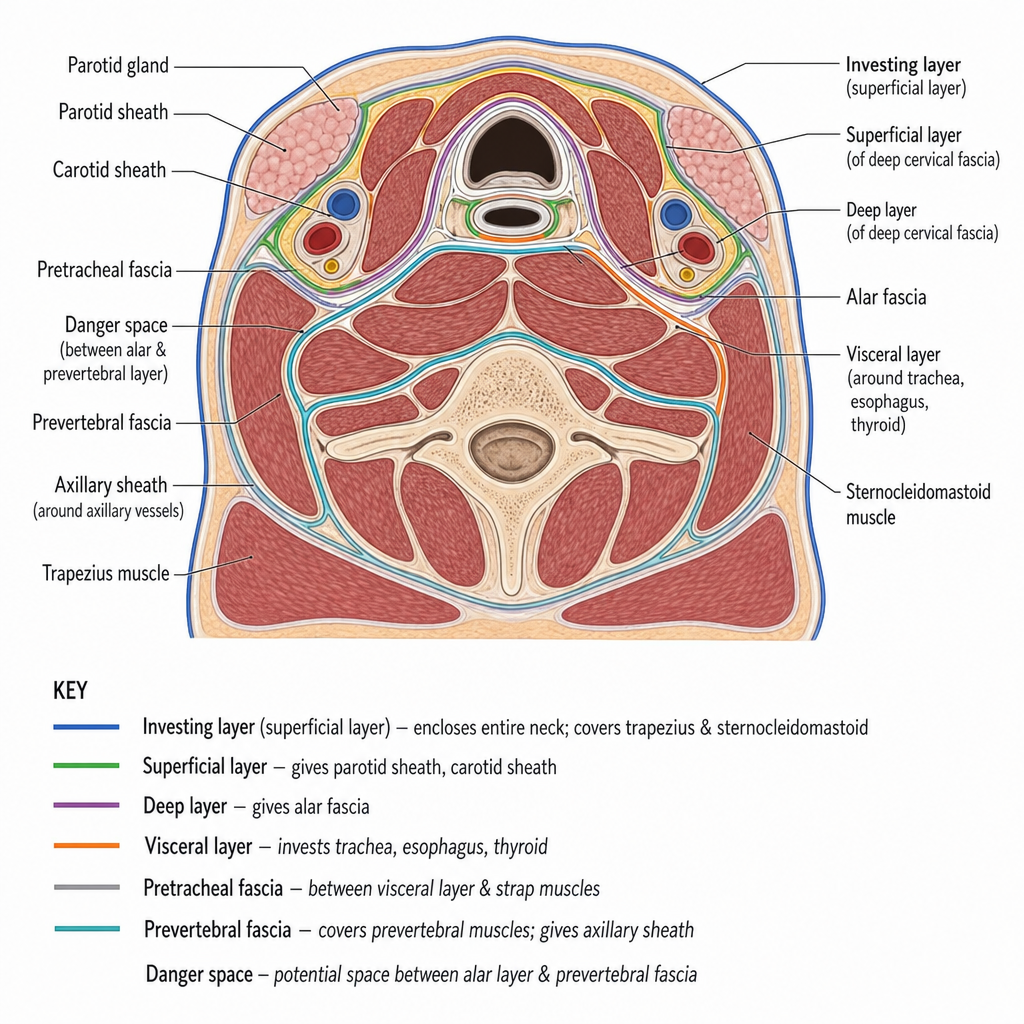
Which of the following nerves runs with the vagus nerve between the internal carotid artery and the internal jugular vein until the angle of the mandible?
All the following are boundaries of the carotid triangle except?
The cricothyroid muscle is supplied by which nerve?
All of the following are true about the larynx EXCEPT?
Which of the following statements are true about the sternocleidomastoid muscle?
The superior thyroid artery originates from which of the following arteries?
Which of the following statements is NOT true regarding the deep cervical lymph nodes?
Which of the following muscles opens the inlet of the larynx?
All the muscles of the larynx are supplied by the recurrent laryngeal nerve, EXCEPT?
What is the usual number of parathyroid glands in a human?
Explanation: ### Explanation The correct answer is **B. Hypoglossal nerve (CN XII)**. **1. Why Hypoglossal Nerve is Correct:** The hypoglossal nerve exits the skull through the hypoglossal canal and descends in the neck. Initially, it lies deep to the internal carotid artery (ICA) and internal jugular vein (IJV). As it descends, it passes **between the ICA and IJV**, lying on the lateral side of the vagus nerve (CN X). At the level of the **angle of the mandible**, it hooks around the occipital artery and crosses the internal and external carotid arteries superficially to enter the submandibular region. This specific anatomical relationship—running between the major vessels alongside the vagus—is a classic anatomical landmark. **2. Why Other Options are Incorrect:** * **Accessory nerve (CN XI):** While it exits the jugular foramen with the vagus, it quickly passes backward, usually crossing **superficial** to the IJV (in 70% of cases) to reach the sternocleidomastoid muscle, rather than running between the vessels. * **Glossopharyngeal nerve (CN IX):** This nerve exits the jugular foramen and passes **forward between** the ICA and ECA, but it stays superior to the hypoglossal nerve and does not descend as far down the carotid sheath. * **Maxillary nerve (CN V2):** This is a branch of the trigeminal nerve that exits via the foramen rotundum into the pterygopalatine fossa. It does not enter the carotid sheath or the neck. **3. NEET-PG High-Yield Pearls:** * **The Carotid Sheath:** Contains the Common/Internal Carotid artery (medial), IJV (lateral), and Vagus nerve (posteriorly in the groove between them). * **The
Explanation: The **Carotid Triangle** is a clinically significant subdivision of the anterior triangle of the neck, named so because it contains the bifurcations of the common carotid artery. [1] ### **Anatomical Boundaries** The carotid triangle is bounded by: * **Superiorly:** Posterior belly of the Digastric muscle (supplemented by Stylohyoid). * **Antero-inferiorly:** Superior belly of the Omohyoid muscle. * **Posteriorly:** Anterior border of the Sternocleidomastoid (SCM) muscle. [1] * **Floor:** Formed by the Hyoglossus, Thyrohyoid, and Middle and Inferior constrictor muscles of the pharynx. ### **Explanation of Options** * **Option A (Correct):** The **Anterior belly of Digastric** forms a boundary of the **Submental** and **Digastric (Submandibular)** triangles, not the carotid triangle. * **Option B:** The posterior belly of the digastric forms the superior (or postero-superior) limit. * **Option C:** The superior belly of the omohyoid forms the lower anterior limit. * **Option D:** The anterior margin of the SCM forms the entire posterior limit. ### **High-Yield Clinical Pearls for NEET-PG** 1. **Contents:** The triangle contains the **Carotid Sheath** (Common Carotid, Internal Jugular Vein, and Vagus nerve). Notably, the **External Carotid Artery** and five of its branches also lie here. [1] 2. **Nerves:** The **Hypoglossal nerve (CN XII)** crosses the internal and external carotid arteries within this triangle. The **Ansa Cervicalis** is typically found embedded in the anterior wall of the carotid sheath here. 3. **Carotid Sinus/Body:** Located at the level of the upper border of the thyroid cartilage (C4 level), these act as baroreceptors and chemoreceptors, respectively.
Explanation: **Explanation:** The **cricothyroid muscle** is unique among the intrinsic muscles of the larynx. While all other intrinsic laryngeal muscles are supplied by the recurrent laryngeal nerve, the cricothyroid is supplied by the **external laryngeal nerve**, which is a branch of the **Superior Laryngeal Nerve (SLN)**. 1. **Why Option A is correct:** The Superior Laryngeal Nerve divides into internal and external branches. The **external laryngeal nerve** provides the motor supply specifically to the cricothyroid muscle. In many exams, "Superior Laryngeal Nerve" is the preferred answer if the specific branch (external) is not listed or if it is considered the parent trunk. 2. **Why Option B is technically more specific but often grouped:** In this specific question format, the SLN is the parent nerve. However, if both "Superior Laryngeal Nerve" and "External Laryngeal Nerve" are options, the **External Laryngeal Nerve** is the more precise anatomical answer. 3. **Why Option C is incorrect:** While the SLN is a branch of the Vagus nerve (CN X), the Vagus is the distant origin. In anatomy questions, the most immediate terminal branch is the required answer. 4. **Why Option D is incorrect:** The Glossopharyngeal nerve (CN IX) supplies the stylopharyngeus muscle and provides sensory input to the oropharynx, but it does not supply laryngeal muscles. **High-Yield Clinical Pearls for NEET-PG:** * **Action:** The cricothyroid tenses and elongates the vocal cords (the "tuning fork" of the larynx), raising the pitch of the voice. * **Clinical Injury:** Damage to the external laryngeal nerve (often during **thyroidectomy** due to its proximity to the superior thyroid artery) leads to a weak, husky voice and loss of the ability to produce high-pitched sounds. * **Rule of Thumb:** All intrinsic muscles of the larynx = Recurrent Laryngeal Nerve; **EXCEPT** Cricothyroid = External Laryngeal Nerve.
Explanation: ### Explanation **1. Why Option A is the Correct Answer (The Exception):** The statement is false because there is one notable exception to the nerve supply of the intrinsic muscles of the larynx. While the **Recurrent Laryngeal Nerve (RLN)** supplies almost all intrinsic muscles [1], the **Cricothyroid muscle** is supplied by the **External Laryngeal Nerve** (a branch of the Superior Laryngeal Nerve). This "one muscle exception" is a classic high-yield anatomy fact. **2. Analysis of Other Options:** * **Option B:** This is a true statement. The cricothyroid is the only intrinsic muscle located on the external surface of the larynx, hence its innervation by the external laryngeal nerve. * **Option C:** This is a true statement. The **Posterior Cricoarytenoid (PCA)** is the sole abductor of the vocal cords ("PCA pulls cords apart"). It is often referred to as the "safety muscle of the larynx" because it keeps the airway open. * **Option D:** This is a true statement. The lymphatic drainage of the larynx above the vocal cords follows the superior laryngeal artery to the upper deep cervical nodes, while below the cords, it drains to the lower deep cervical nodes (pre-laryngeal and pre-tracheal nodes). **3. Clinical Pearls for NEET-PG:** * **Safety Muscle:** Posterior Cricoarytenoid (Abductor). * **Tuning Fork/Pitch Muscle:** Cricothyroid (Tenses the vocal cords). * **RLN Injury:** Unilateral injury leads to hoarseness; bilateral injury can cause respiratory distress due to the cords remaining in a paramedian position [1]. * **Sensory Supply:** Above the vocal cords is by the **Internal Laryngeal Nerve**; below the vocal cords is by the **Recurrent Laryngeal Nerve** [1].
Explanation: The **Sternocleidomastoid (SCM)** is a key landmark muscle of the neck. To understand the correct option, let’s evaluate the anatomical features typically associated with this question: ### **Analysis of Statements** * **(a) Origin & Insertion:** It originates by two heads: a medial **tendinous sternal head** (manubrium) and a lateral **fleshy clavicular head** (medial third of clavicle). It inserts into the lateral surface of the **mastoid process** and the superior nuchal line. * **(b) Nerve Supply:** The motor supply is the **Spinal Accessory Nerve (CN XI)**. Sensory fibers (proprioception) are derived from the ventral rami of **C2 and C3**. * **(c) Relations:** It is enclosed in the **investing layer** of deep cervical fascia. It acts as a "key" to the neck, separating the anterior triangle from the posterior triangle. * **(d) Action (The False Statement):** Unilateral contraction tilts the head toward the shoulder of the *same* side but rotates the face to the **opposite (contralateral) side**. Bilateral contraction flexes the neck. * **(e) Blood Supply:** It receives its blood supply from the superior thyroid, occipital, and posterior auricular arteries. ### **Why Option B is Correct** Option B (a, b, c, and e) is correct because it includes the accurate anatomical descriptions of origin, innervation, and relations, while excluding the common distractor regarding its action (statement d). Statement (d) is often phrased incorrectly in exams by suggesting it rotates the face to the same side. ### **High-Yield Clinical Pearls for NEET-PG** * **Torticollis (Wry Neck):** Permanent contraction of the SCM (often due to birth injury/fibrosis) leads to the head tilting toward and the face rotating away from the affected side. * **Erb’s Point (Punctum Nervosum):** Located at the posterior border of the SCM; it is the exit site for four cutaneous branches of the cervical plexus (Great auricular, Lesser occipital, Transverse cervical, and Supraclavicular nerves). * **Surrounding Structures:** The **External Jugular Vein** crosses the SCM superficially, while the **Carotid Sheath** lies deep to it.
Explanation: The **superior thyroid artery** is the first anterior branch of the **External Carotid Artery (ECA)**. It arises just below the level of the greater cornu of the hyoid bone and descends to supply the upper pole of the thyroid gland. **Why the correct answer is right:** The External Carotid Artery provides the primary arterial supply to the neck and face through eight major branches. The superior thyroid artery is typically the first branch to emerge from the ECA, often originating near its bifurcation from the Common Carotid Artery. It plays a vital role in supplying the thyroid gland and the larynx (via the superior laryngeal artery). **Why the incorrect options are wrong:** * **Internal Carotid Artery (ICA):** In the neck, the ICA has **no branches**. It enters the skull through the carotid canal to supply the brain and the eye. * **Facial Artery:** This is the third anterior branch of the ECA. While it originates from the same parent vessel, it primarily supplies the structures of the face. * **Maxillary Artery:** This is one of the two terminal branches of the ECA (the other being the superficial temporal artery). It originates within the parotid gland and supplies deep structures of the face and the meninges. **High-Yield Clinical Pearls for NEET-PG:** 1. **Surgical Anatomy:** During a thyroidectomy, the superior thyroid artery is ligated **close to the gland** to avoid injuring the **external laryngeal nerve**, which runs in close proximity to the artery. 2. **Blood Supply:** The thyroid gland has a dual supply; the inferior thyroid artery (a branch of the thyrocervical trunk from the subclavian artery) [1] supplies the lower pole. 3. **Mnemonic for ECA branches:** "**S**ome **A**ttic **L**ife **F**orce **O**nly **P**repares **M**aximum **S**trength" (Superior thyroid, Ascending pharyngeal, Lingual, Facial, Occipital, Posterior auricular, Maxillary, Superficial temporal).
Explanation: The deep cervical lymph nodes are a vital chain of nodes responsible for the ultimate lymphatic drainage of the head and neck. **Explanation of the Correct Answer (A):** The deep cervical lymph nodes are specifically arranged along the **internal jugular vein (IJV)**, not the external jugular vein [1]. They are located deep to the sternocleidomastoid muscle. In contrast, the **superficial cervical lymph nodes** are the ones that lie along the external jugular vein. Therefore, statement A is incorrect and the right answer. **Analysis of Other Options:** * **Option B:** The **jugulodigastric node** (located where the posterior belly of the digastric crosses the IJV) is the primary node for the palatine tonsils. It is often referred to as the "principal node of the tonsil." * **Option C:** These nodes are anatomically situated within the carotid sheath [1], lying **deep to the sternocleidomastoid muscle**, which serves as a protective landmark. * **Option D:** The **juguloomohyoid node** (located where the omohyoid muscle crosses the IJV) receives lymphatic drainage from the tongue, specifically the submental and submandibular nodes. It is often called the "principal node of the tongue." **High-Yield NEET-PG Pearls:** * **Leveling System:** Deep cervical nodes are classified into Levels II through IV (Upper, Middle, and Lower) [1]. * **Virchow’s Node:** A supraclavicular node (Level V) on the left side; its enlargement (Troisier’s sign) suggests occult intra-abdominal malignancy (e.g., gastric cancer). * **Drainage:** All lymphatic vessels of the head and neck eventually drain into the deep cervical nodes before entering the jugular lymph trunks.
Explanation: The muscles of the larynx are categorized based on their action on the laryngeal inlet, the vocal cords, and the rima glottidis. ### **Explanation of the Correct Answer** **A. Thyroepiglottic:** This muscle is a continuation of the thyroarytenoid fibers. It originates from the inner surface of the thyroid cartilage and inserts into the margin of the epiglottis. By pulling the margins of the epiglottis toward the thyroid cartilage, it widens the laryngeal inlet. Therefore, it is the **only muscle that opens the inlet of the larynx.** ### **Explanation of Incorrect Options** * **B. Triangular muscle:** This is not a standard anatomical term for a laryngeal muscle. It may be a distractor referring to the shape of other muscles, but it has no functional role in the larynx. * **C. Cricothyroid:** This muscle acts on the vocal cords, not the inlet. It tilts the thyroid cartilage forward, thereby **tensing and lengthening the vocal cords**. It is the only intrinsic muscle supplied by the **External Laryngeal Nerve**. * **D. Lateral cricoarytenoid:** This muscle acts on the rima glottidis. It rotates the arytenoid cartilages medially to **adduct the vocal cords**, effectively closing the glottis for phonation. ### **High-Yield NEET-PG Pearls** * **Inlet Closer:** The **Aryepiglottic muscle** (assisted by oblique arytenoids) is the primary sphincter that closes the laryngeal inlet during swallowing. * **Safety Muscle of Larynx:** The **Posterior Cricoarytenoid** is the only **abductor** of the vocal cords (opens the rima glottidis). * **Nerve Supply:** All intrinsic muscles of the larynx are supplied by the **Recurrent Laryngeal Nerve**, EXCEPT the **Cricothyroid** (External Laryngeal Nerve). * **Sensory Supply:** Above the vocal cords is the Internal Laryngeal Nerve; below the vocal cords is the Recurrent Laryngeal Nerve.
Explanation: ### Explanation The nerve supply of the laryngeal muscles is a high-yield topic in Anatomy. The larynx is innervated by branches of the **Vagus nerve (CN X)**. **1. Why Cricothyroid is the Correct Answer:** All intrinsic muscles of the larynx are supplied by the **Recurrent Laryngeal Nerve (RLN)**, with the sole exception of the **Cricothyroid muscle**. The Cricothyroid is supplied by the **External Laryngeal Nerve** (a branch of the Superior Laryngeal Nerve). * **Concept:** The Cricothyroid is derived from the **4th pharyngeal arch**, while all other intrinsic laryngeal muscles are derived from the **6th pharyngeal arch**. This embryological difference dictates their distinct nerve supplies. **2. Analysis of Incorrect Options:** * **Salpingopharyngeus:** This is a muscle of the pharynx, not the larynx. It is supplied by the pharyngeal plexus (CN X). * **Stylopharyngeus:** This is also a pharyngeal muscle. It is unique because it is the only muscle supplied by the **Glossopharyngeal nerve (CN IX)** (derived from the 3rd pharyngeal arch). * **None of the above:** Incorrect, as Cricothyroid is the classic exception to the RLN rule. **3. NEET-PG Clinical Pearls:** * **The "Safety Muscle":** The **Posterior Cricoarytenoid** is the only abductor of the vocal cords. Paralysis of this muscle (via RLN injury) leads to adduction of the cords, potentially causing airway obstruction [1]. * **Surgery Link:** During thyroidectomy, the **External Laryngeal Nerve** is at risk during ligation of the Superior Thyroid Artery, while the **RLN** is at risk during ligation of the Inferior Thyroid Artery [1]. * **Function:** The Cricothyroid muscle acts as a **tensor** of the vocal cords, increasing the pitch of the voice. Damage to its nerve results in a "weak, husky voice."
Explanation: **Explanation:** The parathyroid glands are small, endocrine glands located on the posterior aspect of the thyroid gland. In approximately **80-90% of the population**, there are **four** parathyroid glands: two superior and two inferior [1], [2]. * **Superior Parathyroid Glands:** Derived from the **fourth pharyngeal pouch**. They are relatively constant in position, usually located at the level of the lower border of the cricoid cartilage. * **Inferior Parathyroid Glands:** Derived from the **third pharyngeal pouch** (along with the thymus). Because they migrate a longer distance during development, their final position is more variable [1]. **Analysis of Options:** * **Option A (4):** This is the standard anatomical number. They are organized as a superior and inferior pair on each side [2]. * **Options B, C, and D:** While numerical variations exist (some individuals may have 3, 5, or even 6 glands due to developmental remnants or division of primordia), these are considered anatomical variations. For examination purposes, "4" is the definitive "usual" number. **High-Yield NEET-PG Pearls:** 1. **Blood Supply:** All four glands are primarily supplied by the **inferior thyroid artery** (a branch of the thyrocervical trunk) [1]. This is a critical landmark during thyroid surgery. 2. **Ectopic Location:** The inferior parathyroids are more likely to be ectopic (found in the mediastinum or thymus) due to their longer migratory path from the 3rd pouch. 3. **Surgical Landmark:** The **recurrent laryngeal nerve** typically passes deep to the parathyroid glands; surgeons must identify it to avoid vocal cord paralysis [1].
Cervical Fascia
Practice Questions
Triangles of the Neck
Practice Questions
Deep Structures of the Neck
Practice Questions
Thyroid and Parathyroid Glands
Practice Questions
Vasculature of the Neck
Practice Questions
Lymphatic Drainage
Practice Questions
Cervical Plexus
Practice Questions
Root of the Neck
Practice Questions
Applied Anatomy and Clinical Correlations
Practice Questions
Surface Anatomy of the Neck
Practice Questions
Get full access to all questions, explanations, and performance tracking.
Start For Free