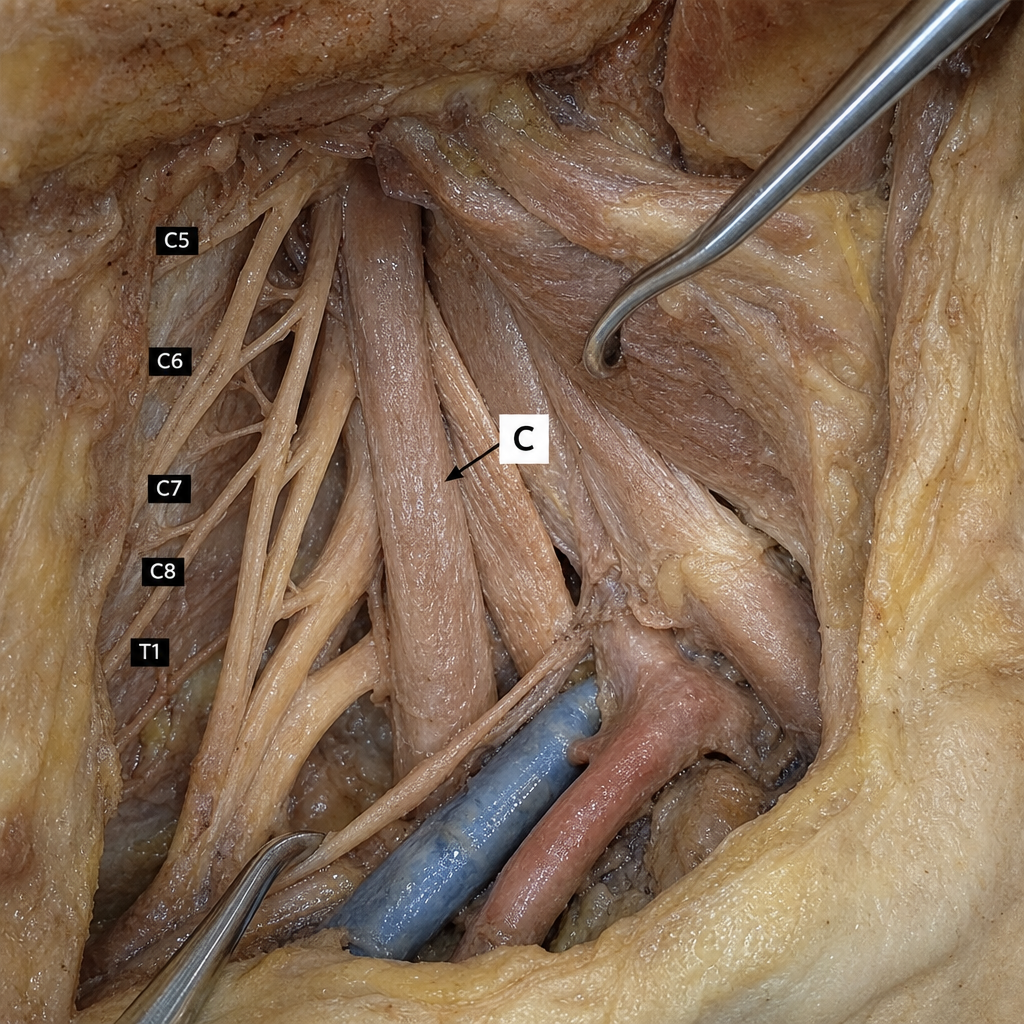
Cervical esophagus receives its arterial supply from which artery?
What is the anterior-posterior diameter of the vocal cords in both males and females?
A 37-year-old man presents with a neck injury. Radiographic imaging reveals a crushed C2 vertebra. Which of the following structures would remain intact following this injury?
From which part of the subclavian artery does the vertebral artery arise?
Exposure of the left subclavian artery by a supraclavicular approach does NOT require cutting of which muscle?
A 56-year-old woman has undergone a complete thyroidectomy. Post-operatively, hoarseness of voice is noted, persisting for 3 weeks. Examination reveals a permanently adducted vocal fold on the right side. Surgical trauma to the innervation of which of the following muscles is most likely responsible for the position of the right vocal fold?
The suboccipital triangle is bounded superolaterally by which structure?
In Galen's anastomosis, the superior laryngeal nerve pierces the inferior constrictor of the pharynx and unites with which of the following?
The inferior thyroid vein drains into which of the following veins?
All of the following form the boundaries of the digastric triangle except?
Explanation: The esophagus is a muscular tube divided into three anatomical segments, each receiving a distinct blood supply based on its location. **1. Why Inferior Thyroid Artery is Correct:** The **cervical esophagus** (extending from the cricopharyngeus to the thoracic inlet) is primarily supplied by the **Inferior Thyroid Artery**, which is a branch of the thyrocervical trunk (from the subclavian artery). This is consistent with the general rule that structures in the neck receive blood from branches of the subclavian or carotid systems. **2. Analysis of Incorrect Options:** * **Superior Thyroid Artery:** This is a branch of the External Carotid Artery. While it supplies the upper pole of the thyroid gland and the larynx (via the superior laryngeal artery), it does not provide significant branches to the esophagus. * **Intercostal Arteries:** These (specifically the posterior intercostals) provide segmental supply to the **thoracic esophagus**, particularly the middle and lower portions. * **Bronchial Arteries:** These are direct branches of the descending thoracic aorta that supply the **thoracic esophagus** along with the tracheobronchial tree. **3. High-Yield Facts for NEET-PG:** * **Venous Drainage:** The cervical esophagus drains into the **Inferior Thyroid Veins**. * **Segmental Supply Summary:** * **Cervical:** Inferior Thyroid Artery. * **Thoracic:** Bronchial arteries and esophageal branches of the Thoracic Aorta. * **Abdominal:** Left Gastric Artery and Left Inferior Phrenic Artery. * **Clinical Correlation:** The esophagus lacks a serosal layer, making it more prone to anastomotic leaks and the spread of malignancy compared to other parts of the GI tract. * **Nerve Supply:** The recurrent laryngeal nerve provides sensory and motor supply to the cervical esophagus.
Explanation: ### Explanation The correct answer is **C: 23 mm and 17 mm**. **Understanding the Concept:** The length of the vocal cords (vocal folds) is a critical anatomical measurement that determines the pitch and resonance of the human voice. In adults, the larynx undergoes sexual dimorphism during puberty. Under the influence of androgens, the male larynx grows significantly larger, and the thyroid cartilage angle becomes more acute (approx. 90° in males vs. 120° in females). This growth results in longer, thicker vocal cords in males (average **23 mm**) compared to females (average **17 mm**). The increased length and mass in males result in a lower-pitched voice. **Analysis of Options:** * **Option C (Correct):** Accurately reflects the standard anatomical measurements found in standard textbooks (e.g., Gray’s Anatomy). * **Options A, B, and D:** These values are significantly higher than the actual anatomical dimensions of the glottis. A diameter of 36 mm or 48 mm would exceed the entire anteroposterior span of the adult larynx. **High-Yield NEET-PG Clinical Pearls:** 1. **Rima Glottidis:** This is the narrowest part of the upper airway in **adults**. In **children**, the narrowest part is the **cricoid cartilage** (subglottis). 2. **Histology:** The vocal cords are covered by **stratified squamous non-keratinized epithelium**, unlike the rest of the respiratory tract, which is lined by pseudostratified ciliated columnar epithelium. 3. **Nerve Supply:** All intrinsic muscles of the larynx are supplied by the **Recurrent Laryngeal Nerve**, except for the **Cricothyroid** (supplied by the External Laryngeal Nerve). 4. **Space of Reinke:** The potential space between the vocal ligament and the overlying mucosa; edema here (Reinke’s edema) is common in chronic smokers.
Explanation: The core of this question lies in understanding the specific attachments of the suboccipital and cervical muscles/ligaments to the **Axis (C2)** versus the **Atlas (C1)**. **Why Rectus Capitis Posterior Minor is correct:** The **Rectus capitis posterior minor** is the only structure among the options that does not attach to C2. It originates from the posterior tubercle of the **Atlas (C1)** and inserts into the medial part of the inferior nuchal line of the occipital bone. Since it spans only the gap between C1 and the skull, a crush injury to C2 would leave its attachments and structural integrity intact. **Analysis of Incorrect Options:** * **Semispinalis cervicis:** This muscle originates from the transverse processes of T1–T6 and inserts into the **spinous processes of C2–C5**. A fracture of the C2 vertebra would disrupt its insertion point. * **Apical ligament:** This ligament connects the **apex of the dens (odontoid process) of C2** to the anterior margin of the foramen magnum. Damage to C2 directly compromises this ligament. * **Alar ligament:** These "check ligaments" extend from the **sides of the dens of C2** to the lateral margins of the foramen magnum. They are critical for limiting rotation and would be damaged in a C2 crush injury. **NEET-PG High-Yield Pearls:** * **C1 (Atlas) vs. C2 (Axis):** Remember that C1 has **no body and no spinous process** (only tubercles). C2 is characterized by the **dens (odontoid process)** and a large, bifid spinous process. * **Suboccipital Triangle:** The Rectus capitis posterior **major**, Obliquus capitis superior, and Obliquus capitis inferior form the boundaries. Note that the Rectus capitis posterior **minor** is *not* a boundary of the suboccipital triangle; it lies medial to it. * **Cruciate Ligament:** Composed of the transverse ligament of the atlas and vertical bands; it is vital for stabilizing the dens against the atlas.
Explanation: The **subclavian artery** is divided into three parts by the **scalenus anterior muscle**: the first part is medial to the muscle, the second part is posterior to it, and the third part is lateral to it. ### **Why Option A is Correct** The **vertebral artery** is the first and largest branch of the **first part** of the subclavian artery. It arises from the superoposterior aspect of the artery, ascends through the foramina transversaria of the upper six cervical vertebrae, and eventually enters the skull via the foramen magnum to form the basilar artery. Other branches of the **1st part** include: 1. **Internal thoracic artery** (descends into the thorax). 2. **Thyrocervical trunk** (gives off the inferior thyroid, suprascapular, and transverse cervical arteries) [1]. ### **Why Other Options are Incorrect** * **Option B (2nd Part):** This part typically gives off only one branch: the **costocervical trunk** (which divides into the superior intercostal and deep cervical arteries). * **Option C (3rd Part):** This part usually has no consistent branches, though it may occasionally give rise to the **dorsal scapular artery**. * **Option D (4th Part):** This is a distractor; the subclavian artery is anatomically divided into only **three parts**. ### **High-Yield Clinical Pearls for NEET-PG** * **Subclavian Steal Syndrome:** Occurs when there is a proximal stenosis of the subclavian artery (before the origin of the vertebral artery), leading to retrograde flow from the vertebral artery to the arm. * **Course:** The vertebral artery is divided into 4 segments (V1-V4). It enters the transverse foramen at the level of **C6** (not C7). * **Triangle of the Vertebral Artery:** Bound medially by the longus colli and laterally by the scalenus anterior; the vertebral artery is the key content.
Explanation: To expose the left subclavian artery via a supraclavicular approach, the surgeon must navigate the structures of the posterior triangle and the root of the neck. The subclavian artery is divided into three parts by the **scalenus anterior** muscle. ### Why Scalenus Medius is the Correct Answer The **scalenus medius** forms the floor of the posterior triangle and lies **posterior** to the subclavian artery and the brachial plexus. During a supraclavicular approach, the goal is to reach the artery as it exits from behind the scalenus anterior. Since the scalenus medius is located behind the vessel, it does not obstruct the surgical field and therefore does not require cutting. ### Why the Other Options are Incorrect * **A. Sternocleidomastoid:** The clavicular head of this muscle covers the medial portion of the supraclavicular space. It often needs to be retracted or partially divided to gain adequate exposure to the deeper structures. * **B. Scalenus Anterior:** This is the key landmark. To expose the second part of the subclavian artery or to mobilize the vessel fully, the scalenus anterior must be divided (taking care to protect the **phrenic nerve** which crosses it). * **C. Omohyoid:** The inferior belly of the omohyoid crosses the posterior triangle horizontally. It frequently lies directly in the surgical path and must be retracted or divided to clear the field. ### High-Yield Clinical Pearls for NEET-PG * **Phrenic Nerve:** Always remember that the phrenic nerve lies on the anterior surface of the scalenus anterior. It must be identified and retracted medially before the muscle is cut. * **Thoracic Duct:** On the **left side**, the thoracic duct arches over the subclavian artery to enter the venous point (junction of IJV and subclavian vein). It is at high risk during this approach. * **Subclavian Steal Syndrome:** Occurs due to proximal stenosis of the subclavian artery, leading to retrograde flow in the vertebral artery. * **Relation:** The subclavian **vein** lies anterior to the scalenus anterior, while the **artery** lies posterior to it.
Explanation: ### Explanation The patient is presenting with a permanently **adducted** vocal fold following a thyroidectomy, indicating a loss of **abduction** (opening) of the vocal cords. **1. Why the Correct Answer (B) is Right:** The **Posterior Cricoarytenoid (PCA)** is the **sole abductor** of the vocal folds. It is innervated by the **Recurrent Laryngeal Nerve (RLN)**, which is closely related to the inferior thyroid artery and is frequently at risk during thyroid surgery. [1] * **Mechanism:** When the PCA is paralyzed, the vocal fold cannot be pulled away from the midline. The opposing adductor muscles (lateral cricoarytenoid and arytenoids) act unopposed, pulling the vocal fold into a median or paramedian (adducted) position inside the surgical field. [1] This results in hoarseness and, if bilateral, can cause respiratory distress. **2. Why the Incorrect Options are Wrong:** * **A. Aryepiglottic:** This muscle helps in closing the laryngeal inlet during swallowing; it does not significantly influence the abduction or adduction of the vocal folds. * **C. Thyroarytenoid:** This muscle acts to **relax** and shorten the vocal folds (lowering pitch). Paralysis would not result in a permanently adducted position. * **D. Transverse arytenoids:** This is an **adductor** muscle. If it were paralyzed, the vocal fold would likely be stuck in an abducted (open) position, not an adducted one. **3. NEET-PG High-Yield Pearls:** * **"Safety Muscle of the Larynx":** Posterior Cricoarytenoid (because it keeps the airway open). * **Nerve Supply Rule:** All intrinsic muscles of the larynx are supplied by the **Recurrent Laryngeal Nerve**, EXCEPT the **Cricothyroid**, which is supplied by the **External Laryngeal Nerve**. * **Cricothyroid Function:** It is the "tenser" of the vocal cords (increases pitch). * **Semon’s Law:** In progressive RLN injury, abductor fibers (PCA) are more susceptible and damaged earlier than adductor fibers.
Explanation: The **suboccipital triangle** is a high-yield anatomical region located deep to the trapezius and semispinalis capitis muscles. Understanding its boundaries is essential for identifying the structures passing through it. ### **Anatomical Boundaries** * **Superomedial:** Rectus capitis posterior major. * **Superolateral:** **Superior oblique** (Obliquus capitis superior). * **Inferolateral:** **Inferior oblique** (Obliquus capitis inferior). * **Floor:** Posterior atlanto-occipital membrane and the posterior arch of the atlas (C1). * **Roof:** Semispinalis capitis muscle. ### **Analysis of Options** * **Option C (Correct):** The **Superior oblique** muscle originates from the transverse process of the atlas and inserts into the occipital bone, forming the **superolateral** boundary. * **Option A:** The **Rectus capitis posterior major** forms the **superomedial** boundary. * **Option B:** The **Rectus capitis posterior minor** lies medial to the major muscle but does **not** form a boundary of the triangle itself. * **Option D:** The **Inferior oblique** forms the **inferolateral** boundary (base) of the triangle. ### **High-Yield NEET-PG Pearls** * **Contents of the Triangle:** 1. **Vertebral Artery (3rd part):** Lies on the groove on the superior surface of the posterior arch of the atlas. 2. **Suboccipital Nerve (Dorsal ramus of C1):** Supplies the muscles of the triangle; it has no sensory distribution. 3. **Suboccipital Venous Plexus.** * **Clinical Note:** The **Greater Occipital Nerve (C2)** is often a distractor; it is *not* a content of the triangle. It emerges below the inferior oblique and crosses the triangle posteriorly to provide sensation to the scalp.
Explanation: **Explanation:** **Galen’s Anastomosis** (also known as the *Ansa of Galen*) is a significant neural connection in the larynx. It is formed by the union of the **internal laryngeal nerve** (a branch of the Superior Laryngeal Nerve) and the **ascending branch of the Recurrent Laryngeal Nerve (RLN)**. 1. **Why Option C is correct:** The internal laryngeal nerve (sensory) pierces the thyrohyoid membrane, while the RLN (motor/sensory) enters the larynx deep to the inferior constrictor muscle. Their communication typically occurs on the posterior surface of the cricoarytenoid muscle. This anastomosis provides supplementary sensory innervation to the subglottic region and may play a role in laryngeal reflexes. 2. **Why other options are incorrect:** * **Option A:** There is no direct midline anastomosis between the left and right superior laryngeal nerves. * **Option B:** The RLN divides into anterior and posterior (or ascending and descending) branches; however, it is specifically the **ascending branch** that travels upward to meet the internal laryngeal nerve. * **Option D:** The Glossopharyngeal nerve (CN IX) provides sensory supply to the oropharynx and the posterior third of the tongue, but it does not participate in Galen’s anastomosis within the larynx. **High-Yield Clinical Pearls for NEET-PG:** * **Sensory Supply:** Above the vocal cords is by the Internal Laryngeal Nerve; below the vocal cords is by the Recurrent Laryngeal Nerve. * **Motor Supply:** All intrinsic muscles of the larynx are supplied by the RLN [1], [2] **except** the Cricothyroid, which is supplied by the External Laryngeal Nerve. * **Injury Landmark:** During thyroid surgery, the RLN is most vulnerable near the **Berry’s ligament** [2] or where it crosses the inferior thyroid artery [1].
Explanation: ### Explanation The thyroid gland is highly vascular and has a distinct venous drainage pattern that is frequently tested in NEET-PG. The drainage occurs via three pairs of veins: 1. **Superior Thyroid Vein:** Follows the superior thyroid artery and drains into the **Internal Jugular Vein (IJV)**. 2. **Middle Thyroid Vein:** A short vein that drains directly into the **IJV**. 3. **Inferior Thyroid Vein:** Unlike the others, these veins form a plexus in front of the trachea and typically drain into the **Left Brachiocephalic Vein** (and occasionally the right). **Why Option C is Correct:** The inferior thyroid veins arise from the lower border of the thyroid gland. They descend in front of the trachea and terminate in the **brachiocephalic veins** (most commonly the left). This is a classic anatomical landmark where the venous drainage does not mirror the arterial supply (the inferior thyroid artery arises from the thyrocervical trunk) [1]. **Analysis of Incorrect Options:** * **A. Internal Jugular Vein:** This receives the superior and middle thyroid veins, but not the inferior. * **B. Superior Vena Cava (SVC):** The SVC is formed by the union of the two brachiocephalic veins. While the blood eventually reaches the SVC, the direct drainage point is the brachiocephalic vein. * **D. External Jugular Vein:** This vein drains the superficial scalp and face; it does not receive drainage from the thyroid gland. **High-Yield Clinical Pearls for NEET-PG:** * **Kocher’s Vein:** This is an accessory middle thyroid vein. It is surgically significant as it must be ligated during thyroidectomy to avoid hemorrhage. * **Thyroid Ima Artery:** Present in ~10% of individuals, it arises from the brachiocephalic trunk or arch of aorta and ascends to the inferior border of the thyroid. * **Tracheostomy Precaution:** The inferior thyroid venous plexus lies directly in front of the cervical trachea and is a major source of bleeding during an emergency tracheostomy [1].
Explanation: ### Explanation The **Digastric Triangle** (also known as the Submandibular Triangle) is a key anatomical space within the anterior triangle of the neck. To identify the correct answer, one must visualize the boundaries formed by the muscles and the mandible. #### Why "Superior belly of omohyoid" is the Correct Answer: The **superior belly of the omohyoid** does not contribute to the boundaries of the digastric triangle. Instead, it forms the anterior boundary of the **carotid triangle** and the superior boundary of the **muscular triangle.** Its anatomical position is too inferior and lateral to reach the submandibular region. #### Analysis of Incorrect Options (Boundaries of the Triangle): * **Anterior belly of digastric:** Forms the **anteroinferior** boundary. * **Posterior belly of digastric:** Forms the **posteroinferior** boundary (along with the stylohyoid muscle). * **Mylohyoid:** Along with the hyoglossus, the mylohyoid muscle forms the **floor** of the digastric triangle. * **Base (Superior boundary):** Formed by the lower border of the body of the mandible and a line extending from the angle of the mandible to the mastoid process. * **Roof:** Formed by the skin, superficial fascia (containing platysma), and the investing layer of deep cervical fascia. #### High-Yield Clinical Pearls for NEET-PG: * **Contents:** The most important structures within this triangle are the **submandibular salivary gland**, submandibular lymph nodes, facial artery/vein, and the **hypoglossal nerve (CN XII)**. * **Floor Muscles:** Remember the "M-H" rule for the floor: **M**ylohyoid (anteriorly) and **H**yoglossus (posteriorly). * **Nerve Supply:** The anterior belly of the digastric is supplied by the nerve to mylohyoid (CN V3), while the posterior belly is supplied by the facial nerve (CN VII). This reflects their different embryological origins (1st and 2nd branchial arches, respectively).
Cervical Fascia
Practice Questions
Triangles of the Neck
Practice Questions
Deep Structures of the Neck
Practice Questions
Thyroid and Parathyroid Glands
Practice Questions
Vasculature of the Neck
Practice Questions
Lymphatic Drainage
Practice Questions
Cervical Plexus
Practice Questions
Root of the Neck
Practice Questions
Applied Anatomy and Clinical Correlations
Practice Questions
Surface Anatomy of the Neck
Practice Questions
Get full access to all questions, explanations, and performance tracking.
Start For Free