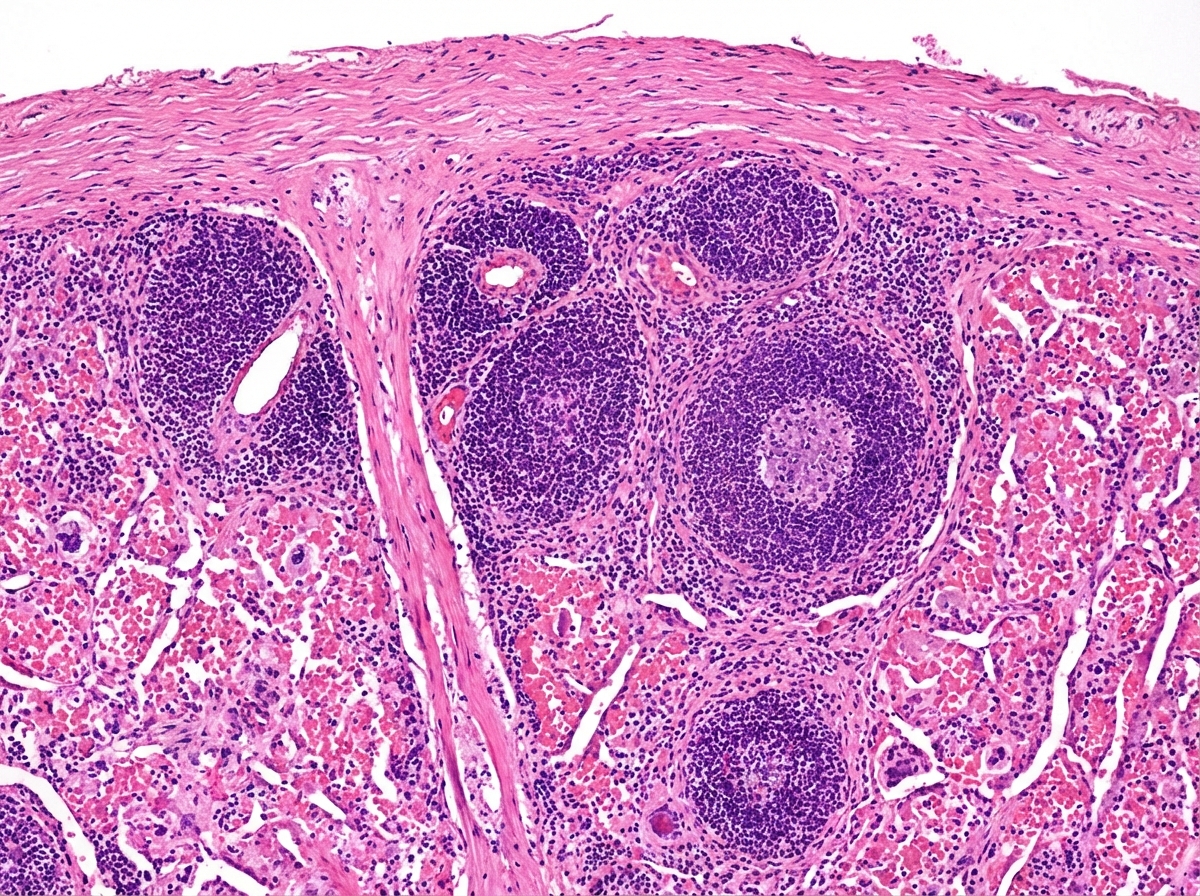
What is the approximate ratio of fat cells to blood cells in bone marrow?
Which of the following statements concerning Hassall corpuscles is true?
Which type of white blood cell has the longest lifespan?
Elastic cartilage is found in which of the following locations?
In the follow-up of Benign Prostatic Hyperplasia (BPH), what is the most important indication for surgery?
The pharyngeal tonsil is lined by which type of epithelium?
Which structure is referred to as the peripheral heart?
Transurethral resection of the prostate (TURP) was performed in an elderly patient with benign prostatic hyperplasia (BPH). Postoperatively, the patient developed altered sensorium. What is the most likely cause?
Plasma cell dyscrasias include all of the following except?
The Auerbach plexus is present in which layer of the gastrointestinal tract?
Explanation: **Explanation:** The composition of bone marrow is dynamic and changes with age. In a healthy adult, the **cellularity** of the bone marrow (the ratio of hematopoietic/blood-forming cells to adipocytes/fat cells) is approximately **50:50**, making the ratio **1:1**. **Why 1:1 is correct:** Under physiological conditions, the marrow space is shared between active red marrow (hematopoietic cells) and inactive yellow marrow (fat cells). A standard clinical rule of thumb to estimate expected cellularity is **"100 minus age."** For a middle-aged adult, this results in roughly 50% cellularity, balanced by 50% fat. Therefore, 1:1 represents the average normal baseline for adult histology. **Analysis of Incorrect Options:** * **A (1:4) and B (1:2):** These ratios represent **hypercellular** marrow. This is seen in infants (where marrow is nearly 100% hematopoietic) or in pathological states like myeloproliferative disorders or compensatory erythropoiesis. * **D (2:1):** This represents **hypocellular** marrow. This is characteristic of elderly individuals (where fat replaces blood cells) or pathological conditions like **Aplastic Anemia**. **High-Yield Clinical Pearls for NEET-PG:** * **Red Marrow vs. Yellow Marrow:** At birth, all marrow is red. With age, centripetal replacement occurs (from distal to proximal bones), leaving red marrow primarily in the axial skeleton (vertebrae, sternum, ribs, pelvis). * **Biopsy Site:** The **Posterior Superior Iliac Spine (PSIS)** is the preferred site for bone marrow aspiration and biopsy in adults. * **Aplastic Anemia:** Defined by a "dry tap" on aspiration and a biopsy showing >90% fat cells (severe hypocellularity).
Explanation: **Explanation:** **Hassall’s corpuscles** (also known as thymic corpuscles) are the most characteristic histological feature of the **thymic medulla**. They are spherical, concentric whorls of flattened **Type VI epithelioreticular cells**. These cells undergo keratinization and sometimes calcification, forming a central eosinophilic mass. **Why the correct answer is right:** * **Option D:** Hassall’s corpuscles are found exclusively in the **medulla** of the thymus. Their primary function is to produce cytokines (like TSLP) that instruct dendritic cells to induce the development of regulatory T cells (Tregs), which are crucial for peripheral tolerance. **Why the incorrect options are wrong:** * **Options A & B:** The **thymic cortex** contains a dense population of T-lymphoblasts (thymocytes) and Type I-III epithelioreticular cells, but it **never** contains Hassall’s corpuscles [1]. While the thymus undergoes involution (atrophy) with age, the corpuscles remain a medullary feature throughout life, often increasing in size and number as one ages. * **Option C:** The stroma of the thymus, including the epithelioreticular cells that form Hassall’s corpuscles, is derived from the **endoderm** of the **3rd pharyngeal pouch**. They are not mesodermal in origin (unlike the stroma of other lymphoid organs). **NEET-PG High-Yield Facts:** 1. **Origin:** Thymus has a dual origin—Endoderm (epithelial stroma) and Mesoderm (lymphocytes). 2. **Blood-Thymus Barrier:** Located only in the **cortex**, preventing premature antigen exposure. 3. **Identification:** In histological sections, the medulla is lighter-staining than the cortex; Hassall’s corpuscles are the "gold standard" for identifying the thymus. 4. **DiGeorge Syndrome:** Failure of the 3rd and 4th pharyngeal pouches to develop, leading to thymic aplasia and T-cell deficiency.
Explanation: The lifespan of white blood cells (WBCs) varies significantly based on their function and circulation patterns. **Lymphocytes** are the correct answer because they are the only leukocytes capable of recirculating between the blood and lymphoid tissues. While some effector lymphocytes live only a few days, **memory B and T cells** can persist for several years, and in some cases, decades, providing long-term immunity [2]. **Analysis of Incorrect Options:** * **Neutrophils:** These are the most abundant but shortest-lived WBCs. In the bloodstream, they circulate for only 6–10 hours [3], and once they migrate into tissues to perform phagocytosis, they survive for just 1–4 days. * **Eosinophils:** These cells typically circulate in the blood for about 8–12 hours before migrating into tissues (primarily the respiratory and GI tracts), where they survive for roughly 8–12 days. * **Monocytes:** These circulate for approximately 1–3 days [1]. However, once they enter tissues and differentiate into **macrophages**, they can live for several months [1]. Despite this, they do not match the multi-year longevity of memory lymphocytes. **High-Yield Clinical Pearls for NEET-PG:** * **Recirculation:** Lymphocytes are the only WBCs that return to the blood after entering tissues [2]. * **Order of Lifespan (Shortest to Longest):** Neutrophils < Eosinophils < Monocytes < Lymphocytes. * **Granulocytes vs. Agranulocytes:** Granulocytes (Neutrophils, Eosinophils, Basophils) generally have much shorter lifespans compared to agranulocytes (Monocytes, Lymphocytes).
Explanation: **Explanation:** Cartilage is classified into three types based on the composition of its intercellular matrix: Hyaline, Elastic, and Fibrocartilage. **Elastic cartilage** is characterized by a dense network of branching elastic fibers in its matrix, providing both structural support and significant flexibility. **Why Option A is Correct:** The **Auditory tube** (Eustachian tube) requires the flexibility to open and close to equalize pressure between the middle ear and the nasopharynx [1]. This functional requirement is met by elastic cartilage. Other classic locations for elastic cartilage follow the **"3 E's and 3 P's"** rule: **E**xternal ear (Auricle), **E**xternal auditory canal, **E**piglottis, **P**inna, **P**haryngotympanic tube, and the **P**rocesses of the arytenoid (specifically the corniculate and cuneiform cartilages). **Why Other Options are Incorrect:** * **B. Nasal septum:** This is composed of **Hyaline cartilage**. It provides rigid support to maintain the airway. * **C. Auricular cartilage:** While the auricle *does* contain elastic cartilage, in the context of this specific MCQ format where "Auditory tube" is marked as the primary key, it serves as a distractor or secondary location. (Note: In many standard texts, both are correct; however, the Auditory tube is a high-yield favorite for examiners). * **D. Costal cartilage:** This is the most common example of **Hyaline cartilage**, connecting the ribs to the sternum [2]. **NEET-PG High-Yield Pearls:** * **Staining:** Elastic cartilage is best visualized using **Orcein** or **Verhoeff’s Van Gieson (VVG)** stains, which turn elastic fibers black/purple. * **Calcification:** Unlike hyaline cartilage, elastic cartilage **does not calcify** with age. * **Growth:** It possesses a perichondrium and grows via both appositional and interstitial mechanisms.
Explanation: The management of Benign Prostatic Hyperplasia (BPH) typically follows a step-ladder approach, starting with watchful waiting or medical therapy (Alpha-blockers/5-alpha-reductase inhibitors). However, surgery (usually TURP) is indicated when complications arise that signify **end-organ damage** or failure of medical management. **Why D is Correct:** **Bilateral hydronephrosis** is an absolute indication for surgery. It indicates that the bladder outlet obstruction is so severe that it has caused chronic urinary retention, leading to high-pressure backflow into the ureters and kidneys. If left untreated, this leads to obstructive uropathy and irreversible **renal failure**. Other absolute indications include refractory urinary retention, recurrent hematuria, and bladder stones. **Analysis of Incorrect Options:** * **A. Prostate size:** Size alone is never an indication for surgery [1]. A patient with a 100g prostate may be asymptomatic, while a patient with a 30g prostate may have severe obstruction [1]. * **B. Single UTI:** A single, easily treated UTI is not an indication. Surgery is considered only if there are **recurrent, persistent UTIs** directly attributable to the post-void residual urine. * **C. Hypertension:** Hypertension is not a contraindication to BPH medications. In fact, Alpha-blockers (like Prazosin) were historically used to treat both conditions simultaneously. **Clinical Pearls for NEET-PG:** * **Most common site for BPH:** Transitional Zone (Histology). * **Most common site for Prostate Cancer:** Peripheral Zone. * **Gold Standard Surgery:** Transurethral Resection of the Prostate (TURP). * **Post-TURP Syndrome:** Caused by hyponatremia due to absorption of glycine (irrigation fluid). * **Median Lobe Enlargement:** Most likely to cause early obstructive symptoms by acting as a "ball-valve" mechanism at the internal urethral orifice.
Explanation: **Explanation:** The **pharyngeal tonsil** (commonly referred to as the **adenoids** when enlarged) is located in the roof and posterior wall of the **nasopharynx** [1]. Since the nasopharynx is part of the respiratory tract, it is primarily lined by **respiratory epithelium**, which is **pseudostratified ciliated columnar epithelium with goblet cells**. Unlike the palatine and lingual tonsils, which are located in the oropharynx and exposed to the mechanical friction of food (requiring a protective stratified squamous lining), the pharyngeal tonsil is exposed only to air [1]. **Analysis of Incorrect Options:** * **Option A (Simple cuboidal):** This is typically found in metabolically active areas like kidney tubules or the thyroid gland, not in the lining of major lymphoid organs. * **Option C (Keratinizing stratified squamous):** This is the epithelium of the skin (epidermis), providing a waterproof, protective barrier. * **Option D (Nonkeratinizing stratified squamous):** This lines the **palatine and lingual tonsils**. While patches of this epithelium may appear in the pharyngeal tonsil due to chronic irritation (metaplasia), it is not the primary histological characteristic. **High-Yield Clinical Pearls for NEET-PG:** * **Waldeyer’s Ring:** A ring of lymphoid tissue in the pharynx consisting of the pharyngeal (superior), tubal (lateral), palatine (lateral), and lingual (inferior) tonsils [1]. * **Adenoid Facies:** Chronic enlargement of the pharyngeal tonsils leads to mouth breathing, a narrow high-arched palate, and a dull facial expression. * **Histological Distinction:** Pharyngeal tonsils lack **crypts**; instead, they have mucosal folds called **pleats**. * **Epithelium Summary:** * Pharyngeal/Tubal Tonsils = Respiratory (Pseudostratified). * Palatine/Lingual Tonsils = Non-keratinized Stratified Squamous.
Explanation: The **Soleus muscle** is referred to as the **"Peripheral Heart"** because of its critical role in venous return from the lower limbs [1]. Unlike the gastrocnemius, the soleus contains a dense network of large, thin-walled venous sinuses (soleal sinuses). When the muscle contracts during walking or standing, it compresses these sinuses, pumping deoxygenated blood upward against gravity toward the heart [1]. The presence of one-way valves in the deep veins ensures that blood flows cranially, mimicking the pumping action of the heart. **Analysis of Options:** * **Soleus (Correct):** Its deep location, lack of involvement in knee movement, and high concentration of venous plexuses make it the primary pump for venous return [1]. * **Popliteus:** Known as the **"Key to the knee,"** it is responsible for unlocking the knee joint by laterally rotating the femur on the tibia; it has no significant role in venous pumping. * **Plantaris:** Often called the **"Freshman’s Nerve,"** it is a vestigial muscle with a long tendon. It is functionally insignificant in humans and does not contribute to the peripheral pump mechanism. **Clinical Pearls for NEET-PG:** * **Venous Stasis:** Prolonged inactivity (e.g., long-haul flights or bedridden patients) leads to failure of the "soleal pump," causing blood to pool [1]. This is a major risk factor for **Deep Vein Thrombosis (DVT)**. * **Muscle Fiber Type:** The soleus is predominantly composed of **Type I (slow-twitch)** fibers, making it highly resistant to fatigue and ideal for maintaining posture and continuous venous pumping. * **Second Heart:** While "peripheral heart" usually refers to the soleus, some texts use the term "abdominal heart" for the diaphragm due to its role in changing intra-abdominal pressure to aid venous return [2].
Explanation: The correct answer is **Hyponatremia (Option C)**. **Underlying Medical Concept:** This clinical scenario describes **TURP Syndrome**, a potentially life-threatening complication of transurethral resection of the prostate. During the procedure, large volumes of non-conductive irrigation fluid (traditionally **1.5% Glycine**) are used to maintain visibility. If the prostatic venous sinuses are opened, this hypotonic fluid is rapidly absorbed into the systemic circulation. This leads to **dilutional hyponatremia** and fluid overload [1]. The sudden drop in serum sodium causes cerebral edema, manifesting as altered sensorium, confusion, seizures, or even coma [1][2]. **Analysis of Incorrect Options:** * **Hypokalemia (A):** While fluid shifts can occur, the primary electrolyte disturbance in TURP syndrome is sodium dilution, not a significant drop in potassium. * **Hypernatremia (B):** This is the opposite of what occurs. The absorption of hypotonic irrigation fluid dilutes the extracellular sodium concentration [1]. * **Hypomagnesemia (D):** Magnesium levels are not typically affected by the irrigation fluids used in TURP. **Clinical Pearls for NEET-PG:** * **Irrigation Fluid:** Glycine is most commonly implicated. Other fluids include Sorbitol or Mannitol. * **Visual Disturbance:** Glycine is an inhibitory neurotransmitter in the retina; its toxicity can cause transient **blindness** or blurred vision. * **Management:** Treatment involves fluid restriction and loop diuretics. In severe cases with neurological symptoms, **hypertonic saline (3% NaCl)** is used to slowly correct sodium levels. * **Prevention:** Modern practice often uses **Bipolar TURP**, which allows the use of **Normal Saline (0.9% NaCl)**, significantly reducing the risk of hyponatremia.
Explanation: **Explanation:** **Plasma cell dyscrasias** are a group of disorders characterized by the neoplastic proliferation of a single clone of plasma cells. These cells typically secrete a monoclonal immunoglobulin or a fragment thereof (M-protein/paraprotein), which can be detected in the serum or urine. **Why Systemic Lupus Erythematosus (SLE) is the correct answer:** SLE is a chronic **autoimmune disease** characterized by the loss of self-tolerance and the production of a wide array of autoantibodies (like ANA and anti-dsDNA). While it involves B-cell hyperactivity, it is **not** a monoclonal neoplastic proliferation of plasma cells. Therefore, it does not fall under the category of plasma cell dyscrasias. **Analysis of incorrect options:** * **Waldenström’s Macroglobulinemia:** A lymphoplasmacytic lymphoma where malignant cells secrete monoclonal **IgM**, leading to hyperviscosity syndrome. * **Heavy Chain Disease:** A rare B-cell proliferative disorder where plasma cells produce only truncated heavy chains without light chains. * **Monoclonal Gammopathy (MGUS):** The most common plasma cell dyscrasia, characterized by the presence of M-protein in the absence of end-organ damage (CRAB features). It is often a precursor to Multiple Myeloma. **High-Yield Clinical Pearls for NEET-PG:** * **Multiple Myeloma** is the prototype plasma cell dyscrasia. Look for the **CRAB** mnemonic: **C**alcium elevation, **R**enal insufficiency, **A**nemia, and **B**one lesions (lytic). * **Diagnosis:** The presence of **"Clock-face" or "Cartwheel" nuclei** in plasma cells on histology is a classic descriptor. * **Bence-Jones Proteins:** These are monoclonal light chains found in the urine of patients with plasma cell dyscrasias; they precipitate at 40-60°C and redissolve at 100°C. * **Russell Bodies:** Cytoplasmic inclusions of immunoglobulins found in plasma cells.
Explanation: **Explanation:** The Enteric Nervous System (ENS) is composed of two primary plexuses that coordinate the functions of the gastrointestinal tract. **1. Why the Muscular layer is correct:** The **Auerbach plexus**, also known as the **Myenteric plexus**, is located in the **Muscularis externa** (muscular layer) [1]. Specifically, it is sandwiched between the inner circular and outer longitudinal smooth muscle layers. Its primary function is to regulate GI motility, including the intensity and rate of rhythmic contractions (peristalsis) [1]. **2. Why other options are incorrect:** * **Mucosa layer:** This layer contains the epithelium, lamina propria, and muscularis mucosae. It does not house a major nerve plexus [3]. * **Submucosa layer:** This layer contains the **Meissner plexus** (Submucosal plexus) [2]. Unlike the Auerbach plexus, the Meissner plexus primarily controls local secretion, absorption, and blood flow. * **Serosa layer:** This is the outermost protective layer of connective tissue and mesothelium; it does not contain the enteric plexuses. **Clinical Pearls for NEET-PG:** * **Hirschsprung Disease:** Caused by the congenital absence of both Auerbach and Meissner plexuses in the distal colon (due to failure of neural crest cell migration), leading to toxic megacolon. * **Achalasia Cardia:** Characterized by the loss of inhibitory neurons in the Auerbach plexus at the Lower Esophageal Sphincter (LES). * **Mnemonic:** **M**eissner is for **M**ucosal secretions (Submucosa); **A**uerbach is for **A**ction/Motility (Muscularis).
Basic Tissue Types
Practice Questions
Cell Biology and Organelles
Practice Questions
Epithelial Tissue
Practice Questions
Connective Tissue
Practice Questions
Muscular Tissue
Practice Questions
Nervous Tissue
Practice Questions
Cardiovascular System Histology
Practice Questions
Lymphoid Organs and Immune System
Practice Questions
Endocrine System Histology
Practice Questions
Respiratory System Histology
Practice Questions
Digestive System Histology
Practice Questions
Urinary and Reproductive System Histology
Practice Questions
Get full access to all questions, explanations, and performance tracking.
Start For Free