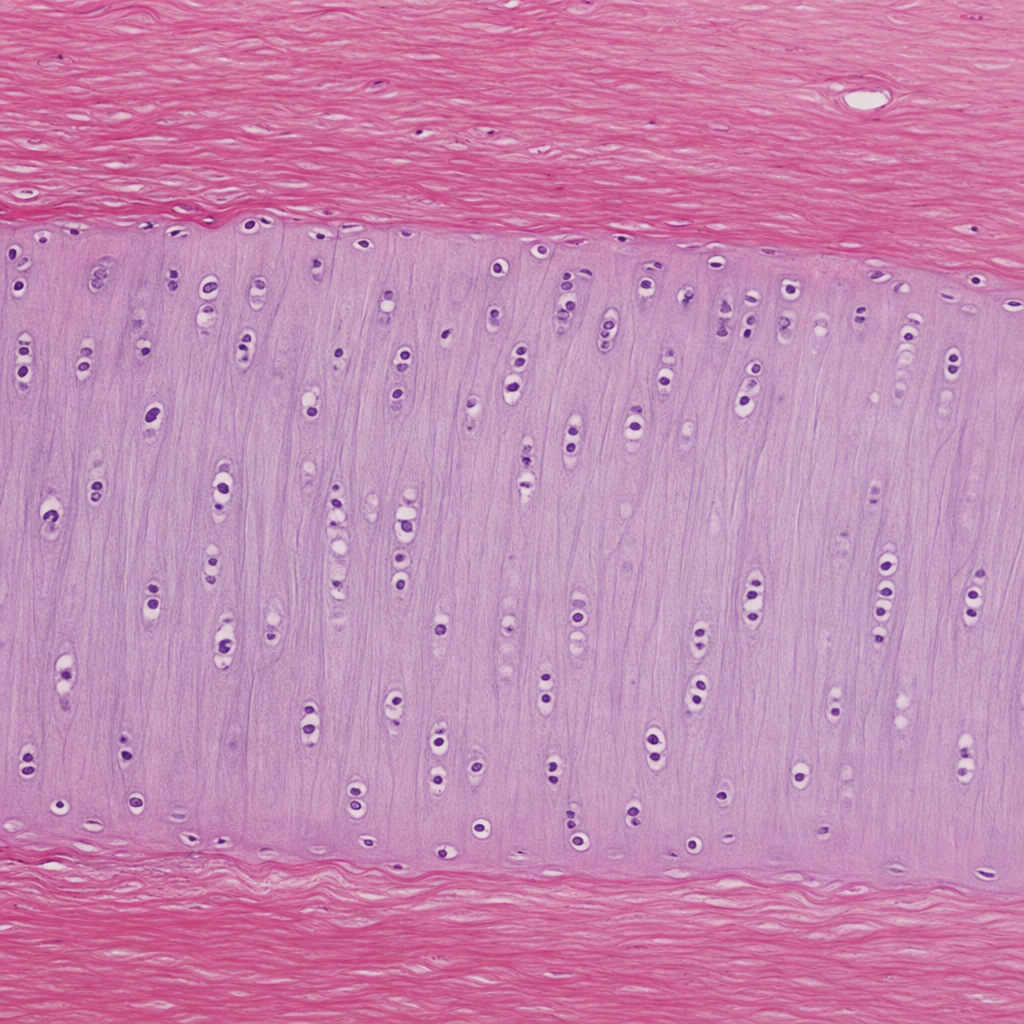
Mature bone is otherwise called?
Which of the following types of cells does not migrate from the base of the crypt to the ends of villi and is unique in this characteristic?
Brunner's glands are seen in which part of the gastrointestinal tract?
Which of the following cells in the lungs are classified as neuroendocrine cells?
Which layers of the epidermis are included in the "Malpighian layer"?
Explanation: ***Lamellar bone*** - **Lamellar bone** is the characteristic form of mature bone, organized into parallel layers or concentric circles around a central canal [1]. - This highly organized structure provides **optimal mechanical strength** and is found in the adult skeleton [1]. *Woven bone* - **Woven bone** is immature, rapidly formed bone, often seen during fetal development, fracture repair, and in some pathological conditions [1, 2]. - It is characterized by its **disorganized collagen fibers** and lower mechanical strength compared to lamellar bone [1, 2]. *Irregular bone* - "Irregular bone" is not a recognized histological classification for mature bone. Bone types are generally classified by their microstructure, such as woven or lamellar. - This term usually refers to the **shape of certain bones** (e.g., vertebrae, sacrum), not their tissue maturity or structure. *Resorbing bone* - **Resorbing bone** refers to bone tissue undergoing degradation by osteoclasts as part of the continuous bone remodeling process. - This is a functional state of bone, not a structural classification of mature bone itself.
Explanation: ***Paneth cell*** - **Paneth cells** are unique among intestinal epithelial cells as they reside at the **base of the crypts of Lieberkühn** and do not migrate along the villi [1]. - They are responsible for secreting antimicrobial peptides, such as **defensins**, and other protective substances into the lumen, playing a crucial role in regulating intestinal flora and innate immunity [1]. *Enteroendocrine cell* - **Enteroendocrine cells** are found throughout the gastrointestinal tract, including the crypts and villi, and they **migrate upwards** from the crypt base as they differentiate [1]. - They secrete various **hormones** that regulate digestion and nutrient absorption, such as serotonin, cholecystokinin, and secretin [2]. *Goblet cell* - **Goblet cells** are mucin-producing cells that are interspersed among other epithelial cells and **migrate upwards** from the crypts to the villi [1]. - They contribute to the protective **mucus layer**, which lubricates the intestinal surface and provides a barrier against pathogens and digestive enzymes. *Enterocyte* - **Enterocytes**, the primary absorptive cells of the small intestine, originate in the crypts and then **migrate rapidly up the villi**, where they mature and perform their absorptive functions [1]. - They are characterized by **microvilli** on their apical surface, forming a brush border critical for nutrient absorption [2].
Explanation: ***Upper duodenum*** - **Brunner's glands** are distinctive submucosal glands found exclusively in the **proximal duodenum**. - These glands secrete an **alkaline mucus-rich fluid** that helps to neutralize the acidic chyme entering from the stomach and protect the duodenal mucosa. *Jejunum* - The jejunum is characterized by prominent **plicae circulares** (circular folds) and a high density of villi, but it lacks Brunner's glands. - Its primary role is **nutrient absorption**, and it does not require the extensive acid-neutralizing capacity provided by Brunner's glands. *Lower duodenum* - While the duodenum generally functions in digestion and absorption, Brunner's glands are specifically located in the **submucosa of the upper (first part) duodenum**, not the lower parts. - The lower duodenum primarily focuses on continued digestion and absorption, with fewer Peyer's patches forming towards its distal end. *Appendix* - The appendix is a small, finger-shaped organ protruding from the large intestine with a primary role in **immune function**, containing abundant lymphoid tissue. - It does not contain Brunner's glands, which are unique to the duodenum and involved in protecting the intestinal lining from gastric acid.
Explanation: ***Kulchitsky cells*** - **Kulchitsky cells**, also known as pulmonary neuroendocrine cells (PNECs), are found in the bronchial and bronchiolar epithelium. - They produce various **bioactive peptides and amines**, regulating airway tone and contributing to lung development and pathology. *Dendritic cells* - **Dendritic cells** are **immune cells** that act as antigen-presenting cells, initiating adaptive immune responses. - They are not classified as neuroendocrine cells and primarily function in immune surveillance. *Type I pneumocytes* - **Type I pneumocytes** are **squamous epithelial cells** that form the primary surface for gas exchange in the alveoli [1]. - Their main function is to facilitate **diffusion of gases** (oxygen and carbon dioxide) and they lack endocrine properties [1]. *Type II pneumocytes* - **Type II pneumocytes** are cuboidal cells responsible for producing and secreting **surfactant**, which reduces alveolar surface tension [1]. - They also act as progenitor cells for Type I pneumocytes but are not considered neuroendocrine cells [1].
Explanation: Stratum spinosum, Stratum basale - The Malpighian layer (stratum malpighi) is a historical term used to refer collectively to the stratum basale (or stratum germinativum) and the stratum spinosum of the epidermis [1]. - These layers are actively involved in cell division and differentiation, producing new keratinocytes and providing structural integrity. Stratum corneum, Stratum granulosum - The stratum corneum is the outermost layer, consisting of dead, flattened keratinocytes, while the stratum granulosum is located deeper, characterized by granular cells containing keratohyalin granules [1]. - These layers are distinct from the Malpighian layer, which focuses on the proliferative and prickly layers. Stratum lucidum, Stratum granulosum - The stratum lucidum is a thin, clear layer found only in thick skin (palms and soles), located superficial to the stratum granulosum. - The stratum granulosum marks the beginning of keratinization, but neither layer is part of the designated Malpighian layer. Stratum spinosum, Stratum lucidum - While the stratum spinosum is part of the Malpighian layer, the stratum lucidum is not and is only present in thick skin, making this combination incorrect. - The Malpighian layer specifically refers to the proliferative and suprabasal layers responsible for keratinocyte production.
Basic Tissue Types
Practice Questions
Cell Biology and Organelles
Practice Questions
Epithelial Tissue
Practice Questions
Connective Tissue
Practice Questions
Muscular Tissue
Practice Questions
Nervous Tissue
Practice Questions
Cardiovascular System Histology
Practice Questions
Lymphoid Organs and Immune System
Practice Questions
Endocrine System Histology
Practice Questions
Respiratory System Histology
Practice Questions
Digestive System Histology
Practice Questions
Urinary and Reproductive System Histology
Practice Questions
Get full access to all questions, explanations, and performance tracking.
Start For Free