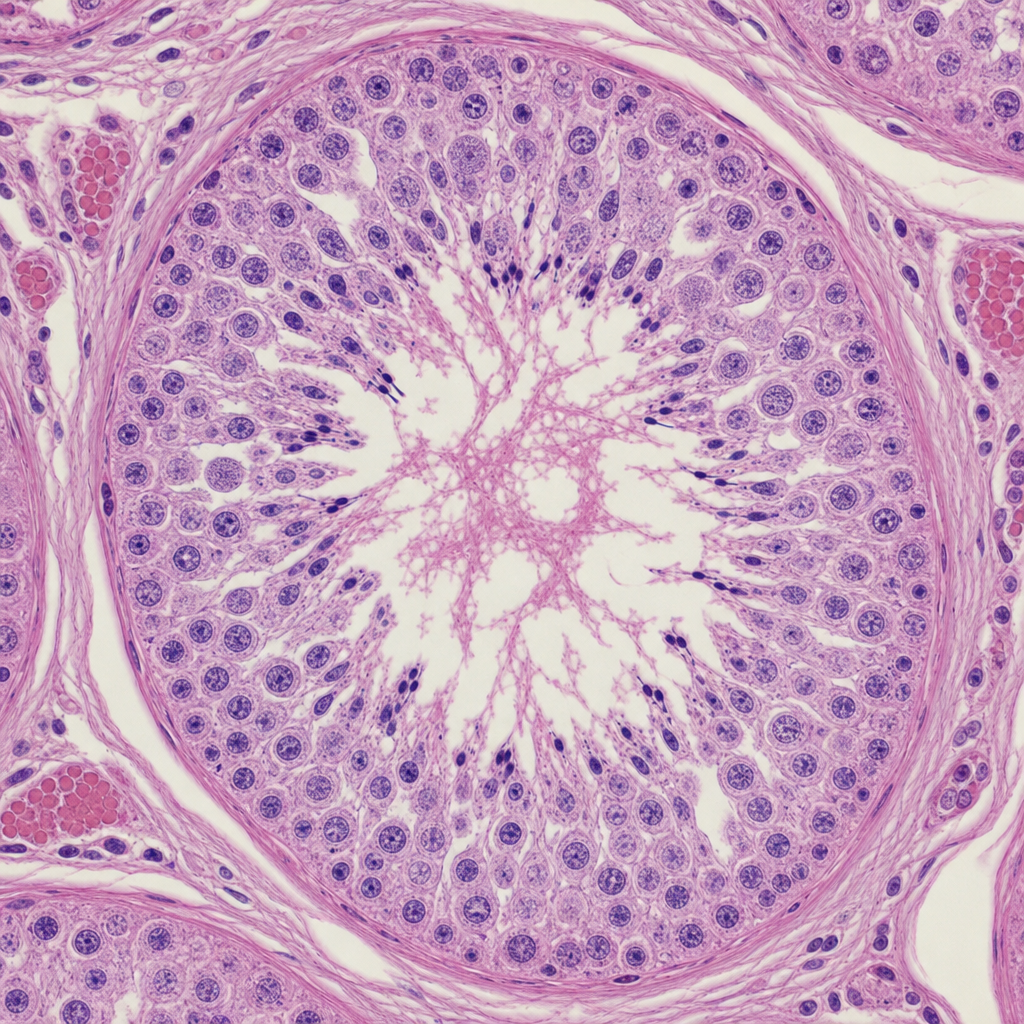
What is the typical length of a human sperm cell?
All the following features are seen in neurons from dorsal root ganglia, EXCEPT:
What are the main types of cells found in the cerebellar cortex?
Transitional epithelium shows maximum distensibility and is the classic teaching example in which of the following structures?
Characteristic of protective epithelium is:
Conjunctival epithelium is a type of what?
The epithelial lining of the urethra below the opening of the ejaculatory ducts is
Intercalated ducts of serous acinar glands are lined by
Which of the following is an example of a sebaceous gland that opens directly to the surface of the skin?
What are gap junctions composed of?
Explanation: ***55 micrometers*** - A typical **human sperm cell** measures approximately **55 micrometers** from the head to the tip of the tail [1]. - This length allows for efficient motility and navigation within the female reproductive tract to reach the ovum [1]. *100 micrometers* - This length is significantly **longer** than the average size of a human sperm cell. - While some cells can achieve this size, it is not typical for **spermatozoa**. *65 micrometers* - Although closer to the actual size, **65 micrometers** is generally considered slightly larger than the average human sperm cell length. - Sperm length is critical for understanding their **mobility** and **fertility** [1]. *50 micrometers* - This measurement is slightly **shorter** than the typical length of a human sperm cell. - The precise length, including the **head** and **flagellum**, contributes to its function.
Explanation: ***They are multipolar*** - Dorsal root ganglia (DRG) neurons are typically **pseudounipolar**, meaning they have a single process that branches into two (peripheral and central) rather than multiple dendrites and an axon [1]. - **Multipolar neurons** are characteristic of motor neurons and interneurons in the central nervous system, not DRG sensory neurons [1]. *They contain lipofuscin granules* - **Lipofuscin granules** are common in long-lived, post-mitotic cells like neurons and are considered "wear and tear" pigments, accumulating with age. - Their presence in DRG neurons is a normal finding and reflects the neuron's metabolic activity over time. *They have eccentrically located nuclei* - While not universally present in all DRG neurons, an **eccentrically located nucleus** is a common histological feature of certain types of DRG neurons, particularly larger ones. - This feature helps distinguish them from other neuron types and can be accentuated by the large amount of cytoplasm in these cells. *They are derived from neural crest cells* - All sensory neurons of the DRG, along with other components like Schwann cells and sympathetic ganglia, originate from **neural crest cells**. - This developmental origin is a fundamental characteristic of DRG neurons, distinguishing them from CNS neurons derived from the neural tube.
Explanation: **Purkinje cells, granule cells, and molecular layer interneurons** - The **cerebellar cortex** is characterized by distinct layers housing these cell types: **Purkinje cells** (large, inhibitory neurons), **granule cells** (small, excitatory neurons), and **molecular layer interneurons** (stellate and basket cells, inhibitory) [1]. - These cells work in concert to process motor information, with Purkinje cells serving as the sole output of the cerebellar cortex [1]. *Glomus cells* - **Glomus cells** are primarily found in the **carotid and aortic bodies**, where they act as chemoreceptors sensing changes in blood oxygen, carbon dioxide, and pH. - They are not a characteristic cell type of the cerebellar cortex. *Principal cells* - **Principal cells** is a general term often used to describe the main excitatory neurons of a brain region, such as **pyramidal cells in the cerebral cortex** or CA3 neurons in the hippocampus [2]. - While granule cells are excitatory in the cerebellum, "principal cells" is not a specific or exclusive term for cerebellar cortical cell types. *Intercalated cells* - **Intercalated cells** are specialized cells found in various locations, such as the **collecting ducts of the kidney** where they regulate acid-base balance, or in the **amygdala** as a type of inhibitory interneuron. - They do not represent a primary cell type of the cerebellar cortex.
Explanation: ***Urinary bladder*** - **Transitional epithelium (urothelium)** lines the entire urinary tract, but the **bladder** is the **classic teaching example** due to its dramatic distensibility during filling [1]. - The bladder can expand from nearly empty to holding 400-600 mL, requiring epithelium that can stretch significantly while maintaining a protective barrier [2]. - The epithelium appears **thick and multi-layered when empty** (6-8 cell layers) and **thin and stretched when full** (2-3 cell layers), with characteristic umbrella cells on the surface [1]. *Ureter* - The ureter is **entirely lined with transitional epithelium**, but its primary function is **peristaltic transport** rather than storage [1]. - While it does undergo some distension during urine passage, the degree of stretching is far less dramatic than the bladder. - The ureter maintains a more constant diameter and thickness of epithelium compared to the bladder. *Urethra* - The urethra has **transitional epithelium only in its proximal portion** (prostatic urethra in males, initial part in females) [1]. - The majority of the urethra is lined with **stratified columnar** or **stratified squamous epithelium**. - Therefore, urethra is NOT a characteristic location for demonstrating transitional epithelium. *Kidney pelvis* - The renal pelvis and calyces are **entirely lined with transitional epithelium** [1]. - However, they function primarily as **collecting funnels** with minimal distensibility compared to the bladder. - The renal pelvis undergoes far less dramatic volume changes than the bladder during normal function.
Explanation: ***High regenerative capacity*** - **Protective epithelia**, such as in the skin or lining of the gastrointestinal tract, are constantly exposed to environmental stressors and damage. - Their cells have a high rate of division and replacement, ensuring the **integrity of the barrier function** [1]. *Microvilli* - **Microvilli** are characteristic of epithelia involved in **absorption**, such as those in the small intestine. - They increase the surface area for absorption but are not the primary characteristic of protective epithelia. *Thinness* - **Thin epithelia**, like **simple squamous epithelium**, are adapted for efficient gas exchange or filtration (e.g., in the lungs or kidney glomeruli). - Protective epithelia are often **stratified** and thus thicker to withstand abrasion and provide a robust barrier. *Pinocytic vesicle* - **Pinocytic vesicles** are involved in **fluid and solute uptake** by cells (pinocytosis or "cell drinking"). - While all cells perform pinocytosis, it is not a defining characteristic unique to protective epithelia.
Explanation: ***Stratified non keratinised squamous*** - The **conjunctival epithelium** is primarily **stratified squamous epithelium**, meaning it has multiple layers of flattened cells. - It is **non-keratinized**, indicating that it does not produce keratin, which helps keep the surface moist and flexible. *Pseudostratified* - **Pseudostratified epithelium** appears to have multiple layers due to the varying heights of cells and nuclei at different levels, but all cells are in contact with the basement membrane. - A common example is in the **trachea**, where it is usually ciliated with goblet cells, not typically found in the conjunctiva. *Stratified columnar* - **Stratified columnar epithelium** has multiple layers of cells, with the outermost layer consisting of columnar cells. - This type of epithelium is relatively rare, found in certain ducts and parts of the urethra, and is not characteristic of the conjunctiva. *Transitional* - **Transitional epithelium**, also known as urothelium, is a specialized stratified epithelium found in the **urinary tract** (e.g., bladder, ureters). - It is unique for its ability to **stretch** and change shape, which is not a primary function of the conjunctival surface.
Explanation: ***Stratified columnar epithelium*** - The **membranous urethra**, which lies immediately **below (distal to) the opening of the ejaculatory ducts**, is lined by **stratified columnar epithelium** or **pseudostratified columnar epithelium**. - This epithelium continues into the **proximal penile (spongy) urethra** before transitioning to stratified squamous epithelium more distally. - This is the standard histological description found in anatomy textbooks (Gray's Anatomy, Inderbir Singh). *Stratified squamous epithelium* - **Non-keratinized stratified squamous epithelium** lines the **distal penile urethra** and **fossa navicularis** (near the external urethral meatus). - This provides protection against friction and chemical irritation at the external opening. - It is NOT the epithelium found immediately below the ejaculatory duct openings. *Transitional epithelium* - **Transitional epithelium (urothelium)** lines the **renal pelvis, ureters, bladder**, and the **prostatic urethra** (above the ejaculatory ducts). - It is adapted for stretching and volume changes but transitions to columnar epithelium below the ejaculatory ducts. *Stratified cuboidal epithelium* - This type of epithelium is relatively rare and found in larger ducts of some glands, such as the **mammary glands** and **sweat glands**. - It is not characteristic of any portion of the urethral lining.
Explanation: Simple cuboidal - The **intercalated ducts** of **serous acinar glands** (such as parotid and pancreas) are lined by **simple cuboidal epithelium**. - This type of epithelium is well-suited for the initial drainage of serous secretions from the acini and allows for efficient transport through the relatively short cells. - Simple cuboidal epithelium provides both structural support and functional activity for these small caliber ducts. *Stratified columnar* - **Stratified columnar epithelium** is rare and found in specific locations like parts of the **male urethra** and some large excretory ducts. - It is not characteristic of the small intercalated ducts of serous acinar glands. *Simple Columnar* - **Simple columnar epithelium** lines **striated ducts** (the larger ducts downstream from intercalated ducts) and excretory ducts of some glands. - While found in the ductal system, it is not the epithelium of the **intercalated ducts** specifically, which are the smallest and most proximal ducts. *Stratified squamous* - **Stratified squamous epithelium** is primarily designed for protection against abrasion, found in areas like the **skin** and **esophagus**. - It is entirely unsuitable for the secretory drainage functions of glandular ducts.
Explanation: ***Fordyce's spots*** - These are **ectopic sebaceous glands** that are not associated with hair follicles and open directly onto the surface of the skin or mucous membranes. - They are commonly found on the lips, buccal mucosa, and genitalia, appearing as small, painless, yellowish or whitish papules. *Meibomian glands of the eyelids* - These are modified **sebaceous glands** located within the eyelids that produce the oily layer of the tear film. - They open onto the margin of the eyelids, not directly onto the skin surface in the same manner as Fordyce's spots. *Tyson's glands of the prepuce* - These are modified **sebaceous glands** found on the inner surface of the preputial folds and the corona of the glans penis. - They secrete **smegma**, a lubricating substance, but are generally considered a variant of sebaceous glands associated with genital structures, not opening widely on the general skin surface. *Koplik's spots (lesions, not glands)* - **Koplik's spots** are pathognomonic **mucosal lesions** associated with **measles (rubeola)**, appearing as small, white spots with a red halo on the buccal mucosa. - They are not glands but rather an inflammatory sign of viral infection, and therefore, not relevant to the question of sebaceous glands opening to the skin surface.
Explanation: ***Connexins*** - **Gap junctions** are intercellular channels that permit the passage of ions and small molecules between adjacent cells [1], and they are primarily formed by proteins called **connexins** [1]. - Six connexin proteins assemble to form a **connexon**, also known as a hemichannel, which then docks with a connexon from an adjacent cell to create a complete gap junction channel [1]. *Catenins* - **Catenins** are a group of proteins involved in cell adhesion by linking cadherins to the **actin cytoskeleton**. - They are crucial for the stability and function of **adherens junctions**, not gap junctions [2]. *Cadherins* - **Cadherins** are transmembrane proteins that mediate **calcium-dependent cell-cell adhesion** in adherens junctions and desmosomes. - They are responsible for homophilic binding between cells, playing a key role in tissue segregation and morphogenesis, but do not form channels [2]. *Claudin* - **Claudins** are a family of proteins that are essential components of **tight junctions** [2]. - They help to form the primary seal of tight junctions, regulating paracellular permeability and maintaining cell polarity [2].
Basic Tissue Types
Practice Questions
Cell Biology and Organelles
Practice Questions
Epithelial Tissue
Practice Questions
Connective Tissue
Practice Questions
Muscular Tissue
Practice Questions
Nervous Tissue
Practice Questions
Cardiovascular System Histology
Practice Questions
Lymphoid Organs and Immune System
Practice Questions
Endocrine System Histology
Practice Questions
Respiratory System Histology
Practice Questions
Digestive System Histology
Practice Questions
Urinary and Reproductive System Histology
Practice Questions
Get full access to all questions, explanations, and performance tracking.
Start For Free