Which of the following layers has abundance of desmosomes? (AIIMS Nov 2017)

Which of the following area is marked in the histology of lymph node? (AIIMS May 2017)

Identify the structure marked in the image of cardiac myocyte. (AIIMS Nov 2018)

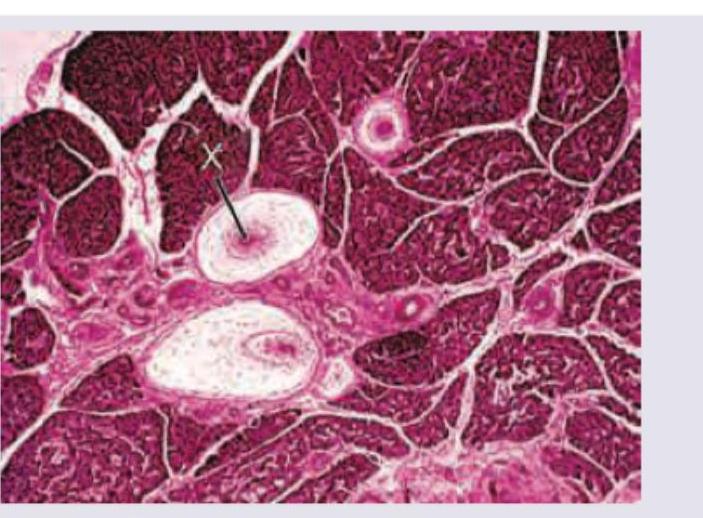
Identify which of the following structure is a sebaceous gland:

Identify the cell marked in the image below

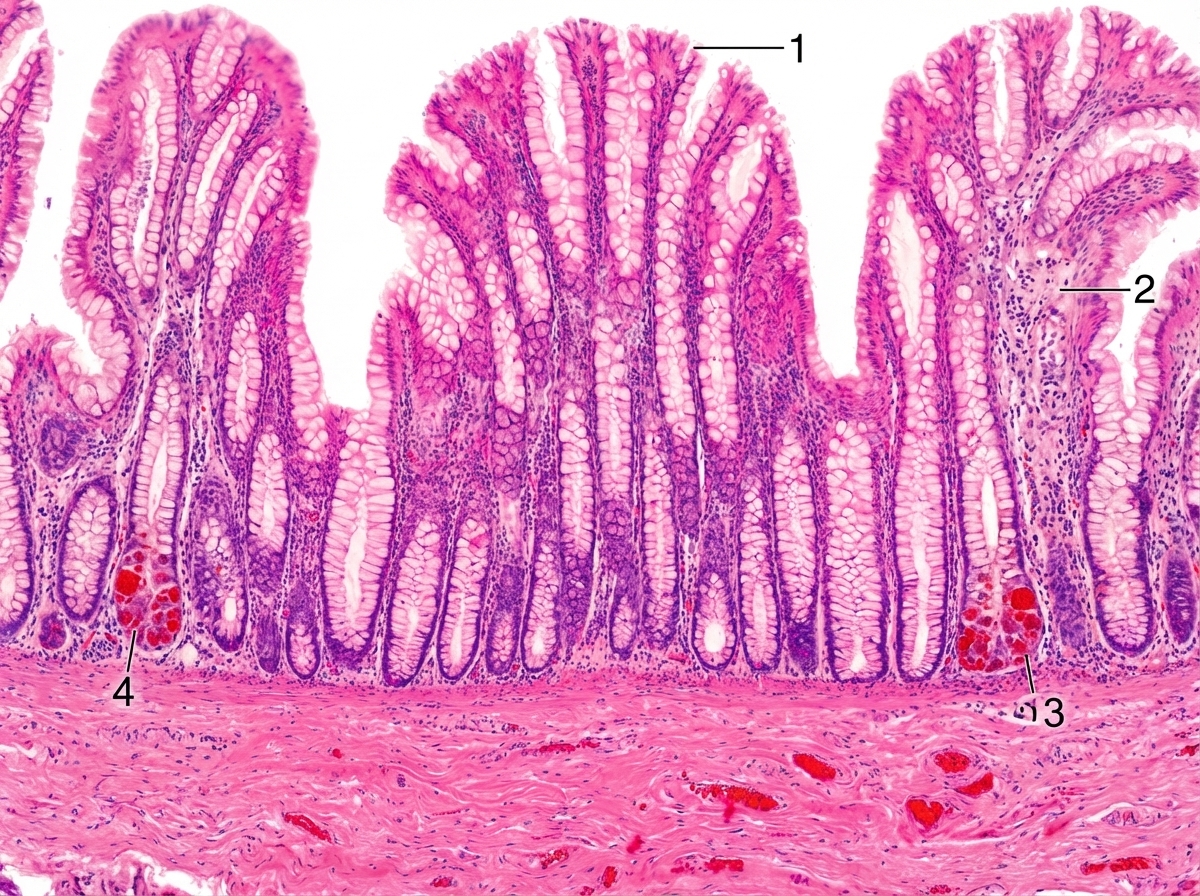
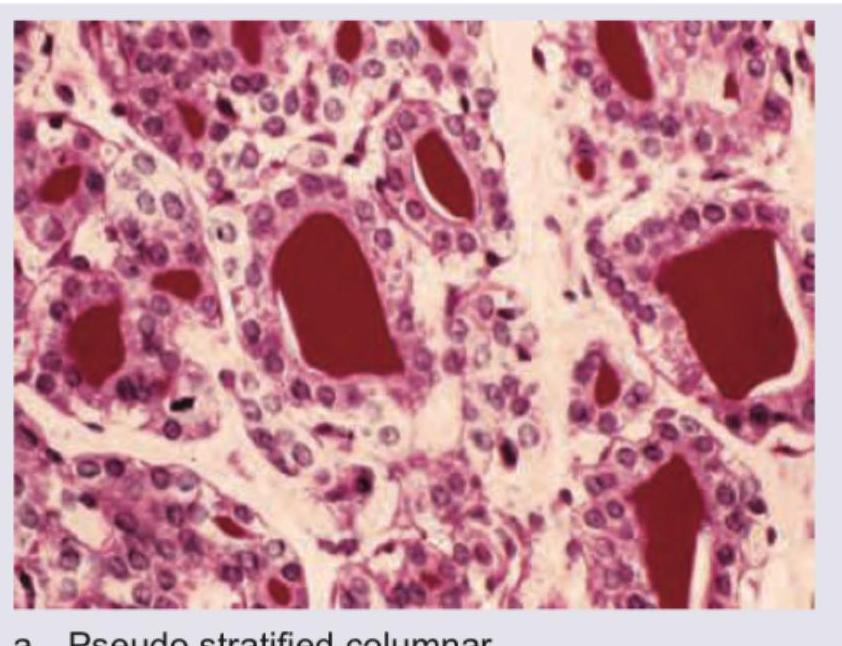
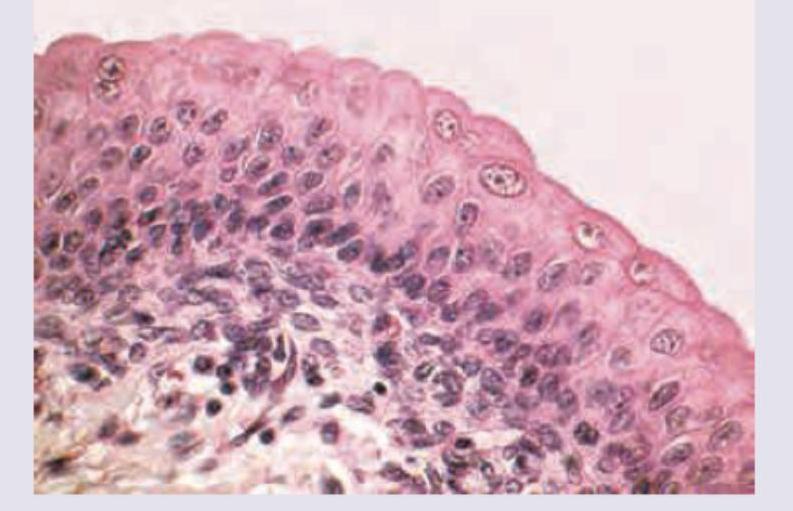
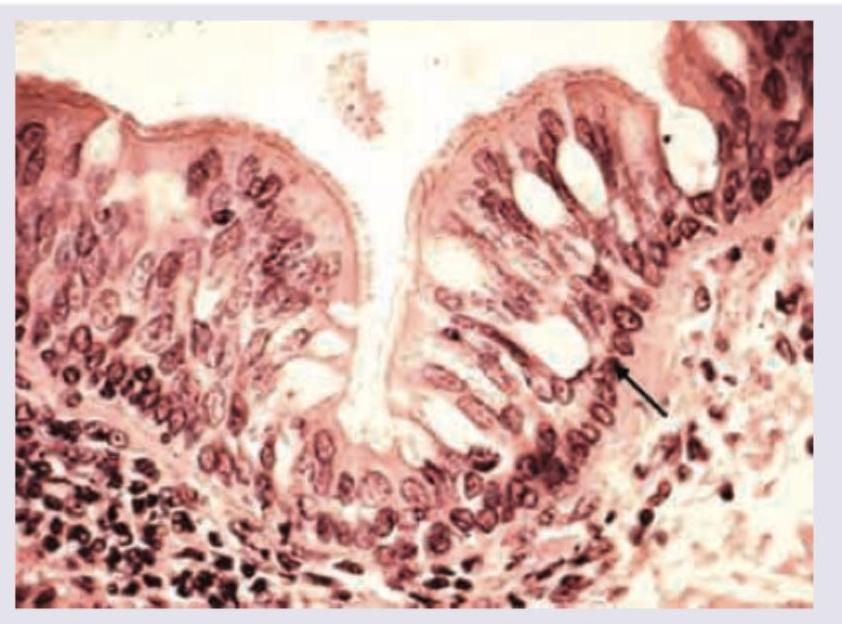
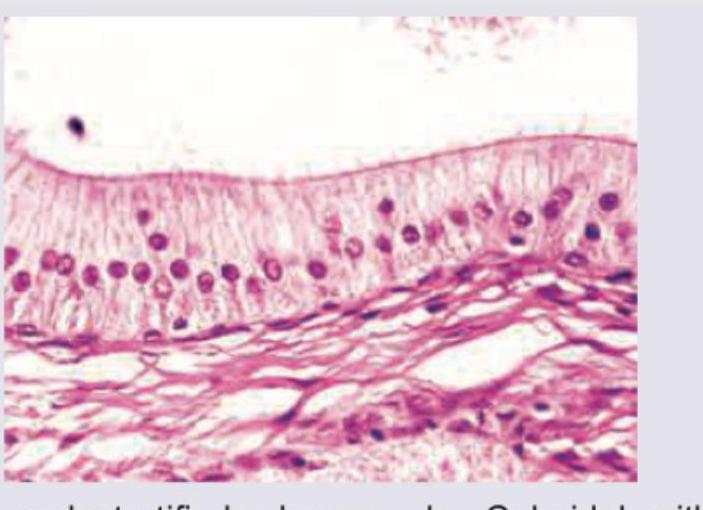
A pathologist examining a tissue sample notes the presence of pseudostratified columnar epithelium with goblet cells and cilia. This tissue was most likely obtained from which of the following locations?
Protein making up the bulk of keratohyaline granules in stratum granulosum of keratinized epithelium is
Gland that secretes an oily substance is:
Merkel cells are found in which of the following tissues?
The main type of collagen in anchoring fibrils (component of dermoepidermal junction) is:
Explanation: ***C*** - Layer C represents the **stratum spinosum** (prickle cell layer) of the epidermis, which is characterized by abundant **desmosomes**. - These desmosomes give the cells a **prickly appearance** when stained, as the cells shrink but the desmosomal attachments remain, pulling on the cell membranes. *A* - Layer A represents the **stratum corneum**, which is the outermost layer consisting of flattened, anucleated cells filled with **keratin**. - While desmosomes are present deeper in the epidermis, this layer is primarily involved in **protection** and shedding of dead cells. *B* - Layer B represents the **stratum granulosum**, characterized by cells containing **keratohyalin granules**. - These granules are precursors to keratin, and while desmosomes connect cells here, they are less prominent than in the stratum spinosum. *D* - Layer D represents the **stratum basale** (basal layer), which is the deepest epidermal layer of cuboidal or columnar cells. - These cells are responsible for **cell proliferation** and connect to the basement membrane via **hemidesmosomes**, and to each other via desmosomes, but not as abundantly as in the stratum spinosum.
Explanation: ***Germinal center*** - The image illustrates a **germinal center**, characterized by its **lighter staining** and a distinct network of cells (likely follicular dendritic cells) which are responsible for B-cell proliferation and differentiation. - The pointer indicates the surrounding, more basophilic lymphocytes, often seen adjacent to the paler germinal center. *Mantle zone* - The mantle zone surrounds the germinal center and consists of **small, inactive B-lymphocytes** that stain more densely (darker) than the cells within the germinal center. - It would be seen as a darker ring immediately outside the lighter germinal center. *Marginal zone* - The marginal zone is typically found in the **spleen** and is a region of B cells that surrounds the white pulp. - It is not a primary structural component identified within the follicular architecture of a lymph node in the manner depicted. *Paracortical area* - The paracortex is primarily a **T-cell zone**, located between the follicles and the medulla within the lymph node. - It would not exhibit the distinct follicular structure with a light center and surrounding darker cells as shown.
Explanation: ***Lipofuscin granules*** - The image displays electron-dense, irregular structures, characteristic of **lipofuscin granules**, which are wear-and-tear pigments accumulating in aging cardiac myocytes. - They are typically located near the nucleus and appear dark due to their complex lipid-protein composition. *Lysosomes* - Lysosomes are typically smaller, more uniformly shaped, and contain hydrolytic enzymes, which is not clearly depicted. - While involved in cellular waste breakdown, they do not typically accumulate as large, intensely electron-dense, irregular aggregates like those shown. *Phagolysosome* - A phagolysosome forms when a phagosome fuses with a lysosome, containing engulfed material often of foreign or cellular debris origin. - The image does not show evidence of recently engulfed material or the typical morphology of a phagocytic vesicle. *Inflammasome* - An inflammasome is a multi-protein intracellular complex involved in the inflammatory response, not a visibly distinct organelle with this characteristic electron microscopic appearance. - It is a signaling platform, not a storage granule, and would not appear as dense, granular deposits in a routine electron micrograph.
Explanation: ***Correct: (2) Sebaceous gland*** - The structure labeled (2) is a **sebaceous gland**, characterized by its **multicellular alveolar structure** typically associated with a hair follicle - Sebaceous glands are **holocrine glands** where the entire cell disintegrates to release sebum (oily secretion) - These glands are found throughout the body except on palms and soles, and produce **sebum for lubrication** of hair and skin - Histologically identified by **grape-like clusters of cells** with foamy cytoplasm due to lipid content *Incorrect: (3) Inner root sheath* - The structure labeled (3) represents the **inner root sheath** of the hair follicle - This is a **structural component**, not a glandular structure - Functions to provide support and guidance to the developing hair shaft - Composed of three layers: Henle's layer, Huxley's layer, and the cuticle *Incorrect: (4) Hair matrix* - The structure labeled (4) indicates the **hair matrix**, located at the base of the hair follicle - This is a **proliferative zone** with actively dividing cells responsible for hair growth - Not a glandular structure, but rather the germinative region where hair cells differentiate - Contains melanocytes that provide pigment to the growing hair *Incorrect: (1) Hair shaft* - The structure labeled (1) is the **hair shaft**, the visible keratinized portion of the hair - This is the **final product** of the hair follicle, composed of dead, keratinized cells - Not a glandular structure, but rather a modified epidermal structure - Extends from the hair follicle through the skin surface
Explanation: ***Mast cell*** - The cell indicated by the arrow displays characteristic features of a **mast cell**, including its large size, prominent central nucleus, and cytoplasm densely packed with numerous large, basophilic (darkly stained) granules. - These granules contain powerful inflammatory mediators like **histamine** and **heparin**, which are key in allergic reactions and inflammation. *Macrophage* - Macrophages are typically larger than mast cells with an **irregular shape**, a kidney-shaped nucleus, and often contain phagocytosed material in their cytoplasm, which is not clearly visible here. - While they are also immune cells, they lack the characteristic dense, uniform basophilic granulation seen in the indicated cell. *Plasma cell* - Plasma cells are characterized by an **eccentric nucleus** with **chromatin clumping** (cartwheel or clock-face appearance) and a prominent Golgi apparatus (perinuclear halo), none of which are evident in the marked cell. - Their cytoplasm is typically basophilic but lacks the distinct large granules. *Fibroblast* - Fibroblasts are typically **spindle-shaped** or stellate cells with elongated nuclei and a sparse cytoplasm, responsible for producing extracellular matrix. - They do not possess the abundant, dense cytoplasmic granules that are a hallmark of the cell shown.
Explanation: ***Bronchi*** - The **bronchi**, as part of the respiratory tract, are lined with **pseudostratified columnar epithelium** that contains abundant **goblet cells** and **cilia** [1]. - **Cilia** help propel mucus and trapped particles out of the respiratory system, while **goblet cells** produce mucus to trap foreign substances [1]. *Small intestine* - The small intestine is lined with **simple columnar epithelium** with **microvilli** (forming a brush border) and goblet cells, but it lacks **cilia**. - Its primary function is nutrient absorption, not particulate clearance. *Skin* - The skin is covered by **stratified squamous epithelium**, specifically **keratinized stratified squamous epithelium**, which provides protection against abrasion and dehydration. - It does not contain **goblet cells**, **cilia**, or **pseudostratified columnar epithelium**. *Esophagus* - The esophagus is lined with **non-keratinized stratified squamous epithelium**, designed to protect against mechanical abrasion during food passage. - It lacks **goblet cells**, **cilia**, and **pseudostratified columnar epithelium**.
Explanation: ***Filaggrin*** - **Filaggrin** is a key protein derived from **profilaggrin** found in **keratohyaline granules** within the stratum granulosum. - Its primary role is to aggregate **keratin filaments** into tight bundles, contributing to the formation of the skin barrier. *Nectin* - **Nectins** are **cell adhesion molecules** involved in cell-cell junctions and signaling pathways, particularly in adherens junctions and tight junctions. - They are not the primary protein component of **keratohyaline granules** in the stratum granulosum. *Vinculin* - **Vinculin** is a **cytoskeletal protein** associated with **focal adhesions** and **adherens junctions**, linking integrins and cadherins to the actin cytoskeleton. - It plays a role in cell adhesion and mechanotransduction but is not found in **keratohyaline granules**. *Involucrin* - **Involucrin** is a precursor protein for the **cornified envelope** in the stratum corneum, cross-linked by transglutaminases to other proteins like loricrin. - While important for skin barrier function, it is not the bulk protein of **keratohyaline granules** themselves, which primarily contain profilaggrin/filaggrin.
Explanation: ***Meibomian gland*** - These glands secrete **oily lipids** (meibum) that form the outermost layer of the tear film, preventing evaporation. - They are a type of **sebaceous gland** located within the eyelids. *Sweat gland* - Sweat glands produce a watery solution of electrolytes and metabolic waste products, primarily for **thermoregulation**. - They do not secrete an **oily substance**, but rather a clear, aqueous fluid. *Lacrimal gland* - The lacrimal gland produces the **aqueous layer of tears**, primarily for lubrication, washing away debris, and providing oxygen to the cornea. - Its secretion is predominantly **watery**, not oily. *Salivary gland* - Salivary glands produce **saliva**, a fluid containing enzymes (like amylase), mucins, and antibodies, important for digestion, lubrication, and oral hygiene. - Saliva is a **mucoserous or aqueous substance**, not an oily secretion.
Explanation: ***Epidermis*** - **Merkel cells** are specialized **neuroendocrine cells** located in the **stratum basale** (deepest layer) of the epidermis [1]. - They function as **mechanoreceptors**, playing a crucial role in **touch sensation**, particularly light touch and discrimination of shapes and textures [1]. *Reticular layer of dermis* - The **reticular layer** is the deeper, thicker layer of the dermis, composed of dense irregular connective tissue. - It primarily contains **collagen and elastic fibers** and is involved in the skin's strength and elasticity, not housing mechanoreceptors like Merkel cells. *Hypodermis* - The **hypodermis** (or superficial fascia) is the layer beneath the dermis, primarily composed of **adipose tissue** and loose connective tissue. - Its main functions include **insulation**, energy storage, and shock absorption; it does not contain Merkel cells. *Papillary layer of dermis* - The **papillary layer** is the superficial layer of the **dermis**, characterized by dermal papillae that interdigitate with the epidermis. - While it contains touch receptors like **Meissner's corpuscles**, it does not contain Merkel cells, which are epidermal.
Explanation: ***Type VII*** - **Type VII collagen** is the primary component of **anchoring fibrils**, which are essential structures that firmly attach the **dermal epidermal junction** to the underlying dermis. [1] - Mutations in the gene encoding **Type VII collagen** can lead to **dystrophic epidermolysis bullosa**, a condition characterized by fragile skin and blister formation due to poor dermal-epidermal adhesion. *Type II* - **Type II collagen** is predominantly found in **hyaline cartilage** and **elastic cartilage**, providing tensile strength and resilience within these tissues. - It is crucial for maintaining the structural integrity of **joints** and the respiratory tract, rather than dermal-epidermal adhesion. *Type IV* - **Type IV collagen** is a major component of **basement membranes**, forming a mesh-like network that provides structural support and filtration properties. - Although present at the **dermal epidermal junction** as part of the **basement membrane**, it does not primarily form the anchoring fibrils themselves. *Type III* - **Type III collagen** is widely distributed in **reticular fibers** in various tissues, including skin, blood vessels, and internal organs. - It provides elasticity and support to tissues, often co-localizing with **Type I collagen**, but does not form anchoring fibrils at the dermal-epidermal junction.
Basic Tissue Types
Practice Questions
Cell Biology and Organelles
Practice Questions
Epithelial Tissue
Practice Questions
Connective Tissue
Practice Questions
Muscular Tissue
Practice Questions
Nervous Tissue
Practice Questions
Cardiovascular System Histology
Practice Questions
Lymphoid Organs and Immune System
Practice Questions
Endocrine System Histology
Practice Questions
Respiratory System Histology
Practice Questions
Digestive System Histology
Practice Questions
Urinary and Reproductive System Histology
Practice Questions
Get full access to all questions, explanations, and performance tracking.
Start For Free