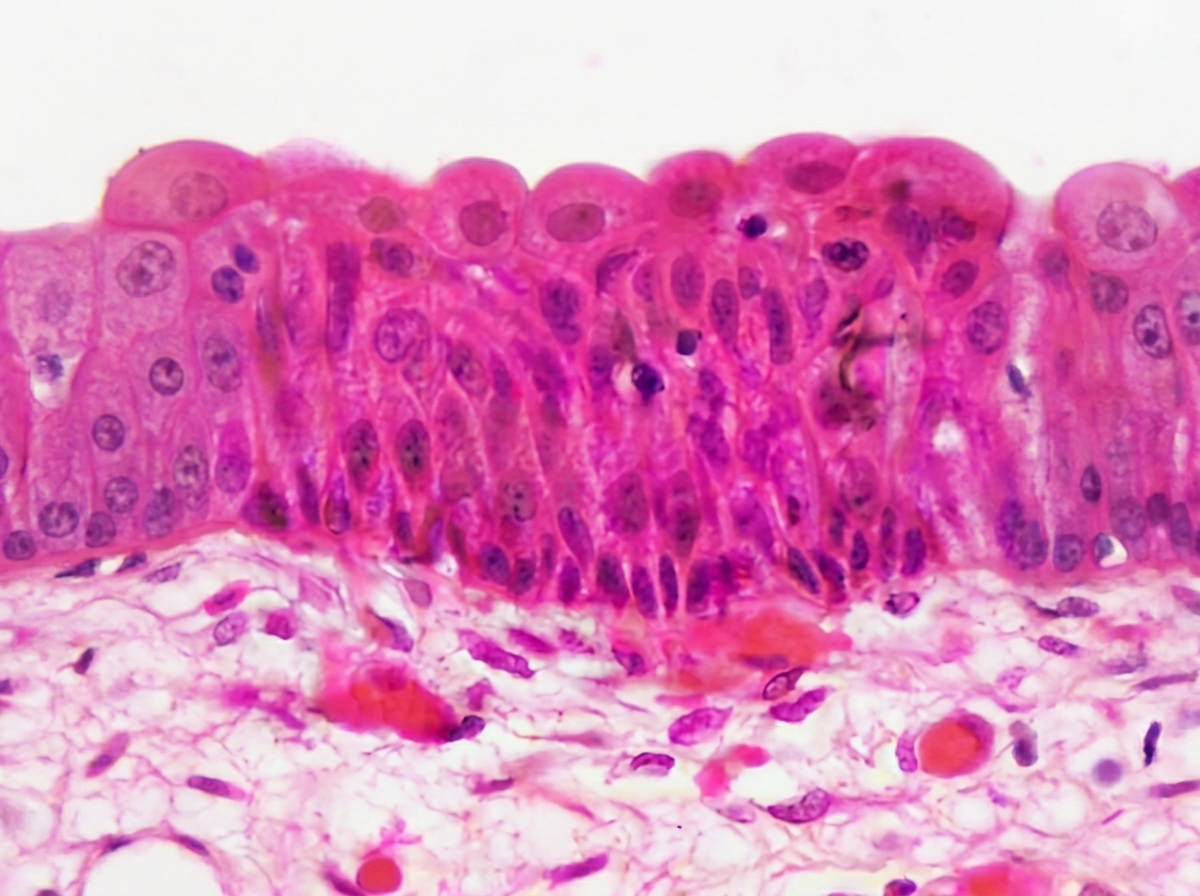
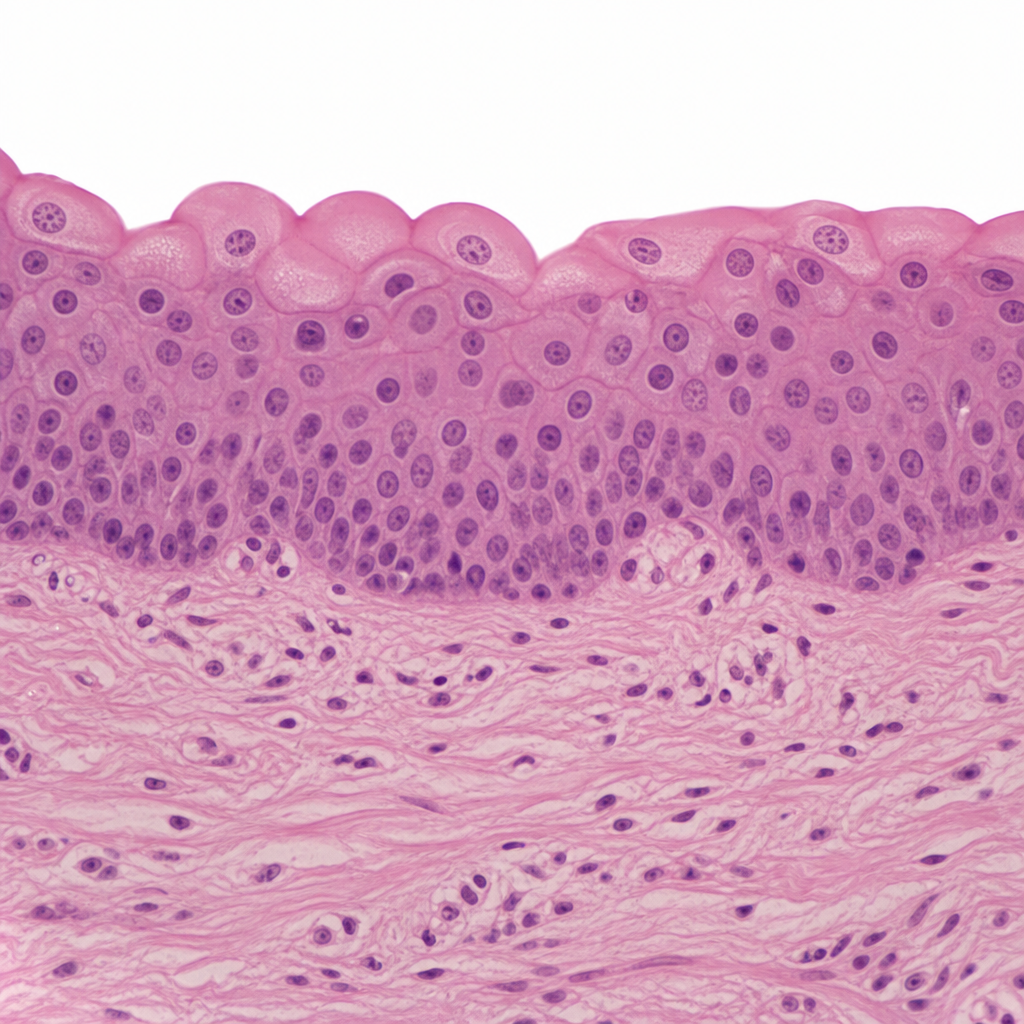
Name the epithelium, and the area where it is found:

Name the structure marked as $X$ :

Identify the type of epithelium shown in the image:

The lower two thirds of the following hematoxylin and eosin stained specimen is similar in appearance to which of the following structures?

The hematoxylin and eosin stained biopsy shown below is taken from which tissue?

Which type of salivary glands is shown in the image?

Which type of salivary glands is shown in the image?

Identify the structure:

The image shows presence of:

Name the structure marked as $X$ which anchors the periosteum to circumferential lamellae in bone:

Explanation: ***Pseudostratified columnar, Respiratory system*** - The image clearly displays cells with nuclei at varying levels, giving the appearance of multiple layers, characteristic of **pseudostratified epithelium**. Additionally, the presence of interspersed clear, goblet-like cells and surface cilia (though not perfectly distinct at this magnification) points to its location in the **respiratory tract**. - This specific type of epithelium, often ciliated with goblet cells, is primarily found lining the larger airways of the **respiratory system**, such as the trachea and bronchi, where it plays a crucial role in trapping and clearing foreign particles. *Cuboidal epithelium, Gastrointestinal system* - **Cuboidal epithelium** consists of cube-shaped cells with centrally located, spherical nuclei, which is not consistent with the varied nuclear levels seen in the image. - While parts of the **gastrointestinal system** (e.g., small ducts of glands) might contain cuboidal epithelium, the lining of the main GI tract is typically columnar or stratified squamous, and does not match the morphology shown. *Ciliated columnar, Female genital system* - While parts of the **female genital system** (e.g., fallopian tubes) are lined with **ciliated columnar epithelium**, the image shows nuclei at different levels, which is a key feature distinguishing pseudostratified from simple columnar epithelium. - Simple ciliated columnar epithelium generally has nuclei aligned at a single level, and typically lacks the abundance of goblet cells often seen in the respiratory pseudostratified type. *Transitional, Urinary bladder* - **Transitional epithelium** (urothelium) is characterized by its ability to stretch, featuring dome-shaped surface cells, particularly in a relaxed state. - The cells in the image lack the characteristic dome-shaped appearance of transitional cells and do not show the typical multi-layered structure with varying shapes that adapt to distension.
Explanation: ***Pacinian Corpuscle in dermis*** - The image displays a **lamellated, onion-like structure** indicative of a Pacinian corpuscle, which is a type of **mechanoreceptor**. - These corpuscles are found in the **dermis** and subcutaneous tissue, specializing in sensing **deep pressure and vibration**. *Ruffini nerve endings in Epidermis* - **Ruffini nerve endings** are typically found in the **dermis**, not the epidermis, and are responsible for sensing **stretch and sustained pressure**. - Their histological appearance is **spindle-shaped** and less complex than the lamellar structure shown. *Purkinje cells in cerebellum* - **Purkinje cells** are large, flask-shaped neurons with extensive dendritic trees, found in the **cerebellar cortex**. - They are clearly distinct from the encapsulated sensory receptor shown in the image. *Osteoclasts in bone marrow* - **Osteoclasts** are large, multi-nucleated cells responsible for **bone resorption**, found on bone surfaces or within bone marrow. - Their histological appearance is characteristic of a macrophage lineage, not an encapsulated nerve ending.
Explanation: ***Pseudostratified columnar*** - This epithelium appears to have multiple layers of nuclei at different levels, which is characteristic of **pseudostratified epithelium**, but all cells are in contact with the basement membrane. - The cells are taller than they are wide, indicating they are **columnar**, and the presence of cilia on the apical surface suggests it is a ciliated variety, commonly found in the **respiratory tract**. - The key identifying feature is nuclei at varying heights creating a false appearance of stratification. *Cuboidal epithelium* - **Cuboidal cells** are typically cube-shaped, with their height and width being roughly equal, and they usually have a single, centrally located nucleus. - The cells in the image are clearly taller than they are wide and exhibit nuclei at varying heights, ruling out a cuboidal morphology. *Simple columnar epithelium* - **Simple columnar epithelium** has a single layer of columnar cells with nuclei aligned at the same level, typically in the basal region. - The image shows nuclei at **different levels**, creating the characteristic pseudostratified appearance, which distinguishes it from true simple columnar epithelium. - While both are columnar, the nuclear arrangement is the key differentiating feature. *Transitional* - **Transitional epithelium** is characterized by its ability to stretch and flatten, a feature of the urinary tract, and typically has umbrella cells on its surface. - The cells in the image do not show the characteristic morphology of transitional epithelium, nor the distinct umbrella cells.
Explanation: ***Intervertebral disk*** - The lower two-thirds of the specimen shows **hyaline-like cartilage** that histologically resembles the **transition zone** of the intervertebral disk, where the inner annulus fibrosus transitions from the nucleus pulposus. - While the nucleus pulposus itself is gelatinous and notochordal in origin, the **inner annulus fibrosus** contains fibrocartilage with regions that can appear similar to hyaline cartilage, particularly in the transitional zones. - The specimen's appearance, with **chondrocytes in lacunae** within a relatively homogeneous matrix, matches the cartilaginous components found in intervertebral disk structure. *Articular disk* - Articular disks are composed predominantly of **fibrocartilage**, characterized by **dense parallel collagen fiber bundles** clearly visible in the matrix and chondrocytes arranged in linear rows between collagen bundles. - The homogeneous matrix appearance in the specimen lacks the prominent fibrous architecture typical of articular disks. *Pinna* - The pinna (external ear) is supported by **elastic cartilage**, which contains abundant **elastic fibers** in its extracellular matrix providing flexibility and resilience. - With H&E staining, elastic cartilage would show a more textured matrix, and special stains would demonstrate extensive elastic fiber networks not present in this specimen. *Epiphyseal growth plate* - While the epiphyseal growth plate consists of **hyaline cartilage**, it exhibits highly characteristic **zonal organization**: resting zone, proliferative zone (with columnar arrangement), hypertrophic zone, and zone of calcification. - The specimen lacks the distinct columnar arrangement and zonal stratification that defines an active epiphyseal growth plate.
Explanation: ***Tonsil*** - The image displays prominent **lymphoid follicles** with **germinal centers** characteristic of tonsillar tissue, which is part of the **mucosa-associated lymphoid tissue (MALT)**. - The surface is lined by **stratified squamous epithelium** (visible at the top), typical for tonsils that are exposed to the oral cavity. *Lymph Node* - While lymph nodes also contain lymphoid follicles with germinal centers, they are typically surrounded by a **fibrous capsule** and have distinct **cortex and medulla** regions, which are not clearly visible here. - Lymph nodes are covered by a thin connective tissue capsule, not stratified squamous epithelium. *Spleen* - The spleen is characterized by distinct **red pulp** (involved in blood filtration and erythrocyte destruction) and **white pulp** (containing lymphoid follicles). - The image lacks the characteristic architecture of red pulp, such as sinusoids filled with blood, and the overall organization differs from splenic tissue. *Thymus* - The thymus is characterized by a **cortex and medulla**, with developing T lymphocytes and Hassall's corpuscles in the medulla. - The absence of Hassall's corpuscles and the presence of a surface epithelium rule out the thymus.
Explanation: ***Mucous*** - The image predominantly displays **mucous acini**, characterized by their **pale-staining cytoplasm** and **flat, basally located nuclei**. - These cells produce **viscous, carbohydrate-rich mucus** for lubrication and protection. *Serous* - **Serous acini** typically show **darker, basophilic cytoplasm** due to abundant rough endoplasmic reticulum and **round, centrally located nuclei**. - They secrete **watery fluid rich in enzymes**, which is not the primary feature seen here. *Mixed* - **Mixed glands** contain both **serous and mucous acini**, often with **serous demilunes** capping the mucous acini. - While some ducts are visible, the overwhelming majority of secretory units are clearly mucous, not a balance of both or prominent serous demilunes. *Papillary* - **Papillary structures** are typically associated with ducts or cyst linings, forming finger-like projections. - This term does not describe a primary type of salivary gland secretory unit based on its cellular composition or secretory product.
Explanation: ***Mixed*** - The image displays both **serous acini** (darkly stained, uniform cells forming spherical structures) and **mucous tubules** (larger, lighter-stained cells often forming more tubular or crescent structures), characteristic of a mixed salivary gland. - The presence of **serous demilunes** capping some mucous tubules further confirms the mixed nature, although not clearly visible at this magnification, it's inferred by the blend of cell types. *Serous* - Serous glands would show almost exclusively **darkly stained, granular acini** producing watery secretions, like the parotid gland. - The image clearly contains lighter-stained, more translucent structures in addition to the dark acini, ruling out a purely serous gland. *Mucous* - Mucous glands would primarily consist of **pale-staining, vacuolated cells** forming tubules, responsible for viscous secretions. - While mucous components are present, significant numbers of darkly stained serous acini are also visible. *Papillary* - "Papillary" refers to a **growth pattern** characterized by finger-like projections, not a type of secretory cell or gland. - This term is typically used in the context of tumors or certain glandular epithelia but not for classifying conventional salivary gland types.
Explanation: ***Tonsil*** - The image displays multiple **crypts** lined by **stratified squamous epithelium** and filled with abundant **lymphoid follicles**, which are characteristic features of a tonsil. - Tonsils are secondary lymphoid organs located in the oropharynx, specialized for immune surveillance of ingested and inhaled antigens. *Lymph node* - Lymph nodes are typically encapsulated and show distinct cortical and medullary regions, lacking the deep crypts seen in the image. - They contain lymphoid follicles but are surrounded by a capsule and have afferent and efferent lymphatic vessels. *Spleen* - The spleen is characterized by red pulp (involved in filtering blood) and white pulp (containing lymphoid follicles around arterioles). - Its histological structure does not include epithelial-lined crypts. *Thymus* - The thymus is distinctively lobulated and features a cortex rich in thymocytes and a medulla containing **Hassall's corpuscles**. - It lacks the prominent lymphoid follicles and crypts observed in the image, as its primary role is T-cell maturation.
Explanation: ***Smooth muscle*** - The image displays elongated, spindle-shaped cells with a single, centrally located nucleus, characteristic features of **smooth muscle** fibers. - The absence of striations (bands) further confirms it is smooth muscle, which is involved in **involuntary movements** of internal organs. *Skeletal muscle* - **Skeletal muscle** fibers are typically long, cylindrical, and multinucleated, with nuclei located peripherally. - They exhibit prominent **striations** due to the organized arrangement of contractile proteins, which are not visible here. *Cardiac muscle* - **Cardiac muscle** cells are branched, possess one or two central nuclei, and exhibit striations, similar to skeletal muscle. - A key differentiating feature is the presence of **intercalated discs**, which are not seen in this image. *Compact bone* - **Compact bone** would show a highly organized structure of **osteons** (Haversian systems) with concentric lamellae and osteocytes within lacunae. - The image clearly displays cellular fibers, not the rigid, calcified matrix of bone.
Explanation: ***Sharpey's fibers*** - **Sharpey's fibers** are collagen fibers from the periosteum that penetrate and anchor into the outer circumferential and interstitial lamellae of compact bone, as indicated by 'X' in the image. - They provide strong attachment for the periosteum to the bone matrix, particularly at tendon and ligament insertion sites, contributing to bone integrity and stability. *Cambium fibers* - The **cambium layer** is the inner cellular layer of the periosteum, containing **osteoprogenitor cells** for bone growth and repair. - It does not refer to specific fibers anchoring the periosteum to the bone matrix but rather to the cellular component involved in bone formation. *Purkinje fibers* - **Purkinje fibers** are specialized cardiac muscle cells located in the subendocardial layer of the ventricles, responsible for rapid conduction of electrical impulses in the heart. - They are unrelated to bone structure or the interaction between the periosteum and bone. *Undulin fibers* - **Undulin** is an extracellular matrix glycoprotein found in various connective tissues, including bone and cartilage, but it is not a primary anchoring fiber for the periosteum. - The term "undulin fibers" is not a standard anatomical term for the structures anchoring the periosteum to bone.
Basic Tissue Types
Practice Questions
Cell Biology and Organelles
Practice Questions
Epithelial Tissue
Practice Questions
Connective Tissue
Practice Questions
Muscular Tissue
Practice Questions
Nervous Tissue
Practice Questions
Cardiovascular System Histology
Practice Questions
Lymphoid Organs and Immune System
Practice Questions
Endocrine System Histology
Practice Questions
Respiratory System Histology
Practice Questions
Digestive System Histology
Practice Questions
Urinary and Reproductive System Histology
Practice Questions
Get full access to all questions, explanations, and performance tracking.
Start For Free