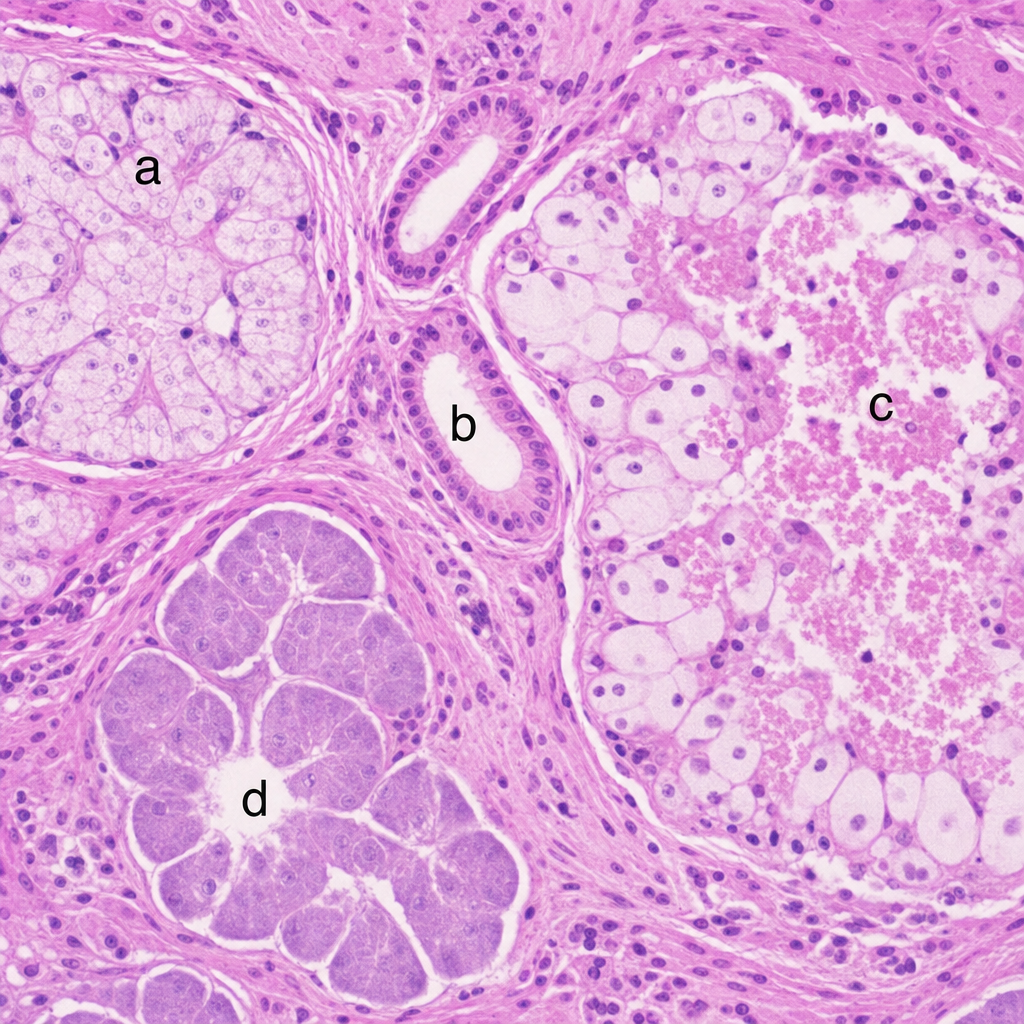
Where does urine collect in case of an extraperitoneal rupture of the bladder?
Nissl's granules contain which of the following?
Kupffer cells in the liver are responsible for which function?
What type of epithelium lines the mucosa of the gallbladder?
What is the primary function of hepatic stellate cells?
Which type of collagen is distributed in rhabdomyosarcoma cells?
Which of the following statements about healthy, intact capillaries is true?
Which muscle originates from bone and the interosseous membrane?
Which of the following statements concerning skin melanocytes is true?
Which of the following statements about Peyronie's disease is FALSE?
Explanation: ### Explanation **1. Why "Above the urogenital diaphragm" is correct:** The urinary bladder is located extraperitoneally in the **true pelvis**, resting superior to the urogenital diaphragm (triangular ligament). When an extraperitoneal rupture occurs—most commonly associated with **pelvic fractures** [1]—the integrity of the bladder wall is breached below the peritoneal reflection. Consequently, urine extravasates into the **prevesical space (Space of Retzius)** and the surrounding pelvic extraperitoneal connective tissue. Since the urogenital diaphragm forms the floor of the pelvic cavity, the extravasated urine remains confined **above** this diaphragm within the pelvic fascia [3]. **2. Why the other options are incorrect:** * **Options A & B (Perineal space / Below the urogenital diaphragm):** These locations are involved in **extraperitoneal rupture of the urethra**, not the bladder [2]. Specifically, a rupture of the bulbous urethra (below the urogenital diaphragm) leads to urine collection in the superficial perineal pouch. This urine can then track into the scrotum and anterior abdominal wall (deep to Scarpa’s fascia) but is anatomically separated from the bladder's pelvic compartment by the urogenital diaphragm. **3. Clinical Pearls for NEET-PG:** * **Intraperitoneal Rupture:** Occurs at the **bladder dome** (the only part covered by peritoneum), usually due to blunt trauma to a full bladder. * **Extraperitoneal Rupture:** Most common type; usually associated with **pubic arch fractures** [1]. * **Classic Presentation:** Gross hematuria, suprapubic pain, and inability to void [1]. * **Investigation of Choice:** Retrograde Cystography (shows "flame-shaped" extravasation in extraperitoneal cases) [1].
Explanation: Explanation: **Nissl’s granules** (also known as Nissl bodies) are large, granular structures found in the cytoplasm of neurons. They are composed of **Rough Endoplasmic Reticulum (RER)** and free **ribosomes** [1]. Their primary function is protein synthesis, which is essential for maintaining the high metabolic activity of neurons and producing neurotransmitters [1, 3]. * **Why Ribosomes (Option D) is correct:** Nissl bodies are essentially stacks of RER. Since ribosomes are the protein-manufacturing machinery attached to the RER (and also present freely), they are the defining component of these granules [1]. They stain intensely with basic dyes (basophilic) like methylene blue or cresyl violet due to the high RNA content. **Analysis of Incorrect Options:** * **Mitochondria (A):** While neurons are rich in mitochondria to meet energy demands, they are distinct organelles and are not part of the Nissl substance. * **Golgi bodies (B):** The Golgi apparatus is involved in packaging proteins but is structurally separate from the Nissl bodies. * **Smooth Endoplasmic Reticulum (C):** SER is involved in lipid synthesis and calcium storage. Nissl granules are specifically composed of *Rough* ER, which is studded with ribosomes [1]. **High-Yield Clinical Pearls for NEET-PG:** * **Distribution:** Nissl granules are found in the **cell body (soma)** and **dendrites**, but they are notably **absent in the Axon and Axon Hillock** [2]. * **Chromatolysis:** When an axon is injured, Nissl granules disperse and disappear from the cell body to initiate repair [3]. This histological change is called chromatolysis [3]. * **Staining:** They are best visualized using **Nissl staining** (e.g., Cresyl Violet), which targets the acidic RNA in the ribosomes.
Explanation: ### Explanation **Correct Answer: D. Phagocytic functions** **1. Why Phagocytic functions is correct:** Kupffer cells are specialized **macrophages** located within the sinusoids of the liver. They are part of the **Mononuclear Phagocyte System (MPS)**. Their primary role is to act as a filter for blood entering the liver from the portal circulation. They engulf and digest cellular debris, aged red blood cells (recycling iron), and systemic pathogens (bacteria and endotoxins). By doing so, they provide the first line of immune defense in the liver [3]. **2. Why other options are incorrect:** * **A. Lytic functions:** While Kupffer cells contain lysosomes for intracellular digestion, "lytic function" usually refers to the secretion of enzymes to break down extracellular structures or the action of Natural Killer (NK) cells (Pit cells in the liver). * **B. Excretory functions:** Excretion in the liver is primarily the role of **Hepatocytes**, which produce bile and transport waste products into the biliary canaliculi [4]. * **C. Absorptive functions:** Absorption of nutrients and vitamins is the primary role of the intestinal epithelium and, to an extent, hepatocytes and **Ito cells** (which store Vitamin A) [1]. **3. High-Yield Facts for NEET-PG:** * **Origin:** Like all macrophages, Kupffer cells are derived from circulating **monocytes** [3]. * **Location:** They are found attached to the endothelial lining of the **hepatic sinusoids** [2]. * **Pit Cells:** These are the liver-specific **Natural Killer (NK) cells** found in the sinusoids. * **Ito Cells (Stellate Cells):** Located in the **Space of Disse**; they store Vitamin A and are responsible for liver fibrosis (collagen production) in cirrhosis [1]. * **Space of Disse:** The perisinusoidal space between the endothelial cells and hepatocytes where nutrient exchange occurs [1].
Explanation: The gallbladder is lined by a **Simple Columnar Epithelium**. These cells are characterized by their tall, rectangular shape and are specialized for the absorption of water and electrolytes, a process essential for concentrating bile stored within the gallbladder. A distinguishing feature of these cells is the presence of numerous **microvilli** (striated border) on their apical surface, which significantly increases the surface area for absorption. **Analysis of Options:** * **A. Cuboidal:** Simple cuboidal epithelium is typically found in areas of secretion or small conduits, such as the thyroid follicles or renal tubules, but not in the gallbladder. * **B. Transitional (Urothelium):** This specialized stratified epithelium is unique to the urinary tract (e.g., bladder, ureters), allowing for distension. * **C. Columnar (Correct):** The tall cells are optimized for the gallbladder's primary function of bile concentration. * **D. Squamous:** Simple squamous epithelium is found where rapid diffusion is required (e.g., alveoli, endothelium), while stratified squamous lines protective surfaces (e.g., esophagus). **High-Yield NEET-PG Pearls:** 1. **Absence of Muscularis Mucosae:** Unlike most of the GI tract, the gallbladder wall lacks a muscularis mucosae and a true submucosa [1]. 2. **Rokitansky-Aschoff Sinuses:** These are deep invaginations of the mucosa into the muscular layer, often associated with chronic cholecystitis. 3. **Luschka’s Ducts:** Small bile ducts found in the connective tissue between the liver and gallbladder; they are a common cause of bile leaks post-cholecystectomy. 4. **No Goblet Cells:** Under normal physiological conditions, the gallbladder mucosa does **not** contain goblet cells or glands (except in the neck region). Presence of goblet cells indicates intestinal metaplasia.
Explanation: **Explanation:** **Hepatic Stellate Cells (HSCs)**, also known as **Ito cells** or lipocytes, are specialized perisinusoidal cells located in the **Space of Disse** (the area between hepatocytes and sinusoidal endothelial cells) [1]. 1. **Why Option A is Correct:** The primary physiological function of hepatic stellate cells is the **storage of Vitamin A (retinoids)** in the form of cytoplasmic lipid droplets. In a healthy liver, these cells remain in a "quiescent state" and serve as the body's largest reservoir for Vitamin A. 2. **Why Other Options are Incorrect:** * **Option B:** Sinusoids are formed by **fenestrated endothelial cells**, which lack a basement membrane to allow for rapid exchange of macromolecules [1]. * **Option C:** While stellate cells have some contractile properties that can influence sinusoidal tone, they do not primarily "increase" perfusion; rather, their activation often leads to increased resistance [1]. * **Option D:** Phagocytosis is the primary function of **Kupffer cells**, which are specialized macrophages located within the lumen of the hepatic sinusoids [1]. **High-Yield Clinical Pearls for NEET-PG:** * **Pathology (Fibrosis):** In response to chronic liver injury (e.g., alcohol, hepatitis), quiescent stellate cells undergo **activation** into **myofibroblasts**. These activated cells lose their Vitamin A droplets and secrete excessive **Type I and Type III collagen**, making them the central players in **liver fibrosis and cirrhosis**. * **Marker:** Desmin is a common immunohistochemical marker used to identify these cells. * **Location:** Always remember they reside in the **Space of Disse** [1].
Explanation: **Explanation:** The correct answer is **Type XIX Collagen**. **1. Why Type XIX is Correct:** Type XIX collagen is a member of the **FACIT** (Fibril-Associated Collagens with Interrupted Triple Helices) family. It is primarily expressed during the embryonic development of skeletal muscle (myogenesis). In adults, its expression is highly restricted; however, it is significantly re-expressed in **rhabdomyosarcoma cells** (a malignant tumor of skeletal muscle origin). It serves as a specific biomarker for muscle differentiation in these neoplastic cells and plays a role in the organization of the muscle basement membrane. **2. Analysis of Incorrect Options:** * **Type V:** This is a regulatory fibrillar collagen found in tissues containing Type I collagen (like skin and bone). It is crucial for regulating the diameter of Type I collagen fibrils but is not a specific marker for rhabdomyosarcoma. * **Type XII:** Another member of the FACIT family, Type XII is typically found in tissues subjected to high mechanical stress, such as tendons and ligaments, where it interacts with Type I collagen. * **Type XXIV:** This is an unconventional fibrillar collagen primarily expressed in developing bone (osteoblasts) and the cornea. It is not associated with myogenic tumors. **3. High-Yield Clinical Pearls for NEET-PG:** * **Rhabdomyosarcoma Marker:** While Type XIX collagen is a histological marker, the most common immunohistochemical (IHC) markers used clinically are **Desmin, Myogenin, and MyoD1** [1]. * **FACIT Collagens:** Remember Types IX, XII, XIV, XVI, and XIX belong to this group. * **Collagen Mnemonic:** * Type I: Bone (One) * Type II: Cartilage (Car-two-lage) * Type III: Reticulin (Blood vessels/Granulation tissue) * Type IV: Basement Membrane (Under the floor)
Explanation: ### Explanation **Correct Answer: D. They inhibit clot formation.** Healthy, intact capillaries are lined by a single layer of **endothelial cells**. These cells are not merely structural barriers but are metabolically active. They maintain a **thromboresistant surface** by secreting substances such as **prostacyclin (PGI2)** and **nitric oxide (NO)**, which inhibit platelet aggregation and promote vasodilation [3]. Additionally, the presence of **heparan sulfate** and **thrombomodulin** on the endothelial surface prevents the activation of the coagulation cascade. Clotting only occurs when this endothelium is damaged, exposing the underlying pro-coagulant subendothelial collagen [3]. **Why the other options are incorrect:** * **A. They control blood pressure:** Blood pressure and peripheral resistance are primarily regulated by **arterioles** (the "resistance vessels"), which have a thick muscular wall capable of significant vasoconstriction and vasodilation [2]. * **B. They are lined by a simple columnar epithelium:** Capillaries are lined by **simple squamous epithelium** (endothelium). Columnar epithelium is typically found in secretory or absorptive surfaces like the intestines. * **C. They have a smooth muscle coat:** Capillaries are the only blood vessels that **lack a tunica media (smooth muscle)** [2]. They consist only of an endothelial layer and a basal lamina, sometimes supported by pericytes. This thinness is essential for efficient gas and nutrient exchange. **High-Yield Facts for NEET-PG:** * **Pericytes:** These are contractile cells found wrapped around capillaries that help regulate blood flow and maintain the blood-brain barrier. * **Types of Capillaries:** 1. **Continuous:** Most common (Muscle, Lung, CNS) [1]. 2. **Fenestrated:** Found where high filtration occurs (Kidney glomeruli, Endocrine glands, Intestines) [1]. 3. **Sinusoidal (Discontinuous):** Large gaps for cell passage (Liver, Spleen, Bone marrow) [1]. * **Weibel-Palade Bodies:** Organelles in endothelial cells that store **von Willebrand factor (vWF)** and P-selectin.
Explanation: ### **Explanation** The **Tibialis anterior** is a muscle of the anterior compartment of the leg. Its origin is characteristic and high-yield for exams: it arises from the **lateral condyle of the tibia**, the **upper two-thirds of the lateral surface of the tibia**, and the adjacent **interosseous membrane**. It inserts into the medial cuneiform and the base of the first metatarsal. #### **Analysis of Options:** * **Tibialis anterior (Correct):** As described, it originates from both the tibial bone and the interosseous membrane. It is the primary dorsiflexor and inverter of the foot. * **Peroneus longus (Incorrect):** This muscle originates from the head and upper two-thirds of the lateral surface of the **fibula**. It does not have a significant origin from the interosseous membrane. * **Peroneus brevis (Incorrect):** This muscle originates from the lower two-thirds of the lateral surface of the **fibula**. * **Tibialis posterior (Incorrect):** While this muscle *does* originate from the interosseous membrane and both the tibia and fibula, it is located in the **deep posterior compartment**. In the context of standard anatomical questions regarding "bone and interosseous membrane" origin in the anterior/lateral leg, Tibialis anterior is the classic answer. (Note: If the question specifies "both bones and the membrane," Tibialis posterior becomes the primary choice). #### **High-Yield Clinical Pearls for NEET-PG:** * **Foot Drop:** Paralysis of the Tibialis anterior (due to Deep Peroneal Nerve injury) leads to "Foot Drop." * **Shin Splints:** Tibialis anterior is commonly involved in "Medial Tibial Stress Syndrome" (shin splints) due to repetitive microtrauma at its origin. * **Nerve Supply:** Tibialis anterior is supplied by the **Deep Peroneal Nerve (L4, L5)**. * **Insertion Fact:** Both Tibialis anterior and Peroneus longus insert into the medial cuneiform and 1st metatarsal, forming a "stirrup" that supports the arches of the foot.
Explanation: **Explanation:** **1. Why Option A is Correct:** Melanocytes are dendritic cells derived from the **neural crest**. Their primary function is the synthesis of **melanin** within specialized organelles called melanosomes [1]. Melanin is transferred to adjacent keratinocytes, where it forms a supranuclear "cap." This cap acts as a physical shield, absorbing and scattering ultraviolet (UV) radiation, thereby protecting the DNA of basal cells from mutagenic damage and pyrimidine dimer formation. **2. Why Other Options are Incorrect:** * **Option B:** Melanocytes are primarily located in the **stratum basale** (the deepest layer of the epidermis), not the dermis [1]. While they have long processes that extend into the stratum spinosum, their cell bodies reside on the basement membrane. * **Option C:** Keratohyalin granules are produced by keratinocytes in the **stratum granulosum**, not by melanocytes. These granules contain profilaggrin, which is essential for the cornification process. * **Option D:** Melanocytes give rise to **Malignant Melanoma** [2]. Basal cell carcinoma (the most common skin cancer) originates from the neoplastic proliferation of basal keratinocytes in the stratum basale. **High-Yield Clinical Pearls for NEET-PG:** * **Epidermal Melanin Unit:** One melanocyte typically serves approximately 36 keratinocytes. * **Race & Pigmentation:** The number of melanocytes is roughly the same across all races; skin color differences are due to the **rate of melanin synthesis**, the size of melanosomes, and their degradation rate. * **Markers:** Melanocytes are positive for **S-100**, HMB-45, and Melan-A. * **Clinical Correlation:** **Vitiligo** is caused by the autoimmune destruction of melanocytes, whereas **Albinism** is due to a genetic deficiency of the enzyme **tyrosinase** (melanocytes are present but non-functional).
Explanation: ### Explanation **Peyronie’s Disease** is a localized connective tissue disorder characterized by the formation of a fibrous, non-compliant plaque in the **tunica albuginea** of the penis. **1. Why Option B is the Correct Answer (False Statement):** Peyronie’s disease is **not** a condition of adolescence. It primarily affects middle-aged and older men, typically between the ages of **45 and 60 years**. The pathophysiology involves repetitive microvascular injury during intercourse, leading to an abnormal wound-healing response that is rarely seen in the adolescent population. **2. Analysis of Other Options:** * **Option A:** While many cases require intervention, spontaneous resolution or significant improvement of symptoms (especially pain) occurs in approximately **10% to 50%** of patients during the initial "active" inflammatory phase. * **Option C:** There is a known genetic and systemic association between Peyronie’s disease and other fibromatoses. Approximately **20%** of patients also have **Dupuytren’s contracture** (palmar fascia thickening), and less commonly, Ledderhose disease (plantar fascia). * **Option D:** The clinical presentation typically includes **painful erections** (during the acute phase), penile curvature (chordee), and palpable firm plaques, which can lead to erectile dysfunction. **High-Yield Clinical Pearls for NEET-PG:** * **Histology:** The plaque consists of dense collagen (Type I and III) and decreased elastin fibers within the tunica albuginea. * **Site:** Most commonly affects the **dorsal aspect** of the penis, leading to upward curvature. * **Treatment:** Medical management includes Vitamin E, Potaba, or intralesional injections (Collagenase *Clostridium histolyticum*). Surgery (Nesbit procedure) is reserved for stable, severe deformities.
Basic Tissue Types
Practice Questions
Cell Biology and Organelles
Practice Questions
Epithelial Tissue
Practice Questions
Connective Tissue
Practice Questions
Muscular Tissue
Practice Questions
Nervous Tissue
Practice Questions
Cardiovascular System Histology
Practice Questions
Lymphoid Organs and Immune System
Practice Questions
Endocrine System Histology
Practice Questions
Respiratory System Histology
Practice Questions
Digestive System Histology
Practice Questions
Urinary and Reproductive System Histology
Practice Questions
Get full access to all questions, explanations, and performance tracking.
Start For Free