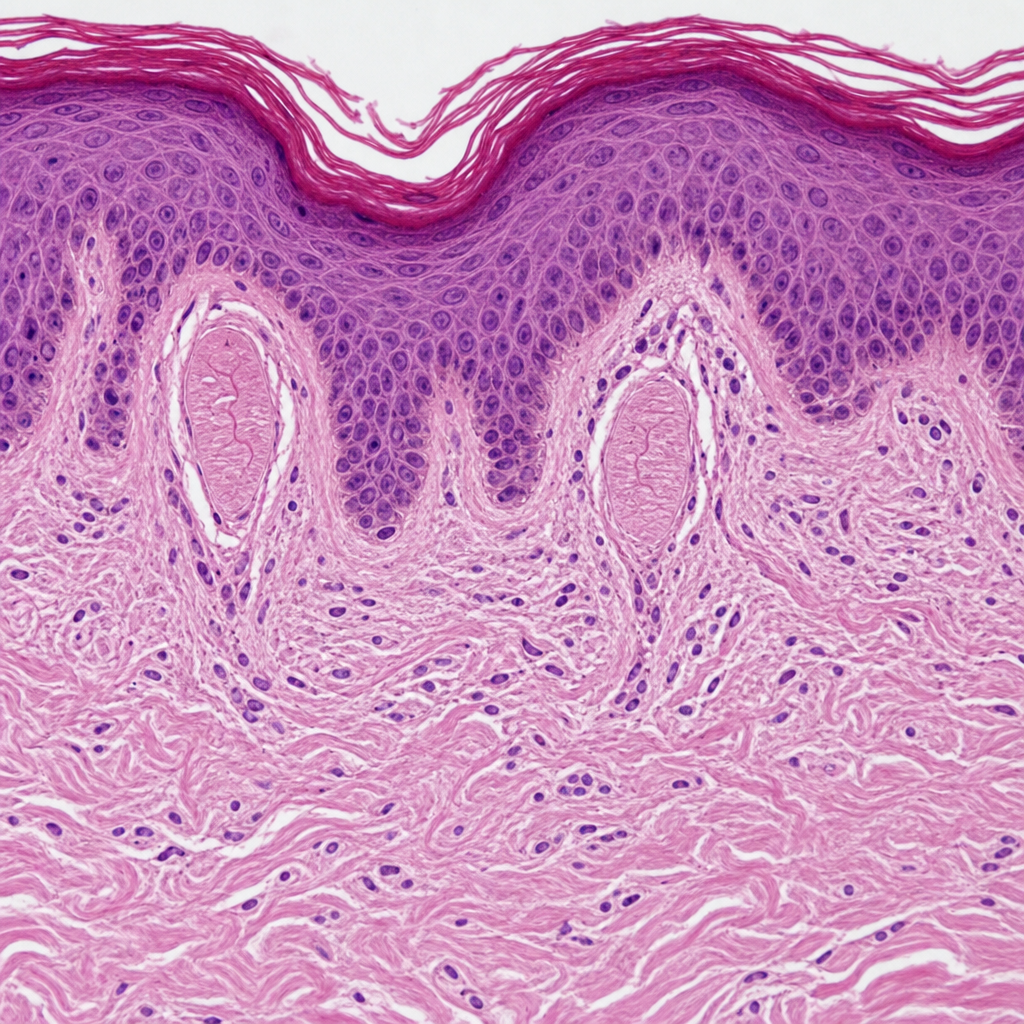
Goblet cells are not seen in which of the following locations?
Which is the commonest site for secondary metastasis in a case of hypernephroma?
Secretory basket cells are located where?
Intercalated discs are characteristic of which tissue type?
Which type of epithelium is characterized by cells possessing an extra reserve of cell membrane?
Brush border is seen in which part of the nephron?
Collagen is found in which of the following, except?
A 40-year-old patient with a single kidney presents with a solitary exophytic mass of 4 cm localized at its lower pole. What is the best-recommended management option?
Which of the following is true about anemia of chronic disease?
Elastic cartilage is typically found in which of the following locations?
Explanation: The correct answer is **D. Esophagus**. [1] **1. Why Esophagus is the correct answer:** The esophagus is lined by **non-keratinized stratified squamous epithelium**. This multi-layered epithelium is designed to provide protection against mechanical abrasion during swallowing. It does not naturally contain Goblet cells. The presence of Goblet cells in the esophagus is a pathological finding known as **intestinal metaplasia** (Barrett’s Esophagus), usually resulting from chronic gastroesophageal reflux disease (GERD). **2. Analysis of Incorrect Options:** * **A. Colon:** The large intestine contains a high density of Goblet cells within its simple columnar epithelium to provide lubrication for the passage of solid fecal matter. [1] * **B. Trachea:** The respiratory tract is lined by **pseudostratified ciliated columnar epithelium** (Respiratory Epithelium), which contains numerous Goblet cells that secrete mucus to trap inhaled particles. * **C. Conjunctiva:** The conjunctiva is lined by stratified columnar/cuboidal epithelium that contains Goblet cells. These cells are essential for secreting the mucous layer of the tear film, which keeps the eye moist. **3. NEET-PG High-Yield Pearls:** * **Definition:** Goblet cells are unicellular glands that secrete mucin. * **Staining:** They are best visualized using **PAS (Periodic Acid-Schiff)** or **Alcian Blue** stains. * **Distribution Rule:** They are found in the respiratory tract (except the vocal cords and terminal bronchioles/alveoli) and the gastrointestinal tract (except the esophagus and stomach). * **Clinical Correlation:** The appearance of Goblet cells in the stomach (Intestinal metaplasia) or esophagus (Barrett’s) is a precursor to adenocarcinoma.
Explanation: **Explanation:** **Hypernephroma**, also known as Renal Cell Carcinoma (RCC), is characterized by its unique tendency for early **hematogenous spread** (venous invasion). **1. Why Lungs are the Correct Answer:** The most common site for distant metastasis in RCC is the **Lungs (50-60%)**. This occurs because the tumor cells characteristically invade the renal vein and the inferior vena cava (IVC). From the IVC, the tumor emboli travel directly to the right side of the heart and are then pumped into the pulmonary circulation, where they lodge in the lung parenchyma. On imaging, these often appear as multiple, well-circumscribed nodules known as **"Cannon-ball metastasis."** **2. Analysis of Incorrect Options:** * **Bones:** This is the second most common site (approx. 30-40%). Metastases are typically **osteolytic** (bone-destroying) and often affect the axial skeleton. * **Adrenal:** While RCC can spread to the ipsilateral adrenal gland via direct extension or venous routes, it is less frequent than pulmonary involvement. * **Brain:** Brain metastasis occurs in only about 5% of cases and usually represents a late-stage manifestation of the disease. **3. High-Yield Clinical Pearls for NEET-PG:** * **Route of Spread:** Unlike most carcinomas (which spread via lymphatics), RCC primarily spreads via the **bloodstream**. * **Classic Triad:** Hematuria (most common), flank pain, and a palpable mass (seen in only 10% of patients). * **Histology:** The **Clear Cell** variant is the most common histological subtype. * **Left-sided Varicocele:** A classic physical finding in males if the tumor obstructs the left renal vein, preventing drainage of the left testicular vein.
Explanation: ### Explanation **Concept Overview:** "Secretory basket cells" is a descriptive term for **Myoepithelial cells**. These are specialized contractile cells found in exocrine glands, such as salivary glands, mammary glands, and sweat glands. They possess features of both epithelium (cytokeratin filaments) and smooth muscle (actin and myosin). **Why Option C is Correct:** Myoepithelial cells are strategically located **between the basal plasma membrane of the secretory (acinar) cells and the basal lamina** of the epithelium. When these cells contract, they squeeze the acinus like a "basket," increasing the pressure and facilitating the expulsion of secretory products into the ductal system. **Analysis of Incorrect Options:** * **Option A:** They are not *inside* the acini; they are part of the epithelial layer but remain external to the secretory cells themselves. * **Option B:** While myoepithelial cells can be found surrounding intercalated ducts, their primary and most characteristic "basket-like" morphology is associated with the secretory acini. * **Option D:** Striated ducts and larger excretory ducts generally lack myoepithelial cells, as the primary force for secretion has already been generated at the acinar level. **High-Yield NEET-PG Pearls:** * **Staining:** Myoepithelial cells are best visualized using immunohistochemistry for **S-100**, **SMA (Smooth Muscle Actin)**, or **p63**. * **Function:** They prevent the distension of the acini when secretion pressure rises. * **Clinical Relevance:** In breast pathology, the **presence** of a myoepithelial layer is a hallmark of benign or *in situ* lesions; its **absence** is a diagnostic feature of invasive carcinoma. * **Salivary Glands:** They are most numerous in the submandibular and sublingual glands compared to the parotid.
Explanation: **Explanation:** **Intercalated discs** are specialized junctional complexes found exclusively in **cardiac muscle**. They represent the interface between adjacent cardiomyocytes and are essential for the heart's function as a functional syncytium [1]. 1. **Why Cardiac Muscle is Correct:** Intercalated discs consist of three types of cell junctions: * **Fascia adherens:** Anchors actin filaments and transmits contractile forces. * **Desmosomes (Macula adherens):** Provide mechanical stability, preventing cells from pulling apart during contraction. * **Gap junctions:** Allow for rapid electrical coupling and ion flow, ensuring synchronized contraction of the myocardium. 2. **Why Other Options are Incorrect:** * **Skeletal Muscle:** These are long, multinucleated fibers formed by the fusion of myoblasts. They lack intercalated discs and function as independent anatomical units [1]. * **Hyaline Cartilage:** This is a connective tissue characterized by chondrocytes residing in lacunae within a glassy matrix. It does not contain contractile fibers or intercalated discs. * **Comp cyclone:** This appears to be a distractor/typographical error and is not a recognized histological tissue type. **High-Yield NEET-PG Pearls:** * **Step-ladder appearance:** Under light microscopy, intercalated discs give cardiac muscle a characteristic "step-like" appearance. * **Location:** They always coincide with the **Z-lines** of the sarcomere [1]. * **Clinical Correlation:** Mutations in proteins forming the desmosomes within intercalated discs (e.g., desmoplakin) are linked to **Arrhythmogenic Right Ventricular Cardiomyopathy (ARVC)**. * **Regeneration:** Cardiac muscle has virtually no regenerative capacity; damaged muscle is replaced by fibrous scar tissue.
Explanation: **Explanation:** **1. Why Transitional Epithelium is Correct:** Transitional epithelium (also known as **Urothelium**) [1] is uniquely designed to withstand the stretching and toxicity of urine. The hallmark of this epithelium is the presence of **Umbrella cells** (superficial layer) which possess an **extra reserve of cell membrane**. This is stored in the form of **fusiform vesicles** (discoid vesicles) within the cytoplasm. When the bladder fills and the epithelium stretches, these vesicles fuse with the apical plasma membrane, increasing the surface area of the cell to prevent rupture. Additionally, the membrane contains specialized thickened protein plaques called **uroplakins**, which act as a barrier against the osmotic effects of urine. **2. Why the Other Options are Incorrect:** * **Stratified Squamous:** This epithelium is designed for protection against mechanical abrasion (e.g., skin, esophagus). It lacks the specialized intracellular vesicle system for membrane expansion. * **Stratified Cuboidal/Columnar:** These are relatively rare (found in large ducts of sweat glands or conjunctiva) and serve primarily as protective linings or conduits. They do not undergo the significant cyclical distension required to necessitate a membrane reserve. **3. NEET-PG High-Yield Clinical Pearls:** * **Location:** Found exclusively in the urinary tract (Renal pelvis, Ureters, Urinary bladder, and proximal part of the Urethra) [1]. * **Morphology:** In a relaxed state, cells appear dome-shaped (Umbrella cells); when stretched, they appear flattened/squamous. * **Key Feature:** It is the only epithelium that is **waterproof** due to the presence of tight junctions and uroplakin plaques. * **Pathology:** Most bladder cancers are **Transitional Cell Carcinomas (TCC)**, often associated with smoking or exposure to aniline dyes.
Explanation: The **Proximal Convoluted Tubule (PCT)** is the correct answer because it is the primary site for reabsorption in the nephron [1]. To facilitate this, the PCT is lined by **simple cuboidal epithelium** featuring a dense **brush border of microvilli** on the apical surface [1]. This specialization increases the surface area approximately 20-fold, allowing for the massive reabsorption of water, glucose, amino acids, and electrolytes [1][2]. **Analysis of Incorrect Options:** * **Bowman’s Capsule:** The parietal layer consists of simple squamous epithelium, while the visceral layer contains specialized cells called **podocytes** [1]. Neither possesses a brush border. * **Distal Convoluted Tubule (DCT):** While also lined by simple cuboidal epithelium, the DCT lacks a brush border (it has only a few short, irregular microvilli). This makes the lumen of the DCT appear "cleaner" and wider under a microscope compared to the "fuzzy" lumen of the PCT. * **Loop of Henle:** The thin segments are lined by simple squamous epithelium, and the thick segments by cuboidal epithelium without a brush border. **High-Yield Clinical Pearls for NEET-PG:** * **Histology Identification:** In H&E stained sections, the PCT lumen often appears "star-shaped" or occluded due to the brush border and debris, whereas the DCT lumen appears clear and distinct. * **Mitochondria:** The PCT has a high concentration of mitochondria at the basal end (basal striations) to provide ATP for active transport (Na+/K+ ATPase). * **Clinical Correlation:** The PCT is the most metabolically active part of the nephron and is the primary site of injury in **Acute Tubular Necrosis (ATN)** caused by ischemia or toxins (e.g., aminoglycosides).
Explanation: The core concept tested here is the distinction between **connective tissue structures** (extracellular matrix) and the **cells** that produce them [4]. **Why Option C is Correct:** **Fibroblasts** are the primary biological cells responsible for synthesizing the precursors of the extracellular matrix and collagen [4]. While fibroblasts contain the machinery to produce procollagen, they are **cells**, not structural tissues composed of collagen fibers [1]. Collagen is an extracellular protein; once synthesized, it is secreted out of the fibroblast into the extracellular space to form fibers [1]. Therefore, collagen is *produced* by fibroblasts but is not a structural component *of* the cell itself. **Why Other Options are Incorrect:** * **A. Ligament:** These are dense regular connective tissues that connect bone to bone. they are primarily composed of Type I collagen fibers arranged to resist tensile forces. * **B. Tendon:** These connect muscle to bone and consist of closely packed, parallel bundles of Type I collagen fibers. * **D. Aponeurosis:** These are pearly-white, sheet-like structures that act as flattened tendons. They are histologically identical to tendons and ligaments, consisting of dense layers of collagen. **High-Yield Clinical Pearls for NEET-PG:** * **Collagen Types:** Remember **Type I** (Bone, Tendon, Skin, Ligament), **Type II** (Cartilage), **Type III** (Reticulin/Blood vessels), and **Type IV** (Basement membrane) [3]. * **Vitamin C:** Essential for the hydroxylation of proline and lysine residues during collagen synthesis; deficiency leads to Scurvy [2]. * **Scleroderma:** Characterized by excessive systemic deposition of collagen by overactive fibroblasts.
Explanation: ### **Explanation** The management of renal masses is guided by the size of the tumor and the functional status of the patient’s kidneys. In this scenario, the patient has a **solitary kidney**, making the preservation of nephrons a clinical priority. **1. Why Partial Nephrectomy is Correct:** Partial nephrectomy (Nephron-Sparing Surgery or NSS) is the gold standard for **T1 renal tumors (≤ 7 cm)** [1]. It is specifically indicated in "imperative" situations, such as when the patient has a solitary kidney, bilateral renal tumors, or pre-existing renal insufficiency. Since the mass is 4 cm (T1a) and localized at the lower pole (accessible), NSS allows for complete tumor removal while preserving enough renal parenchyma to avoid permanent dialysis [1]. **2. Why Other Options are Incorrect:** * **Radical Nephrectomy (A):** This involves the removal of the entire kidney, Gerota’s fascia, and the adrenal gland. In a patient with a solitary kidney, this would result in immediate, permanent renal failure. * **Radical Nephrectomy with Dialysis (B):** While surgically possible, it is not the "best" management. Dialysis significantly decreases the quality of life and increases cardiovascular morbidity compared to preserving native kidney function. * **Radical Nephrectomy with Transplantation (C):** Transplantation is a secondary measure for end-stage renal disease. It is not a primary management strategy for a resectable T1 tumor when the native kidney can be partially saved. **3. NEET-PG High-Yield Pearls:** * **T1a Tumor:** < 4 cm; **T1b Tumor:** 4–7 cm. Both are ideal candidates for NSS [1]. * **Absolute Indications for NSS:** Solitary kidney, bilateral tumors, or chronic kidney disease (CKD). * **Elective Indication:** A small polar tumor with a normal contralateral kidney. * **Triad of Renal Cell Carcinoma (RCC):** Hematuria, flank pain, and palpable mass (seen in only 10% of cases). * **Most common histological type of RCC:** Clear cell carcinoma (originates from the **Proximal Convoluted Tubule**) [2].
Explanation: Anemia of Chronic Disease (ACD), also known as anemia of inflammation, is the second most common cause of anemia worldwide. It occurs due to the body’s inflammatory response to chronic infections, malignancies, or autoimmune disorders. **Why Option C is Correct:** The pathophysiology of ACD is driven by **Hepcidin**, an acute-phase reactant produced by the liver in response to IL-6. Hepcidin degrades ferroportin (the iron export channel), leading to: 1. **Sequestration of iron** within macrophages and hepatocytes. 2. **Decreased intestinal iron absorption.** Because iron is trapped inside storage cells, **Serum Ferritin** (the storage form of iron) remains **normal or increased**. This distinguishes ACD from Iron Deficiency Anemia (IDA), where ferritin is always low. **Why Other Options are Incorrect:** * **A. Increased TIBC:** In ACD, Total Iron Binding Capacity (TIBC) is **decreased**. The body downregulates transferrin production to limit iron availability to potential pathogens. * **B. Normal serum iron levels:** Serum iron is **decreased** in ACD because iron is "locked away" in macrophages and not available in the circulation. * **D. Increased transferrin saturation:** Since serum iron is low, the **transferrin saturation is decreased** (typically 10-20%). **NEET-PG High-Yield Pearls:** * **Hallmark:** Low serum iron + Low TIBC + Normal/High Ferritin. * **Key Mediator:** Hepcidin (inhibits ferroportin). * **Morphology:** Usually normocytic normochromic, but can become microcytic hypochromic in long-standing cases. * **Treatment:** Treat the underlying inflammatory condition; erythropoietin may be used in specific cases (e.g., CKD).
Explanation: Explanation: Elastic cartilage is characterized by a dense network of branching elastic fibers within its matrix, providing both structural support and exceptional flexibility. It is designed to withstand repeated bending while maintaining its original shape. 1. Why Pinnae is Correct: The Pinna (auricle) of the external ear is the classic example of elastic cartilage. Other high-yield locations include the External Auditory Meatus, the Eustachian tube, and specific parts of the larynx (the Epiglottis, Corniculate, and Cuneiform cartilages). A helpful mnemonic is the "6 Es": Ear (Pinna), External Auditory Meatus, Eustachian tube, Epiglottis, and the small laryngeal cartilages (E-corniculate and E-cuneiform). 2. Why Incorrect Options are Wrong: * Articular ends of bones: These are composed of Hyaline cartilage [1], which provides a smooth, low-friction surface for joint movement but lacks elastic fibers. While the healing of fractures can involve the formation of fibrocartilage and hyaline cartilage calluses, articular surfaces remain hyaline [1]. * Pubic symphysis: This is composed of Fibrocartilage, the strongest type of cartilage, containing thick bundles of Type I collagen to resist heavy pressure and tension. * Larynx: While parts of the larynx contain elastic cartilage (as noted above), the larynx as a whole is primarily composed of Hyaline cartilage (Thyroid, Cricoid, and the base of the Arytenoids). In standardized exams, if "Larynx" and a specific elastic structure like "Pinna" are both listed, the Pinna is the more definitive answer. Clinical Pearls for NEET-PG: * Staining: Unlike hyaline cartilage, elastic cartilage requires special stains like Orcein or Verhoeff’s Van Gieson (VVG) to visualize the dark-staining elastic fibers. * Calcification: Unlike hyaline cartilage, elastic cartilage does not calcify with age. * Perichondrium: Elastic cartilage is always surrounded by a perichondrium, which provides its blood supply and new chondroblasts.
Basic Tissue Types
Practice Questions
Cell Biology and Organelles
Practice Questions
Epithelial Tissue
Practice Questions
Connective Tissue
Practice Questions
Muscular Tissue
Practice Questions
Nervous Tissue
Practice Questions
Cardiovascular System Histology
Practice Questions
Lymphoid Organs and Immune System
Practice Questions
Endocrine System Histology
Practice Questions
Respiratory System Histology
Practice Questions
Digestive System Histology
Practice Questions
Urinary and Reproductive System Histology
Practice Questions
Get full access to all questions, explanations, and performance tracking.
Start For Free