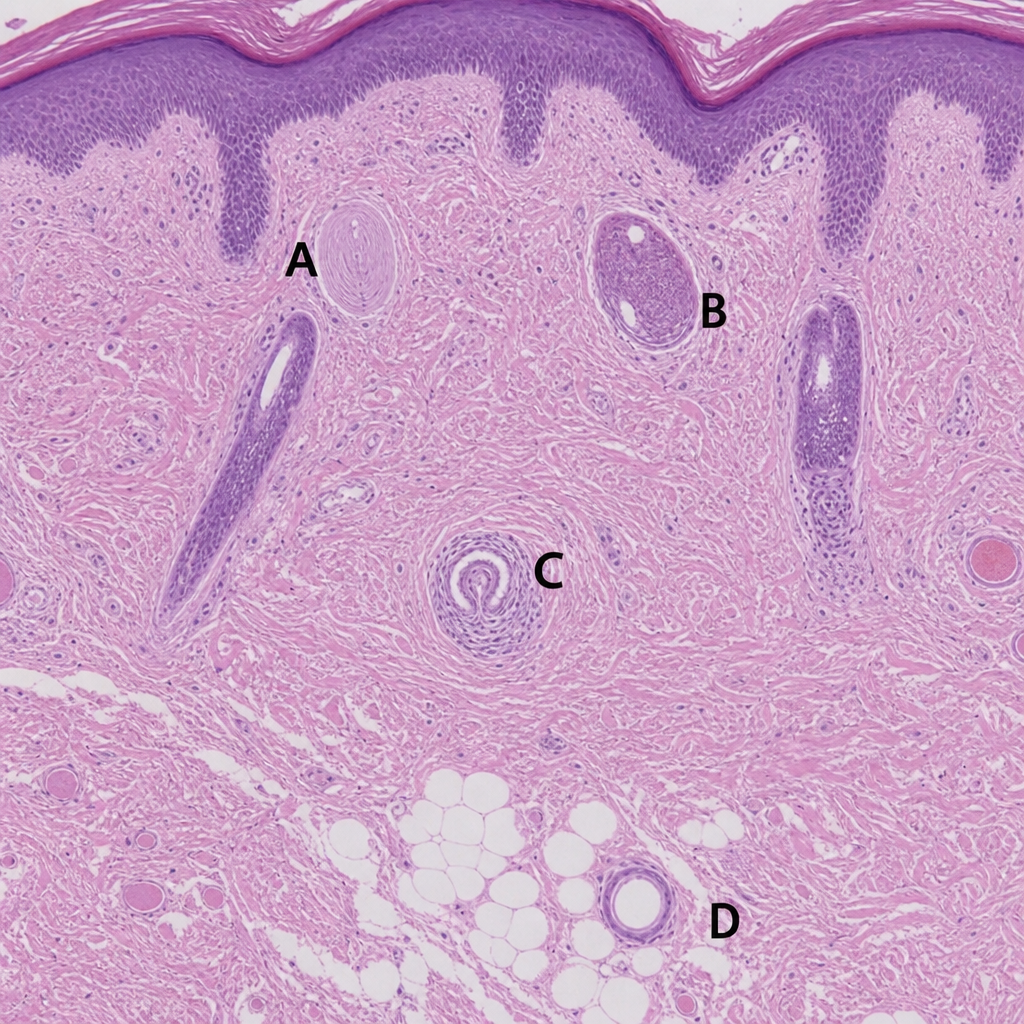
Odland bodies are seen in which layer of the epidermis?
A patient with stage II transitional cell carcinoma of the bladder presents with hematuria. Which of the following statements regarding the management of her condition is true?
Which of the following is the most troublesome source of bleeding during a radical retropubic prostatectomy?
All of the following are examples of Ball and Socket Joints except?
Which of the following structures helps to anchor an epithelial cell to the basement membrane?
All of the following can cause megakaryocytic thrombocytopenia, except?
Which of the following structures does NOT possess non-keratinized stratified squamous epithelium?
Inappropriate erythropoietin level is found in all conditions EXCEPT:
Brunner glands are seen in which part of the gastrointestinal tract?
All are true about anemia of chronic disease, except?
Explanation: **Explanation:** Odland bodies, also known as **lamellar bodies** or membrane-coating granules, are specialized secretory organelles found within the keratinocytes of the epidermis [1]. **Why Stratum Granulosum is correct:** Odland bodies are synthesized in the *stratum spinosum* but are most prominent and functional in the **stratum granulosum**. These organelles contain a mixture of glycosphingolipids, phospholipids, and ceramides. In the granular layer, they fuse with the cell membrane and discharge their lipid contents into the intercellular spaces via exocytosis. This process is crucial for forming the **epidermal water permeability barrier**, which prevents transepidermal water loss and protects against environmental insults. **Analysis of Incorrect Options:** * **Basal cell layer (Stratum basale):** This is the germinative layer focused on cell division (mitosis). It contains melanocytes and Merkel cells but does not yet possess the specialized secretory machinery for lipid barrier formation [1]. * **Stratum lucidum:** This is a thin, clear layer found only in thick skin (palms and soles). It consists of dead cells containing eleidin; by this stage, Odland bodies have already discharged their contents. * **Stratum corneum:** This is the outermost layer consisting of flattened, cornified cells (corneocytes). While the *lipids* from Odland bodies reside between these cells, the organelles themselves are no longer present [1]. **High-Yield Clinical Pearls for NEET-PG:** * **Contents:** Odland bodies contain lipids (ceramides), hydrolytic enzymes, and proteins (pro-filaggrin). * **Clinical Correlation:** A deficiency or defect in lamellar bodies is implicated in **Ichthyosis vulgaris** and **Atopic Dermatitis**, leading to a compromised skin barrier. * **Keratohyalin Granules:** Also found in the stratum granulosum; these are non-membrane bound and contain **profilaggrin**, which eventually aggregates keratin filaments.
Explanation: ### Explanation **1. Why the Correct Answer is Right:** Stage II Transitional Cell Carcinoma (TCC) of the bladder indicates **muscle-invasive bladder cancer (MIBC)**, where the tumor has invaded the muscularis propria (T2). While Transurethral Resection of Bladder Tumor (TURBT)—often colloquially referred to in questions alongside TURP—is the initial diagnostic and therapeutic step, it is rarely curative for muscle-invasive disease [1]. Clinical data shows that approximately **70% of patients with muscle-invasive disease** will eventually require a **radical cystectomy** within 5 years due to the high rate of recurrence, progression, or failure of bladder-sparing protocols. **2. Why the Incorrect Options are Wrong:** * **Option A:** Cystoscopic fulguration is reserved for low-grade, non-invasive (Ta) papillary tumors. It is insufficient for Stage II (muscle-invasive) disease, which requires more aggressive intervention (Radical Cystectomy or Chemo-radiation). * **Option C:** Smoking is the **most significant risk factor** for transitional cell carcinoma, increasing the risk by 3–4 times. Cigarette smoke contains aromatic amines (like beta-naphthylamine) that are excreted in urine and act as potent carcinogens. * **Option D:** Chemotherapy plays a vital role in Stage II disease. **Neoadjuvant cisplatin-based chemotherapy** followed by radical cystectomy is the gold standard, as it improves overall survival compared to surgery alone. **3. NEET-PG High-Yield Pearls:** * **Most common site:** Lateral or posterior walls of the bladder. * **Histology:** Transitional epithelium (Urothelium) is 5–7 layers thick; look for "umbrella cells" on the surface. * **Risk Factors:** Smoking (No. 1), Aniline dyes (rubber/leather industry), Schistosoma haematobium (associated with **Squamous Cell CA**, not TCC), and Cyclophosphamide. * **Staging:** T2 (Stage II) = Invasion of Muscularis Propria; T3 = Perivesical fat invasion; T4 = Invasion of adjacent organs (prostate, uterus, pelvic wall) [1].
Explanation: ### Explanation **Correct Answer: A. Dorsal venous complex** The **Dorsal Venous Complex (DVC)**, also known as the Santorini plexus, is the most significant source of intraoperative hemorrhage during a radical retropubic prostatectomy. Anatomically, the DVC lies within the endopelvic fascia, anterior to the prostate and the urethra. During the retropubic approach, the surgeon must divide the puboprostatic ligaments and control this high-pressure venous plexus to serialize the apex of the prostate and the urethra. Because these veins are thin-walled, lack valves, and are tethered to the surrounding fascia, they do not collapse easily when injured, leading to profuse bleeding. **Why the other options are incorrect:** * **B & C. Inferior and Superior Vesical Pedicles:** While the inferior vesical artery provides the primary arterial supply to the prostate, these pedicles are typically ligated in a controlled, lateral fashion during the dissection of the "prostatic pedicles." [1] They are less likely to cause "troublesome" or unexpected massive bleeding compared to the DVC. * **D. Seminal Vesicular Artery:** This is a smaller branch encountered during the posterior dissection. While it requires control, its caliber and location do not pose the same surgical challenge or volume of blood loss as the DVC. **Clinical Pearls for NEET-PG:** * **Santorini’s Plexus:** Another name for the dorsal venous complex; it communicates with the internal pudendal vein and the vesical venous plexus. * **Batson’s Plexus:** The prostatic venous plexus communicates with the vertebral venous plexus (valveless), explaining why prostate cancer characteristically metastasizes to the **lumbar spine**. * **Nerve Sparing:** The cavernous nerves (responsible for erections) run posterolateral to the prostate; careful management of the DVC is crucial to avoid damaging these nerves during apical dissection.
Explanation: **Explanation:** The **Ball and Socket joint (Spheroid joint)** is a type of multiaxial synovial joint where a hemispherical head fits into a cup-like cavity, allowing movement in multiple axes (flexion/extension, abduction/adduction, and rotation). **Why Option B is Correct:** The **Incudomalleolar joint** (between the head of the malleus and the body of the incus) is a **Saddle joint** (Sellar joint). In this joint, the opposing surfaces are reciprocally concavo-convex. This is a high-yield exception in middle ear anatomy often tested in NEET-PG. **Analysis of Incorrect Options:** * **Hip Joint (Option C):** The classic example of a ball and socket joint, where the head of the femur articulates with the acetabulum of the hip bone. * **Incus and Stapes Joint (Option D):** The **Incudostapedial joint** is a **Ball and Socket joint**. It connects the lentiform process of the incus with the head of the stapes. * **Talo-calcaneo-navicular Joint (Option A):** This is a complex multiaxial joint where the rounded head of the talus fits into the "socket" formed by the navicular bone and the calcaneus. It is functionally classified as a ball and socket joint. **NEET-PG Clinical Pearls:** 1. **Shoulder vs. Hip:** Both are ball and socket, but the shoulder is more mobile (shallow glenoid), while the hip is more stable (deep acetabulum). 2. **Middle Ear Joints:** Remember the mnemonic **"IMS"**—**I**ncudomalleolar = **S**addle; **I**ncudostapedial = **B**all & Socket. 3. **Other Ball & Socket joints:** Shoulder (Glenohumeral) and Sternoclavicular joint (though often debated, it is functionally multiaxial, but anatomically saddle-shaped).
Explanation: **Explanation:** The correct answer is **Hemidesmosome**. **1. Why Hemidesmosome is correct:** Hemidesmosomes are specialized junctional complexes found on the **basal surface** of epithelial cells. Their primary function is to anchor the cytoskeleton (specifically intermediate filaments like keratin) to the underlying **basement membrane** (specifically the basal lamina) [1]. They utilize **integrins** as transmembrane proteins to bind to laminin and collagen in the extracellular matrix, providing mechanical stability to the epithelium [1]. **2. Why other options are incorrect:** * **Adherent Junction (Zonula Adherens):** These are cell-to-cell junctions that link the actin filaments of adjacent cells [1]. They are located on the lateral membranes, not the basal surface. * **Connexon:** This is the structural unit of a **Gap Junction**. It consists of six connexin proteins forming a channel that allows for direct chemical and electrical communication between adjacent cells. * **Gap Junction:** These are communicating junctions that allow the passage of ions and small molecules between neighboring cells; they do not provide structural anchoring to the basement membrane [1]. **3. High-Yield Clinical Pearls for NEET-PG:** * **Bullous Pemphigoid:** An autoimmune blistering disease where antibodies (anti-BP180/BP230) attack **hemidesmosomes**, leading to subepidermal blisters (tense bullae). * **Pemphigus Vulgaris:** An autoimmune disease where antibodies attack **desmosomes** (specifically Desmoglein 1 and 3), leading to intraepidermal blisters (flaccid bullae) and a positive Nikolsky sign. * **Integrins vs. Cadherins:** Remember that hemidesmosomes use **integrins** (cell-to-matrix), while desmosomes use **cadherins** (cell-to-cell).
Explanation: To understand this question, we must first define **Megakaryocytic Thrombocytopenia**. This refers to a condition where the bone marrow contains a normal or increased number of megakaryocytes, but the peripheral platelet count is low. This occurs because platelets are being destroyed or consumed in the periphery faster than the marrow can produce them. ### 1. Why Aplastic Anemia is the Correct Answer **Aplastic Anemia** is a state of bone marrow failure characterized by **pancytopenia** and a **hypocellular marrow**. In this condition, the hematopoietic stem cells are damaged, leading to a marked decrease or total absence of megakaryocytes in the bone marrow. Therefore, it causes **amegakaryocytic thrombocytopenia**. ### 2. Analysis of Incorrect Options (Peripheral Destruction) In these conditions, the bone marrow is healthy and attempts to compensate for low platelets by increasing megakaryopoiesis: * **Idiopathic Thrombocytopenic Purpura (ITP):** An autoimmune condition where anti-platelet antibodies lead to splenic destruction of platelets. The marrow shows increased megakaryocytes. * **Systemic Lupus Erythematosus (SLE):** Similar to ITP, SLE involves immune-mediated peripheral destruction of platelets. * **Disseminated Intravascular Coagulation (DIC):** A consumptive coagulopathy where platelets are used up in widespread microthrombi formation. The marrow remains hyperactive to replace the loss. ### 3. NEET-PG High-Yield Pearls * **Bone Marrow Biopsy:** The gold standard to differentiate between central (production) and peripheral (destruction) causes of thrombocytopenia. * **Megakaryocyte Marker:** CD41 and CD61 are specific immunohistochemical markers for megakaryocytes. * **Endoreduplication:** Megakaryocytes are unique because they undergo DNA replication without cell division, a process called endomitosis, resulting in a polyploid nucleus. * **TPO (Thrombopoietin):** Produced primarily in the liver; it is the chief regulator of megakaryocyte maturation.
Explanation: **Explanation:** The correct answer is **D. Uterus**. **1. Why Uterus is the Correct Answer:** The lining of the uterus (endometrium) consists of **simple columnar epithelium** [1], [2]. This epithelium is functional and undergoes cyclic changes under hormonal influence [2]. In contrast, non-keratinized stratified squamous epithelium (NKSSE) is designed for protection against mechanical abrasion in moist environments, a function not required by the uterine cavity. **2. Analysis of Incorrect Options:** * **A. Cornea:** The anterior surface of the cornea is lined by NKSSE. It provides a smooth, protective, and transparent surface. It is unique because it is non-keratinized to maintain transparency for light refraction. * **B. Vagina:** The vaginal mucosa is lined by NKSSE. This thick, multi-layered epithelium protects the tissue from friction during intercourse and resists the acidic environment created by commensal bacteria (Lactobacilli). * **C. Esophagus:** The esophagus is lined by NKSSE to protect the underlying tissue from the abrasive force of swallowed food boluses. **3. High-Yield Clinical Pearls for NEET-PG:** * **Metaplasia:** The most common site for epithelial transition is the **Squamocolumnar Junction (SCJ)** in the cervix. Here, simple columnar epithelium of the endocervix meets the NKSSE of the ectocervix. This is a high-yield site for cervical cancer screening (Pap smear). * **Barrett’s Esophagus:** Chronic acid reflux can cause the NKSSE of the esophagus to undergo metaplasia into simple columnar epithelium (intestinal metaplasia). * **Memory Aid:** NKSSE is found in "Moist" areas prone to friction: **M**outh, **O**esophagus, **I**nside of Vagina, **S**clera/Cornea, and **T**hroat (Vocal folds).
Explanation: **Explanation:** The core concept of this question lies in distinguishing between **Appropriate** and **Inappropriate** secondary polycythemia. **Appropriate Secondary Polycythemia** occurs when Erythropoietin (EPO) levels rise as a physiological response to **hypoxia** (low oxygen). The body increases red blood cell production to improve oxygen delivery. * **High Altitude (Option C):** Lower atmospheric pressure leads to hypoxia, triggering a physiological rise in EPO [1]. * **Lung Disease (Option B):** Chronic obstructive pulmonary disease (COPD) or restrictive lung diseases impair gas exchange, causing systemic hypoxia and a compensatory rise in EPO. **Inappropriate Secondary Polycythemia** occurs when EPO levels rise in the **absence of hypoxia**, usually due to ectopic production by a tumor or localized renal ischemia. * **Renal Cell Carcinoma (Option A):** This is a classic paraneoplastic syndrome where the tumor cells autonomously secrete EPO. **Why Benign Liver Tumor is the Correct Answer:** While the liver is the primary source of EPO in the fetus and a secondary source in adults [1], **benign** liver tumors (like hemangiomas or focal nodular hyperplasia) do not typically secrete EPO. In contrast, **Hepatocellular Carcinoma (HCC)**—a malignant tumor—is a well-known cause of ectopic EPO production. Therefore, a benign liver tumor is the "exception" as it does not typically lead to elevated EPO levels. **High-Yield Clinical Pearls for NEET-PG:** * **Potter’s Mnemonic for Ectopic EPO:** **P**heochromocytoma, **R**enal Cell Carcinoma, **H**epatocellular Carcinoma, **H**emangioblastoma (Cerebellar), and **U**terine Fibroids (**PRHHU**) [1]. * **Polycythemia Vera:** Unlike the conditions above, EPO levels in Polycythemia Vera are **low** because the RBC production is independent of EPO (JAK2 mutation).
Explanation: **Explanation:** **Brunner’s glands** (duodenal glands) are the hallmark histological feature of the **duodenum**. They are compound tubular submucosal glands located specifically in the **submucosa** of the duodenum [3]. Their primary function is to secrete an alkaline fluid (rich in bicarbonate and mucin) that neutralizes the acidic chyme entering from the stomach, thereby protecting the duodenal mucosa and providing an optimal pH for pancreatic enzyme activity [1]. **Analysis of Options:** * **A. Duodenum (Correct):** Brunner’s glands are found exclusively in the submucosa of the duodenum, most abundantly in the proximal part (first part) [3]. * **B. Esophagus:** The esophagus contains esophageal glands proper in the submucosa, but these are distinct from Brunner’s glands. * **C. Cardia of stomach:** The stomach contains gastric glands in the *mucosa* (lamina propria), not the submucosa [2]. * **D. Small intestine:** While the duodenum is part of the small intestine, this option is too broad. The jejunum and ileum lack Brunner’s glands and are instead characterized by Plicae circulares and Peyer’s patches, respectively. **High-Yield Clinical Pearls for NEET-PG:** * **Location:** They are located **below** the muscularis mucosa (in the submucosa) [3]. * **Stimulation:** Secretion is stimulated by secretin, vagal stimulation, and tactile irritation [1]. * **Clinical Correlation:** Hyperplasia of Brunner’s glands (Brunneroma) can occur, usually as a benign response to chronic gastric acid hypersecretion (e.g., in Peptic Ulcer Disease). * **Differentiating Feature:** In a histology slide, if you see glands in the submucosa of the GIT, it is either the **Esophagus** or the **Duodenum**. If Villi are also present, it is definitively the Duodenum.
Explanation: **Explanation:** Anemia of Chronic Disease (ACD), also known as Anemia of Inflammation, is driven by the cytokine-mediated increase in **Hepcidin**. Hepcidin inhibits ferroportin, preventing iron release from macrophages and decreasing intestinal iron absorption. **Why Option B is the correct answer (The "Except"):** In ACD, iron is "trapped" within the reticuloendothelial system (macrophages). Since **Ferritin** is an acute-phase reactant and reflects stored iron, its levels are **increased or normal**, never decreased. A decreased ferritin is the hallmark of Iron Deficiency Anemia (IDA), not ACD [1]. **Analysis of Incorrect Options:** * **A. Decreased serum iron:** True. Since iron is sequestered in macrophages and not released into the plasma, circulating serum iron levels fall [1]. * **C. Decreased TIBC:** True. Total Iron Binding Capacity (TIBC) is a measure of transferrin. In inflammatory states, the liver decreases transferrin production. This helps differentiate ACD (Low TIBC) from IDA (High TIBC) [1]. * **D. Increased bone marrow iron:** True. Prussion blue staining of a bone marrow aspirate in ACD shows abundant iron within macrophages, confirming that the body has iron but cannot utilize it for erythropoiesis. **NEET-PG High-Yield Pearls:** * **Key Mediator:** Interleukin-6 (IL-6) stimulates the liver to produce **Hepcidin**. * **Morphology:** Usually Normocytic Normochromic, but can become Microcytic Hypochromic in long-standing cases [1]. * **The "Gold Standard" Differentiator:** * **ACD:** High Ferritin, Low TIBC, High Marrow Iron. * **IDA:** Low Ferritin, High TIBC, Absent Marrow Iron [1]. * **Transferrin Saturation:** Decreased in both ACD and IDA.
Basic Tissue Types
Practice Questions
Cell Biology and Organelles
Practice Questions
Epithelial Tissue
Practice Questions
Connective Tissue
Practice Questions
Muscular Tissue
Practice Questions
Nervous Tissue
Practice Questions
Cardiovascular System Histology
Practice Questions
Lymphoid Organs and Immune System
Practice Questions
Endocrine System Histology
Practice Questions
Respiratory System Histology
Practice Questions
Digestive System Histology
Practice Questions
Urinary and Reproductive System Histology
Practice Questions
Get full access to all questions, explanations, and performance tracking.
Start For Free