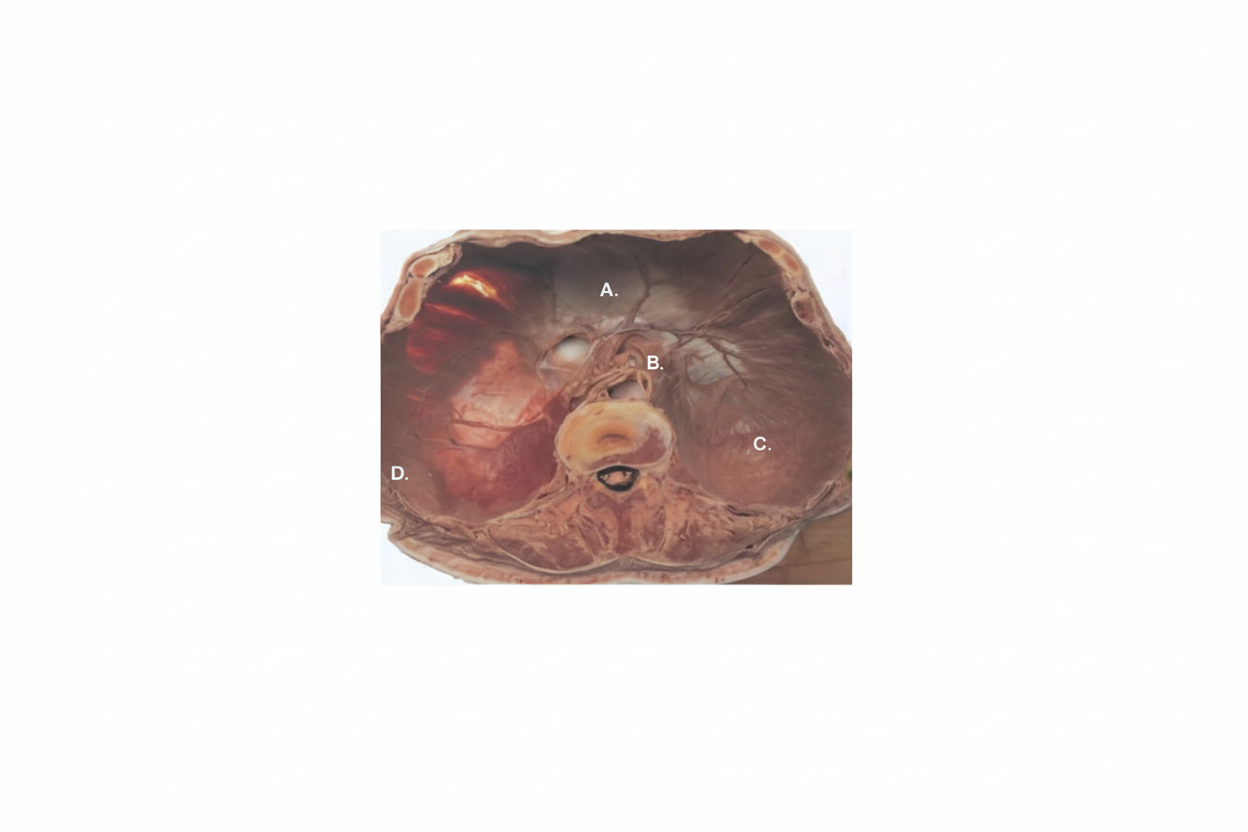
All of the following statements about the embryology of Meckel's diverticulum are true except:
Hirschsprung's disease is due to?
The third ventricle is derived from which embryonic structure?
Independent assortment of chromosomes occurs at which stage of meiosis?
Trophoblast differentiates at which post-fertilization day?
A 3-month-old child presents with a typical mewing cry and congenital heart disease. Which chromosome abnormality is associated with these findings?
What is the term for a dome-shaped skull?
What is the term for a primary defect in structure?
In the adult heart, the floor of the fossa ovalis represents:
What is the abnormality seen in the following karyotype?

Explanation: Meckel’s diverticulum is the most common congenital anomaly of the gastrointestinal tract [2]. It is a true diverticulum, containing all layers of the intestinal wall [1]. 1. Why Option C is the correct answer (False statement): The incidence of Meckel’s diverticulum in the general population is approximately 2%, not 20% [1]. This is a classic component of the "Rule of 2s," making Option C the incorrect statement and thus the correct answer for this question [2]. 2. Analysis of other options: * Option A: It typically arises from the antimesenteric border of the ileum, usually within 2 feet (approx. 60–90 cm) of the ileocecal valve [1]. * Option B: It is an embryological remnant of the vitelline duct (omphalomesenteric duct) [1]. Normally, this duct obliterates by the 7th week of gestation; failure to do so results in a diverticulum. * Option D: Ectopic tissue is found in about 50% of symptomatic cases. Gastric mucosa is the most common (found in ~60-80% of cases with ectopic tissue), followed by pancreatic tissue [2]. The acid produced by ectopic gastric mucosa can lead to peptic ulceration and painless bleeding. Clinical Pearls for NEET-PG (The Rule of 2s): * 2% incidence in the population [1]. * 2 feet (60 cm) proximal to the ileocecal valve [2]. * 2 inches in length. * 2 types of common ectopic tissue (Gastric and Pancreatic) [1]. * 2 times more common in males. * Usually presents by 2 years of age (if symptomatic). * Technetium-99m pertechnetate scan (Meckel’s scan) is the investigation of choice for detecting ectopic gastric mucosa.
Explanation: ### Explanation **Hirschsprung’s Disease (Congenital Aganglionic Megacolon)** is a developmental disorder characterized by the absence of ganglion cells in the myenteric (Auerbach’s) and submucosal (Meissner’s) plexuses of the distal colon [3]. **Why Option C is Correct:** During embryonic development (weeks 5–12), **neural crest cells** migrate from the cranial region (specifically the vagal neural crest) to the caudal end of the gastrointestinal tract [2]. These cells eventually differentiate into the enteric nervous system. Hirschsprung’s disease occurs when this migration is interrupted prematurely. Because migration occurs in a **cranio-caudal direction**, the most distal part (the rectum) is always involved, while the proximal extent varies. **Why Other Options are Incorrect:** * **Option A:** The defect involves the **parasympathetic** enteric nervous system within the gut wall, not the sympathetic chain. * **Option B:** The longitudinal muscles are typically present; however, they cannot function correctly without neural coordination, leading to functional obstruction. * **Option D:** Taenia coli are structural bands of longitudinal muscle; their malformation is not the primary pathology of aganglionosis. **High-Yield Clinical Pearls for NEET-PG:** * **Gold Standard Diagnosis:** Rectal suction biopsy (shows absence of ganglion cells and presence of hypertrophied nerve bundles) [3]. * **Most Common Site:** Rectosigmoid region (Short-segment disease) [1]. * **Clinical Presentation:** Delayed passage of meconium (>48 hours), neonatal intestinal obstruction, and "blast sign" on digital rectal exam [1]. * **Associated Conditions:** Down Syndrome (Trisomy 21) and mutations in the **RET proto-oncogene** [2]. * **Radiology:** Barium enema shows a "transition zone" between the narrow aganglionic segment and the dilated proximal colon (megacolon) [1].
Explanation: The ventricular system of the brain develops from the central cavity of the neural tube. Its configuration is directly linked to the development of the primary and secondary brain vesicles. **Explanation of the Correct Answer:** The **Prosencephalon** (forebrain) divides into the **Telencephalon** and the **Diencephalon**. The **Diencephalon** (also known as the **Thalamecephalon** in some embryological contexts) forms the structures surrounding the third ventricle, including the thalamus, hypothalamus, and epithalamus. Therefore, the cavity of the Diencephalon persists as the **Third Ventricle**. **Analysis of Incorrect Options:** * **Mesencephalon (Midbrain):** The cavity of the mesencephalon does not expand into a ventricle; instead, it narrows to form the **Cerebral Aqueduct (of Sylvius)**, which connects the third and fourth ventricles. * **Rhombencephalon (Hindbrain):** This vesicle divides into the metencephalon and myelencephalon. Its cavity becomes the **Fourth Ventricle**. * **Telencephalon:** This vesicle gives rise to the cerebral hemispheres. Its cavities expand to form the **Lateral Ventricles** (First and Second ventricles). **High-Yield Clinical Pearls for NEET-PG:** * **Foramina of Monro:** These connect the lateral ventricles to the third ventricle. Obstruction here leads to unilateral or bilateral supratentorial hydrocephalus. * **Blood-CSF Barrier:** The choroid plexus, which produces CSF, is found in the roof of the third ventricle. * **Developmental Landmark:** The **Lamina Terminalis** represents the cephalic end of the primitive neural tube and forms the anterior wall of the third ventricle.
Explanation: **Explanation:** The core concept tested here is the timing of **Meiosis I (Reduction Division)**. Independent assortment of chromosomes occurs during **Anaphase I**, where homologous chromosome pairs separate and migrate to opposite poles randomly. **1. Why Option C is Correct:** The transition from a **Primary Spermatocyte (46, XY)** to a **Secondary Spermatocyte (23, X or 23, Y)** represents the completion of Meiosis I [1]. It is during this phase that both **crossing over** (Prophase I) and **independent assortment** (Anaphase I) occur, ensuring genetic diversity. Since independent assortment happens during the first meiotic division, it must occur between the primary and secondary spermatocyte stages [3]. **2. Why Other Options are Incorrect:** * **Option A & B:** These stages involve **Mitosis** [2]. Primordial germ cells divide to form spermatogonia, and spermatogonia divide to produce primary spermatocytes [3]. Mitosis maintains the diploid number (46, XY) and does not involve independent assortment. * **Option D:** This represents **Meiosis II (Equational Division)**. In this stage, sister chromatids separate (similar to mitosis), but the genetic shuffling (assortment) has already been completed in Meiosis I. **High-Yield NEET-PG Pearls:** * **Primary Spermatocytes** are the largest germ cells in the seminiferous tubules and stay in Prophase I for approximately 22 days [3]. * **Nondisjunction** (failure of chromosomes to separate) during this stage is the leading cause of numerical chromosomal abnormalities like Down Syndrome. * **Spermiogenesis** is the morphological transformation of a spermatid into a mature spermatozoon; it involves no cell division.
Explanation: **Explanation:** The correct answer is **Day 8**. This question tests the timeline of early embryonic development, specifically the events following implantation. **1. Why Day 8 is correct:** Implantation begins around Day 6 post-fertilization. By **Day 8**, the blastocyst is partially embedded in the endometrial stroma [1]. At this stage, the **trophoblast** differentiates into two distinct layers: [1] * **Inner Cytotrophoblast:** A layer of mononucleated cells with distinct cell boundaries (the "cellular" layer) [1]. * **Outer Syncytiotrophoblast:** A multinucleated zone without distinct cell boundaries that invades the uterine wall and secretes **hCG** (Human Chorionic Gonadotropin) [1]. Simultaneously, the embryoblast differentiates into the epiblast and hypoblast, forming the **bilaminar germ disc** [1]. **2. Why other options are incorrect:** * **Day 12:** By this time, the blastocyst is completely embedded, and the **extraembryonic mesoderm** begins to form [1]. Lacunar networks in the syncytiotrophoblast establish the primordial uteroplacental circulation. * **Day 14:** This marks the end of the second week ("Week of 2s"). The **primitive streak** begins to appear, signaling the start of gastrulation. * **Days 16-18:** This period corresponds to the third week of development, characterized by **gastrulation** (formation of the trilaminar disc: ectoderm, mesoderm, and endoderm) and the formation of the notochord. **High-Yield Clinical Pearls for NEET-PG:** * **Rule of 2s (Week 2):** Trophoblast splits into 2 layers (Cyto & Syncytio); Embryoblast into 2 layers (Epi & Hypoblast); 2 cavities form (Amniotic & Yolk sac) [1]. * **hCG Production:** Secreted by the **Syncytiotrophoblast**. It is detectable in maternal blood by Day 8-11 and in urine by Day 14. * **Primary Villi:** These appear by the end of the 2nd week (Day 13-14) and consist of a cytotrophoblastic core covered by syncytium.
Explanation: **Explanation:** The clinical presentation of a "mewing cry" (resembling a kitten) combined with congenital heart disease is the hallmark of **Cri-du-chat Syndrome** (Cat's cry syndrome). This condition is caused by a partial deletion of the **short arm (p) of chromosome 5** [1]. 1. **Why 5p deletion is correct:** The characteristic high-pitched, monochromatic cry is due to abnormal laryngeal development and neurological impairment [1]. Associated features include microcephaly, round "moon-like" face, hypertelorism, and intellectual disability. Congenital heart defects (most commonly VSD, PDA, or ASD) occur in about 15-20% of cases. 2. **Why other options are incorrect:** * **5q deletion:** Deletions of the long arm of chromosome 5 are associated with myelodysplastic syndrome (5q- syndrome) in adults, not congenital pediatric syndromes. * **4p deletion:** This causes **Wolf-Hirschhorn Syndrome**. While it also involves midline defects, it is characterized by a "Greek warrior helmet" facies (prominent glabella), cleft lip/palate, and seizures, rather than a cat-like cry. * **9p deletion:** Known as Alfi's syndrome, it presents with trigonocephaly and upward slanting palpebral fissures, but lacks the specific laryngeal cry. **High-Yield Clinical Pearls for NEET-PG:** * **Mnemonic:** "p" stands for *petit* (short arm); "q" stands for *queue* (long arm). * **Cri-du-chat** = 5p deletion [1]. * **Wolf-Hirschhorn** = 4p deletion. * The cry in Cri-du-chat usually disappears as the child grows older, making early diagnosis crucial. * Most cases (85%) are de novo deletions, while the remainder result from unequal crossing over or parental translocation [1].
Explanation: The term for a dome-shaped or "tower-shaped" skull is **Oxycephaly** (also known as Turricephaly). This condition occurs due to the premature closure (craniosynostosis) of both the **coronal and sagittal sutures**. Because the skull cannot expand laterally or anteroposteriorly, it grows vertically toward the anterior fontanelle, resulting in a high, conical, or dome-shaped appearance. **Analysis of Options:** * **A. Brachycephaly:** Characterized by a "short" skull. It results from the premature closure of the **coronal suture** bilaterally, causing the head to become abnormally wide and flat at the back. * **C. Scaphocephaly:** The most common form of craniosynostosis, characterized by a "boat-shaped" skull. It is caused by the premature closure of the **sagittal suture**, leading to a long and narrow head. * **D. Rhombocephaly:** This is not a standard term for skull shape; rather, the *rhombencephalon* refers to the embryological hindbrain. **High-Yield NEET-PG Pearls:** 1. **Craniosynostosis:** The general term for premature fusion of cranial sutures [1]. 2. **Plagiocephaly:** An asymmetrical skull shape, often resulting from unilateral closure of the coronal or lambdoid sutures (or positional factors). 3. **Apert Syndrome:** A high-yield genetic condition often associated with oxycephaly and syndactyly (fused fingers/toes). 4. **Rule of Thumb:** Sagittal closure = Long head (Scaphocephaly); Coronal closure = Wide head (Brachycephaly); Multiple sutures = Tower head (Oxycephaly).
Explanation: **Explanation:** In embryology, structural defects are classified based on their timing and underlying mechanism. **1. Why Malformation is Correct:** A **Malformation** is a **primary structural defect** resulting from an intrinsically abnormal developmental process. It occurs during the period of organogenesis (typically weeks 3–8 of gestation) [1]. Because the "blueprint" or the genetic programming of the tissue is flawed from the start, the organ or structure never forms correctly. Examples include congenital heart defects, cleft lip, and polydactyly [1]. **2. Why Other Options are Incorrect:** * **Deformation (B):** This is a secondary alteration in the shape or form of a *normally* developed structure due to **mechanical forces** (extrinsic pressure) in the uterine environment. Common causes include oligohydramnios or uterine crowding. Example: Clubfoot (Talipes equinovarus). * **Disruption (C):** This involves the destruction of a structure that was developing normally. It is caused by an external interference or vascular insult, not a genetic or mechanical factor. Example: **Amniotic Band Syndrome**, where fibrous bands "strangle" developing limbs. * **Sequence (D):** This refers to a pattern of multiple anomalies derived from a **single known or hypothesized prior anomaly**. Example: **Potter Sequence**, where renal agenesis leads to oligohydramnios, which then causes pulmonary hypoplasia and flattened facies. **High-Yield Clinical Pearls for NEET-PG:** * **Malformation:** Intrinsic (Genetic/Environmental) | Timing: Organogenesis [1]. * **Deformation:** Extrinsic (Mechanical) | Timing: Late gestation. * **Disruption:** Destructive (Vascular/Strangulation) | Non-progressive. * **Syndrome:** A group of anomalies occurring together with a specific common etiology (e.g., Down Syndrome), whereas a **Sequence** is a cascade of events.
Explanation: The development of the interatrial septum is a high-yield topic in embryology. To understand the adult anatomy of the right atrium, one must visualize the embryological "valves" that regulate fetal circulation [2]. ### **Explanation of the Correct Answer** During heart development, the **septum primum** grows downward toward the endocardial cushions [1]. While its upper portion eventually disappears, its lower portion persists as a thin, membranous flap. After birth, when left atrial pressure exceeds right atrial pressure, this flap is pushed against the septum secundum, functionally closing the foramen ovale. In the adult heart, this thin, membranous part forms the **floor of the fossa ovalis**. ### **Analysis of Incorrect Options** * **Septum secundum (Option D):** This is a thick, muscular structure that grows to the right of the septum primum. It does not disappear and forms the **limbus (annulus) fossae ovalis**, which is the prominent muscular rim surrounding the fossa [1]. * **Septum intermedium (Option A):** This refers to the fused **endocardial cushions** that divide the atrioventricular canal into right and left orifices [1]. While the septa attach to it, it does not form the floor of the fossa. * **Septum spurium (Option C):** Also known as the "false septum," this is a transient ridge formed by the fusion of the right and left venous valves. It has no contribution to the fossa ovalis. ### **NEET-PG High-Yield Pearls** * **Foramen Ovale:** The gap between the free edge of the septum secundum and the septum primum [2]. * **Probe Patency:** Occurs in approximately 25% of adults when the two septa fail to fuse anatomically, though they remain functionally closed. * **Crista Terminalis:** Represents the junction between the primitive atrium (rough part) and the sinus venosus (smooth part/sinus venarum). * **Triangle of Koch:** An important landmark for the AV node, bounded by the Tendon of Todaro, the septal leaflet of the tricuspid valve, and the orifice of the coronary sinus.
Explanation: ***Gynecomastia with long thin limbs*** - The karyotype 47,XXY represents **Klinefelter syndrome**, which classically presents with **gynecomastia** due to hormonal imbalances and testosterone deficiency. - Patients typically exhibit **tall stature** with **long limbs** and **eunuchoid body proportions** due to delayed epiphyseal closure. *Short stature with webbed neck* - These features are characteristic of **Turner syndrome** with karyotype **45,X** (monosomy X). - Turner syndrome also presents with **shield chest**, **coarctation of aorta**, and **streak ovaries**. *High-pitched cry* - This is the hallmark feature of **Cri du chat syndrome** caused by **deletion of chromosome 5p**. - Associated with **microcephaly**, **intellectual disability**, and **distinctive facial features**. *Round face with protruding tongue* - These are classic features of **Down syndrome** (trisomy 21) with karyotype **47,XX+21** or **47,XY+21**. - Down syndrome also presents with **intellectual disability**, **simian crease**, and **cardiac defects**.
Gametogenesis and Fertilization
Practice Questions
Early Embryonic Development
Practice Questions
Placentation
Practice Questions
Development of Nervous System
Practice Questions
Development of Cardiovascular System
Practice Questions
Development of Gastrointestinal System
Practice Questions
Development of Urogenital System
Practice Questions
Development of Musculoskeletal System
Practice Questions
Development of Head and Neck
Practice Questions
Congenital Anomalies
Practice Questions
Teratology
Practice Questions
Molecular Mechanisms in Development
Practice Questions
Get full access to all questions, explanations, and performance tracking.
Start For Free