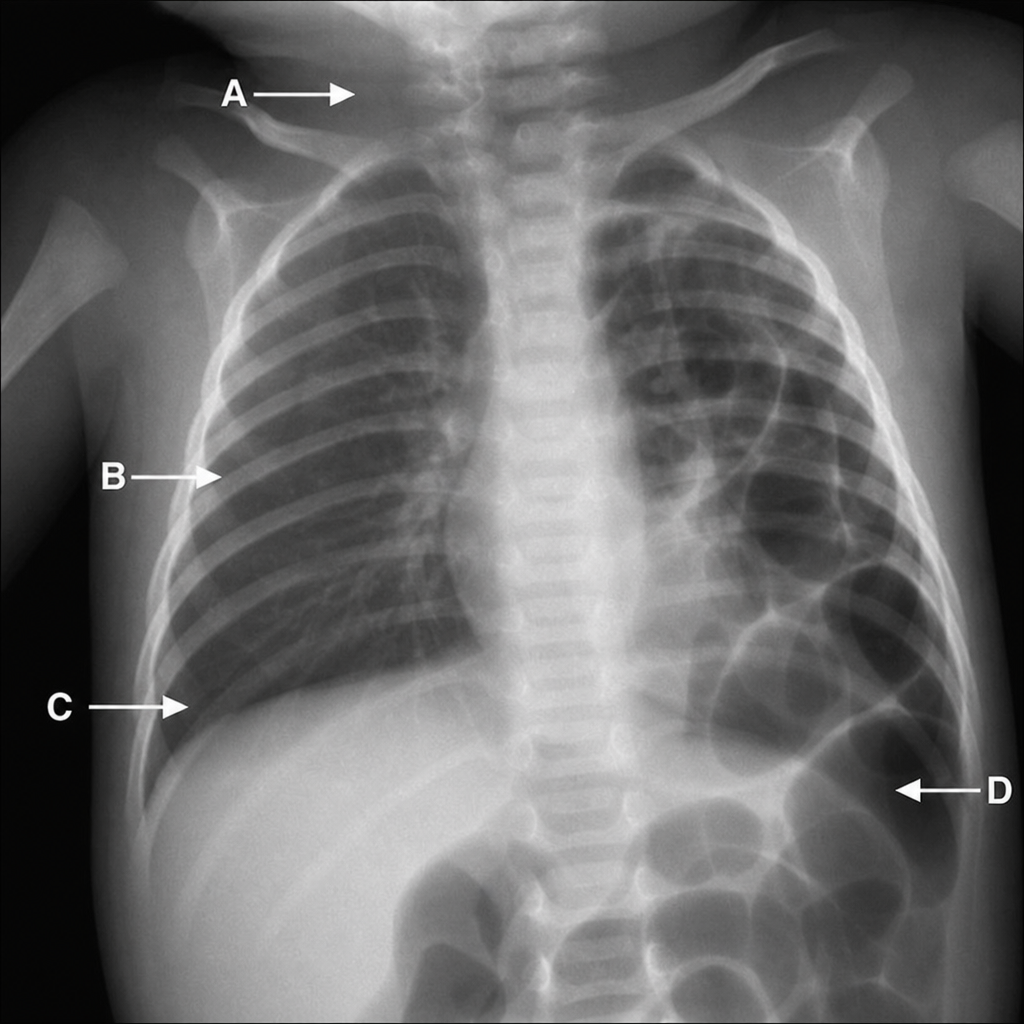
Ossicular portions found within the mesotympanum embryologically originate from which of the following?
Oogonia reach their maximum number at which stage of human development?
Reiche's cartilage derivative is:
The Nodal and lefty2 genes are associated with which process?
By which week of gestation is the formation of primordial follicles completed in the human fetus?
T cell migration to the tonsil occurs at which intrauterine age?
All of the following factors stimulate angiogenesis in a fetus, except?
Complete failure of fusion of the Müllerian ducts leads to which of the following congenital anomalies?
The mantle zone of the neural tube differentiates into an alar plate and a basal plate. Which of the following brainstem nuclei is NOT derived from the alar plate?
All of the following are associated with cardiac looping, EXCEPT?
Explanation: ### Explanation The middle ear ossicles (Malleus, Incus, and Stapes) develop from the cartilaginous elements of the first and second branchial (pharyngeal) arches. **Why the Second Branchial Arch is correct:** The **Second Branchial Arch (Reichert’s cartilage)** gives rise to the **Stapes** (except the footplate), the **Styloid process**, the **Stylohyoid ligament**, and the **Lesser cornu of the hyoid**. Since the stapes and the long process of the incus are situated within the mesotympanum, the second arch is the primary embryological contributor to the ossicular portions found in this specific anatomical space. [1] **Analysis of Incorrect Options:** * **A. First Branchial Arch (Meckel’s cartilage):** This arch gives rise to the **Malleus** (head and neck) and the **Incus** (body and short process). While it contributes to the ossicular chain, the question specifically targets the portions within the mesotympanum often associated with second arch derivatives. [1] * **C. Otic Capsule:** This is a mesenchymal condensation that forms the bony labyrinth of the inner ear. Crucially, the **footplate of the stapes** and the annular ligament are derived from the otic capsule, not the branchial arches. [1] * **D. Neural Sinus:** This is not a recognized embryological precursor for middle ear structures. **High-Yield Clinical Pearls for NEET-PG:** * **Mnemonic for Ossicles:** **M**alleus & **I**ncus = **1**st Arch; **S**tapes = **2**nd Arch (except footplate). * **Nerve Supply:** The **Tensor Tympani** (attached to Malleus) is supplied by V3 (1st arch nerve), while the **Stapedius** (attached to Stapes) is supplied by CN VII (2nd arch nerve). [1] * **Eustachian Tube & Middle Ear Cavity:** These are derived from the **1st Pharyngeal Pouch** (Endoderm). * **External Auditory Meatus:** Derived from the **1st Pharyngeal Cleft** (Ectoderm).
Explanation: The development of female gametes follows a specific chronological pattern of proliferation and attrition. Oogonia are derived from primordial germ cells that migrate to the genital ridge. Once there, they undergo rapid mitotic division. 1. **Why the 5th Month is Correct:** The population of oogonia increases exponentially through mitosis until the **5th month of intrauterine life (IUL)**. At this peak, the ovaries contain approximately **7 million** germ cells (oogonia and primary oocytes) [1]. After this point, a massive process of programmed cell death (atresia) begins, and no new oogonia are formed for the rest of the individual's life [1]. 2. **Analysis of Incorrect Options:** * **4th Month:** Mitotic division is still actively increasing the population; the peak has not yet been reached. * **6th & 7th Month:** By this stage, the process of **atresia** has already begun. The total number of germ cells starts to decline significantly. By birth, the number drops to approximately 1–2 million [1]. 3. **High-Yield NEET-PG Pearls:** * **Meiotic Arrest:** Primary oocytes begin their first meiotic division before birth but remain arrested in the **Diplotene stage of Prophase I** (mediated by Oocyte Maturation Inhibitor) until puberty [1]. * **Numbers at a Glance:** * Peak (5th month): 7 million [1]. * Birth: 1–2 million [1]. * Puberty: 40,000 (only ~400-500 are actually ovulated) [1]. * **Key Concept:** Unlike males (who produce spermatogonia throughout life), females are born with a finite number of potential gametes [1].
Explanation: The question pertains to the derivatives of the **Second Pharyngeal Arch** (Hyoid Arch). The cartilage of the second arch is known as **Reichert’s cartilage**. **1. Why the Correct Answer is Right:** Reichert’s cartilage undergoes endochondral ossification to form several structures in the head and neck. Its derivatives include: * **Stapes** (except the vestibular surface of the footplate). * **Styloid process** of the temporal bone. * **Stylohyoid ligament**. * **Lesser cornu** and the **upper part of the body** of the hyoid bone. Therefore, the **Styloid process** is a direct derivative of Reichert's cartilage. **2. Why the Other Options are Incorrect:** * **Incus and Malleus (Options A & B):** These are derivatives of the **First Pharyngeal Arch** (Mandibular Arch) cartilage, known as **Meckel’s cartilage**. * **Stapes footplate (Option C):** This is a high-yield distinction. While the head, neck, and crura of the stapes come from Reichert’s cartilage, the **vestibular surface of the footplate** and the annular ligament are derived from the **neural crest cells and the otic capsule**. **3. NEET-PG High-Yield Pearls:** * **Nerve of the 2nd Arch:** Facial Nerve (CN VII). * **Muscles of the 2nd Arch:** Muscles of facial expression, Stapedius, Stylohyoid, and the posterior belly of Digastric. * **Mnemonic for 2nd Arch Cartilage:** "**S**" structures — **S**tapes, **S**tyloid process, **S**tylohyoid ligament, **S**maller (lesser) cornu of hyoid. * **Clinical Correlation:** Treacher Collins Syndrome involves malformation of the 1st and 2nd arch derivatives.
Explanation: ### Explanation The correct answer is **A. Cardiac looping**. **Mechanism of Lateralization** The development of the heart begins with a straight heart tube. To achieve its final anatomical position, it must undergo **cardiac looping** (D-looping). This process is governed by the establishment of **left-right asymmetry** (lateralization) during gastrulation. * **The Molecular Pathway:** The signaling molecule **TGF-β (Transforming Growth Factor beta)** family plays a crucial role. Specifically, **Nodal** and **Lefty2** are expressed exclusively on the **left side** of the lateral plate mesoderm. * These genes upregulate the transcription factor **PITX2**, which acts as the "master gene" for left-sidedness. This molecular cascade ensures the heart tube loops to the right, positioning the primitive apex to the left. **Analysis of Incorrect Options:** * **B. Intestinal looping:** While the gut also undergoes rotation and physiological heartbeat rotations, the specific Nodal/Lefty2 signaling pathway is most classically associated with the initial breaking of symmetry in the cardiovascular system. * **C. Cardiac septation:** This process occurs *after* looping and involves different molecular signals (such as BMPs and TBX5) to divide the heart into four chambers. **NEET-PG High-Yield Pearls:** * **Situs Inversus:** Failure or reversal of the Nodal/Lefty2 signaling pathway can lead to *Situs Inversus* or *Dextrocardia*. * **Kartagener Syndrome:** Associated with primary ciliary dyskinesia. Cilia in the primitive streak (node) normally circulate Nodal/Lefty2 to the left; if they are immotile, these genes distribute randomly, leading to situs abnormalities. * **Master Gene:** Always remember **PITX2** is the final downstream effector for left-sided organ orientation.
Explanation: ### Explanation **1. Why 18 weeks is correct:** The development of the female germline follows a specific chronological sequence. Primordial germ cells migrate to the gonadal ridge by the 5th–6th week. These cells undergo rapid mitosis to become **oogonia**. Starting around the **11th to 12th week**, oogonia enter the first meiotic prophase to become **primary oocytes**. A primary oocyte surrounded by a single layer of flattened follicular cells constitutes a **primordial follicle**. This process of "folliculogenesis" begins in the inner cortex and peaks between **18 to 22 weeks** of gestation [1]. By the 18th week, the formation of the pool of primordial follicles is largely established, representing the total reproductive potential of the female. **2. Why other options are incorrect:** * **4 weeks:** At this stage, the embryo is in the organogenesis phase. Primordial germ cells are still located in the wall of the yolk sac and have not yet reached the genital ridges. * **8 weeks:** The gonads are "indifferent" at the beginning of this period. While sexual differentiation begins, the oogonia are still undergoing active mitosis and have not yet entered meiosis to form follicles. * **13 weeks:** This marks the *beginning* of the transition from oogonia to primary oocytes and the subsequent formation of the first primordial follicles, but the process is far from complete. **3. High-Yield Clinical Pearls for NEET-PG:** * **Peak Germ Cell Count:** Reaches its maximum (approx. 7 million) at **20 weeks** of gestation [1]. * **Atresia:** A massive decline occurs thereafter; only 1–2 million remain at birth, and roughly 400,000 at puberty [1]. * **Meiotic Arrest:** Primary oocytes remain arrested in the **Diplotene stage of Prophase I** until ovulation (triggered by the LH surge). * **Oogonia:** There are **no oogonia** left at birth; all have either become primary oocytes or undergone atresia [1].
Explanation: The development of the palatine tonsil is a multi-stage process involving the interaction of the endodermal lining of the **second pharyngeal pouch** and the surrounding mesenchyme. 1. **Why 18-19 weeks is correct:** While the tonsillar primordium begins to form around the 8th week, the actual **colonization of T-lymphocytes** into the tonsillar stroma occurs significantly later [1]. T-cell precursors migrate from the thymus and bone marrow to the tonsils between **18 and 19 weeks** of intrauterine life. This marks the transition of the tonsil into a functional secondary lymphoid organ. B-cells typically arrive shortly after, and organized lymphoid follicles appear even later (around 30 weeks). 2. **Analysis of Incorrect Options:** * **6-7 weeks:** This is too early for lymphoid migration. At this stage, the pharyngeal arches and pouches are just beginning to differentiate. * **10-11 weeks:** During this period, the endodermal buds of the second pouch begin to penetrate the mesenchyme to form tonsillar crypts, but the organ is not yet seeded by mature T-cells. * **14-15 weeks:** The lymphatic vessels and initial connective tissue framework are developing, but the peak migration of T-lymphocytes has not yet reached its definitive stage. **High-Yield Facts for NEET-PG:** * **Embryological Origin:** The epithelium of the palatine tonsil is derived from the **2nd pharyngeal pouch**. * **Tonsillar Crypts:** These are formed by the solid ingrowth of endodermal cells into the mesenchyme, which later canalize. * **Waldeyer’s Ring:** The palatine tonsil is a key component of this mucosal-associated lymphoid tissue (MALT). * **Thymus vs. Tonsil:** Remember that the **Thymus** (Primary lymphoid organ) develops from the **3rd pharyngeal pouch** and is populated by stem cells much earlier (around 9-10 weeks).
Explanation: ### Explanation **Concept:** Angiogenesis is the physiological process through which new blood vessels form from pre-existing ones. This process is tightly regulated by a balance between **angiogenic stimulators** (pro-angiogenic factors) and **angiogenic inhibitors** (anti-angiogenic factors) [1]. **Why Parent Option D is Correct:** **Interferon Alpha (IFN-α)** is a potent **angiogenic inhibitor**. It suppresses the production of pro-angiogenic factors like bFGF and VEGF and inhibits the proliferation and migration of endothelial cells. **Why the Other Options are Incorrect:** * **A. VEGF:** This is the most potent and specific primary mediator of angiogenesis [1]. It stimulates endothelial cell proliferation, migration, and increases vascular permeability. * **B. bFGF (FGF-2):** A powerful mitogen for endothelial cells [1]. It plays a crucial role in the early stages of vessel formation and wound healing. * **C. IL-8:** A pro-inflammatory cytokine that also acts as a potent promoter of angiogenesis by inducing endothelial cell chemotaxis and proliferation. **High-Yield NEET-PG Pearls:** * **Angiogenic Stimulators:** VEGF, bFGF, IL-8, Angiogenin, TGF-α, TGF-β, and TNF-α (at low doses). * **Angiogenic Inhibitors:** Interferon-α, Angiostatin, Endostatin, Thrombospondin-1, and Platelet Factor 4 (PF4). * **HIF-1 (Hypoxia-Inducible Factor):** The key transcription factor that upregulates VEGF expression in response to low oxygen levels in the fetus. * **Clinical Correlation:** Bevacizumab is a monoclonal antibody against VEGF used in cancer therapy to inhibit tumor angiogenesis [1].
Explanation: The development of the female reproductive tract depends on the fusion and canalization of the **Müllerian (paramesonephric) ducts**. The upper ends form the fallopian tubes, while the lower parts fuse to form the uterus, cervix, and upper vagina [1]. **1. Why Uterus Didelphys is correct:** Uterus didelphys occurs due to the **complete failure of fusion** of the two Müllerian ducts. Since the ducts do not merge at all, each duct develops independently into its own hemi-uterus and cervix. This results in a "double uterus" with two separate uterine bodies and two distinct cervices (often associated with a longitudinal vaginal septum) [2]. **2. Why the other options are incorrect:** * **Bicornuate uterus:** This results from **partial failure of fusion** of the Müllerian ducts [2]. The lower part fuses (single cervix), but the upper part remains separate (two uterine horns). * **Subseptate uterus:** This is a failure of **resorption** of the midline septum after the ducts have already fused [2]. The external contour of the uterus is normal, but the cavity is divided. * **Unicornuate uterus:** This occurs due to the **agenesis or failure of development** of one Müllerian duct, not a fusion defect. **Clinical Pearls for NEET-PG:** * **Renal Anomalies:** Müllerian duct anomalies are frequently associated with **renal agenesis** or ectopia (due to the close developmental relationship between the paramesonephric and mesonephric ducts). Always screen the kidneys. * **HSG vs. MRI:** Hysterosalpingography (HSG) can visualize the cavity, but **MRI** or **3D Ultrasound** is the gold standard for distinguishing between a bicornuate and septate uterus by evaluating the fundal contour. * **Septate Uterus:** This is the most common Müllerian anomaly and is associated with the highest rate of reproductive failure (miscarriages) [2].
Explanation: The development of the neural tube involves the differentiation of the mantle zone into two functional regions: the Alar plate (dorsal) and the Basal plate (ventral), separated by the sulcus limitans. 1. **Why Hypoglossal Nucleus is the correct answer:** The **Basal plate** is primarily **motor** in function. The **Hypoglossal nucleus (CN XII)** is a General Somatic Efferent (GSE) nucleus located in the medulla. Since it provides motor innervation to the tongue muscles, it is derived from the basal plate, not the alar plate. 2. **Analysis of Incorrect Options (Alar Plate Derivatives):** The **Alar plate** is primarily **sensory** in function. * **Solitary nucleus (B):** This is a sensory nucleus (SVA/GVA) receiving taste and visceral sensations; thus, it is alar-derived. * **Dorsal column nuclei (C):** The Nucleus Gracilis and Cuneatus are relay centers for fine touch and proprioception (sensory), originating from the alar plate. * **Inferior olivary nucleus (A):** Although involved in motor coordination, this nucleus (along with the pontine nuclei) is formed by neuroblasts that migrate ventrally from the **rhombic lips** of the alar plate. **High-Yield NEET-PG Clinical Pearls:** * **Mnemonic:** **A**lar = **A**scending/Sensory; **B**asal = **B**ecoming Motor. * **Sulcus Limitans:** The longitudinal groove that separates the alar and basal plates. * **Rhombic Lips:** Specialized parts of the alar plate that give rise to the **Cerebellum**, Inferior Olive, and Pontine nuclei. * **Cranial Nerve Nuclei:** In the brainstem, motor nuclei (Basal) are located medially, while sensory nuclei (Alar) are located laterally.
Explanation: **Explanation:** Cardiac looping is a critical developmental process occurring in the 4th week of gestation, where the linear heart tube transforms into a complex S-shaped structure. This process is essential for establishing the correct anatomical relationship between the atria and ventricles. **Why "None of the above" is correct:** Cardiac looping is strictly regulated by a cascade of transcription factors and signaling molecules that establish **left-right asymmetry**. All three options listed (Lefty, PITX2, and HAND1) are actively involved in this process. Since all are associated with cardiac looping, none can be excluded. **Analysis of Options:** * **Lefty & PITX2 (Left-Right Patterning):** The lateral plate mesoderm expresses **NODAL** and **LEFTY-2** on the left side. these upregulate **PITX2**, a "master gene" responsible for left-sidedness. Failure in this pathway leads to cardiac looping defects like *situs inversus* or *dextrocardia*. * **HAND1 & HAND2 (Chamber Specification):** As the heart loops, specific transcription factors regulate chamber formation. **HAND1** is primarily expressed in the future left ventricle, while **HAND2** is expressed in the right ventricle. They are essential for the expansion and positioning of the heart chambers during the looping process. **High-Yield Clinical Pearls for NEET-PG:** * **Direction:** The heart tube normally loops to the **right** (D-looping). * **Kartagener Syndrome:** Associated with *situs inversus* due to dynein arm defects, leading to a failure in establishing the Nodal cilia flow required for normal looping. * **NKX2.5:** Often called the "Tinman" gene; it is the master gene for heart development and specifies the cardiogenic field before looping begins.
Gametogenesis and Fertilization
Practice Questions
Early Embryonic Development
Practice Questions
Placentation
Practice Questions
Development of Nervous System
Practice Questions
Development of Cardiovascular System
Practice Questions
Development of Gastrointestinal System
Practice Questions
Development of Urogenital System
Practice Questions
Development of Musculoskeletal System
Practice Questions
Development of Head and Neck
Practice Questions
Congenital Anomalies
Practice Questions
Teratology
Practice Questions
Molecular Mechanisms in Development
Practice Questions
Get full access to all questions, explanations, and performance tracking.
Start For Free