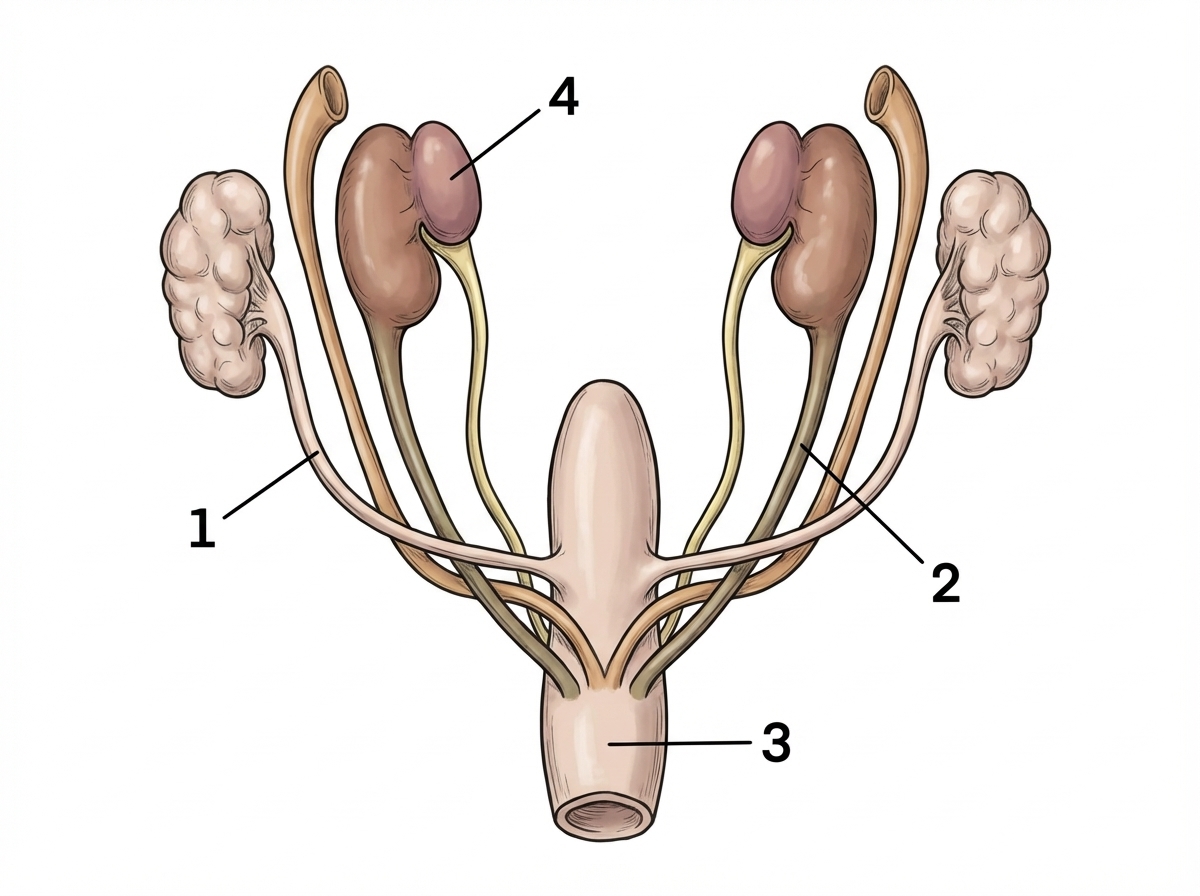
Palatine tonsil develops from which pharyngeal pouch?
The cervix develops from which embryonic structure?
Lanugo hair appears at:
Melanoblast cells appear in the basal layer of the epidermis during which stage of development?
Which of the following is not a neural crest derivative?
The spleen originates from which space of the peritoneal cavity?
A 1-day-old infant has a mass protruding through her umbilicus. Physical examination reveals an umbilical hernia. A CT scan reveals that part of another organ is attached to the inner surface of the hernia. What portion of the gastrointestinal tract is most likely to be attached to the inner surface of the umbilical hernia?
Which of the following structures is derived from the third pharyngeal arch?
Which of the following structures is not involved in the development of the diaphragm?
Fallopian tube dysmotility is seen in which of the following conditions?
Explanation: The pharyngeal pouches are endodermal outpocketings that give rise to various structures in the head and neck. The **second pharyngeal pouch** is the specific embryological origin of the **palatine tonsil**. 1. **Why Option B is Correct:** During the 2nd month of development, the endodermal lining of the second pouch proliferates and forms buds that invade the surrounding mesenchyme. These buds are later infiltrated by lymphatic tissue to form the palatine tonsil. A remnant of this pouch persists in adults as the **tonsillar fossa**. 2. **Why Other Options are Incorrect:** * **Option A (First Pouch):** Develops into the **tubotympanic recess**, which forms the auditory (Eustachian) tube and the middle ear cavity. * **Option B (Second Pouch):** Forms the palatine tonsil. * **Option C (Third Pouch):** Has a dorsal and ventral wing. The dorsal wing forms the **inferior parathyroid glands**, while the ventral wing forms the **thymus** [1]. * **Option D (Fourth Pouch):** The dorsal wing forms the **superior parathyroid glands**. The ventral part (often associated with the 5th pouch) forms the **ultimobranchial body**, which gives rise to the parafollicular (C) cells of the thyroid gland. **High-Yield NEET-PG Pearls:** * **Mnemonic for Parathyroids:** "3 is low, 4 is high." (3rd pouch = Inferior parathyroid; 4th pouch = Superior parathyroid). * **DiGeorge Syndrome:** Results from the failure of the 3rd and 4th pouches to develop, leading to thymic aplasia (immunodeficiency) and hypocalcemia (lack of parathyroids) [1]. * **Ectoderm vs. Endoderm:** Remember that pharyngeal **clefts** are ectodermal, while **pouches** are endodermal. The 1st cleft is the only one that persists (as the External Auditory Meatus).
Explanation: The **Mullerian duct** (also known as the Paramesonephric duct) is the primordial structure that gives rise to the female reproductive tract. During female development, the absence of Anti-Mullerian Hormone (AMH) allows these ducts to persist. The cranial ends remain open to form the fallopian tubes [2], while the caudal vertical parts fuse in the midline to form the **uterovaginal canal**. This canal subsequently differentiates into the **uterus, the cervix, and the upper 1/3rd of the vagina** [1]. **Analysis of Options:** * **Wolffian duct (Mesonephric duct):** In males, this develops into the epididymis, vas deferens, and seminal vesicles. In females, it regresses, leaving only vestigial remnants like Gartner’s cysts or the Epoophoron [2]. * **Mesonephros:** This is the "middle kidney" of the embryo. While it provides the scaffold for the Wolffian duct, it does not directly form the cervix. * **Metanephros:** This structure is the precursor to the definitive adult kidney (specifically the renal parenchyma). **High-Yield Clinical Pearls for NEET-PG:** 1. **Fusion Defects:** Failure of the Mullerian ducts to fuse properly leads to uterine anomalies such as **Uterus Didelphys** (double uterus/cervix) or **Bicornuate Uterus**. 2. **Vaginal Dual Origin:** Remember that the upper 1/3rd of the vagina is Mullerian (mesodermal), while the lower 2/3rd is derived from the **Urogenital Sinus** (endodermal) [1]. 3. **Mayer-Rokitansky-Küster-Hauser (MRKH) Syndrome:** A high-yield condition characterized by Mullerian agenesis, resulting in the absence of the uterus, cervix, and upper vagina.
Explanation: **Explanation:** The correct answer is **4 months (Option A)**. **1. Why 4 months is correct:** Lanugo refers to the fine, soft, downy hair that covers the body of the fetus [1]. Embryologically, hair follicles begin to develop at the end of the 3rd month, but the actual lanugo hair becomes visible on the surface of the skin during the **4th month (approximately 16–20 weeks)**. These hairs are essential for holding the *vernix caseosa* (a waxy protective coating) against the fetal skin, preventing maceration by the amniotic fluid. **2. Why the other options are incorrect:** * **5 months (Option B):** By the 5th month, lanugo is well-established and covers the entire body, but it first *appears* during the 4th month. * **6 months (Option C):** At this stage, the fetus is fully covered in lanugo. This is also the period when eyebrows and eyelashes become distinct. * **7 months (Option D):** From the 7th month (28 weeks) onwards, lanugo begins to shed as the fetus gains subcutaneous fat. By birth, it is usually replaced by vellus hair, except perhaps on the shoulders and back. **3. NEET-PG High-Yield Clinical Pearls:** * **Vernix Caseosa:** Produced by sebaceous glands; it protects fetal skin and is anchored by lanugo. * **Shedding Pattern:** Lanugo is typically shed between **32 to 36 weeks** of gestation. Its presence in large amounts at birth is a clinical sign of **prematurity**. * **Hypertrichosis Lanuginosa:** A pathological condition where lanugo-like hair persists or grows in adults, often associated with internal malignancies (paraneoplastic syndrome) or eating disorders like Anorexia Nervosa.
Explanation: **Explanation:** The development of the skin and its appendages is a high-yield topic in embryology. Melanocytes are derived from **neural crest cells**. During the first few weeks of development, these cells undergo an epithelial-to-mesenchymal transition, migrating from the dorsal neural tube into the mesoderm. 1. **Why A is correct:** By the **8th to 10th week** of intrauterine life, melanoblasts (precursors to melanocytes) migrate into the developing skin. They specifically reach and settle into the **basal layer of the epidermis** during the **3rd month** (approximately 12 weeks). Once there, they differentiate into mature melanocytes and begin producing melanosomes. 2. **Why other options are incorrect:** * **B (5th month):** By this stage, the skin is already covered by *vernix caseosa*, and the differentiation of hair follicles and sebaceous glands is well-advanced. Melanocytes are already functional. * **C & D (7th and 8th month):** These represent the late third trimester. At this point, the focus is on the keratinization of the epidermis and the accumulation of subcutaneous fat. Waiting until this stage for melanoblast migration would result in significant developmental delays in skin pigmentation. **High-Yield Clinical Pearls for NEET-PG:** * **Origin:** Epidermis is derived from **Surface Ectoderm**; Dermis is derived from **Mesoderm**; Melanocytes are derived from **Neural Crest Cells**. * **Waardenburg Syndrome:** A condition caused by the failure of neural crest cell migration, leading to patches of white skin/hair (piebaldism) and sensorineural deafness. * **Albinism:** Melanocytes are present in normal numbers, but there is a genetic deficiency in the enzyme **tyrosinase**, leading to a lack of melanin production. * **Langerhans Cells:** These are immune cells of the skin derived from **Bone Marrow (Mesoderm)**, appearing in the epidermis around the 7th week.
Explanation: The development of the eye involves multiple germ layers. The **Sphincter pupillae** and **Dilator pupillae** are unique because they are derived from the **Neuroectoderm** (specifically the outer layer of the optic cup). This is a high-yield exception in embryology, as most muscles in the body are of mesodermal origin. **Why the other options are incorrect:** * **Melanocytes (B):** These are classic neural crest derivatives. They migrate from the neural folds to various sites, including the skin, uveal tract of the eye, and stria vascularis of the inner ear. * **Ciliary Ganglion (C):** All peripheral nervous system ganglia (sensory, sympathetic, and parasympathetic) are derived from **Neural Crest Cells**. The ciliary ganglion specifically receives preganglionic parasympathetic fibers that terminate there [1]. * **Ciliary Muscle (A):** Unlike the iris muscles, the ciliary muscle and the stroma of the iris develop from the **Neural Crest** (specifically the periocular mesenchyme). The ciliary muscle receives postganglionic projections from the ciliary ganglion [1]. **High-Yield NEET-PG Pearls:** 1. **The "Rule of Two" for Iris Muscles:** Both the Sphincter and Dilator pupillae are derived from **Neuroectoderm**. 2. **Neural Crest Mnemonic (MOTHER):** **M**elanocytes, **O**dontoblasts, **T**racheal cartilage, **H**eart (Conotruncal septum), **E**nteric/Endocrine (Adrenal medulla), **R**esponses (Ganglia). 3. **Sclera and Cornea:** The fibrous and vascular coats of the eye (except the blood vessels) are primarily derived from **Neural Crest Cells**. 4. **Lens:** Derived from **Surface Ectoderm**.
Explanation: The spleen is a unique organ because, unlike most abdominal viscera, it is **mesodermal** in origin rather than endodermal. It develops during the 5th week of gestation as a localized proliferation of mesenchymal cells within the **Dorsal Mesogastrium** (the portion of the dorsal mesentery associated with the stomach). **Why the correct answer is right:** As the spleen grows within the layers of the dorsal mesentery, it divides this mesentery into two distinct ligaments: 1. **Gastrosplenic ligament:** Connecting the stomach to the spleen. 2. **Lienorenal (Splenorenal) ligament:** Connecting the spleen to the left kidney. Because it develops entirely within this posterior peritoneal fold, the spleen is classified as an intraperitoneal organ derived from the dorsal mesentery. **Why the incorrect options are wrong:** * **Ventral Mesentery:** This gives rise to the **liver**, gallbladder, and lesser omentum [1]. It exists only in the upper abdomen (foregut) and attaches to the anterior abdominal wall [1]. * **Left Subhepatic Space:** This is a clinical anatomical space (part of the supracolic compartment) where abscesses can form, but it is not an embryological site of origin. * **Infracolic Compartment:** This refers to the space below the transverse colon containing the small intestine loops; the spleen is located in the supracolic compartment. **High-Yield Clinical Pearls for NEET-PG:** * **Histology:** The spleen develops from **mesenchymal lobules** which later fuse. Failure of fusion leads to **accessory spleens (splenunculi)**, most commonly found in the splenic hilum or the tail of the pancreas. * **Rotation:** The rotation of the stomach to the left pushes the spleen into the left hypochondrium. * **Blood Supply:** Despite its development in the dorsal mesogastrium, its artery (Splenic Artery) is a branch of the **Celiac Trunk** (the artery of the foregut).
Explanation: ### Explanation **1. Why the Correct Answer is Right (Ileum):** The correct answer is the **Ileum** because of its embryological relationship with the **Vitelline duct (Omphalomesenteric duct)**. During the 6th week of development, the midgut undergoes physiological herniation into the umbilical cord. The apex of the midgut loop is connected to the yolk sac via the vitelline duct. This apex specifically corresponds to the **distal ileum**. In cases of an umbilical hernia, the ileum is the most proximal and mobile structure to the umbilical ring. Furthermore, if the vitelline duct fails to obliterate, it can result in a **Meckel’s diverticulum**, which is located on the antimesenteric border of the ileum (approximately 2 feet proximal to the ileocecal valve) [1]. Therefore, the ileum is the most likely organ to be attached to or found within the sac of an umbilical hernia [1]. **2. Why the Incorrect Options are Wrong:** * **Anal Canal (A):** The anal canal is derived from the hindgut (upper part) and proctodeum (lower part). It is located in the pelvis, far from the umbilical region. * **Appendix (B) & Cecum (C):** While the cecum and appendix are part of the midgut, they are located on the **caudal limb** of the midgut loop. During rotation and retraction (10th week), they settle in the right iliac fossa. They are not the primary structures attached to the vitelline duct at the umbilical apex. **3. Clinical Pearls for NEET-PG:** * **Physiological Herniation:** Occurs at 6 weeks; return of midgut to the abdomen occurs at 10 weeks. * **Rule of 2s (Meckel’s Diverticulum):** 2% of the population, 2 inches long, 2 feet from the ileocecal valve, 2 types of ectopic tissue (gastric and pancreatic), presents by age 2 [1]. * **Omphalocele vs. Gastroschisis:** Omphalocele is a midline defect covered by peritoneum/amnion (failure of midgut to return); Gastroschisis is a paraumbilical defect (usually right side) with no covering sac.
Explanation: The pharyngeal (branchial) arches are fundamental to head and neck development. Each arch contains a central cartilaginous rod, a cranial nerve, and an artery. **Correct Answer Explanation:** The **third pharyngeal arch** is associated with the **Greater cornu** and the **lower part of the body of the hyoid bone**. Its nerve supply is the **Glossopharyngeal nerve (CN IX)**, and its primary muscular derivative is the stylopharyngeus. **Analysis of Incorrect Options:** * **A. Styloid process:** This is derived from the **second pharyngeal arch** (Reichert’s cartilage). The second arch also gives rise to the lesser cornu and upper part of the body of the hyoid bone, the stapes, and the stylohyoid ligament. * **B. Malleus & C. Incus:** These are derivatives of the **first pharyngeal arch** (Meckel’s cartilage). The first arch also forms the mandible (as a template), the sphenomandibular ligament, and the anterior ligament of the malleus. **High-Yield Clinical Pearls for NEET-PG:** * **Hyoid Bone Rule:** Remember the "2-3 split." The upper part/lesser cornu comes from the **2nd arch**, while the lower part/greater cornu comes from the **3rd arch**. * **Nerve Mnemonics:** * 1st Arch: Trigeminal (V2, V3) * 2nd Arch: Facial (VII) * 3rd Arch: Glossopharyngeal (IX) * 4th & 6th Arches: Vagus (X) - Superior laryngeal and Recurrent laryngeal branches respectively. * **Treacher Collins Syndrome:** Results from the failure of first arch neural crest cell migration, leading to mandibular hypoplasia and malformed ossicles (malleus/incus).
Explanation: The diaphragm is a composite structure derived from four distinct embryonic sources. The **Pleuropericardial membrane** is the correct answer because it is **not** involved in the development of the diaphragm; instead, it gives rise to the **fibrous pericardium** and the mediastinal pleura as it separates the pleural cavities from the pericardial cavity [1]. #### Development of the Diaphragm (The 4 Components): 1. **Septum Transversum (Option B):** This is the primordium of the diaphragm [2]. It forms the **Central Tendon**. It initially lies opposite the C3-C5 somites, explaining the phrenic nerve’s origin. 2. **Pleuroperitoneal Membranes (Option C):** These close the pericardioperitoneal canals. They contribute to the **primitive diaphragm** but represent only a small portion of the adult structure. 3. **Dorsal Mesentery of Esophagus:** This forms the **Crura** of the diaphragm. 4. **Somatic Body Wall (Option A):** During months 9–12 of gestation, the lungs expand and "excavate" the body wall. This adds a **peripheral rim** of muscular tissue to the diaphragm and forms the costodiaphragmatic recesses. #### Clinical Pearls for NEET-PG: * **Congenital Diaphragmatic Hernia (Bochdalek):** Most commonly occurs due to the failure of the **Pleuroperitoneal membrane** to fuse, typically on the **left side** (as the right side closes earlier and is protected by the liver). * **Mnemonic for Diaphragm Origins:** "**S**everal **P**arts **B**uild **D**iaphragm" (**S**eptum transversum, **P**leuroperitoneal membrane, **B**ody wall, **D**orsal mesentery). * **Nerve Supply:** The phrenic nerve (C3, 4, 5) provides motor supply, reflecting the septum transversum's cervical origin.
Explanation: **Explanation:** **Correct Answer: C. Kartagener Syndrome** Kartagener syndrome is a subset of **Primary Ciliary Dyskinesia (PCD)**, characterized by the triad of situs inversus, chronic sinusitis, and bronchiectasis. The underlying pathology is a genetic defect in the **dynein arms** of cilia (9+2 microtubule arrangement). The lining of the Fallopian tubes (salpinx) consists of ciliated columnar epithelium. These cilia are responsible for the transport of the ovum toward the uterus and the movement of sperm toward the egg. In Kartagener syndrome, these cilia are immotile or dyskinetic, leading to **Fallopian tube dysmotility**. This significantly increases the risk of **ectopic pregnancy** [1] and **female infertility**, mirroring the mechanism of male infertility caused by immotile sperm flagella. **Analysis of Incorrect Options:** * **A. Noonan Syndrome:** A genetic disorder (often PTPN11 mutation) characterized by short stature, webbed neck, and pulmonary stenosis. It does not involve ciliary dysfunction. * **B. Turner Syndrome (45, XO):** Characterized by "streak ovaries" and primary amenorrhea due to accelerated oocyte atresia [2]. While it causes infertility, the mechanism is ovarian failure, not tubal dysmotility. * **C. Marfan Syndrome:** A connective tissue disorder caused by FBN1 mutations affecting fibrillin-1. It involves skeletal, ocular, and cardiovascular systems (e.g., aortic dissection) but not ciliary motility. **NEET-PG High-Yield Pearls:** * **Dynein Arms:** The ATPase protein responsible for the sliding movement of microtubules in cilia. * **Clinical Triad:** Situs inversus + Bronchiectasis + Sinusitis. * **Infertility Link:** In males, it is due to immotile spermatozoa (flagellar defect); in females, it is due to impaired ciliary action in the fallopian tubes. * **Diagnosis:** Screening via nasal nitric oxide levels; confirmed by electron microscopy or genetic testing.
Gametogenesis and Fertilization
Practice Questions
Early Embryonic Development
Practice Questions
Placentation
Practice Questions
Development of Nervous System
Practice Questions
Development of Cardiovascular System
Practice Questions
Development of Gastrointestinal System
Practice Questions
Development of Urogenital System
Practice Questions
Development of Musculoskeletal System
Practice Questions
Development of Head and Neck
Practice Questions
Congenital Anomalies
Practice Questions
Teratology
Practice Questions
Molecular Mechanisms in Development
Practice Questions
Get full access to all questions, explanations, and performance tracking.
Start For Free