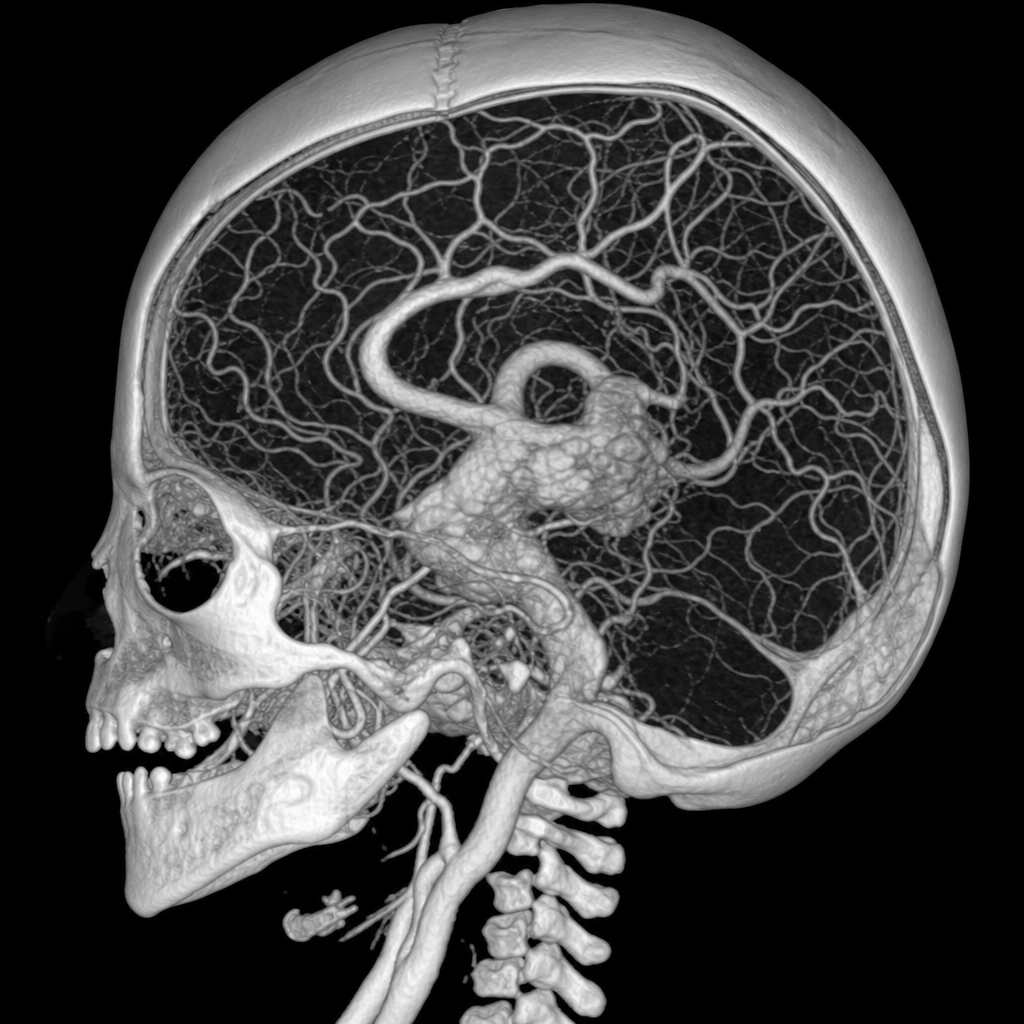
Which of the following is NOT a true statement regarding the derivatives of the aortic arches?
Which of the following statements is NOT true regarding paramedian pits?
The Glossopharyngeal nerve supplies the posterior 1/3 of the tongue because it develops from which embryological structure?
The diaphragm is formed of all the following except?
Ossification of long bones begins at what age?
What is the name of the congenital anomaly this child is suffering from?

The visceral efferent column of the neural tube arises from which embryonic structure?
During the first 3-4 months of gestation, erythrocytes are formed by which structure?
During development, the parts of the ear develop at different intervals. All of the following structures are of adult size at birth, EXCEPT?
Oogonia reach their maximum number at which of the following stages of human development?
Explanation: The aortic arches are a series of six pairs of mesenchymal vessels that connect the aortic sac to the dorsal aortae. Understanding their transformation is crucial for NEET-PG. **Explanation of the Correct Answer (D):** Option D is the incorrect statement (and thus the correct answer) because the **5th aortic arch** is a rudimentary structure that either never forms or forms incompletely and quickly regresses. In human embryology, it is considered **functionally absent or transient in 100% of embryos**, not just 5%. It leaves no permanent vascular derivatives. **Analysis of Incorrect Options:** * **A (True):** The **6th aortic arch** (Pulmonary arch) gives rise to the left and right pulmonary arteries. On the left side, the distal part persists as the **ductus arteriosus** (ligamentum arteriosum postnatally) [2]. * **B (True):** The **1st aortic arch** largely disappears, but a small portion persists to form the **maxillary artery**. (Mnemonic: *1st is Max*). * **C (True):** The arches develop in a cranio-caudal succession. By the time the 6th arch is forming, the 1st and 2nd arches have already largely regressed. They are **never all present at the same time**. **High-Yield Clinical Pearls:** * **3rd Arch:** Forms the Common Carotid and proximal Internal Carotid arteries. (*C is the 3rd letter*). * **4th Arch:** On the **Left**, it forms the Arch of Aorta [1]; on the **Right**, it forms the proximal part of the Right Subclavian artery. * **Recurrent Laryngeal Nerve:** Its asymmetrical course is due to the transformation of the 6th arch. On the right, it hooks around the subclavian (4th arch) because the distal 6th arch disappears; on the left, it hooks around the ligamentum arteriosum (6th arch) [1].
Explanation: **Explanation:** **Paramedian Pits** (also known as congenital lip pits) are rare developmental malformations. The correct answer is **Option B** because these pits are characteristically found on the **lower lip**, not the upper lip. 1. **Why Option B is correct (The Concept):** Paramedian pits occur due to the failure of the embryonic **lateral labial sulci** to obliterate during the development of the mandibular process. Since the mandibular process forms the lower lip, these pits are anatomically restricted to the lower lip. Finding pits on the upper lip is extremely rare and usually associated with different syndromic patterns (like commissural pits). 2. **Why other options are incorrect:** * **Option A & C:** These are true anatomical descriptions. Paramedian pits are typically bilateral, symmetric indentations located on either side of the midline on the vermilion border of the lower lip. * **Option D:** This is a true clinical association. Paramedian lip pits are a hallmark feature of **Van der Woude Syndrome**, which is the most common form of syndromic orofacial clefting. **High-Yield Clinical Pearls for NEET-PG:** * **Van der Woude Syndrome:** Autosomal Dominant inheritance; caused by a mutation in the **IRF6 gene**. It is characterized by the triad of paramedian lower lip pits, cleft lip, and/or cleft palate. * **Kabuki Syndrome:** Another condition where lower lip pits may be seen, alongside skeletal abnormalities and intellectual disability. * **Embryology:** Remember that the lower lip forms from the fusion of the two **mandibular prominences**, while the upper lip forms from the fusion of the **medial nasal prominences** and the **maxillary prominences**.
Explanation: ### Explanation The development of the tongue is a high-yield topic in embryology, as its complex nerve supply reflects its multisource origin from the pharyngeal arches. **Why Hypobranchial Eminence is Correct:** The tongue develops from the floor of the primitive pharynx. The **posterior 1/3 (base)** of the tongue is derived from the **cranial part of the hypobranchial eminence** (also known as the *copula of His*). This structure is formed by the mesoderm of the **3rd pharyngeal arch**. Since the **Glossopharyngeal nerve (CN IX)** is the nerve of the 3rd arch, it provides both general and special sensory (taste) innervation to the posterior 1/3 of the tongue [1]. **Analysis of Incorrect Options:** * **A. Hyoid arch (2nd Arch):** While the 2nd arch initially contributes to the tongue, it is eventually overgrown by the 3rd arch (hypobranchial eminence). Consequently, the 2nd arch nerve (Facial nerve) does not supply the tongue mucosa, except for a small area near the epiglottis via the internal laryngeal nerve. * **B. Tuberculum impar:** This is a median swelling that, along with the two **lateral lingual swellings**, forms the **anterior 2/3** of the tongue. * **C. Mandibular arch (1st Arch):** The 1st arch gives rise to the lateral lingual swellings and tuberculum impar. Therefore, the nerve of the 1st arch (**Lingual nerve**, a branch of CN V3) provides general sensation to the anterior 2/3. **NEET-PG High-Yield Pearls:** 1. **Anterior 2/3:** Derived from 1st Arch. General sensation: Lingual nerve (V3); Taste: Chorda tympani (VII). 2. **Posterior 1/3:** Derived from 3rd Arch (Hypobranchial eminence). Sensation & Taste: Glossopharyngeal nerve (IX) [1]. 3. **Posteriormost part:** Derived from 4th Arch. Nerve: Internal laryngeal nerve (X). 4. **Muscles:** All tongue muscles (except Palatoglossus) develop from **occipital myotomes** and are supplied by the **Hypoglossal nerve (XII)**. Palatoglossus is supplied by the Pharyngeal plexus (X).
Explanation: The diaphragm is a complex musculotendinous partition that develops from four distinct embryonic sources during the 4th to 12th weeks of gestation. ### **Why Paraxial Mesoderm is the Correct Answer** The diaphragm is primarily derived from **lateral plate mesoderm** and **somites** (specifically cervical somites C3-C5), not paraxial mesoderm. While paraxial mesoderm gives rise to the axial skeleton and skeletal muscles of the trunk, the specific muscular components of the diaphragm migrate from the cervical somites into the other three primordia. ### **Analysis of Other Options (The Four Sources)** 1. **Septum Transversum (Option A):** This is the primordium of the **central tendon** of the diaphragm [1]. It initially lies opposite the cervical somites, explaining the phrenic nerve's origin (C3, 4, 5). 2. **Pleuroperitoneal Membranes (Option C):** These close the communication between the pleural and peritoneal cavities. Failure of these membranes to fuse is the most common cause of **Congenital Diaphragmatic Hernia (Bochdalek).** 3. **Dorsal Mesentery of Oesophagus (Option D):** This forms the **crura** of the diaphragm. 4. **Body Wall (Lateral Plate Mesoderm):** Though not listed as a primary option, the peripheral muscular part of the diaphragm is derived from the internal layer of the lateral body walls. ### **High-Yield Clinical Pearls for NEET-PG** * **Mnemonic for Sources:** "**S**everal **P**arts **B**uild **D**iaphragm" (**S**eptum transversum, **P**leuroperitoneal membrane, **B**ody wall, **D**orsal mesentery). * **Nerve Supply:** "C3, 4, 5 keep the diaphragm alive." The phrenic nerve provides both motor and sensory supply to the central part. * **Bochdalek Hernia:** Most common (85-90%), occurs posterolaterally, usually on the **left side** due to the earlier closure of the right pleuroperitoneal canal and the presence of the liver. * **Morgagni Hernia:** Occurs anteriorly through the space of Larrey.
Explanation: The development of the human skeleton occurs through two types of ossification: intramembranous and endochondral [1]. Most long bones develop via **endochondral ossification**, where a hyaline cartilage model is gradually replaced by bone [1]. **Why Option B is Correct:** Primary centers of ossification for most long bones (such as the femur and humerus) typically appear during the **7th to 8th week of intrauterine life (IUL)**. Specifically, the clavicle is the first bone to begin ossifying (around the 5th–6th week), followed closely by the femur and other long bones by the 7th week. This marks the transition from the embryonic period to the fetal period. [1] **Analysis of Incorrect Options:** * **Option A (3rd week):** This is the period of gastrulation (formation of the three germ layers). Bone formation has not yet begun; the mesoderm is just beginning to differentiate into somites. * **Option C (5th week):** During this stage, limb buds are just forming, and mesenchymal condensation begins to create the initial "scaffold." Only the clavicle (a membrane bone) starts ossifying late in this period. [1] * **Option D (9th week):** By this time, ossification is already well underway in the primary centers of the diaphysis of most long bones. **High-Yield Clinical Pearls for NEET-PG:** * **First bone to ossify:** Clavicle (5th–6th week IUL) via intramembranous ossification. [1] * **First long bone to ossify:** Femur. * **Primary Center:** Usually appears before birth (diaphysis). * **Secondary Center:** Usually appears after birth (epiphysis), with the exception of the **distal end of the femur** and **proximal end of the tibia**, which appear just before birth (used as a medico-legal indicator of fetal maturity).
Explanation: ***Anencephaly*** - Results from **failure of anterior neural tube closure** during the 3rd-4th week of embryonic development, leading to absence of the **cranial vault** and **cerebral hemispheres**. - Characterized by **exposed neural tissue** (cerebrovasculosa) and **prominent eyes** due to lack of overlying skull and brain tissue. *Encephalocele* - A **neural tube defect** where brain tissue herniates through a **skull defect**, typically in the **occipital region**. - The **cranial vault remains intact** except for the localized defect, unlike the complete absence seen in anencephaly. *Hydranencephaly* - A condition where **cerebral hemispheres are replaced by fluid-filled sacs**, but the **skull and scalp remain normal**. - The **cranial vault is present and intact**, distinguishing it from anencephaly where the vault is completely absent. *Diastematomyelia* - A **spinal cord malformation** where the cord is split by a **bony or fibrous septum**, affecting the **vertebral column**. - This is a **spinal neural tube defect**, not a cranial anomaly, and does not involve the brain or skull.
Explanation: ### Explanation The development of the spinal cord and brainstem involves the differentiation of the neural tube into distinct functional zones. This process is regulated by the **sulcus limitans**, a longitudinal groove that divides the neural tube into a dorsal and a ventral half. **1. Why the Basal Plate is correct:** The **Basal plate** is the ventral thickening of the mantle layer. It is primarily **motor** in function. It gives rise to two major functional columns: * **General Somatic Efferent (GSE):** Innervates skeletal muscles (e.g., anterior horn cells). * **General Visceral Efferent (GVE):** Innervates smooth muscles, cardiac muscles, and glands (e.g., lateral horn cells/autonomic preganglionic neurons) [1]. Therefore, all efferent (motor) components, including visceral ones, originate from the basal plate [1]. **2. Analysis of Incorrect Options:** * **A. Alar plate:** This is the dorsal thickening of the mantle layer. It is **sensory** in function and gives rise to the General Somatic Afferent (GSA) and General Visceral Afferent (GVA) columns. * **C & D. Roof and Floor plates:** These are thin midline structures located at the dorsal and ventral midlines, respectively. They do not contain neuroblasts; instead, they serve as pathways for nerve fibers crossing from one side to the other (commissures) and act as signaling centers (e.g., Shh from the floor plate) for dorsoventral patterning. **3. High-Yield Clinical Pearls for NEET-PG:** * **Mnemonic:** **A**lar = **A**fferent (Sensory); **B**asal = **B**eferent (Motor - *conceptual mnemonic*). * **Signaling Molecules:** The **Basal plate** is induced by **Sonic Hedgehog (Shh)** secreted by the notochord and floor plate. The **Alar plate** is induced by **BMP** and **Wnt** secreted by the overlying ectoderm and roof plate. * In the brainstem, the same arrangement persists, but the plates are pushed laterally by the widening of the fourth ventricle, placing motor nuclei medially and sensory nuclei laterally.
Explanation: ### Explanation The development of blood cells (hematopoiesis) in the fetus occurs in distinct chronological stages, often remembered by the mnemonic **"Young Liver Synthesizes Blood."** **1. Why Bone Marrow is the Correct Answer (in the context of the provided key):** While the question asks for the "3-4 month" period, there is a common point of confusion in exam patterns. Technically, the **Liver** is the dominant site during the second trimester (3–6 months). However, the **Bone Marrow** begins its transition to becoming the primary hematopoietic organ starting around the **end of the 4th month** (approx. 18 weeks). In many standardized formats, if the question emphasizes the transition toward the end of the first trimester or early second trimester, the shift toward definitive medullary hematopoiesis is being tested. **2. Analysis of Incorrect Options:** * **A. Yolk Sac:** This is the **Mesoblastic stage**. It is the first site of hematopoiesis, starting at the 3rd week of gestation and concluding by the end of the 2nd month. * **B. Liver:** This is the **Hepatic stage**. The liver is the chief site of blood cell formation from the 2nd month until the 6th month [1]. It peaks at the 3rd–4th month. * **C. Spleen:** The spleen contributes to hematopoiesis primarily between the 3rd and 6th months but is never the primary site compared to the liver. **3. NEET-PG High-Yield Clinical Pearls:** * **Chronology:** Yolk Sac (3–8 weeks) → Liver (6 weeks–birth) → Spleen (10–28 weeks) → Bone Marrow (18 weeks onwards). * **Primary Site at Birth:** By the 7th month of gestation, the bone marrow becomes the primary site. * **Hb Types:** Yolk sac produces Gower hemoglobin; the Liver produces Fetal Hemoglobin (HbF); Bone marrow produces Adult Hemoglobin (HbA) [1]. * **Clinical Note:** If bone marrow fails (e.g., in myelofibrosis), the body reverts to the **Liver and Spleen** for blood production, a process called **Extramedullary Hematopoiesis**.
Explanation: **Explanation:** In human development, the auditory apparatus is unique because several of its components reach adult dimensions before or at the time of birth. This is a high-yield concept in embryology and ENT anatomy. **1. Why Maxillary Antrum is the Correct Answer:** The **Maxillary Antrum (Maxillary Sinus)** is the only option listed that is **not** adult-sized at birth. At birth, it is merely a small, fluid-filled slit (measuring approximately 7 x 4 x 4 mm). It undergoes biphasic growth (at ages 0–3 and 7–12) and only reaches its full adult volume after the eruption of all permanent teeth, around age 15–18. **2. Analysis of Incorrect Options:** * **Ear Ossicles (Malleus, Incus, Stapes):** These are the first bones to fully ossify in the body (by the 4th–5th month of fetal life) and are of **full adult size at birth**. * **Oval Window:** Along with the internal ear structures (like the cochlea and vestibule), the oval window reaches adult dimensions during the fetal period to accommodate the already adult-sized stapes footplate. * **Middle Ear Cavity (Tympanic Cavity):** The cavity itself, along with the tympanic membrane, is essentially of adult size at birth, although the surrounding mastoid air cells have not yet pneumatized. **Clinical Pearls for NEET-PG:** * **Mastoid Antrum:** Like the middle ear, the mastoid antrum is of **adult size at birth**, but the **mastoid process** is absent (it develops at age 2 due to the pull of the Sternocleidomastoid muscle). * **Internal Ear:** The bony labyrinth reaches adult size by the 20th week of gestation. * **Ethmoid Sinus:** Present at birth (like the maxillary sinus) but not adult-sized. * **Frontal and Sphenoid Sinuses:** These are typically **absent at birth** and start developing postnatally.
Explanation: ### Explanation **Correct Option: A. Five months of fetal life** The development of female gametes follows a unique "peak and decline" pattern. Primordial germ cells migrate to the gonadal ridge and undergo rapid mitotic division to become **oogonia**. This mitotic activity reaches its peak during the **5th month of intrauterine life**, at which point the total number of oogonia is estimated to be approximately **7 million** [1]. After this peak, no new oogonia are formed. Instead, a process of programmed cell death (atresia) begins. By the time of birth, many oogonia have either degenerated or entered the first meiotic division to become primary oocytes, reducing the count to about 600,000 to 2 million [1]. **Why other options are incorrect:** * **B, C, and D:** These options represent postnatal stages. Unlike males, who produce sperm continuously from puberty onwards, females are born with a finite number of oocytes. By **puberty**, the number has already depleted significantly to approximately **300,000 to 400,000** due to continuous atresia. Therefore, the count at puberty or adulthood is significantly lower than the mid-fetal peak. --- ### High-Yield Clinical Pearls for NEET-PG: * **The "7-2-4" Rule:** Remember the numbers: **7 million** at 5 months gestation (peak), **2 million** at birth, and **400,000** at puberty [1]. * **Meiotic Arrest:** Primary oocytes begin Meiosis I during fetal life but are arrested in the **Diplotene stage of Prophase I** (dictyotene stage) until puberty [1], [2]. * **Completion of Meiosis:** Meiosis I is completed just before ovulation (forming the secondary oocyte and first polar body) [2]. Meiosis II is only completed if **fertilization** occurs. * **Atresia:** Over 99% of the original germ cell population is lost through atresia; only about 400–500 oocytes are actually ovulated during a woman's reproductive lifespan [1].
Gametogenesis and Fertilization
Practice Questions
Early Embryonic Development
Practice Questions
Placentation
Practice Questions
Development of Nervous System
Practice Questions
Development of Cardiovascular System
Practice Questions
Development of Gastrointestinal System
Practice Questions
Development of Urogenital System
Practice Questions
Development of Musculoskeletal System
Practice Questions
Development of Head and Neck
Practice Questions
Congenital Anomalies
Practice Questions
Teratology
Practice Questions
Molecular Mechanisms in Development
Practice Questions
Get full access to all questions, explanations, and performance tracking.
Start For Free