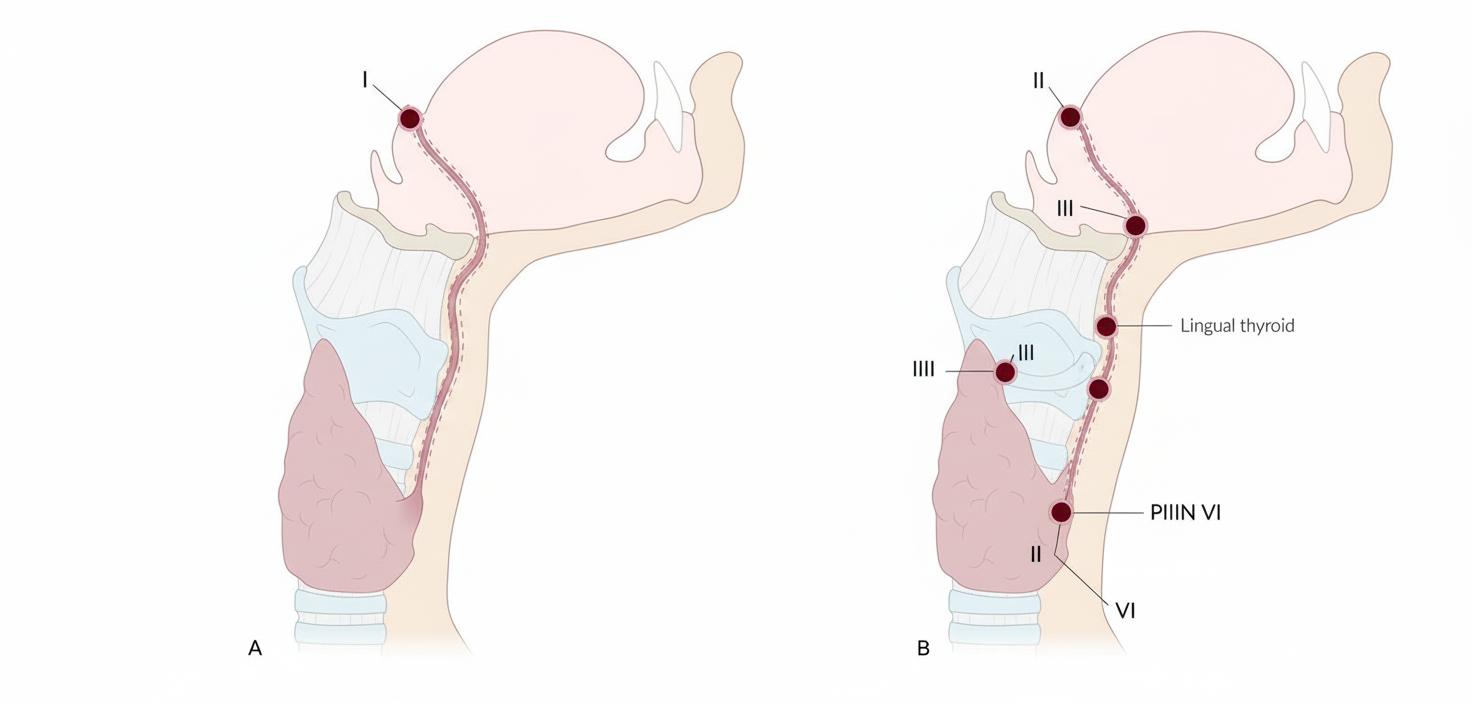
List the odd one out among the following:
The presence of a uterus and fallopian tubes in an otherwise phenotypically normal male is due to which of the following?
Which of the following is a neural tube defect?
Which of the following structures is derived from the ectoderm?
Which structure is derived from the right aortic arch?
Ligamentum teres is formed from which of the following embryologic structures?
What is the normal composition of vessels within the umbilical cord?
Trophoblast gives rise to all of the following EXCEPT?
Persistence of the distal part of the vitellointestinal duct results in which of the following?
At the end of week 2 of development (day 14), what is the composition of the embryonic disc?
Explanation: **Explanation:** The core concept of this question lies in identifying the correct association between chromosomal aneuploidies and their clinical eponyms. **Why Option A is the Correct Answer (The "Odd One Out"):** Option A is factually incorrect and represents a mismatch. **Trisomy 18** is clinically known as **Edwards syndrome**, not Noonan syndrome. **Noonan syndrome** is an autosomal dominant genetic disorder (often involving mutations in the *PTPN11* gene) characterized by short stature, heart defects (pulmonic stenosis), and webbed neck. It is often referred to as the "male version of Turner syndrome" but occurs in both sexes with a normal karyotype. **Analysis of Incorrect Options (Correct Associations):** * **Option B: Trisomy 21 (Down syndrome):** This is the most common autosomal trisomy [1]. Key features include Simian crease, mental retardation, and Brushfield spots [1]. * **Option C: Trisomy 18 (Edwards syndrome):** This is the second most common autosomal trisomy. Key features include "rocker-bottom" feet, clenched fists with overlapping fingers, and micrognathia. * **Option D: Trisomy 13 (Patau syndrome):** Characterized by midline defects such as holoprosencephaly, cleft lip/palate, and polydactyly. **High-Yield Clinical Pearls for NEET-PG:** * **Mnemonic for Trisomies:** **P**atau (13 - **P**uberty age), **E**dwards (18 - **E**lection age), **D**own (21 - **D**rinking age). * **Maternal Screening:** In Down syndrome, HCG and Inhibin-A are **increased**, while AFP and Estriol are **decreased**. In Edwards syndrome, all four markers are typically decreased. * **Noonan vs. Turner:** Noonan syndrome presents with **Pulmonic Stenosis**, whereas Turner syndrome (45,XO) is associated with **Coarctation of the Aorta** [2].
Explanation: This question refers to **Persistent Mullerian Duct Syndrome (PMDS)**, a rare form of internal male pseudohermaphroditism. ### **Explanation of the Correct Answer** In a normal 46, XY fetus, the SRY gene leads to the development of testes. The Sertoli cells of the fetal testes secrete **Mullerian-inhibiting factor (MIF)**, also known as Anti-Mullerian Hormone (AMH) [1]. MIF causes the regression of the paramesonephric (Mullerian) ducts, which would otherwise form the uterus, fallopian tubes, and upper vagina. In PMDS, there is either a **deficiency of MIF** or a **mutation in its receptor**. Consequently, the Mullerian ducts fail to regress and develop into female internal pelvic organs, despite the presence of functioning Leydig cells that produce testosterone to virilize the external genitalia [1]. ### **Why Other Options are Incorrect** * **B. Lack of testosterone:** Testosterone is responsible for the stabilization of Wolffian ducts (internal male structures) and the development of external male genitalia [1]. A lack of testosterone would result in ambiguous or female external genitalia, not a phenotypically normal male. * **C. Increased levels of estrogens:** Estrogens do not play a primary role in the initial differentiation of internal genital ducts in males; the presence or absence of MIF and Testosterone are the key determinants. * **D. 46, XX karyotype:** A 46, XX individual would typically be phenotypically female. While some conditions (like SRY translocation) exist, they do not explain the specific retention of Mullerian structures in a phenotypic male with testes. ### **High-Yield Clinical Pearls for NEET-PG** * **Clinical Presentation:** PMDS is often an incidental finding during surgery for **undescended testes (cryptorchidism)** or **inguinal hernias** (Hernia Uteri Inguinalis). * **Karyotype:** Always **46, XY**. * **External Genitalia:** Normal male (virilization is intact because testosterone production is normal). * **Key Structures Present:** Testes (often undescended), Uterus, and Fallopian tubes.
Explanation: **Explanation:** Neural Tube Defects (NTDs) result from the failure of the neural tube to close spontaneously between the **3rd and 4th week** of development (22nd to 28th day). These defects can occur at the cranial end (leading to Anencephaly or Encephalocele) or the caudal end (leading to Spina Bifida) [2]. * **Spina bifida occulta:** This is the mildest form of NTD, characterized by a failure of the vertebral arches to fuse. It is often asymptomatic and marked by a tuft of hair or a birthmark over the site. * **Encephalocele:** This is a cranial NTD where the brain and meninges herniate through a defect in the skull (most commonly occipital) [2]. * **Dermal sinus:** This is a narrow tract lined by epithelium that extends from the skin to the spinal cord or its coverings. It represents a focal failure of the surface ectoderm to separate from the neuroectoderm. Since all three conditions arise from defective primary neurilation or the subsequent separation of germ layers, **Option D** is the correct answer. **High-Yield NEET-PG Pearls:** * **Biomarkers:** Elevated **Alpha-fetoprotein (AFP)** in maternal serum and amniotic fluid, along with increased **Acetylcholinesterase**, are diagnostic markers for open NTDs [2]. * **Prevention:** Periconceptional intake of **Folic acid (400 mcg/day)** reduces the risk of NTDs by up to 70%. * **Location:** The most common site for Spina Bifida is the **lumbosacral region** [3]. * **Association:** NTDs are often associated with **Chiari II malformations** and hydrocephalus [1], [3].
Explanation: The development of the eye is a complex process involving multiple germ layers. The correct answer is **Option A: Epithelium of the iris**, which is derived from the **neuroectoderm** (a specialized derivative of the ectoderm). **Why the correct answer is right:** The eye develops from three primary sources: neuroectoderm, surface ectoderm, and mesenchyme (mesoderm and neural crest cells). The **neuroectoderm** gives rise to the optic cup. The inner and outer layers of this optic cup form the two layers of the **iris epithelium**, as well as the retina and the posterior epithelium of the ciliary body [1]. Notably, the sphincter and dilator pupillae muscles are also neuroectodermal in origin—a rare exception where muscles are not mesodermal. **Why the incorrect options are wrong:** * **B. Ciliary muscles:** Unlike the iris muscles, the ciliary muscles develop from the **mesenchyme** (specifically neural crest cells). * **C. Vascular endothelium:** All blood vessels, including those of the hyaloid system and choroid, are derived from the **mesoderm** [1]. * **D. Sclera:** The fibrous coat of the eye, including the sclera and the posterior layers of the cornea, is derived from the **mesenchyme** (neural crest cells) [1]. **High-Yield Clinical Pearls for NEET-PG:** * **Surface Ectoderm:** Gives rise to the **Lens**, corneal epithelium, and lacrimal apparatus [1]. * **Neuroectoderm:** Gives rise to the **Retina**, optic nerve, and iris epithelium. * **Neural Crest Cells:** Give rise to the **Corneal stroma**, sclera, and ciliary muscle. * **Coloboma:** Results from the failure of the choroid fissure to close (usually inferiorly).
Explanation: The development of the pharyngeal arch arteries is a high-yield topic for NEET-PG. To understand this question, we must look at the transformation of the **4th aortic arch**. ### **Explanation of the Correct Answer** The **4th aortic arch** develops differently on the right and left sides: * **Left 4th Arch:** Forms the definitive **arch of the aorta** (specifically the segment between the left common carotid and left subclavian arteries). * **Right 4th Arch:** Forms the **proximal part of the right subclavian artery**. **Note on the Question:** In standard embryology, the "Aortic Arch" is derived from the *left* 4th arch. However, if the question refers to the **Right Aortic Arch** as a clinical/anatomical entity (a congenital anomaly where the aorta curves to the right), it is formed when the right 4th arch and right dorsal aorta persist while the left counterparts regress [1]. ### **Analysis of Incorrect Options** * **A. Right common carotid artery:** Derived from the **3rd aortic arch**. (The 3rd arch forms the Common Carotid and the proximal part of the Internal Carotid on both sides). * **B. Right subclavian artery:** Only the **proximal portion** is derived from the right 4th arch. The distal portion is formed by the right 7th intersegmental artery and the right dorsal aorta. * **D. None of the above:** Incorrect, as the aortic arch (in the context of a "Right Aortic Arch" anomaly) is the direct derivative. ### **High-Yield NEET-PG Pearls** * **1st Arch:** Maxillary artery. * **2nd Arch:** Stapedial artery and Hyoid artery. * **3rd Arch:** Common Carotid and proximal Internal Carotid. * **4th Arch:** Arch of Aorta (Left); Proximal Right Subclavian (Right). * **6th Arch (Pulmonary Arch):** Proximal Pulmonary arteries (Both sides); **Ductus Arteriosus** (Left side only). * **Recurrent Laryngeal Nerve:** The right nerve hooks around the right subclavian (4th arch), while the left hooks around the ligamentum arteriosum (6th arch) [2].
Explanation: The **Ligamentum teres hepatis** (round ligament of the liver) is the fibrous remnant of the **left umbilical vein** [1]. During fetal life, the left umbilical vein carries oxygenated and nutrient-rich blood from the placenta to the fetus [1]. After birth, when the umbilical cord is clamped, the vein collapses and undergoes fibrosis to form this ligament, which runs in the free margin of the falciform ligament [1]. **Analysis of Options:** * **Umbilical Artery (Option A):** These carry deoxygenated blood from the fetus to the placenta. Postnatally, the proximal parts remain open as superior vesical arteries, while the distal parts obliterate to form the **medial umbilical ligaments**. * **Urachus (Option C):** This is a fibrous remnant of the allantois, which connects the fetal bladder to the umbilicus. After birth, it becomes the **median umbilical ligament**. * **Persistent Vitellointestinal Duct (Option D):** This duct connects the midgut to the yolk sac. If it fails to obliterate, it can result in a **Meckel’s diverticulum**, vitelline cyst, or vitelline fistula. **High-Yield Facts for NEET-PG:** * **Ductus Venosus:** Shunts blood from the umbilical vein to the IVC; its remnant is the **Ligamentum venosum** [1]. * **Ductus Arteriosus:** Shunts blood from the pulmonary artery to the aorta; its remnant is the **Ligamentum arteriosum**. * **Clinical Correlation:** In cases of portal hypertension, the paraumbilical veins (within the ligamentum teres) can recanalize, leading to **Caput Medusae**.
Explanation: The umbilical cord is the vital conduit between the developing fetus and the placenta. In a normal full-term pregnancy, the umbilical cord contains **three vessels**: **two umbilical arteries** and **one umbilical vein**, all embedded within a gelatinous connective tissue called **Wharton’s Jelly** [1]. 1. **Why Option B is Correct:** * **Two Umbilical Arteries:** These carry **deoxygenated** blood and waste products from the fetus to the placenta [1]. * **One Umbilical Vein:** This carries **oxygenated** and nutrient-rich blood from the placenta to the fetus [3]. * *Note:* Initially, in early embryonic life, there are two veins (right and left). However, the **right umbilical vein disappears** around the 8th week of gestation, leaving only the persistent **left umbilical vein**. 2. **Why Other Options are Incorrect:** * **Option A & D:** These do not represent the physiological state after the first trimester. While two veins exist early in development, the right one undergoes atrophy. * **Option C:** A Single Umbilical Artery (SUA) is a structural abnormality. While it can occur, it is not the "normal" composition. **High-Yield Clinical Pearls for NEET-PG:** * **Single Umbilical Artery (SUA):** This is the most common umbilical cord anomaly. It is frequently associated with congenital malformations, particularly **renal anomalies** and **trisomy 18**. * **Wharton’s Jelly:** Derived from extraembryonic mesoderm, it prevents compression of the vessels. * **Remnants:** The umbilical vein becomes the **Ligamentum Teres** (in the free margin of the falciform ligament), and the umbilical arteries become the **Medial Umbilical Ligaments** [3]. * **Allantois:** The umbilical cord also contains the remnant of the allantois (urachus) [2].
Explanation: ### Explanation The **Trophoblast** is the outer cell layer of the blastocyst that primarily contributes to the formation of the placenta and fetal membranes [1]. It does not contribute to the formation of the embryo proper [3]. **1. Why "Intra-embryonic mesoderm" is the correct answer:** The **Intra-embryonic mesoderm** is derived from the **Epiblast** during the process of gastrulation (3rd week of development). Cells of the epiblast migrate through the primitive streak to form the three primary germ layers: Ectoderm, Endoderm, and Mesoderm. Since it originates from the inner cell mass (embryoblast) and not the trophoblast [3], it is the correct "EXCEPT" option. **2. Analysis of Incorrect Options:** * **Cytotrophoblast:** This is the inner, mitotically active layer of the trophoblast. It provides the stem cell population that fuses to form the syncytium [1]. * **Syncytiotrophoblast:** This is the outer, multinucleated layer of the trophoblast that invades the uterine wall and secretes **hCG** [1]. It is derived directly from the cytotrophoblast [1]. * **Extra-embryonic mesoderm:** While its origin is debated (some sources suggest the yolk sac/hypoblast), standard embryological teaching for NEET-PG considers it a derivative of the **trophoblast** (specifically the primary mesoderm) that fills the space between the trophoblast and the primitive yolk sac [1], [2]. **3. High-Yield Clinical Pearls for NEET-PG:** * **hCG Production:** Secreted by the **Syncytiotrophoblast**; it maintains the corpus luteum [1]. * **Gastrulation:** The process of converting a bilaminar disc into a trilaminar disc (Ecto, Meso, Endo) via the **Primitive Streak**. * **Trophoblast vs. Embryoblast:** Trophoblast = Placenta/Membranes [1]; Embryoblast = Embryo proper [3]. * **Hydatidiform Mole:** Results from abnormal trophoblastic proliferation.
Explanation: The **vitellointestinal duct** (omphalomesenteric duct) normally obliterates during the 7th week of intrauterine life. Failure of this process leads to various congenital anomalies depending on which part remains patent [1]. ### **Explanation of the Correct Answer** **B. Raspberry tumor:** This occurs when the **distal (umbilical) end** of the vitellointestinal duct remains patent while the rest obliterates. The remaining intestinal mucosa at the umbilicus undergoes prolapse or hypertrophy, forming a bright red, vascular, granular mass that resembles a raspberry. It often presents with a mucoid discharge. ### **Explanation of Incorrect Options** * **A. Meckel's diverticulum:** This is the most common anomaly, but it results from the persistence of the **proximal (ileal) part** of the duct [2]. It is located on the antimesenteric border of the ileum. * **C. Peritoneal mice:** These are small, detached, calcified bodies (often from appendices epiploicae) found free-floating in the peritoneal cavity. They are unrelated to embryological duct remnants. ### **High-Yield Clinical Pearls for NEET-PG** * **Complete Patency:** Results in an **Umbilical Fecal Fistula**, where fecal matter discharges from the umbilicus [1]. * **Intermediate Patency:** Results in an **Enterocystoma** (Vitelline cyst) held by fibrous bands to the umbilicus and ileum [1]. * **Meckel’s Diverticulum "Rule of 2s":** 2% of the population, 2 inches long, 2 feet proximal to the ileocaecal valve, 2 types of ectopic tissue (Gastric and Pancreatic), and presents by age 2 [1], [2]. * **Differential Diagnosis:** A Raspberry tumor must be clinically distinguished from an **umbilical granuloma** (which is treated with silver nitrate).
Explanation: ### Explanation **1. Why the correct answer is right:** The second week of development is famously known as the **"Week of 2s."** During this period, the inner cell mass (embryoblast) differentiates into two distinct layers: the **Epiblast** (columnar cells) and the **Hypoblast** (cuboidal cells) [1]. Together, these two layers form the **Bilaminar Embryonic Disc**. This stage is completed by day 14, just before the onset of gastrulation. **2. Why the other options are wrong:** * **Option A (Epiblast only):** The embryoblast does not exist as a single layer; it differentiates into two layers simultaneously as the amniotic cavity and yolk sac form. * **Option C (Ectoderm and endoderm):** While the epiblast will eventually give rise to the ectoderm and the hypoblast is replaced by endoderm, these terms are strictly reserved for the **trilaminar stage** (Week 3). Using these terms for Week 2 is embryologically premature. * **Option D (Ectoderm, mesoderm, and endoderm):** This describes the **Trilaminar Embryonic Disc**, which forms during **Week 3** via the process of gastrulation (starting around day 15–16 with the appearance of the primitive streak). **3. High-Yield NEET-PG Pearls:** * **The "Rule of 2s" for Week 2:** * **2 Trophoblast layers:** Cytotrophoblast and Syncytiotrophoblast. * **2 Embryoblast layers:** Epiblast and Hypoblast [1]. * **2 Cavities:** Amniotic cavity and Yolk sac [1]. * **Epiblast:** Gives rise to **all three germ layers** of the embryo proper. * **Hypoblast:** Forms the endodermal lining of the yolk sac but does not contribute to the body of the embryo. * **Prechordal Plate:** A localized thickening of hypoblast cells at the cranial end, marking the future site of the mouth (buccopharyngeal membrane).
Gametogenesis and Fertilization
Practice Questions
Early Embryonic Development
Practice Questions
Placentation
Practice Questions
Development of Nervous System
Practice Questions
Development of Cardiovascular System
Practice Questions
Development of Gastrointestinal System
Practice Questions
Development of Urogenital System
Practice Questions
Development of Musculoskeletal System
Practice Questions
Development of Head and Neck
Practice Questions
Congenital Anomalies
Practice Questions
Teratology
Practice Questions
Molecular Mechanisms in Development
Practice Questions
Get full access to all questions, explanations, and performance tracking.
Start For Free