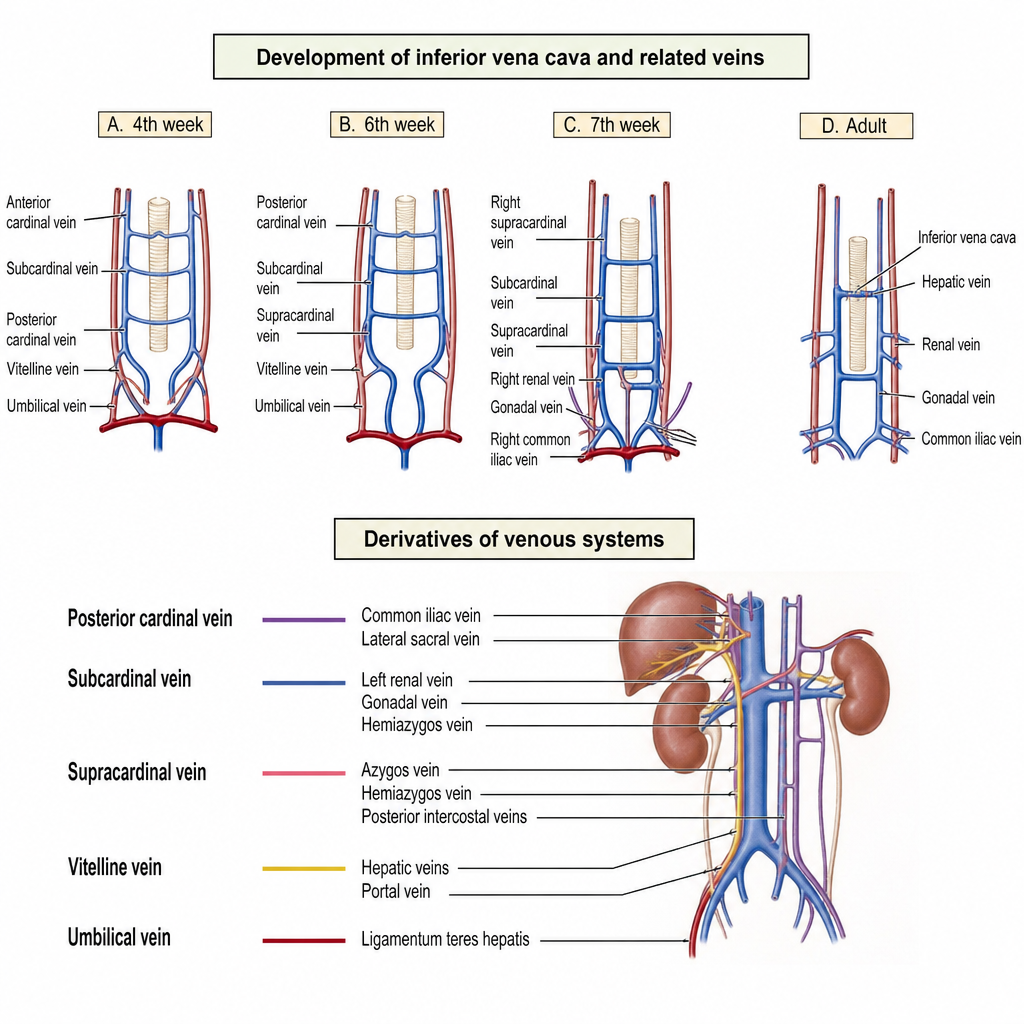
The ovary develops from all of the following embryological structures except:
Lumbar hemivetebral malformation results from the abnormal development of which embryonic structure?
The philtrum of the upper lip is derived from which embryonic structure?
The primordia of the craniofacial complex develops from which structure?
Which of the following is NOT associated with the vitello-intestinal duct?
The patent vitello-intestinal duct most often discharges what substance?
Failure of Hertwig's epithelial sheath diaphragm to form at the proper horizontal level leads to what developmental anomaly?
What are the daughter cells formed from the cleavage of a zygote called?
The genital tubercle forms which part in females?
Male and female differentiation of the fetus occurs at which gestational age?
Explanation: The development of the ovary involves the integration of three distinct cell lineages. The **Urogenital sinus** is the correct answer because it does not contribute to the ovary; instead, it gives rise to the urinary bladder, urethra, and the lower portion of the vagina [1]. ### **Developmental Components of the Ovary:** 1. **Coelomic Epithelium (Option A):** This forms the **germinal epithelium** of the ovary and gives rise to the **granulosa cells** (follicular cells). 2. **Yolk Sac Endoderm (Option B):** **Primordial germ cells** originate from the wall of the yolk sac near the allantois [2]. They migrate along the dorsal mesentery of the hindgut to reach the gonadal ridge. These cells eventually become **oogonia**. 3. **Gonadal Ridge Mesenchyme (Option C):** The underlying mesoderm (mesenchyme) forms the **ovarian stroma**, connective tissue, and the **theca cells**. ### **Why Urogenital Sinus is the Exception:** The urogenital sinus is the ventral part of the cloaca. In females, it develops into the **bladder, urethra, vestibule, and the lower 1/3rd of the vagina** [1]. The ovary, being an internal pelvic organ derived from the intermediate mesoderm and germ cells, has no developmental input from the urogenital sinus. ### **High-Yield Clinical Pearls for NEET-PG:** * **Migration Timing:** Primordial germ cells reach the gonadal ridge by the **6th week** of gestation. * **Müllerian vs. Urogenital Sinus:** The upper 2/3rd of the vagina is derived from the **Paramesonephric (Müllerian) ducts**, while the lower 1/3rd is from the **Urogenital sinus** [1]. * **Determining Factor:** The absence of the **SRY gene** (and thus absence of Testis Determining Factor) allows the indifferent gonad to develop into an ovary.
Explanation: ### Explanation **1. Why Ventral Sclerotome is Correct:** The vertebral column develops from the **sclerotome** portion of the somites. Each somite differentiates into a ventromedial part (sclerotome) and a dorsolateral part (dermomyotome). The **ventral sclerotome** cells migrate medially to surround the notochord and form the **vertebral bodies**. A **hemivertebra** occurs due to the failure of one of the two chondrification centers of the vertebral body to develop or fuse. Since the vertebral body is derived specifically from the ventral sclerotome, any malformation involving a "half-vertebra" (wedge-shaped body) is a defect of this specific embryonic layer. **2. Analysis of Incorrect Options:** * **Dorsal Sclerotome:** These cells migrate dorsally to surround the neural tube. They form the **vertebral (neural) arch**, spine, and transverse processes. Defects here lead to conditions like spina bifida, not hemivertebrae. * **Intermediate Cell Mass:** This gives rise to the **urogenital system** (kidneys, gonads, and associated ducts). It has no role in axial skeletal formation. * **Notochord:** While the notochord induces the surrounding mesoderm to form the vertebrae, its primary remnant in adults is the **nucleus pulposus** of the intervertebral disc. It does not directly form the bony vertebral body. **3. Clinical Pearls for NEET-PG:** * **Hemivertebra Clinical Sign:** It is the most common cause of **congenital scoliosis** (lateral curvature of the spine). * **Resegmentation:** Remember that each definitive vertebra is formed by the fusion of the **caudal half** of one sclerotome with the **cranial half** of the one below it (Von Ebner's fissure). * **VACTERL Association:** Hemivertebrae are often associated with other anomalies (Vertebral, Anal, Cardiac, Tracheo-Esophageal, Renal, and Limb). Always screen for renal anomalies (via ultrasound) if a hemivertebra is detected.
Explanation: The development of the face occurs between the 4th and 8th weeks of gestation, primarily from five facial primordia surrounding the stomodeum. **Explanation of the Correct Answer:** The **Medial Nasal Processes** (derived from the frontonasal process) fuse in the midline to form the **intermaxillary segment**. This segment is a crucial precursor that gives rise to three specific structures: 1. The **philtrum** (the vertical groove) of the upper lip. 2. The premaxillary part of the maxilla (carrying the four incisor teeth). 3. The primary palate. Therefore, the central portion of the upper lip is a direct derivative of the medial nasal processes. **Analysis of Incorrect Options:** * **Maxillary Prominence:** These form the lateral parts of the upper lip and the secondary palate. They fuse with the medial nasal processes to complete the upper lip. Failure of this fusion results in *Cleft Lip*. * **Mandibular Prominence:** These fuse in the midline to form the lower lip, lower jaw (mandible), and the lower part of the cheeks. * **Lateral Nasal Process:** These form the **alae (sides) of the nose**. They do not contribute to the formation of the upper lip. **High-Yield Clinical Pearls for NEET-PG:** * **Cleft Lip:** Occurs due to failure of fusion between the **Maxillary prominence** and the **Medial nasal process**. * **Oblique Facial Cleft:** Caused by the failure of fusion between the **Maxillary prominence** and the **Lateral nasal process** (along the nasolacrimal groove). * **Macrostomia (Large mouth):** Results from failure of fusion between the maxillary and mandibular prominences. * **Nerve Supply:** Since the upper lip is derived from the maxillary process (CN V2) and the lower lip from the mandibular process (CN V3), their sensory innervations follow this embryonic origin.
Explanation: ### Explanation **1. Why Hensen’s Node is Correct:** Hensen’s node (also known as the **primitive node**) is the functional organizer of the vertebrate embryo located at the cranial end of the primitive streak. During gastrulation, cells invaginating through Hensen’s node migrate cranially to form the **prechordal plate** and the **notochord**. The prechordal plate is the primary signaling center essential for the induction of the **forebrain (prosencephalon)** and the subsequent development of the **craniofacial complex**. Without the inductive signals from the node and its derivatives, the facial structures and midline brain anatomy fail to develop. **2. Analysis of Incorrect Options:** * **B. Notochordal process:** While derived from Hensen’s node, the notochord primarily serves as the longitudinal axis of the embryo and induces the overlying ectoderm to form the neural tube. It contributes to the vertebral column (nucleus pulposus) rather than the facial primordia. * **C. Cloacal membrane:** This is located at the caudal end of the embryonic disc. It represents the future site of the anus and urogenital openings; it has no role in cranial development. * **D. Blastopore:** In lower vertebrates, the blastopore is the opening into the archenteron. In humans, the primitive streak is considered the functional equivalent of the blastopore, but the specific "organizer" for the head is the node itself. **3. NEET-PG High-Yield Pearls:** * **Holoprosencephaly:** A clinical condition resulting from the failure of the prechordal plate (derived from Hensen's node) to induce the forebrain, leading to midline facial defects (e.g., cyclopia, cleft lip). * **Situs Inversus:** Ciliary movement within Hensen’s node establishes left-right asymmetry. Defects in these cilia lead to Kartagener syndrome. * **Remnants:** The primitive streak usually disappears; if it persists, it can lead to **Sacrococcygeal Teratoma** (the most common tumor in newborns).
Explanation: The **vitello-intestinal duct** (also known as the omphalomesenteric duct) normally connects the primitive midgut to the yolk sac and obliterates by the 7th week of intrauterine life [3]. Failure of this duct to disappear leads to various congenital anomalies [1]. ### Why Mesenteric Cyst is the Correct Answer A **mesenteric cyst** is a fluid-filled sac located between the layers of the mesentery. It typically arises from sequestered lymphatic tissue or ectopic lymphatic growth (lymphangioma) and is **not** embryologically derived from the vitello-intestinal duct. ### Explanation of Incorrect Options The following are all remnants of a persistent vitello-intestinal duct: * **Ileal (Meckel’s) Diverticulum:** The most common anomaly, occurring when the proximal part of the duct remains patent [1], [2]. It is located on the antimesenteric border of the ileum. * **Umbilical Fistula:** Occurs when the entire duct remains patent, creating a direct communication between the ileum and the umbilicus, leading to the discharge of fecal matter through the navel [1]. * **Enterocystoma (Vitelline Cyst):** Occurs when both ends of the duct obliterate, but the middle portion remains patent and accumulates fluid, forming a cyst suspended by fibrous cords [1]. ### High-Yield Clinical Pearls for NEET-PG * **Meckel’s Diverticulum "Rule of 2s":** 2% of the population, 2 inches long, 2 feet proximal to the ileocecal valve, 2 types of ectopic tissue (gastric and pancreatic), and often presents by age 2 [1], [2]. * **Vascular Supply:** The vitelline duct is accompanied by the **vitelline arteries**, which eventually give rise to the **Superior Mesenteric Artery**. * **Differential Diagnosis:** Do not confuse a vitelline cyst with a **urachal cyst**; the latter is a remnant of the allantois and connects to the bladder, not the ileum [3].
Explanation: The **vitello-intestinal duct** (also known as the omphalomesenteric duct) is an embryonic structure that connects the primitive midgut to the yolk sac [1]. Normally, this duct obliterates between the 5th and 8th weeks of intrauterine life. ### Why Mucus is the Correct Answer When the duct remains completely patent (Patent Vitello-intestinal Duct), it maintains a connection between the ileum and the umbilicus. However, the most common clinical presentation is the discharge of **mucus**. This occurs because the duct is lined with intestinal mucosa (columnar epithelium) containing goblet cells that continuously secrete mucus. While fecal matter can theoretically pass through if the lumen is wide, the narrow nature of the duct usually results in a persistent, clear, or mucoid discharge at the umbilicus. ### Explanation of Incorrect Options * **Pus (B):** This indicates an acute infection (omphalitis) rather than a congenital structural patency, though a patent duct can become secondarily infected. * **Urine (C):** Urinary discharge from the umbilicus is characteristic of a **patent urachus**, which is a failure of the allantois to obliterate, connecting the bladder to the umbilicus. * **Faeces (D):** While possible in a very wide patent duct, it is less common than mucoid discharge. Fecal fistula is a more severe manifestation [1]. ### NEET-PG High-Yield Pearls * **Meckel’s Diverticulum:** The most common remnant of the vitello-intestinal duct (remnant of the proximal part) [1]. * **Rule of 2s:** Meckel's is 2 inches long, 2 feet from the ileocaecal valve, occurs in 2% of the population, and often presents by age 2 [1]. * **Ectopic Tissue:** Meckel’s often contains gastric mucosa (leading to bleeding) or pancreatic tissue [1]. * **Differential Diagnosis:** Always distinguish a patent vitello-intestinal duct (fecal/mucus) from a patent urachus (urine).
Explanation: ### Explanation **Correct Answer: A. Taurodontism** **Mechanism:** The root shape and number are determined by **Hertwig’s Epithelial Root Sheath (HERS)**. During development, the horizontal part of this sheath (the epithelial diaphragm) normally constricts at a specific level to initiate the formation of the furcation (the point where roots separate). In **Taurodontism**, there is a failure of this diaphragm to invaginate at the proper horizontal level. Instead, it migrates apically (downward) much later than normal. This results in an elongated pulp chamber, a vertically long tooth body, and extremely short roots with a low furcation. **Analysis of Incorrect Options:** * **B. Dentin Dysplasia:** This is a genetic defect affecting dentin formation. Type I (Radicular) involves abnormal HERS function leading to "rootless teeth," but it is a defect in dentin matrix deposition rather than a horizontal leveling failure of the diaphragm. * **C. Pulp Polyp:** Also known as chronic hyperplastic pulpitis, this is an inflammatory response where pulp tissue proliferates out of a large carious lesion. It is an acquired clinical condition, not a developmental anomaly of HERS. * **D. Amelogenesis Imperfecta:** This is a hereditary disorder affecting **enamel** formation (ectodermal origin). HERS is involved in root formation (dentin/cementum interface), not the mineralization of crown enamel. **High-Yield Clinical Pearls for NEET-PG:** * **Radiographic Appearance:** Taurodontism is often described as **"Bull-like teeth"** due to the enlarged body and short roots. * **Associations:** It is frequently associated with **Klinefelter syndrome**, Tricho-dento-osseous syndrome, and Down syndrome. * **Classification:** Shifman and Channel classified taurodontism into three degrees: **Hypo-, Meso-, and Hyper-taurodontism**, based on the degree of apical displacement of the pulp floor.
Explanation: ### Explanation **Correct Answer: D. Blastomere** **Underlying Concept:** Cleavage is a series of rapid mitotic divisions that occur in the zygote shortly after fertilization [1]. Unlike typical mitosis, cleavage involves division without an increase in the overall cytoplasm volume (the zona pellucida remains intact, restricting growth). The individual daughter cells produced during these initial divisions are called **blastomeres** [1]. As cleavage progresses, these cells become progressively smaller with each division. **Analysis of Incorrect Options:** * **A. Morula:** This is a solid ball of cells (typically 16 to 32 cells) formed about 3–4 days after fertilization [1],[2]. It is the *result* of multiple cleavage divisions, not the name of the individual daughter cells themselves. * **B. Gastrula:** This refers to the stage of development following the blastula, characterized by the formation of the three germ layers (ectoderm, mesoderm, and endoderm) through the process of gastrulation. * **C. Blastula (Blastocyst in humans):** This stage occurs when a fluid-filled cavity (blastocele) forms within the morula [2]. It consists of an inner cell mass (embryoblast) and an outer layer (trophoblast). **NEET-PG High-Yield Pearls:** * **Compaction:** At the 8-cell stage, blastomeres maximize their contact with each other via tight junctions, a process called compaction. * **Totipotency:** Individual blastomeres up to the 4-to-8-cell stage are **totipotent**, meaning each cell has the potential to develop into a complete embryo (the basis for monozygotic twinning) [3]. * **Timing:** The zygote reaches the **morula** stage by Day 3 and the **blastocyst** stage by Day 4–5, entering the uterine cavity for implantation [1],[2].
Explanation: ### Explanation The development of external genitalia occurs from common undifferentiated structures during the first 7 weeks of gestation. Under the influence of estrogen (in females) or dihydrotestosterone (in males), these structures differentiate into sex-specific organs. **1. Why the Correct Answer is Right:** The **genital tubercle** is the most cranial part of the undifferentiated external genitalia [1]. In the absence of androgens, it undergoes limited growth to form the **clitoris** [1]. In males, the same structure elongates significantly to form the glans penis and the corpora cavernosa. **2. Why the Incorrect Options are Wrong:** * **Labia majora (Option A):** These develop from the **labioscrotal swellings** (genital swellings) [1]. In males, these swellings fuse in the midline to form the scrotum. * **Labia minora (Option B):** These develop from the **urogenital folds** (cloacal folds) [2]. In males, these folds fuse to form the ventral aspect of the penis and the penile urethra. **3. High-Yield Facts & Clinical Pearls for NEET-PG:** | Undifferentiated Structure | Female Derivative | Male Derivative | | :--- | :--- | :--- | | **Genital Tubercle** | Clitoris | Glans penis, Corpora cavernosa | | **Urogenital Folds** | Labia minora | Ventral penis / Penile urethra | | **Labioscrotal Swellings** | Labia majora | Scrotum | | **Urogenital Sinus** | Vestibule, Lower 2/3 of Vagina | Prostate, Bulbourethral glands | * **Clinical Pearl:** Failure of the urogenital folds to fuse in males results in **Hypospadias**, where the urethral opening is on the ventral surface of the penis. * **Key Hormone:** Development of male genitalia requires **DHT** (converted from testosterone by 5-alpha reductase), whereas female development is the "default" pathway in the absence of androgens.
Explanation: ### Explanation **1. Why 10-12 Weeks is Correct:** The sexual differentiation of a fetus is a sequential process. While genetic sex is determined at fertilization (XY or XX), the gonads remain **indifferent** until the 7th week. Phenotypic differentiation (external genitalia) begins around the 9th week under the influence of dihydrotestosterone (in males) or the absence of androgens (in females) [1]. By **10-12 weeks**, the external genitalia have developed sufficiently to be morphologically distinct, making this the period where definitive male and female differentiation occurs. **2. Analysis of Incorrect Options:** * **2-4 weeks (Option C):** This is the period of gastrulation and early organogenesis. The primordial germ cells are still migrating from the yolk sac to the gonadal ridges; no sexual differentiation has begun. * **16-18 weeks (Option B):** While differentiation is very obvious on a routine mid-trimester ultrasound at this stage, the actual biological process of differentiation was completed much earlier (by the end of the first trimester). * **24-26 weeks (Option D):** This is the period of viability and significant lung maturation (surfactant production). It is far beyond the window of primary sexual differentiation. **3. NEET-PG High-Yield Pearls:** * **SRY Gene:** Located on the short arm of the Y chromosome; it is the "master switch" for testis determination. * **Müllerian Inhibiting Substance (MIS):** Secreted by **Sertoli cells**, it causes regression of Paramesonephric ducts in males [1]. * **Testosterone:** Secreted by **Leydig cells**, it stimulates the development of Mesonephric (Wolffian) ducts into the male internal genital tract [1]. * **External Genitalia:** The phallus becomes the glans penis or clitoris; labioscrotal swellings become the scrotum or labia majora [1].
Gametogenesis and Fertilization
Practice Questions
Early Embryonic Development
Practice Questions
Placentation
Practice Questions
Development of Nervous System
Practice Questions
Development of Cardiovascular System
Practice Questions
Development of Gastrointestinal System
Practice Questions
Development of Urogenital System
Practice Questions
Development of Musculoskeletal System
Practice Questions
Development of Head and Neck
Practice Questions
Congenital Anomalies
Practice Questions
Teratology
Practice Questions
Molecular Mechanisms in Development
Practice Questions
Get full access to all questions, explanations, and performance tracking.
Start For Free