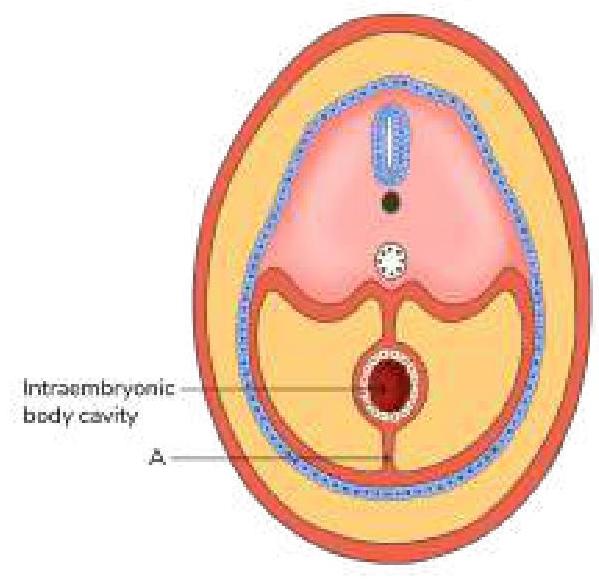
Trigone of bladder is derived from?
Eustachian tube develops from:
Clitoris develops from
All of the following muscles are derived from second branchial arch except:
What is the time period for the embryonic period?
Lower 1/5th of vagina is formed by?
Craniopharyngioma arises from -
Appendix of epididymis is a remnant of
Most common type of foregut cysts is?
The distal nail matrix forms which of the following?
Explanation: Distal part of Mesonephric duct - The **trigone of the bladder** develops from the **caudal (distal) ends of the mesonephric ducts**, which are absorbed into the posterior wall of the forming bladder. - The mesonephric duct origin contributes to the **smooth muscle** of the trigone, giving it distinct structural characteristics compared to the rest of the bladder wall. - The trigone appears as a smooth triangular area bounded by the two ureteric orifices and the internal urethral orifice [1]. *Ventral part of Urogenital sinus* - The **ventral part of the urogenital sinus** primarily forms the **fundus and body of the urinary bladder**, but not the trigone. - This region undergoes differentiation to form the majority of the bladder's wall and provides the epithelial lining for the entire bladder including the trigone. *Distal part of Paramesonephric duct* - The **paramesonephric ducts (Müllerian ducts)** are primarily involved in the development of the female reproductive tract, forming the **fallopian tubes, uterus, and upper vagina**. - They do not contribute to the formation of the urinary bladder or its trigone. *Ventral part of Mesonephric duct* - While the mesonephric ducts are crucial, it is specifically the **distal (caudal) ends** that are incorporated into the bladder to form the trigone, not merely the general ventral part. - The more proximal parts of the mesonephric ducts in males develop into structures like the **epididymis, v\as deferens, seminal vesicles, and ejaculatory ducts**.
Explanation: ***1st pharyngeal pouch*** - The **Eustachian tube** (also known as the pharyngotympanic tube or auditory tube) develops from the **endoderm** of the first pharyngeal pouch. - This embryonic structure also gives rise to the **tympanic cavity** and the mastoid air cells, forming part of the middle ear. *2nd and 3rd pharyngeal pouch* - The **second pharyngeal pouch** primarily contributes to the development of the **palatine tonsils**. - The **third pharyngeal pouch** is involved in the formation of the **inferior parathyroid glands** and the **thymus**. *3rd pharyngeal pouch* - The **third pharyngeal pouch** specifically differentiates into the **inferior parathyroid glands** and the **thymus**. - It does not contribute to the formation of the Eustachian tube. *2nd pharyngeal pouch* - The **second pharyngeal pouch** is primarily associated with the development of the **palatine tonsils** and the tonsillar fossa. - It does not play a role in the embryological development of the Eustachian tube.
Explanation: ***Genital tubercle*** - The **clitoris** in females (and the glans penis in males) develops embryologically from the undifferentiated **genital tubercle** [2]. - This structure forms early in fetal development and differentiates based on the presence or absence of **androgens**. *Labio Scrotal Swelling* - The **labioscrotal swellings** in females develop into the **labia majora**. - In males, these same swellings fuse to form the **scrotum**. *Genital folds* - The **genital folds** (urethral folds) in females form the **labia minora**. - In males, these folds fuse in the midline to form the **spongy urethra** and the ventral aspect of the penis. *Urogenital Sinus* - The **urogenital sinus** gives rise to the **lower vagina**, urethra, and vestibule in females [1]. - In males, it forms the **bladder**, urethra, and prostate gland.
Explanation: ***Anterior belly of digastric*** - The **anterior belly of the digastric muscle** is derived from the **first branchial arch**. - It is innervated by the **mandibular division of the trigeminal nerve (CN V3)**. *Stapedius* - The **stapedius muscle** develops from the **second branchial arch**. - It is innervated by the **facial nerve (CN VII)**, which also arises from the second branchial arch. *Posterior belly of digastric* - The **posterior belly of the digastric muscle** originates from the **second branchial arch**. - Its innervation is also provided by the **facial nerve (CN VII)**. *Orbicularis oculi* - The **orbicularis oculi muscle** is a muscle of facial expression, deriving from the **second branchial arch**. - It is innervated by the **facial nerve (CN VII)**.
Explanation: 3rd to 8th week of gestation - The embryonic period begins at the start of the 3rd week (around day 15-16, after gastrulation begins) and concludes at the end of the 8th week of gestation [2]. - During this critical period, all major organs and body systems are formed in a process called organogenesis [2]. - This is the most critical period of development when the embryo is most susceptible to teratogens [1]. 9 weeks to birth - This time frame describes the fetal period, which follows the embryonic period (starting at week 9) [2]. - The fetal period is primarily characterized by the growth and maturation of tissues and organs formed during the embryonic stage [1]. 22 weeks intrauterine to 7 days after birth - This period describes the perinatal period, which is a medical classification related to outcomes around birth. - It encompasses conditions affecting the fetus from viability until the first week postpartum, not the embryonic developmental stage. 0-14 days of gestation - This initial period is often referred to as the pre-embryonic stage or the period of the zygote and blastocyst [3]. - It involves fertilization, cleavage, blastulation, and implantation, leading to the formation of the bilaminar embryonic disc and early gastrulation [3].
Explanation: ***Urogenital sinus*** - The lower 1/5th to 1/3rd of the vagina develops from the **urogenital sinus** [1], which is an embryonic structure derived from the cloaca. - This part of the vagina is continuous with the vestibule and is lined by stratified squamous epithelium. *Mullerian duct* - The **Mullerian ducts** (paramesonephric ducts) merge to form the upper 4/5ths to 2/3rds of the vagina [1], the uterus, and the fallopian tubes. - While it contributes to most of the vaginal canal, it does not form the most distal portion. *Mesonephric duct* - The **mesonephric ducts** (Wolffian ducts) are crucial for the development of male reproductive structures. - In females, these ducts typically regress, leaving only vestigial remnants. *Cloaca* - The **cloaca** is a primordial structure that eventually divides into the urogenital sinus anteriorly and the anorectal canal posteriorly. - While the urogenital sinus is derived from the cloaca, the cloaca itself does not directly form the functional part of the adult vagina.
Explanation: Rathke's pouch - Craniopharyngiomas arise from remnants of Rathke's pouch, an embryonic structure that forms the anterior pituitary gland. - Rathke's pouch is an ectodermal outpouching from the roof of the primitive oral cavity (stomodeum) that migrates upward during embryonic development. - These squamous epithelial remnants can persist along the path of migration and give rise to craniopharyngiomas, typically in the suprasellar region. - The tumor's location near the pituitary stalk is due to the developmental pathway, but the embryological origin is specifically Rathke's pouch. Cerebellum - Tumors arising from the cerebellum are typically medulloblastomas or cerebellar astrocytomas, which are distinctly different from craniopharyngiomas [2]. - The cerebellum is a hindbrain derivative responsible for coordination and balance. - Cerebellar tumors present with ataxia and motor deficits, not the endocrine dysfunction characteristic of craniopharyngiomas. Pineal gland - Tumors of the pineal gland, such as pineoblastomas [1] or germinomas, originate from pinealocytes or germ cells, respectively. - These tumors are associated with Parinaud's syndrome (upgaze palsy) due to compression of the tectal plate. - Pineal region tumors are anatomically and embryologically distinct from craniopharyngiomas. Posterior pituitary - The posterior pituitary (neurohypophysis) develops from a downward extension of the hypothalamus, not from Rathke's pouch. - It is composed of axons from hypothalamic neurons and glial cells (pituicytes). - Tumors specifically from the posterior pituitary are extremely rare and differ histologically from craniopharyngiomas, which arise from epithelial remnants of Rathke's pouch.
Explanation: ***Mesonephric duct*** - The **appendix of the epididymis** is a vestigial remnant of the **mesonephric duct (Wolffian duct)**. - In males, the mesonephric duct gives rise to the **epididymis**, **vas deferens**, and **seminal vesicles**, while its cranial end may persist as the appendix of the epididymis. *Mullerian duct* - The **Müllerian duct (paramesonephric duct)** is primarily involved in the development of the **female reproductive organs** (fallopian tubes, uterus, and upper vagina). - In males, the Müllerian ducts normally **regress** due to the action of Müllerian-inhibiting substance (MIS) produced by Sertoli cells; their remnants in males are the **appendix testis** and the **prostatic utricle**. *Paramesonephric duct* - This is another name for the **Müllerian duct**, and as explained above, its remnants in males are the appendix testis and prostatic utricle, not the appendix of the epididymis. - It plays a crucial role in the development of the fallopian tubes, uterus, and upper vagina in females. *None of the options* - This option is incorrect because the appendix of the epididymis is indeed a remnant of a specific embryonic structure, the **mesonephric duct**. - Identifying the correct embryonic origin is key to understanding the development of reproductive organs.
Explanation: ***Bronchogenic*** - **Bronchogenic cysts** are derivatives of the primitive foregut and are the **most common type of congenital cysts** found in the mediastinum [1]. - They arise from abnormal budding of the tracheobronchial tree during embryonic development, leading to cysts composed of respiratory epithelium, cartilage, and smooth muscle [1]. *Enteric* - **Enteric cysts** (or duplication cysts) originate from the primitive gut and are typically lined with gastrointestinal mucosa, often containing **submucosal and muscular layers**. - While they can be found in the mediastinum, they are **less common** than bronchogenic cysts and are more frequently associated with the gastrointestinal tract. *Esophageal* - **Esophageal cysts** are rare forms of foregut cysts that specifically arise from abnormal budding of the esophagus. - They are typically lined by **squamous or columnar epithelium** and are distinguished from other foregut cysts by their close anatomical relationship to the esophagus, but are not the most common type. *Mixed type* - The term "mixed type" often refers to cysts exhibiting features of more than one type of foregut cyst, but this is a **less common classification for standalone cysts**. - While some cysts may have atypical linings, the **categorization of foregut cysts is primarily based on their predominant tissue origin and histological features**.
Explanation: ***Ventral Portion of nail plate*** The **distal nail matrix** is the primary contributor to the bulk of the **nail plate**, specifically forming its **ventral (inferior/deeper) portion**. This region is responsible for the rapid proliferation and keratinization of cells that give the nail its thickness and strength. The distal matrix accounts for approximately **80-90% of the nail plate volume**. *Dorsal Portion of nail plate* The **dorsal (superficial/top) portion of the nail plate** is predominantly formed by the **proximal nail matrix**, not the distal matrix. This part contributes to the smooth, shiny superficial layer of the nail. *Both of the options* This is incorrect because the **distal and proximal nail matrices** have distinct and separate roles in forming specific parts of the nail plate. The distal matrix forms only the ventral portion, while the proximal matrix forms the dorsal portion. *None of the options* This is incorrect as the **distal nail matrix** clearly has a specific and significant role in **nail plate formation**, specifically forming the ventral portion.
Gametogenesis and Fertilization
Practice Questions
Early Embryonic Development
Practice Questions
Placentation
Practice Questions
Development of Nervous System
Practice Questions
Development of Cardiovascular System
Practice Questions
Development of Gastrointestinal System
Practice Questions
Development of Urogenital System
Practice Questions
Development of Musculoskeletal System
Practice Questions
Development of Head and Neck
Practice Questions
Congenital Anomalies
Practice Questions
Teratology
Practice Questions
Molecular Mechanisms in Development
Practice Questions
Get full access to all questions, explanations, and performance tracking.
Start For Free