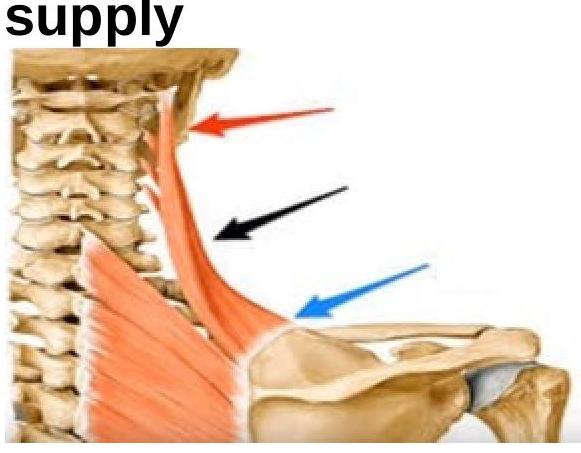
Which nerve supplies the trapezius muscle?
During an outbreak of meningitis, a 20-year-old student presents with headache, fever, chills, and stiff neck. A lumbar puncture is planned. Cerebrospinal fluid (CSF) is normally withdrawn from which of the following spaces?
A 32-year-old male elite athlete felt severe pain radiating to the posterior aspect of his right thigh and leg during an intense training session involving heavy weights. MRI revealed a ruptured L4/L5 intervertebral disk. Which nerve is most probably affected?
Which muscle, anatomically considered a back muscle, is functionally related to the thorax?
A 42-year-old woman with metastatic breast cancer is known to have tumors in the intervertebral foramina between the fourth and fifth cervical vertebrae and between the fourth and fifth thoracic vertebrae. Which of the following spinal nerves may be damaged?
All of the following characteristics differentiate a typical cervical vertebra from a typical thoracic vertebra except?
Jefferson's fracture involves which cervical vertebra(e)?
Maximum flexion in thoracic vertebrae occurs at which region?
The inferior angle of the scapula is at the level of which thoracic vertebra?
Contents of the suboccipital triangle are formed by all of the following structures, EXCEPT?
Explanation: The **Trapezius** is a large, superficial muscle of the back that acts on the pectoral girdle. It is unique among back muscles because it does not receive its primary motor innervation from the brachial plexus or spinal nerves. **1. Why Spinal Accessory Nerve is Correct:** The **Spinal Accessory nerve (CN XI)** provides the **motor supply** to the trapezius. It enters the deep surface of the muscle after crossing the posterior triangle of the neck. It is important to note that while CN XI provides motor fibers, the **ventral rami of C3 and C4** provide sensory (proprioceptive) fibers to the muscle. **2. Why the other options are incorrect:** * **Greater occipital nerve (C2):** This is a purely sensory nerve that supplies the skin of the posterior scalp. It does not provide motor innervation to the trapezius. * **Thoracodorsal nerve (C6-C8):** A branch of the posterior cord of the brachial plexus, it supplies the **Latissimus dorsi** muscle [1]. * **Dorsal Scapular nerve (C5):** Arising from the C5 root of the brachial plexus, it supplies the **Levator scapulae** and the **Rhomboids** (major and minor). **High-Yield Clinical Pearls for NEET-PG:** * **Iatrogenic Injury:** The Spinal Accessory nerve is the most commonly injured nerve during lymph node biopsies or surgeries in the **posterior triangle** of the neck. * **Clinical Presentation:** Injury leads to "drooping" of the shoulder, inability to shrug (weakness in elevation), and difficulty in abducting the arm above the horizontal level (due to loss of upward rotation of the scapula). * **Testing:** The trapezius is tested by asking the patient to shrug their shoulders against resistance.
Explanation: ### Explanation **Correct Option: D. Subarachnoid space** The **subarachnoid space** is the anatomical compartment located between the arachnoid mater and the pia mater [3]. It contains the **Cerebrospinal Fluid (CSF)** and the major blood vessels of the brain and spinal cord [2]. In a lumbar puncture (spinal tap), the needle must penetrate the dura and arachnoid mater to enter this space to sample CSF for diagnostic purposes, such as confirming meningitis [1]. **Analysis of Incorrect Options:** * **A. Epidural space:** This space lies between the dura mater and the vertebral canal [3]. It contains internal vertebral venous plexuses and fat. It is the site for **epidural anesthesia**, but it does not contain CSF. * **B. Subdural space:** This is a "potential space" between the dura and arachnoid mater [3]. In health, these layers are closely apposed; clinical significance is usually limited to pathological conditions like a subdural hematoma. * **C. Space between the spinal cord and the pia mater:** There is no functional space here. The pia mater is a delicate, vascular membrane that is **firmly adherent** to the surface of the spinal cord and brain. **High-Yield Clinical Pearls for NEET-PG:** * **Level of Lumbar Puncture:** In adults, it is usually performed at the **L3-L4 or L4-L5** interspace to avoid the spinal cord, which ends at **L1-L2** (in infants, the cord ends at **L3**). * **Structures Pierced (Outer to Inner):** Skin → Superficial fascia → Supraspinous ligament → Interspinous ligament → **Ligamentum flavum** (gives a characteristic "pop") → Epidural space → Dura mater → Arachnoid mater → **Subarachnoid space**. * **Landmark:** The **Tuffier’s line** (intercristal line) connects the highest points of the iliac crests and corresponds to the **L4 spinous process**.
Explanation: ### Explanation **1. Why L5 is the Correct Answer:** In the lumbar spine, the nerve roots exit the vertebral canal **below** their corresponding vertebrae through the intervertebral foramina. However, due to the oblique course of the cauda equina, a **posterolateral (paracentral) disc herniation**—the most common type—typically spares the nerve root exiting at that level and instead compresses the **traversing nerve root** (the one exiting at the level below) [1]. In this case, at the **L4/L5 level**, the L4 nerve root has already exited above the disc. The **L5 nerve root** is the one currently traversing the L4/L5 disc space to reach its exit point below the L5 vertebra [1]. Therefore, an L4/L5 herniation most commonly affects the **L5 nerve root**. This presents clinically as pain radiating down the posterior/lateral thigh and leg (sciatica) [1]. **2. Why Other Options are Incorrect:** * **L4 (Option B):** The L4 nerve root exits the L4/L5 foramen *above* the disc level. It would only be affected by a rare "far lateral" or "foraminal" disc herniation, not a standard posterolateral rupture. * **L2 & L3 (Options C & A):** These nerve roots exit at much higher levels (L2/L3 and L3/L4 respectively) and are anatomically distant from an L4/L5 disc rupture. **3. NEET-PG High-Yield Pearls:** * **Rule of Thumb:** A posterolateral disc herniation affects the **lower** of the two vertebrae involved (e.g., L5/S1 affects S1). * **L5 Nerve Root Compression:** Look for weakness in **big toe dorsiflexion** (Extensor Hallucis Longus) and sensory loss on the dorsal aspect of the foot [1]. * **S1 Nerve Root Compression:** Look for loss of the **Ankle Jerk reflex** and weakness in plantar flexion. * **Most Common Site:** L4/L5 and L5/S1 are the most frequent sites of lumbar disc herniation [1].
Explanation: **Explanation:** The **Latissimus dorsi** is anatomically classified as a superficial extrinsic back muscle because of its location and origin. However, it is functionally related to the thorax (and upper limb) due to its insertion into the floor of the bicipital groove of the humerus. It acts as a powerful adductor, extensor, and internal rotator of the arm. Crucially, it is often referred to as the **"Climbing Muscle"** and the **"Coughing Muscle"**; during forceful expiration (like coughing or sneezing), it compresses the posterior aspect of the thorax, assisting in the expulsion of air. [1] **Analysis of Options:** * **Rhomboid (Major/Minor):** These are extrinsic back muscles that primarily function to retract and rotate the scapula, relating them functionally to the **scapulothoracic joint**, not the thoracic cage itself. * **Trapezius:** A superficial back muscle that acts on the pectoral girdle (scapula and clavicle) to rotate, elevate, and depress the shoulder. * **Levator costae:** While these muscles are located in the back and act on the ribs (elevating them), they are anatomically classified as **deep/intrinsic muscles of the thorax** (or posterior thoracic wall), not primarily as "back muscles" in the context of this functional distinction. **High-Yield Pearls for NEET-PG:** * **Nerve Supply:** Thoracodorsal nerve (C6, C7, C8). [1] * **Clinical Significance:** The Latissimus dorsi forms the posterior boundary of the **Triangle of Petit** (Lumbar triangle) and the posterior fold of the axilla. [1] * **Surgical Use:** It is commonly used as a pedicled flap in reconstructive breast surgery.
Explanation: ### Explanation The core concept tested here is the **relationship between spinal nerves and their corresponding vertebrae**, which differs between the cervical and thoracic regions. **1. Why Option D is Correct:** * **Cervical Region:** There are 8 cervical spinal nerves but only 7 cervical vertebrae. In this region, spinal nerves **C1 through C7 exit ABOVE** their numerically corresponding vertebrae. Therefore, the nerve passing through the intervertebral foramen between C4 and C5 is the **C5 nerve** [1]. * **Thoracic/Lumbar Region:** Starting from T1 downwards, the pattern shifts because the C8 nerve exits between C7 and T1. Consequently, all thoracic, lumbar, and sacral nerves **exit BELOW** their corresponding vertebrae. Therefore, the nerve passing through the intervertebral foramen between T4 and T5 is the **T4 nerve** [1]. **2. Analysis of Incorrect Options:** * **Option A & C:** Incorrect because the nerve between C4-C5 is C5, not C4. * **Option B:** Incorrect because the nerve between T4-T5 is T4, not T5. **3. Clinical Pearls & High-Yield Facts for NEET-PG:** * **The "C8" Rule:** The C8 nerve is the "transition" nerve; it exits below C7 and above T1. This is why there are 8 cervical nerves despite only 7 cervical vertebrae. * **Disc Prolapse Rule:** * In the **cervical spine**, a posterolateral disc prolapse typically compresses the nerve root exiting at that level (e.g., C5-C6 disc affects C6 nerve) [1]. * In the **lumbar spine**, a posterolateral disc prolapse usually compresses the *traversing* nerve root (the one exiting one level below). For example, an L4-L5 disc herniation typically affects the L5 nerve root. * **Numbering:** Remember: C-nerves = Above; T/L/S-nerves = Below.
Explanation: **Explanation:** The core of this question lies in identifying the structural differences between cervical and thoracic vertebrae. The correct answer is **D (Has a large vertebral body)** because this is a characteristic of **thoracic** (and even more so, lumbar) vertebrae, not cervical ones. **1. Why Option D is the Correct Answer:** Cervical vertebrae are designed for mobility rather than weight-bearing; hence, they have **small, kidney-shaped bodies**. As we move down the vertebral column, the weight-bearing load increases, necessitating larger vertebral bodies. Therefore, a "large vertebral body" is a feature that differentiates a thoracic vertebra from a cervical one, but the statement implies it is a cervical feature, making it the "except" choice. **2. Analysis of Incorrect Options:** * **A. Triangular vertebral canal:** This is a **typical feature of cervical vertebrae** (to accommodate the cervical enlargement of the spinal cord). Thoracic vertebrae have a smaller, circular canal. * **B. Foramen transversarium:** This is the **pathognomonic feature** of all cervical vertebrae. It transmits the vertebral artery (except in C7). Thoracic vertebrae lack this foramen. * **C. Superior articular facet direction:** In cervical vertebrae, facets are directed **backwards and upwards** (facilitating flexion/extension). In thoracic vertebrae, they are directed backwards and laterally. **High-Yield Clinical Pearls for NEET-PG:** * **C1 (Atlas):** Lacks a body and a spine. * **C2 (Axis):** Characterized by the **Dens (Odontoid process)**. * **C7 (Vertebra Prominens):** Has a long, non-bifid spinous process; its foramen transversarium does *not* transmit the vertebral artery (only accessory vertebral veins). * **Heart-shaped body:** Characteristic of thoracic vertebrae. * **Bifid spinous process:** Characteristic of typical cervical vertebrae (C3-C6).
Explanation: **Explanation:** **Jefferson’s fracture** is a classic burst fracture of the **C1 vertebra (Atlas)**. It typically occurs due to a severe axial loading force applied to the top of the head (e.g., diving into a shallow pool or falling from a height onto the head) [1]. Because the Atlas is a ring-shaped bone with thin anterior and posterior arches, the vertical force drives the lateral masses of C1 outward, causing multiple fractures (usually four) through the arches [1]. **Analysis of Options:** * **Option A (C1): Correct.** By definition, a Jefferson fracture specifically involves the ring of the Atlas. * **Option B (C2): Incorrect.** Fractures of the C2 (Axis) are distinct. A fracture of the pars interarticularis of C2 is known as a **Hangman’s fracture**, while fractures of the dens are simply called **Odontoid fractures**. * **Option C & D: Incorrect.** While multiple cervical vertebrae can be injured in high-trauma accidents, the specific eponym "Jefferson’s fracture" refers exclusively to the C1 burst fracture. **Clinical Pearls for NEET-PG:** 1. **Mechanism:** Axial loading (compression) [1]. 2. **Radiology:** On an **Open-mouth (Odontoid) X-ray view**, a Jefferson fracture is identified by the lateral displacement (overhang) of the C1 lateral masses relative to the C2 articular facets. 3. **Stability:** The stability of this fracture depends on the integrity of the **Transverse ligament of the Atlas**. If this ligament is ruptured, the fracture is considered unstable. 4. **Neurology:** Interestingly, patients often remain neurologically intact because the "burst" mechanism actually increases the diameter of the spinal canal, reducing the risk of immediate cord compression.
Explanation: The degree of mobility in the thoracic spine is primarily governed by the orientation of the zygapophyseal (facet) joints and the presence of the rib cage. **Why Lower Thoracic is correct:** The **Lower Thoracic region (T11–T12)** exhibits the maximum range of flexion. This is due to two anatomical factors: 1. **Facet Orientation:** In the lower thoracic region, the facet joints begin to transition from a coronal orientation (which limits flexion) to a sagittal orientation, similar to the lumbar vertebrae. This sagittal alignment is biomechanically optimized for flexion and extension. 2. **Floating Ribs:** Unlike the upper and middle segments, the lower thoracic vertebrae are associated with "floating ribs" (11th and 12th) that do not attach to the sternum. This lack of an anterior bony bridge significantly reduces the structural rigidity of the cage, allowing for greater segmental motion. **Analysis of Incorrect Options:** * **Upper Thoracic (A):** Flexion is highly restricted here because the ribs are firmly attached to the sternum via short, rigid costal cartilages, and the facet joints are oriented coronally to favor rotation. * **Middle Thoracic (B):** While slightly more mobile than the upper segment, the presence of the sternum and the imbricated (overlapping) spinous processes still significantly limit flexion. * **Same at all levels (D):** This is incorrect as the thoracic spine is the most heterogenous region of the vertebral column regarding mobility. **High-Yield Clinical Pearls for NEET-PG:** * **Rotation:** Maximum in the **Upper Thoracic** region (due to coronal facet alignment). * **Flexion/Extension:** Maximum in the **Lower Thoracic** (T11-T12) and Lumbar regions. * **Thoracolumbar Junction (T12-L1):** This is the most common site for spinal fractures because it is the transition zone between the rigid thoracic cage and the mobile lumbar spine.
Explanation: The scapula is a landmark bone of the posterior thorax, and its various parts correspond to specific vertebral levels. This is a high-yield concept for surface anatomy and clinical examinations. **1. Why T7 is Correct:** In a person standing in the anatomical position with arms at the side, the **inferior angle of the scapula** typically lies at the level of the **spinous process of the T7 vertebra**. It also corresponds to the **7th intercostal space**. This landmark is clinically significant for identifying ribs and performing procedures like thoracocentesis. **2. Why Other Options are Incorrect:** * **T4:** This level corresponds to the **Sternal Angle (Angle of Louis)** anteriorly. Posteriorly, it marks the level where the trachea bifurcates and the arch of the aorta begins/ends. * **T5:** This level is generally between the root of the spine and the inferior angle. * **T6:** This is often the level of the oblique fissure of the lung when the arm is abducted. **3. Clinical Pearls & High-Yield Facts:** * **Root of the Spine of Scapula:** Corresponds to the **T3** spinous process. * **Superior Angle of Scapula:** Corresponds to the **T2** spinous process. * **Medial Border:** Runs parallel to the vertebral column, approximately 5 cm lateral to the spinous processes. * **Triangle of Auscultation:** Bound medially by the Trapezius, laterally by the Scapula (medial border), and inferiorly by the Latissimus Dorsi. It is the best place to listen to respiratory sounds. * **Sprengel’s Deformity:** A congenital condition where the scapula fails to descend, remaining at a higher cervical/thoracic level.
Explanation: The **suboccipital triangle** is a high-yield anatomical region located deep to the trapezius and semispinalis capitis muscles. Understanding its boundaries and contents is essential for NEET-PG. ### **Explanation of Options** * **Lesser Occipital Nerve (Correct Answer):** This nerve arises from the ventral rami of **C2** (cervical plexus). It ascends along the posterior border of the sternocleidomastoid muscle to supply the scalp. It is a superficial structure and **does not** enter or form the contents of the suboccipital triangle. * **Vertebral Artery (Incorrect):** The 3rd part of the vertebral artery lies on the groove on the superior surface of the posterior arch of the atlas (C1), forming a major content of the triangle. * **Suboccipital Nerve (Incorrect):** This is the dorsal ramus of **C1**. It emerges between the vertebral artery and the posterior arch of the atlas to supply the muscles forming the triangle. * **Greater Occipital Nerve (Incorrect):** While the Greater Occipital Nerve (dorsal ramus of **C2**) is technically not a "content" inside the triangle (it emerges below the inferior oblique muscle), it is frequently associated with the region in exams. However, compared to the Lesser Occipital Nerve, it is anatomically closer. In many standard textbooks, the **Suboccipital Venous Plexus** is listed as the third primary content alongside the Vertebral Artery and C1 nerve. ### **High-Yield Clinical Pearls** * **Boundaries:** * *Superomedial:* Rectus capitis posterior major. * *Superolateral:* Obliquus capitis superior. * *Inferolateral:* Obliquus capitis inferior. * **Roof:** Semispinalis capitis and Longissimus capitis. * **Floor:** Posterior atlanto-occipital membrane and posterior arch of atlas. * **Nerve Supply:** All muscles of the suboccipital triangle are supplied by the **Suboccipital nerve (C1)**. Note that C1 has no sensory distribution to the skin.
Vertebral Column
Practice Questions
Spinal Cord and Meninges
Practice Questions
Back Muscles and Fasciae
Practice Questions
Vertebral Joints and Ligaments
Practice Questions
Vasculature of the Back
Practice Questions
Innervation of the Back
Practice Questions
Clinical Aspects of Back Disorders
Practice Questions
Applied Anatomy of the Back
Practice Questions
Surface Anatomy of the Back
Practice Questions
Development of the Vertebral Column
Practice Questions
Get full access to all questions, explanations, and performance tracking.
Start For Free