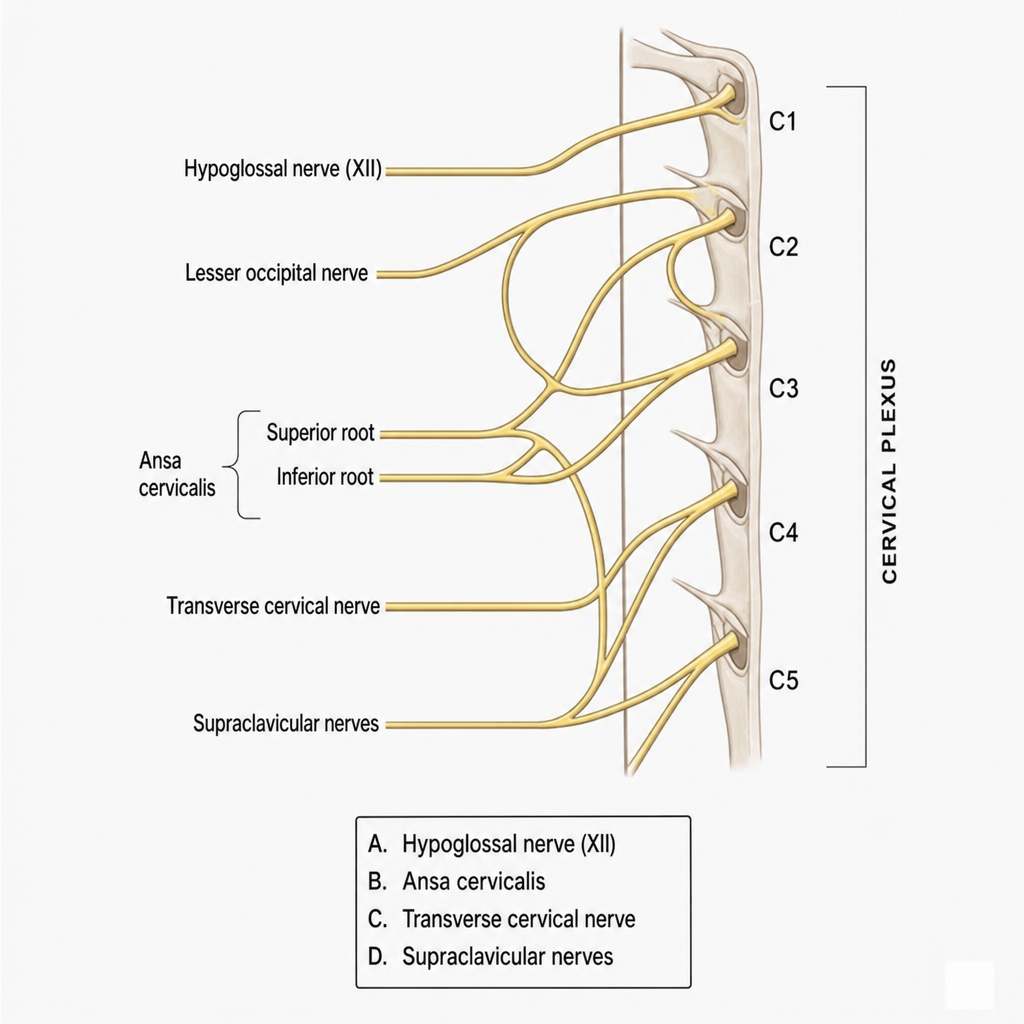
The transverse ligament of the atlas is part of which of the following ligaments?
What is the difference between a typical cervical and a typical thoracic vertebra?
Which of the following spinal nerve roots is spared in lumbar sympathectomy?
All of the following are contents of the suboccipital triangle, except?
The subcostal nerve arises from which spinal nerve root?
Which ventral or dorsal ramus of a cervical nerve is the suboccipital nerve?
Which muscle is supplied by the dorsal scapular nerve?
The movement at which of the following joints permits a person to say 'NO' by head movement?
A 45-year-old woman presents with neck pain. An MRI reveals a herniated disk in the cervical region. Physical examination demonstrates weakness in wrist extension and paresthesia on the back of her arm and forearm. Which of the following spinal nerves is most likely injured?
Which cervical joint does not permit head movement?
Explanation: The **transverse ligament of the atlas** is the strongest and most critical component of the **cruciform (cruciate) ligament** of the atlas. The cruciform ligament is named for its cross-like shape and consists of two main parts: 1. **Transverse ligament of the atlas:** A thick, strong band stretching between the tubercles on the medial sides of the lateral masses of C1. It holds the dens of the axis (C2) against the anterior arch of the atlas, forming a pivot joint. 2. **Vertical bands:** Superior and inferior longitudinal bands that extend from the transverse ligament to the occipital bone (superiorly) and the body of the axis (inferiorly). ### Why Other Options are Incorrect * **Ligamenta flava:** These are yellow elastic ligaments that connect the laminae of adjacent vertebrae. They do not involve the dens or the transverse ligament. * **Anterior Longitudinal Ligament (ALL):** A broad fibrous band that runs along the anterior surfaces of the vertebral bodies. It limits extension of the spine. * **Posterior Longitudinal Ligament (PLL):** This runs along the posterior aspect of the vertebral bodies within the vertebral canal. Its superior continuation (from C2 to the occipital bone) is known as the **tectorial membrane**, which covers the cruciform ligament. ### High-Yield Clinical Pearls for NEET-PG * **Stability:** The transverse ligament is the primary stabilizer of the atlanto-axial joint. If it ruptures (e.g., in Down syndrome or Rheumatoid Arthritis), it can lead to **atlanto-axial subluxation**, potentially compressing the spinal cord. * **Steele’s Rule of Thirds:** At the level of the atlas, the vertebral canal is occupied by one-third dens, one-third spinal cord, and one-third "free space" (filled with fluid and fat). * **Jefferson Fracture:** A burst fracture of C1; if the transverse ligament remains intact, the fracture is considered stable.
Explanation: **Explanation:** The primary distinguishing feature of all cervical vertebrae (C1–C7) is the presence of the **foramen transversarium** (transverse foramen) within the transverse processes. This foramen serves as a conduit for the vertebral artery (except in C7, where it transmits only accessory vertebral veins), the vertebral vein, and sympathetic nerves. Thoracic vertebrae lack this feature, making Option B the definitive anatomical differentiator. **Analysis of Incorrect Options:** * **Option A (Triangular body):** Typical cervical vertebrae have small, **oval/rectangular** bodies with uncinate processes. It is the **vertebral foramen** of cervical vertebrae that is triangular, not the body. Thoracic bodies are heart-shaped. * **Option C (Superior articular facet):** In cervical vertebrae, these facets are directed **upwards and backwards**. While this is a feature of cervical vertebrae, it is not the *primary* differentiator in this context, as thoracic facets are also directed backwards (but more laterally). * **Option D (Large vertebral body):** Cervical vertebrae have the smallest bodies. Vertebral body size increases as you move down the column (Lumbar > Thoracic > Cervical) to support increasing body weight. **High-Yield NEET-PG Pearls:** 1. **C7 (Vertebra Prominens):** The foramen transversarium of C7 is small and does **not** transmit the vertebral artery. 2. **Bifid Spinous Process:** A characteristic feature of typical cervical vertebrae (C2–C6). 3. **Costal Facets:** The presence of costal facets on the body and transverse processes is the pathognomonic feature of **thoracic** vertebrae. 4. **Carotid Tubercle:** The anterior tubercle of the C6 transverse process is called Chassaignac’s tubercle, where the carotid artery can be compressed against the bone.
Explanation: The lumbar sympathetic chain consists of ganglia and intervening cords located on the anterolateral aspect of the lumbar vertebrae. In a lumbar sympathectomy, the goal is to denervate the lower limbs to improve blood flow (vasodilation) or manage chronic pain. Why L1 is spared: The L1 sympathetic ganglion is intentionally spared during a bilateral lumbar sympathectomy to prevent ejaculatory dysfunction (retrograde ejaculation) in males. The L1 ganglion provides sympathetic innervation to the internal urethral sphincter; its preservation ensures the sphincter closes during ejaculation, directing semen through the urethra rather than into the bladder. Additionally, the preganglionic sympathetic outflow for the lower limb typically begins from T11 to L2, but the surgical target for lower limb ischemia is usually the L2-L4 chain. Analysis of Incorrect Options: * L2 & L3: These ganglia are the primary targets for excision. They provide the majority of the sympathetic supply to the vessels of the lower limb. Removing them effectively reduces vasomotor tone. * L4: This is also frequently removed or disconnected. The standard surgical procedure involves the removal of the L2, L3, and L4 sympathetic ganglia to ensure complete sympathetic denervation of the leg and foot. Clinical Pearls for NEET-PG: * Anatomical Landmark: The lumbar sympathetic chain lies in the retroperitoneal space, along the medial border of the Psoas major muscle. * Right vs. Left: The right chain is covered by the Inferior Vena Cava (IVC), while the left chain is lateral to the Abdominal Aorta. * Key Indication: Buerger’s disease (Thromboangiitis obliterans) and peripheral arterial disease (PAD) with rest pain. * High-Yield Fact: The most common complication of bilateral L1 resection is failure of ejaculation, not impotence (which is parasympathetic/S2-S4 mediated).
Explanation: The **suboccipital triangle** is a high-yield anatomical region located deep to the semispinalis capitis muscle. Understanding its boundaries and contents is crucial for NEET-PG. ### **Explanation of the Correct Answer** **D. Occipital artery:** This is the correct answer because the occipital artery is **not** a content of the triangle. Instead, it crosses the apex of the triangle superficially, lying on the superior oblique muscle before ascending into the scalp. It is a branch of the external carotid artery. ### **Analysis of Incorrect Options (Contents of the Triangle)** * **A. Vertebral artery:** Specifically, the **3rd part** of the vertebral artery lies on the groove on the superior surface of the posterior arch of the atlas (C1), forming the floor of the triangle. * **B. Dorsal ramus of C1 nerve:** Also known as the **suboccipital nerve**, it emerges between the vertebral artery and the posterior arch of the atlas to supply the suboccipital muscles. It typically has no cutaneous branch. * **C. Suboccipital plexus of veins:** This venous network drains into the vertebral veins and lies within the fatty tissue of the triangle. ### **High-Yield Clinical Pearls for NEET-PG** * **Boundaries:** * *Superomedial:* Rectus capitis posterior major. * *Superolateral:* Obliquus capitis superior. * *Inferolateral:* Obliquus capitis inferior. * **The Greater Occipital Nerve (C2):** Often confused with C1, this nerve is **not** a content; it emerges below the obliquus capitis inferior and crosses the triangle superficially. * **Roof:** Formed by the semispinalis capitis and longissimus capitis. * **Floor:** Formed by the posterior atlanto-occipital membrane and the posterior arch of the atlas.
Explanation: ### Explanation **1. Why the Correct Answer is Right:** The **subcostal nerve** is the name given to the **ventral (anterior) ramus of the 12th thoracic nerve (T12)** [1]. Unlike the T1–T11 nerves, which run between the ribs and are called "intercostal nerves," the T12 nerve travels inferior to the 12th rib, hence the prefix "sub-" (below) and "costal" (rib). It provides motor innervation to the muscles of the anterolateral abdominal wall (including the rectus abdominis and pyramidalis) and sensory innervation to the skin over the hip and lower abdominal region. **2. Why the Other Options are Wrong:** * **Options A & B (T6):** The ventral ramus of T6 is the 6th intercostal nerve, which supplies the 6th intercostal space and the skin over the epigastrium. * **Option C (Dorsal ramus of T12):** The dorsal (posterior) rami of all spinal nerves supply the deep muscles of the back and the overlying skin. They do not form the named peripheral nerves of the body wall like the subcostal or intercostal nerves [1]. **3. Clinical Pearls & High-Yield Facts for NEET-PG:** * **Course:** The subcostal nerve enters the abdomen behind the lateral arcuate ligament and runs lateral to the quadratus lumborum muscle. * **Lumbosacral Plexus:** The ventral ramus of T12 gives a communicating branch to the L1 nerve root, contributing to the formation of the **lumbar plexus**. * **Referred Pain:** Irritation of the subcostal nerve can cause pain referred to the suprapubic region or the lateral aspect of the hip (via its lateral cutaneous branch). * **Surgical Landmark:** It is frequently encountered during posterior surgical approaches to the kidney (nephrectomy).
Explanation: ### Explanation The **suboccipital nerve** is the **dorsal ramus of the C1 spinal nerve**. Unlike most spinal nerves, the C1 nerve typically lacks a sensory (cutaneous) component and its dorsal ramus is primarily motor. It emerges from the spinal cord, passes over the posterior arch of the atlas (C1 vertebra), and enters the suboccipital triangle to provide motor innervation to the four suboccipital muscles (Rectus capitis posterior major/minor and Obliquus capitis superior/inferior). **Analysis of Options:** * **C1 dorsal ramus (Correct):** This is the anatomical definition of the suboccipital nerve. It is unique because it generally does not have a cutaneous branch and does not supply the skin. * **C1 ventral ramus (Incorrect):** This branch passes anteriorly to participate in the formation of the cervical plexus and supplies the rectus capitis lateralis and anterior muscles. * **C2 dorsal ramus (Incorrect):** This is known as the **Greater Occipital Nerve**. Unlike C1, it is primarily sensory and provides cutaneous innervation to the posterior scalp up to the vertex. * **C2 ventral ramus (Incorrect):** This branch contributes to the cervical plexus and specifically forms the **Lesser Occipital Nerve** (sensory to the skin behind the ear). **High-Yield Clinical Pearls for NEET-PG:** * **Suboccipital Triangle:** The suboccipital nerve (C1 dorsal ramus) and the **vertebral artery** are the two major structures found within this triangle. * **Sensory vs. Motor:** Remember that C1 is primarily motor (Suboccipital nerve), while C2 is primarily sensory (Greater Occipital nerve). * **C3 Dorsal Ramus:** Known as the **Third Occipital Nerve**, it supplies the skin of the lower back of the head. * **Nerve vs. Artery:** While the C1 nerve is the suboccipital nerve, the suboccipital artery is a branch of the vertebral artery.
Explanation: **Explanation:** The **dorsal scapular nerve** (C5 root of the brachial plexus) is a motor nerve that supplies muscles responsible for stabilizing and elevating the scapula. It pierces the middle scalene muscle and descends deep to the levator scapulae and the rhomboids. **Why Levator Scapulae is Correct:** The dorsal scapular nerve provides direct motor innervation to the **Levator scapulae** (along with branches from C3 and C4) and both the **Rhomboid major and minor**. These muscles act together to elevate and retract the scapula. **Analysis of Incorrect Options:** * **Teres minor:** Supplied by the **axillary nerve** (C5, C6). It is a member of the rotator cuff muscles and facilitates lateral rotation of the humerus. * **Trapezius:** Supplied by the **spinal accessory nerve (CN XI)** for motor function and C3-C4 spinal nerves for proprioception. It is a superficial back muscle. * **Serratus anterior:** Supplied by the **long thoracic nerve** (C5, C6, C7). Damage to this nerve leads to "winging of the scapula." **High-Yield Clinical Pearls for NEET-PG:** * **Nerve Root:** The dorsal scapular nerve arises directly from the **C5 root** before the formation of the trunks. * **Rhomboid Test:** To test the dorsal scapular nerve, ask the patient to place their hands on their hips and push their elbows backward against resistance; weakness indicates nerve or rhomboid muscle damage. * **Triangle of Auscultation:** The borders are formed by the Trapezius (superior/medial), Latissimus dorsi (inferior), and the medial border of the Scapula. The Rhomboid major forms the floor.
Explanation: The movement of the head to signify "NO" is a **rotational movement** that occurs primarily at the **Atlanto-axial joint**. ### **Why the Atlanto-axial Joint is Correct** The atlanto-axial joint is a complex of three synovial joints between the first (C1/Atlas) and second (C2/Axis) cervical vertebrae. The key feature is the **pivot joint** formed between the **dens (odontoid process)** of the axis and the anterior arch of the atlas. This anatomical arrangement allows the atlas (carrying the skull) to rotate around the dens, facilitating approximately 50% of the total cervical rotation—the characteristic "NO" movement. ### **Analysis of Incorrect Options** * **A. Atlanto-occipital joint:** This is a condylar synovial joint between the occipital condyles and the superior articular facets of the atlas. It primarily permits flexion and extension (nodding), known as the **"YES" movement**. * **C & D. C2-C3 and C3-C4 joints:** These are typical cervical intervertebral joints consisting of intervertebral discs and zygapophyseal (facet) joints. While they contribute to the overall range of motion of the neck, they do not provide the specialized pivot mechanism required for the "NO" rotation. ### **High-Yield Clinical Pearls for NEET-PG** * **Ligamentous Support:** The **Transverse ligament of the atlas** is the most important structure holding the dens against the atlas. Rupture (e.g., in Rheumatoid Arthritis or trauma) leads to atlanto-axial subluxation. * **Alar Ligaments:** These "check ligaments" limit the degree of rotation at the atlanto-axial joint. * **Hangman’s Fracture:** A fracture of the pars interarticularis of C2 (Axis), usually due to hyperextension. * **Jefferson Fracture:** A burst fracture of C1 (Atlas) caused by axial loading (e.g., diving into a shallow pool).
Explanation: ### Explanation The patient presents with symptoms characteristic of **C7 radiculopathy**, which is the most common cervical disc herniation. [1] **1. Why C7 is Correct:** * **Motor Deficit:** The C7 nerve root supplies the **Triceps** (elbow extension) and the **Extensors of the wrist**. Weakness in wrist extension (specifically via the extensor carpi radialis brevis and extensor digitorum) is a classic sign of C7 involvement. * **Sensory Deficit:** The C7 dermatome covers the **middle finger** and the **posterior aspect of the arm and forearm**. Paresthesia in these regions strongly points toward C7. * **Reflex:** Although not mentioned, a diminished **triceps reflex** would further confirm C7 injury. **2. Why Other Options are Incorrect:** * **C5:** Injury typically results in weakness of shoulder abduction (Deltoid) and elbow flexion (Biceps). The sensory loss occurs over the lateral aspect of the upper arm (regimental badge area). * **C6:** This nerve root controls elbow flexion (Biceps) and wrist extension (Extensor carpi radialis longus). While C6 also involves wrist extension, the sensory loss is localized to the **lateral forearm and thumb**, not the back of the arm/forearm. * **C8:** Injury leads to weakness in **finger flexors** (grip strength) and intrinsic hand muscles. Sensory loss occurs on the medial side of the hand and the little finger. **3. Clinical Pearls for NEET-PG:** * **Rule of N+1:** In the cervical spine, the nerve root exits **above** the numerically corresponding vertebra (e.g., the C7 nerve exits between C6 and C7). Therefore, a C6-C7 disc herniation compresses the **C7 nerve root**. * **Most Common Site:** C6-C7 (affecting C7) is the most frequent site of cervical disc prolapse, followed by C5-C6 (affecting C6). [1] * **Key Landmark:** C7 sensory distribution is the "Middle Finger." Remember: **C6 (Thumb), C7 (Middle), C8 (Pinky).**
Explanation: ### Explanation The question asks which joint does **not** permit head movement. To answer this, one must distinguish between movements of the **head** (cranium) and movements of the **cervical spine**. **1. Why Option B is Correct:** The **Atlanto-axial joint (C1-C2)** is a specialized synovial joint between the first and second cervical vertebrae. While it is the most mobile articulation in the spine—responsible for approximately 50% of all cervical rotation (the "No" movement)—it facilitates the rotation of the **C1 vertebra (atlas) upon the C2 vertebra (axis)**. It does not involve the occipital bone; therefore, it is a movement of the neck/spine, not a movement of the head relative to the vertebral column. **2. Analysis of Incorrect Options:** * **Option A (Atlanto-occipital joint):** This is the articulation between the occipital condyles and the atlas (C1). It is primarily a hinge joint responsible for flexion and extension of the head (the **"Yes" movement**). This is a direct head movement. * **Options C & D (C2-C3 and C3-C4):** These are typical cervical intervertebral joints. While they primarily contribute to the flexion, extension, and lateral bending of the **neck**, they collectively allow the entire cervical column to position the head in space. However, in the context of "specialized head movements" taught in anatomy, the C1-C2 joint is the classic answer for a joint that moves the vertebrae but not the head itself. **3. Clinical Pearls for NEET-PG:** * **The "Yes" Joint:** Atlanto-occipital joint (Ellipsoid type). * **The "No" Joint:** Atlanto-axial joint (Pivot type). * **Cruciate Ligament:** The transverse ligament of the atlas is the most important structure stabilizing the C1-C2 joint. Its rupture (common in Rheumatoid Arthritis) can lead to atlanto-axial subluxation and spinal cord compression. * **Hangman’s Fracture:** A fracture of the pars interarticularis of C2 (axis), often occurring during hyperextension.
Vertebral Column
Practice Questions
Spinal Cord and Meninges
Practice Questions
Back Muscles and Fasciae
Practice Questions
Vertebral Joints and Ligaments
Practice Questions
Vasculature of the Back
Practice Questions
Innervation of the Back
Practice Questions
Clinical Aspects of Back Disorders
Practice Questions
Applied Anatomy of the Back
Practice Questions
Surface Anatomy of the Back
Practice Questions
Development of the Vertebral Column
Practice Questions
Get full access to all questions, explanations, and performance tracking.
Start For Free