Tardy ulnar nerve palsy is most commonly associated with which of the following fractures of the humerus?
Which of the following clinical findings is characteristic of both osteomalacia and rickets?
All are true about osteoarthritis, except
Pronator teres syndrome is related to which nerve?
Arthritis mutilans is seen in?
Which of the following structures does not pass through the greater sciatic foramen?
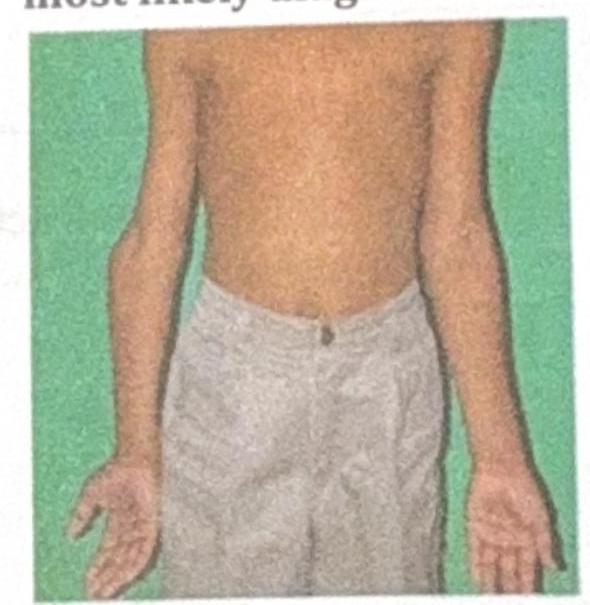
A 10-year-old boy presents with the physical findings shown in the image, characterized by inward angulation of the elbows. What is the most likely diagnosis?
Block vertebrae are seen in which condition?
Foot eversion is caused by
Statement 1 - A 59-year-old patient presents with flaccid bullae. Histopathology shows a suprabasal acantholytic split. Statement 2 - The row of tombstones appearance is diagnostic of Pemphigus vulgaris.
Explanation: ***Medial condyle of the humerus*** - Fractures involving the **medial condyle** or **epicondyle** can directly injure the **ulnar nerve** as it passes through the cubital tunnel. - Malunion or delayed healing of these fractures can lead to chronic irritation or compression, resulting in **tardy ulnar nerve palsy**. *Lateral condyle of the humerus* - Fractures of the **lateral condyle** are less directly associated with ulnar nerve injury because the nerve is located on the medial side of the elbow. - While all elbow fractures carry some risk of nerve injury, the proximity of the ulnar nerve to the medial structures makes medial condyle fractures more relevant. *Supracondylar condyle of the humerus* - **Supracondylar fractures** are more commonly associated with injury to the **brachial artery** and the **median nerve** (Volkmann's contracture). - Although any severe elbow trauma can cause nerve damage, primary ulnar nerve involvement is less typical with supracondylar fractures compared to medial condyle fractures. *Fracture shaft of the humerus* - Fractures of the **humeral shaft** are most commonly associated with injury to the **radial nerve** due to its close proximity to the mid-shaft of the humerus. - The ulnar nerve courses more distally and medially, making shaft fractures an infrequent cause of direct ulnar nerve palsy.
Explanation: ***Muscle weakness*** - **Muscle weakness** is a common symptom in both rickets (in children) and osteomalacia (in adults) due to **impaired mineralization of bone matrix** and compromised muscle function [1]. - This weakness often presents as **difficulty walking**, standing, or performing daily activities. *Frontal bossing in the skull* - **Frontal bossing** (prominent forehead) is a specific sign of **rickets** in children, resulting from excessive unmineralized osteoid on the skull [1]. - It is not typically seen in adult **osteomalacia**, as the skull bones are already formed. *Defects in tooth enamel* - **Defects in tooth enamel** are primarily associated with a prolonged and severe deficiency of **vitamin D or calcium during tooth development**, which is characteristic of childhood **rickets**. - While vitamin D and calcium are crucial for overall bone health, enamel defects are less common or severe in adult-onset **osteomalacia**. *Prominent costochondral junctions* - **Prominent costochondral junctions** (rachitic rosary) are a classic sign of **rickets** in children, caused by the enlargement of the cartilage at the ends of the ribs due to defective mineralization [1]. - This finding is specific to growing children and is not observed in adults with **osteomalacia**.
Explanation: ***Quadriceps atrophy*** - While muscle weakness can occur in osteoarthritis due to pain and disuse, **quadriceps atrophy** is not a universal or defining characteristic of the disease itself, nor is it consistently observed as a primary feature. - The statement implies that quadriceps atrophy is *always* true about osteoarthritis, which is incorrect as it's a potential consequence but not inherently present in all cases or a direct pathological feature. *MCP is spared* - The **metacarpophalangeal (MCP) joints** are typically spared in osteoarthritis, unlike in rheumatoid arthritis. - Osteoarthritis predominantly affects the **distal interphalangeal (DIP)** and **proximal interphalangeal (PIP)** joints of the hands, as well as the **carpometacarpal (CMC) joint of the thumb**. *Glucosamines are beneficial* - **Glucosamine sulfate** is a commonly used supplement in osteoarthritis, with some studies suggesting it may provide modest pain relief and slow cartilage degradation in certain patients. - While its efficacy is debated and not universally accepted as curative, many patients report subjective benefit, and it is considered a complementary therapy. *Loose bodies in the ankle joint* - **Loose bodies**, also known as joint mice, are fragments of cartilage or bone that can break off and float within the joint space. - These are a recognized complication of osteoarthritis, particularly in weight-bearing joints like the **ankle**, and can cause locking or catching sensations.
Explanation: ***Median Nerve*** - **Pronator teres syndrome** is a **compression neuropathy** of the **median nerve** as it passes between the two heads of the pronator teres muscle [1]. - Symptoms include pain in the proximal forearm, paresthesia in the median nerve distribution, and weakness in forearm pronation and thumb/finger flexion [1]. *Axillary Nerve* - The **axillary nerve** innervates the **deltoid** and **teres minor** muscles and supplies sensation to the lateral shoulder. - Its compression or injury would lead to shoulder weakness and sensory deficits, not forearm symptoms. *Ulnar Nerve* - The **ulnar nerve** passes through **Guyon's canal** at the wrist and the cubital tunnel at the elbow [1]. - Compression leads to symptoms in the **medial 1.5 digits** and weakness of intrinsic hand muscles, not related to the pronator teres. *Radial Nerve* - The **radial nerve** innervates the **extensor muscles** of the arm and forearm. - Compression or injury would result in wrist drop or sensory deficits on the dorsal hand, symptoms not associated with pronator teres syndrome.
Explanation: ***Psoriatic arthropathy*** - **Arthritis mutilans** is a severe, destructive form of psoriatic arthritis characterized by marked **osteolysis** and telescoping deformities of the digits [1]. - This condition is almost exclusively associated with **psoriatic arthritis**, representing its most aggressive subtype [1]. *Rheumatoid arthritis* - While rheumatoid arthritis can cause severe joint destruction, it typically manifests as **erosive arthritis** with joint deformities like **swan-neck** and **boutonnière deformities**, but not true arthritis mutilans [3]. - The pattern of bone destruction (osteolysis) seen in arthritis mutilans is distinct from the erosions in rheumatoid arthritis. *Spondyloarthropathy* - This is a broad category that includes diseases like ankylosing spondylitis and reactive arthritis, which primarily affect the **axial skeleton** and entheses. - While some spondyloarthropathies can cause peripheral joint involvement, they generally do not lead to the extreme osteolysis and telescoping digits characteristic of arthritis mutilans. *Reactive arthritis* - Reactive arthritis is an aseptic inflammatory arthritis that often follows infection, characterized by **oligoarthritis**, dactylitis, and enthesitis [2]. - This condition does not typically cause the severe, mutilating joint destruction seen in arthritis mutilans.
Explanation: ***Obturator nerve*** - The **obturator nerve** passes through the **obturator foramen** into the medial compartment of the thigh, not the greater sciatic foramen. - Its primary function is to innervate the **adductor muscles** of the thigh and provide sensory innervation to the medial thigh. *Piriformis* - The **piriformis muscle** passes through the **greater sciatic foramen**, dividing it into suprapiriform and infrapiriform spaces. - It runs from the anterior surface of the **sacrum** to the greater trochanter of the femur. *Superior gluteal nerve* - The **superior gluteal nerve** passes through the **suprapiriform part** of the greater sciatic foramen. - It innervates the **gluteus minimus**, **gluteus medius**, and **tensor fasciae latae muscles**. *Inferior gluteal nerve* - The **inferior gluteal nerve** passes through the **infrapiriform part** of the greater sciatic foramen. - It specifically innervates the **gluteus maximus muscle**.
Explanation: ***Cubitus varus deformity*** - The image clearly illustrates an **inward angulation of the elbow** (gunstock deformity), which is characteristic of **cubitus varus**. This often occurs after a supracondylar fracture of the humerus that heals with malunion. - This deformity typically results in a decreased or reversed carrying angle of the elbow. *Madelung deformity* - This is a rare congenital anomaly characterized by **dorsal and radial bowing of the distal radius** and premature fusion of the ulnar physis. - It primarily affects the wrist, leading to a visible prominence of the distal ulna and carpal bone subluxation, which is not depicted in the elbow region in the image. *Nursemaid's elbow* - This is a common injury in young children where the **radial head is subluxated** from the annular ligament, often due to a sudden pull on the forearm. - It presents as acute pain and refusal to use the arm, but does not involve a chronic structural deformity or angulation of the elbow joint as shown in the image. *Klippel-Feil syndrome* - This is a rare congenital disorder characterized by the **fusion of two or more cervical vertebrae**. - Its primary manifestations are a short neck, low posterior hairline, and restricted neck movement, with no direct involvement or deformity of the elbow joint itself.
Explanation: ***Klippel-Feil syndrome*** - **Block vertebrae** are a characteristic radiographic finding in **Klippel-Feil syndrome**, resulting from the congenital fusion of two or more cervical vertebrae. - This fusion leads to a **short neck**, **low hairline**, and **restricted neck motion**. *Pagets disease* - **Paget's disease** is a chronic condition of abnormal bone remodeling, leading to enlarged and weakened bones. - While it can cause vertebral body changes, **block vertebrae** resulting from congenital fusion are not a typical feature. *Leukemia* - **Leukemia** involves uncontrolled proliferation of abnormal white blood cells, which can infiltrate bone marrow and cause lytic or blastic lesions in bones. - It does not cause **block vertebrae**, which are a developmental anomaly. *TB* - **Tuberculosis (TB) of the spine (Pott's disease)** is an infectious condition causing vertebral destruction, collapse, and kyphosis. - While TB can lead to vertebral collapse and eventual fusion during healing, the primary pathology is destructive and not the congenital fusion seen as **block vertebrae**.
Explanation: ***Peroneus longus*** - The **peroneus longus** muscle (fibularis longus) is a primary evertor of the foot. - It originates from the head and upper lateral surface of the fibula, inserts into the medial cuneiform and first metatarsal, and its contraction pulls the foot outwards and downwards. *Tibialis anterior* - The **tibialis anterior** is the primary dorsiflexor and invertor of the foot. - It pulls the foot upwards and inwards, which is the opposite action of eversion. *Tibialis posterior* - The **tibialis posterior** is a strong invertor and plantar flexor of the foot. - It contributes to maintaining the arch of the foot and does not cause eversion. *Extensor digitorum* - The **extensor digitorum longus** primarily extends the toes and assists in dorsiflexion of the ankle. - While it may have a slight eversion component, it is not the primary muscle responsible for foot eversion.
Explanation: ***Correct: Statements 1 & 2 are correct, 2 is not explaining 1*** **Analysis of Statement 1:** - A 59-year-old patient with **flaccid bullae** and **suprabasal acantholytic split** on histopathology is the classic presentation of **Pemphigus vulgaris** - The flaccid (easily ruptured) nature of bullae distinguishes it from tense bullae seen in bullous pemphigoid - The suprabasal location of the split (just above the basal layer) with acantholysis (loss of cell-to-cell adhesion) is pathognomonic - **Statement 1 is CORRECT** ✓ **Analysis of Statement 2:** - The **"row of tombstones" or "tombstone appearance"** is indeed a diagnostic histopathological feature of Pemphigus vulgaris - This appearance results from basal keratinocytes remaining attached to the basement membrane while suprabasal cells separate due to acantholysis - The intact basal cells standing upright resemble a row of tombstones - **Statement 2 is CORRECT** ✓ **Does Statement 2 explain Statement 1?** - Statement 2 describes a **histopathological appearance** (tombstone pattern) that is a **consequence** of the suprabasal split - However, it does NOT explain the **underlying cause** of the flaccid bullae or the suprabasal split - The true explanation involves **IgG autoantibodies against desmoglein 3 (and desmoglein 1)**, which attack intercellular adhesion structures (desmosomes), causing **acantholysis** - Therefore, **Statement 2 does NOT explain Statement 1** ✗ *Incorrect: Statement 2 is the correct explanation for Statement 1* - While both statements describe features of Pemphigus vulgaris, the tombstone appearance is a descriptive finding, not an explanatory mechanism *Incorrect: Statements 1 and 2 are incorrect* - Both statements are medically accurate descriptions of Pemphigus vulgaris features *Incorrect: Statement 1 is incorrect* - Statement 1 correctly describes the cardinal clinical and histopathological features of Pemphigus vulgaris
Get full access to all questions, explanations, and performance tracking.
Start For Free