Community Medicine
9 questionsConsider the following management methods/techniques : 1. System analysis 2. Organizational design 3. Personnel management 4. Information systems Which of the above methods/techniques are based on behavioural sciences?
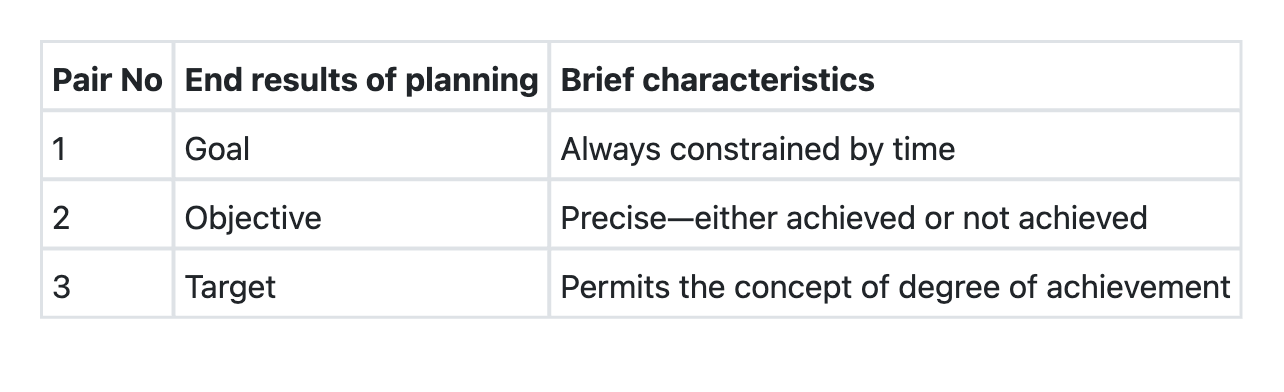
In the following table, the end results of planning are qualified by brief characteristics. How many of the pairs given above are correctly matched?
Consider the following steps of a planning cycle : 1. Assigning priorities among the problems 2. Evaluation 3. Selecting best programme 4. Operating the programme Which among the following is the correct sequence of steps?
Which of the following statements are correct for incidence rate? 1. It is useful for taking action to control a disease. 2. Rising incidence rates may indicate ineffectiveness of the current control programmes. 3. Fluctuation in incidence rate may indicate a change in aetiology of disease. Select the answer using the code given below.
Consider the following definition : "A high level of infection beginning early in life and affecting most of the child population, leading to a state of equilibrium such that the adult population shows evidence of the disease much less commonly than the children." Which one of the following terms best fits this definition?
Consider the following statements regarding dengue : 1. The mosquito becomes infective after an extrinsic incubation period of 8-10 days. 2. Once it becomes infective, the mosquito remains infective for life. 3. The genital tract of the mosquito does not get infected. Which of the statements given above are correct?
A researcher has obtained the country-level data on the average Body Mass Index (BMI) and the average sugar intake for 100 countries. Which among the following will be best suited to present the relationship between BMI and sugar intake in the 100 countries?
Frontline health workers are employed to record the births and deaths in countries which have made slow progress in the development of a comprehensive vital registration system. This approach is known as
While calculating the ‘total dependency ratio’, which one of the following is used in the denominator?
UPSC-CMS 2024 - Community Medicine UPSC-CMS Practice Questions and MCQs
Question 81: Consider the following management methods/techniques : 1. System analysis 2. Organizational design 3. Personnel management 4. Information systems Which of the above methods/techniques are based on behavioural sciences?
- A. 1, 2 and 3 (Correct Answer)
- B. 1, 2 and 4
- C. 2, 3 and 4
- D. 1, 3 and 4
Explanation: ***1, 2 and 3*** - **System analysis** in management context involves understanding human behavior within organizational systems, analyzing workflows, and interpersonal dynamics to optimize processes and structures. When applied to organizational management, it incorporates behavioral principles. - **Organizational design** is fundamentally rooted in behavioral sciences, focusing on structuring roles, relationships, and hierarchies to enhance human interaction, motivation, and performance based on principles from organizational psychology and sociology. - **Personnel management** directly deals with human resource management, applying behavioral science principles including motivation theory, leadership styles, group dynamics, employee relations, and organizational behavior. *1, 2 and 4* - This option incorrectly includes **information systems**, which are primarily technology-focused and rooted in computer science and data management rather than behavioral sciences. - While information systems may influence organizational behavior, their core methodologies are not based on behavioral science principles. *2, 3 and 4* - This option incorrectly includes **information systems** while excluding **system analysis**. - Information systems are technology-based rather than behavioral science-based. *1, 3 and 4* - This option incorrectly includes **information systems**, which are technology-focused rather than behavioral science-based. - It also excludes **organizational design**, which is a fundamental behavioral science application in management, focusing on how structure affects human behavior and organizational effectiveness.
Question 82: In the following table, the end results of planning are qualified by brief characteristics. How many of the pairs given above are correctly matched?
- A. All of the pairs
- B. None of the pairs
- C. Only two of the pairs
- D. Only one of the pairs (Correct Answer)
Explanation: ***Only one of the pairs (Correct Answer)*** - Only Pair No. 2 is correctly matched in the table - An **objective** is correctly characterized as "precise—either achieved or not achieved" - Objectives are specific, measurable statements that are binary in nature (achieved or not achieved) - The other pairs (Goal and Target) contain inaccuracies in their given characteristics *All of the pairs (Incorrect)* - Not all pairs accurately describe the end results of planning - Specifically, the characteristics given for "Goal" and "Target" are not entirely correct - Goals are generally broader and may not always be strictly time-constrained as described *None of the pairs (Incorrect)* - This is incorrect as at least one pair is correctly defined - The definition of "Objective" as "precise—either achieved or not achieved" is accurate - Eliminating all pairs would be incorrect *Only two of the pairs (Incorrect)* - Only one pair (Objective) is correctly matched, not two - Goals are generally broader and may not always be strictly time-constrained in the way described in the table - Targets are often precise and quantifiable, similar to objectives, rather than permitting a "degree of achievement" as suggested
Question 83: Consider the following steps of a planning cycle : 1. Assigning priorities among the problems 2. Evaluation 3. Selecting best programme 4. Operating the programme Which among the following is the correct sequence of steps?
- A. 1 → 3 → 4 → 2 (Correct Answer)
- B. 2 → 3 → 4 → 1
- C. 3 → 4 → 1 → 2
- D. 1 → 2 → 3 → 4
Explanation: ***1 → 3 → 4 → 2*** - The planning cycle begins with **identifying and prioritizing problems**, as this guides all subsequent decisions. - After prioritizing, the next logical step is to **select the best program** or intervention to address the identified problems. Following this, the chosen program is **operated** or implemented, and finally, its effectiveness is **evaluated**. *2 → 3 → 4 → 1* - This sequence incorrectly places **evaluation** at the beginning, before problems have been identified or prioritized. - **Prioritizing problems** (step 1) must occur early in the cycle to set the foundation for action, not after initial program selection and operation. *3 → 4 → 1 → 2* - This option incorrectly suggests **selecting a program** before **prioritizing problems**, which is illogical as program selection should be driven by identified needs. - **Prioritizing problems** (step 1) happens too late in this sequence, as it should precede program selection (step 3). *1 → 2 → 3 → 4* - This sequence is incorrect because **evaluation** (step 2) must occur after the program has been **operated** (step 4) to assess its outcomes. - The order of **selecting the best program** (step 3) and **operating the program** (step 4) is reversed, as selection logically precedes operation.
Question 84: Which of the following statements are correct for incidence rate? 1. It is useful for taking action to control a disease. 2. Rising incidence rates may indicate ineffectiveness of the current control programmes. 3. Fluctuation in incidence rate may indicate a change in aetiology of disease. Select the answer using the code given below.
- A. 2 and 3 only
- B. 1, 2 and 3 (Correct Answer)
- C. 1 and 3 only
- D. 1 and 2 only
Explanation: ***1, 2 and 3*** - All three statements about **incidence rate** are correct. Incidence rate measures the rate at which new cases of a disease occur in a population at risk during a specified period. - **Statement 1 is correct**: Incidence rate is fundamental for **public health action and disease control**. It identifies when and where new cases are occurring, enabling targeted interventions and resource allocation. - **Statement 2 is correct**: **Rising incidence rates during control programmes** clearly indicate that current measures are ineffective or inadequate. This serves as a critical feedback mechanism for evaluating and modifying disease control strategies. - **Statement 3 is correct**: **Fluctuations in incidence rate may indicate changes in disease etiology**. The word "may" is key - while fluctuations can result from detection or reporting changes, they can also signal genuine etiological shifts such as emergence of new pathogen variants, changes in virulence, or alterations in environmental risk factors. Monitoring incidence trends is specifically used to detect such etiological changes. *1 and 2 only* - This option incorrectly excludes Statement 3. Fluctuations in incidence rate **can indeed indicate etiological changes**, which is why epidemiologists monitor incidence trends to detect emerging variants, changes in transmission patterns, or new risk factors. - The statement uses "may indicate" (not "always indicates"), making it epidemiologically accurate. *2 and 3 only* - This option incorrectly excludes Statement 1. The **incidence rate is essential for disease control action** - it is the primary metric used to identify disease burden, track trends, and guide intervention strategies. - Without monitoring incidence, public health authorities cannot effectively plan or implement control measures. *1 and 3 only* - This option incorrectly excludes Statement 2. A **rising incidence rate** is a clear indicator of control programme failure or inadequacy, making it crucial for programme evaluation and modification. - Ignoring this relationship would mean missing vital feedback on intervention effectiveness.
Question 85: Consider the following definition : "A high level of infection beginning early in life and affecting most of the child population, leading to a state of equilibrium such that the adult population shows evidence of the disease much less commonly than the children." Which one of the following terms best fits this definition?
- A. Hyperendemic
- B. Hypoendemic
- C. Holoendemic (Correct Answer)
- D. Pandemic
Explanation: ***Holoendemic*** - This term describes a situation where an infection is **highly prevalent** early in life, affecting most children, leading to a state of **equilibrium** in adulthood where the disease is less common. - This pattern is often observed with diseases like **malaria** in endemic regions, where early exposure leads to acquired immunity. *Hyperendemic* - Refers to a disease that is **persistently present** at a **high level** of incidence and/or prevalence in a specific population, affecting all age groups, not specifically children. - While reflecting high prevalence, it doesn't emphasize the early-life infection leading to adult equilibrium as strongly as holoendemic. *Hypoendemic* - This term describes a disease with a **low level of incidence and prevalence** within a population. - It implies infrequent disease occurrence, which is the opposite of the high initial infection rate described in the definition. *Pandemic* - A **widespread epidemic** of an infectious disease that has spread across a large region, multiple continents, or even worldwide. - This term describes the geographical extent of a disease outbreak, not its specific pattern of age-related prevalence or immunity within a single population.
Question 86: Consider the following statements regarding dengue : 1. The mosquito becomes infective after an extrinsic incubation period of 8-10 days. 2. Once it becomes infective, the mosquito remains infective for life. 3. The genital tract of the mosquito does not get infected. Which of the statements given above are correct?
- A. 2 and 3 only
- B. 1 and 3 only
- C. 1 and 2 only (Correct Answer)
- D. 1, 2 and 3
Explanation: ***1 and 2 only*** - The **extrinsic incubation period** for dengue in mosquitoes (Aedes aegypti and Aedes albopictus) is indeed **8-10 days** at optimal temperatures, after which the mosquito becomes infective. - Once infected, the mosquito's salivary glands harbor the virus, making it capable of transmitting dengue for the **rest of its life**. *2 and 3 only* - While statement 2 is correct, statement 3 is incorrect. The **genital tract of the mosquito can be infected**; vertical transmission (from infected female mosquito to offspring via eggs) is a known but less common route of spread. *1 and 3 only* - Statement 1 is correct, but statement 3 is incorrect as the **genital tract can be infected**, leading to vertical transmission in mosquitoes. *1, 2 and 3* - This option is incorrect because statement 3 is false. The dengue virus can infect the **genital tract** of the mosquito, allowing for **vertical transmission** to its offspring.
Question 87: A researcher has obtained the country-level data on the average Body Mass Index (BMI) and the average sugar intake for 100 countries. Which among the following will be best suited to present the relationship between BMI and sugar intake in the 100 countries?
- A. Frequency polygon
- B. Bar chart
- C. Scatter diagram (Correct Answer)
- D. Pie diagram
Explanation: ***Scatter diagram*** - A **scatter diagram** is ideally suited for visualizing the relationship or **correlation** between two continuous variables, in this case, average BMI and average sugar intake per country. - Each point on the diagram represents a single country, with its coordinates determined by its corresponding BMI and sugar intake values, allowing for easy identification of patterns or trends. *Frequency polygon* - A **frequency polygon** is used to display the **frequency distribution** of a single continuous variable, showing the shape of the data. - It is not designed to show the relationship between two different variables. *Bar chart* - A **bar chart** is typically used to compare **categorical data** or show changes in a **single variable over time**. - It does not effectively display the relationship or correlation between two continuous variables like BMI and sugar intake. *Pie diagram* - A **pie diagram** is used to represent **proportions** or percentages of a whole for a single categorical variable. - It is not suitable for visualizing the relationship between two continuous quantitative variables.
Question 88: Frontline health workers are employed to record the births and deaths in countries which have made slow progress in the development of a comprehensive vital registration system. This approach is known as
- A. census
- B. lay reporting (Correct Answer)
- C. registration of vital events
- D. sample registration system
Explanation: ***lay reporting*** - **Lay reporting** involves non-medical or community health workers collecting basic health information, such as births and deaths, especially in regions with inadequate formal registration systems. - This method is valuable for gathering **community-level data** and improving the reach of health surveillance where professional healthcare infrastructure is limited. *census* - A **census** is a complete enumeration of a population at a specific point in time, usually conducted by the government to collect demographic and socioeconomic data. - While it counts individuals, it does not typically involve the continuous recording of **vital events** like births and deaths by frontline health workers. *registration of vital events* - **Registration of vital events** refers to the official and continuous recording of births, deaths, marriages, and divorces by civil authorities, which is part of a comprehensive vital registration system. - The question describes a scenario where this comprehensive system is underdeveloped, necessitating an alternative like **lay reporting**. *sample registration system* - A **sample registration system** involves collecting vital statistics from a representative sample of the population rather than the entire population. - While it's used to estimate demographic indicators, it typically involves more structured data collection methods and is distinct from utilizing **frontline health workers** for primary recording in underserved areas.
Question 89: While calculating the ‘total dependency ratio’, which one of the following is used in the denominator?
- A. Midyear population
- B. Population 15 to 64 years (Correct Answer)
- C. Population 14 to 70 years
- D. Population 0 to 65 years
Explanation: ***Population 15 to 64 years*** - The **total dependency ratio** is calculated by dividing the sum of the **dependent population** (ages 0-14 and 65+) by the **working-age population** (ages 15-64). - Therefore, the **denominator** represents the segment of the population that is generally considered to be in their most productive working years. *Midyear population* - The **midyear population** refers to the population at the midpoint of a given year and is often used as a general denominator for various rates (e.g., birth rates, death rates). - However, in the context of the dependency ratio, a specific age group—the **working-age population**—is required in the denominator to reflect economic burden. *Population 14 to 70 years* - This age range does not accurately represent the standard definition of the **working-age population** or the traditional age groups used for calculating dependency ratios. - The internationally accepted age range for the working population is typically **15-64 years**. *Population 0 to 65 years* - This range includes both **dependent children** (0-14) and potentially some of the **elderly dependent population** (65 and over), thus it does not represent the **working-age population** for the denominator. - The denominator for the dependency ratio specifically excludes these dependent age groups.
Microbiology
1 questionsConsider the following statements regarding dengue virus : 1. It has four distinct serotypes. 2. Infection with any one serotype confers lifelong immunity for that virus serotype. 3. Secondary infection with dengue serotype 2 leads to severe form of dengue. Which of the statements given above are correct?
UPSC-CMS 2024 - Microbiology UPSC-CMS Practice Questions and MCQs
Question 81: Consider the following statements regarding dengue virus : 1. It has four distinct serotypes. 2. Infection with any one serotype confers lifelong immunity for that virus serotype. 3. Secondary infection with dengue serotype 2 leads to severe form of dengue. Which of the statements given above are correct?
- A. 1 and 2 only (Correct Answer)
- B. 2 and 3 only
- C. 1 and 3 only
- D. 1, 2 and 3
Explanation: ***1 and 2 only*** - Dengue virus indeed has **four distinct serotypes (DENV-1, DENV-2, DENV-3, DENV-4)**, explaining different epidemiological patterns and reinfections. - Infection with one serotype provides **lifelong homologous immunity** against that specific serotype, meaning a person will not get sick again from the same serotype. *2 and 3 only* - While statement 2 is correct, statement 3 is not universally true, as severe dengue can occur with secondary infection of any serotype, although **DENV-2** and **DENV-3** are more frequently implicated. - This option incorrectly excludes the fact that dengue has four distinct serotypes, which is a fundamental aspect of its biology and epidemiology. *1 and 3 only* - While statement 1 is correct, statement 3 is a simplification; severe dengue in secondary infections is due to **antibody-dependent enhancement (ADE)**, which can happen with various heterologous serotypes, not exclusively DENV-2. - This option incorrectly implies that infection with one serotype does not confer lifelong immunity to that specific serotype, which is a key characteristic of dengue immunity. *1, 2 and 3* - This option is incorrect because statement 3, while partially true, is too absolute. Severe dengue can be linked to **DENV-2** or **DENV-3** in secondary infections but isn't exclusive to DENV-2. - The risk of severe dengue is due to a **secondary infection** with a **heterologous serotype**, not specifically serotype 2, though DENV-2 often causes more severe illness in secondary infections.