In the National Malaria Control Programme, Indoor Residual Spray (IRS) is the primary method of vector control in rural setting. Which one of the following is the 'insecticide of choice'?
Q112
Consider the following statements with regard to selection of Accredited Social Health Activist (ASHA) under NRHM :
1. ASHA must be a woman preferably of age 18 to 25 years.
2. ASHA should be married.
3. ASHA must be a resident of the village.
4. ASHA may be a married, widowed or divorced woman. Which of the statements given above are correct with regard to process of selection of ASHA?
Q113
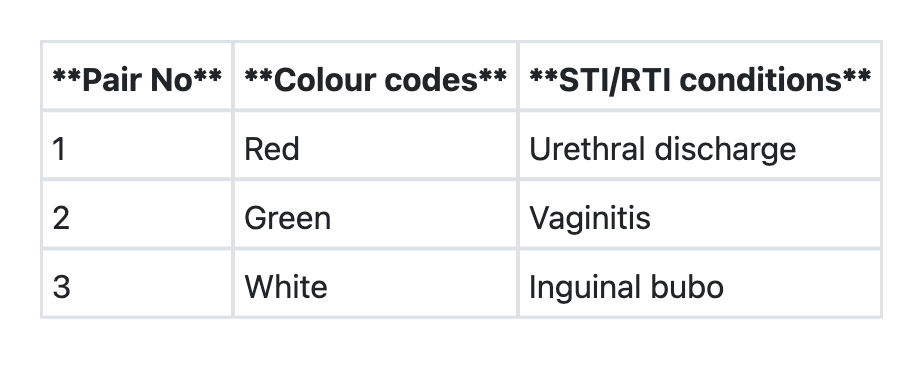
The National AIDS Control Organization provides prepacked colour-coded STI/RTI kits as a free supply to its designated STI/RTI clinics. Consider the following pairs: Pair No Colour codes STI/RTI conditions 1 Red Urethral discharge 2 Green Vaginitis 3 White Inguinal bubo How many of the pairs given above are correctly matched?
Q114
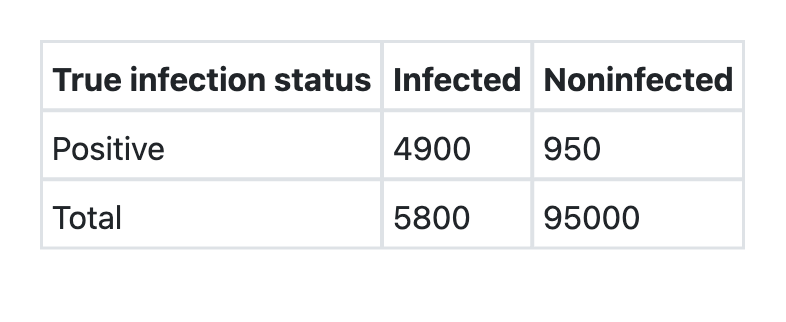
The table below shows the results of ELISA test for HIV infection :
Consider the following statements :
1. The sensitivity is 98%.
2. The specificity is 99%.
Which of the statements given above is/are correct?
UPSC-CMS 2024 - Community Medicine UPSC-CMS Practice Questions and MCQs
Question 111: In the National Malaria Control Programme, Indoor Residual Spray (IRS) is the primary method of vector control in rural setting. Which one of the following is the 'insecticide of choice'?
A. Synthetic pyrethroid (Correct Answer)
B. Temephos
C. DDT
D. Malathion
Explanation: ***Synthetic pyrethroid***
- **Synthetic pyrethroids** are the **insecticide of choice** for Indoor Residual Spraying (IRS) in many national malaria control programs due to their **rapid knockdown effect** and good residual activity.
- They are effective against various mosquito species and have a **relatively low toxicity** to humans at recommended concentrations.
*Temephos*
- **Temephos** is primarily used as a **larvicide**, often applied to waterbodies to control mosquito larvae.
- It is **not suitable for IRS** as it lacks the necessary residual effect on surfaces to control adult mosquitoes effectively.
*DDT*
- **DDT** was historically a very effective insecticide for malaria control but is now **restricted or banned** in many countries due to its **environmental persistence** and potential health concerns.
- While still used in some specific contexts, it is generally **not the primary insecticide of choice** for new or ongoing programs due to these restrictions and growing **insecticide resistance**.
*Malathion*
- **Malathion** is an **organophosphate insecticide** that can be used for IRS, but it generally has a **shorter residual effect** compared to synthetic pyrethroids.
- It may also have issues with **odor** and require more frequent reapplication, making it a less preferred option than pyrethroids in many programs.
Question 112: Consider the following statements with regard to selection of Accredited Social Health Activist (ASHA) under NRHM :
1. ASHA must be a woman preferably of age 18 to 25 years.
2. ASHA should be married.
3. ASHA must be a resident of the village.
4. ASHA may be a married, widowed or divorced woman. Which of the statements given above are correct with regard to process of selection of ASHA?
A. 1 and 2 only
B. 2 and 3 only
C. 3 and 4 only (Correct Answer)
D. 1, 2, 3 and 4
Explanation: ***3 and 4 only***
- An ASHA worker must be a **resident of the village** she serves to ensure local knowledge and trust, making statement 3 correct.
- The criteria specify that an ASHA may be **married, widowed, or divorced**, making statement 4 correct and reflecting inclusivity in selection.
*1 and 2 only*
- While ASHA candidates are typically women, the age criteria are usually **25 to 45 years**, not 18-25, making statement 1 incorrect.
- Being married is not a mandatory criterion; **single, widowed, or divorced women** are also eligible, making statement 2 incorrect.
*2 and 3 only*
- As explained earlier, being married (statement 2) is **not a mandatory requirement**, as eligibility extends to widowed or divorced women.
- While being a resident of the village (statement 3) is correct, statement 2 is incorrect, so this option is not entirely correct.
*1, 2, 3 and 4*
- This option includes statements 1 and 2, which are **incorrect**. Statement 1 refers to an incorrect age range, and statement 2 incorrectly states that ASHA must be married.
Question 113: The National AIDS Control Organization provides prepacked colour-coded STI/RTI kits as a free supply to its designated STI/RTI clinics. Consider the following pairs: Pair No Colour codes STI/RTI conditions 1 Red Urethral discharge 2 Green Vaginitis 3 White Inguinal bubo How many of the pairs given above are correctly matched?
A. All the pairs
B. Only one pair
C. None of the pairs
D. Only two of the pairs (Correct Answer)
Explanation: ***Only two of the pairs***
- Pair 1 (Red - Urethral discharge) is **correctly matched** according to NACO STI/RTI syndromic management guidelines
- Pair 3 (White - Inguinal bubo) is **correctly matched** as per NACO color-coding system
- Pair 2 (Green - Vaginitis) is **incorrectly matched** because Green kit is designated for lower abdominal pain, not vaginitis
- **Yellow kit** is used for vaginal discharge/vaginitis, not Green
- NACO color-coded kits ensure standardized syndromic management: Red (urethral discharge), Yellow (vaginal discharge), Green (lower abdominal pain), White (genital ulcer/inguinal bubo)
*Only one pair*
- This is incorrect as two pairs are correctly matched (Red-Urethral discharge and White-Inguinal bubo)
- Green is not the correct color for vaginitis; it is meant for lower abdominal pain syndrome
*All the pairs*
- This is incorrect because Pair 2 (Green-Vaginitis) is wrongly matched
- Green kit is designated for lower abdominal pain, while Yellow kit is for vaginal discharge/vaginitis
- Only two out of three pairs are correctly matched
*None of the pairs*
- This is incorrect as both Pair 1 (Red-Urethral discharge) and Pair 3 (White-Inguinal bubo) are correctly matched according to NACO guidelines
- Two pairs show accurate color-syndrome correlation
Question 114: The table below shows the results of ELISA test for HIV infection :
Consider the following statements :
1. The sensitivity is 98%.
2. The specificity is 99%.
Which of the statements given above is/are correct?
A. Both 1 and 2
B. 2 only (Correct Answer)
C. Neither 1 nor 2
D. 1 only
Explanation: ***2 only***
- From the ELISA test table, we need to calculate sensitivity and specificity using standard formulas.
- **True Positives (TP)** = Infected individuals who tested positive = **4900**
- **False Negatives (FN)** = Infected individuals who tested negative = 5800 - 4900 = **900**
- **True Negatives (TN)** = Non-infected individuals who tested negative = 95000 - 950 = **94050**
- **False Positives (FP)** = Non-infected individuals who tested positive = **950**
- **Sensitivity = TP / (TP + FN)** = 4900 / 5800 = **84.48%** (NOT 98%)
- **Specificity = TN / (TN + FP)** = 94050 / 95000 = **99.0%** ✓
- **Statement 1 is INCORRECT** (sensitivity is 84.48%, not 98%)
- **Statement 2 is CORRECT** (specificity is indeed 99%)
*1 only*
- This option is incorrect because statement 1 claims sensitivity is 98%, but the calculated sensitivity is only 84.48%.
- The test correctly identifies only about 84.5% of infected individuals, missing approximately 15.5% (false negatives).
*Both 1 and 2*
- This option is incorrect because statement 1 is false.
- While statement 2 regarding specificity (99%) is correct, statement 1 regarding sensitivity (98%) is incorrect.
*Neither 1 nor 2*
- This option is incorrect because statement 2 is correct.
- The specificity calculation clearly shows 99%, so at least one statement is correct.
Obstetrics and Gynecology
1 questions
Q111
The most common cause of maternal mortality in India is
UPSC-CMS 2024 - Obstetrics and Gynecology UPSC-CMS Practice Questions and MCQs
Question 111: The most common cause of maternal mortality in India is
A. unsafe abortion
B. toxaemia of pregnancy
C. obstetric haemorrhage (Correct Answer)
D. obstructed labour
Explanation: ***Obstetric haemorrhage***
- **Postpartum hemorrhage (PPH)** remains the leading **direct cause** of maternal mortality in India and globally
- Most commonly results from **uterine atony** (inadequate uterine contraction after delivery), accounting for approximately 70% of PPH cases
- Other causes include retained placental tissue, genital tract trauma, and coagulation disorders
- Contributes to approximately **30-35%** of maternal deaths in India according to recent SRS data
*Unsafe abortion*
- Significant contributor to maternal mortality, particularly in regions with limited access to safe abortion services
- Complications include **sepsis, hemorrhage, and uterine perforation**
- Ranks as the second or third leading cause depending on the data source, but not the most common overall
*Toxaemia of pregnancy*
- Also known as **pre-eclampsia and eclampsia**, this is an important cause of maternal mortality
- Complications include **eclamptic seizures, stroke, HELLP syndrome, and multi-organ failure**
- Ranks third to fourth among direct causes of maternal death in India
*Obstructed labour*
- Can lead to serious complications including **uterine rupture, postpartum hemorrhage, and sepsis**
- With improved access to cesarean sections, the contribution to maternal mortality has decreased
- Now contributes less to overall maternal mortality compared to hemorrhage