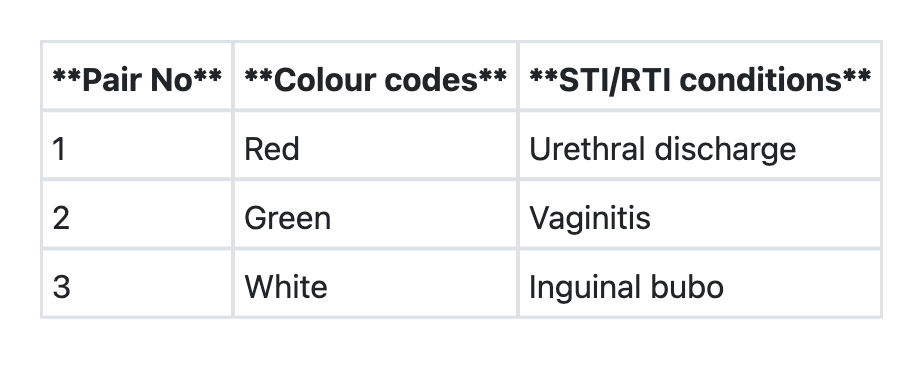
Question 31: The National AIDS Control Organization provides prepacked colour-coded STI/RTI kits as a free supply to its designated STI/RTI clinics. Consider the following pairs: Pair No Colour codes STI/RTI conditions 1 Red Urethral discharge 2 Green Vaginitis 3 White Inguinal bubo How many of the pairs given above are correctly matched?
- A. All the pairs
- B. Only one pair
- C. None of the pairs
- D. Only two of the pairs (Correct Answer)
Explanation: ***Only two of the pairs***
- Pair 1 (Red - Urethral discharge) is **correctly matched** according to NACO STI/RTI syndromic management guidelines
- Pair 3 (White - Inguinal bubo) is **correctly matched** as per NACO color-coding system
- Pair 2 (Green - Vaginitis) is **incorrectly matched** because Green kit is designated for lower abdominal pain, not vaginitis
- **Yellow kit** is used for vaginal discharge/vaginitis, not Green
- NACO color-coded kits ensure standardized syndromic management: Red (urethral discharge), Yellow (vaginal discharge), Green (lower abdominal pain), White (genital ulcer/inguinal bubo)
*Only one pair*
- This is incorrect as two pairs are correctly matched (Red-Urethral discharge and White-Inguinal bubo)
- Green is not the correct color for vaginitis; it is meant for lower abdominal pain syndrome
*All the pairs*
- This is incorrect because Pair 2 (Green-Vaginitis) is wrongly matched
- Green kit is designated for lower abdominal pain, while Yellow kit is for vaginal discharge/vaginitis
- Only two out of three pairs are correctly matched
*None of the pairs*
- This is incorrect as both Pair 1 (Red-Urethral discharge) and Pair 3 (White-Inguinal bubo) are correctly matched according to NACO guidelines
- Two pairs show accurate color-syndrome correlation
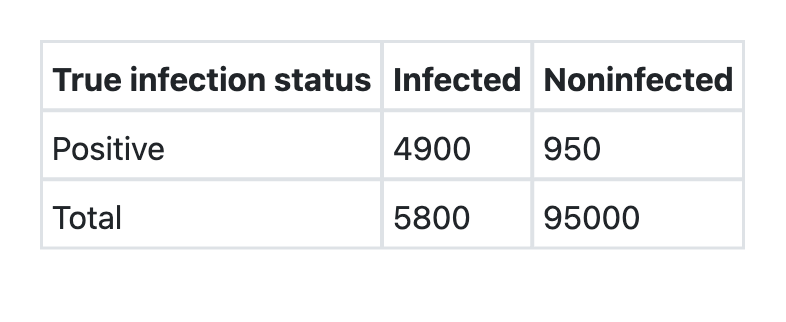
Question 32: The table below shows the results of ELISA test for HIV infection :
Consider the following statements :
1. The sensitivity is 98%.
2. The specificity is 99%.
Which of the statements given above is/are correct?
- A. Both 1 and 2
- B. 2 only (Correct Answer)
- C. Neither 1 nor 2
- D. 1 only
Explanation: ***2 only***
- From the ELISA test table, we need to calculate sensitivity and specificity using standard formulas.
- **True Positives (TP)** = Infected individuals who tested positive = **4900**
- **False Negatives (FN)** = Infected individuals who tested negative = 5800 - 4900 = **900**
- **True Negatives (TN)** = Non-infected individuals who tested negative = 95000 - 950 = **94050**
- **False Positives (FP)** = Non-infected individuals who tested positive = **950**
- **Sensitivity = TP / (TP + FN)** = 4900 / 5800 = **84.48%** (NOT 98%)
- **Specificity = TN / (TN + FP)** = 94050 / 95000 = **99.0%** ✓
- **Statement 1 is INCORRECT** (sensitivity is 84.48%, not 98%)
- **Statement 2 is CORRECT** (specificity is indeed 99%)
*1 only*
- This option is incorrect because statement 1 claims sensitivity is 98%, but the calculated sensitivity is only 84.48%.
- The test correctly identifies only about 84.5% of infected individuals, missing approximately 15.5% (false negatives).
*Both 1 and 2*
- This option is incorrect because statement 1 is false.
- While statement 2 regarding specificity (99%) is correct, statement 1 regarding sensitivity (98%) is incorrect.
*Neither 1 nor 2*
- This option is incorrect because statement 2 is correct.
- The specificity calculation clearly shows 99%, so at least one statement is correct.