UPSC-CMS 2024 — Community Medicine
32 Previous Year Questions with Answers & Explanations
Which types of cancer are associated with exposure to ionizing radiation? 1. Leukaemia 2. Lung cancer 3. Breast cancer 4. Lymphoma Select the correct answer using the code given below.
Injectable medroxyprogesterone IP 150 mg/mL contraceptive injection is available in Family Health Programme of the Government of India under the name
As per the Open Vial Policy, partially used multidose vials of which of the following vaccines can be used over more than one immunization session? 1. BCG vaccine 2. DPT vaccine 3. Hepatitis B vaccine 4. Measles vaccine Select the correct answer using the code given below.
The statement, "Health is a dynamic equilibrium between man and environment and disease a maladjustment of the human organism to environment" explains which one of the following concepts of health?
The table given below shows three broad components under which the objectives of the National Health Policy, 2017 can be grouped, along with examples of goals/objectives under each component. How many of the pairs shown in the table are correctly matched? Select the correct answer using the code given below.

Consider the following management methods/techniques : 1. System analysis 2. Organizational design 3. Personnel management 4. Information systems Which of the above methods/techniques are based on behavioural sciences?
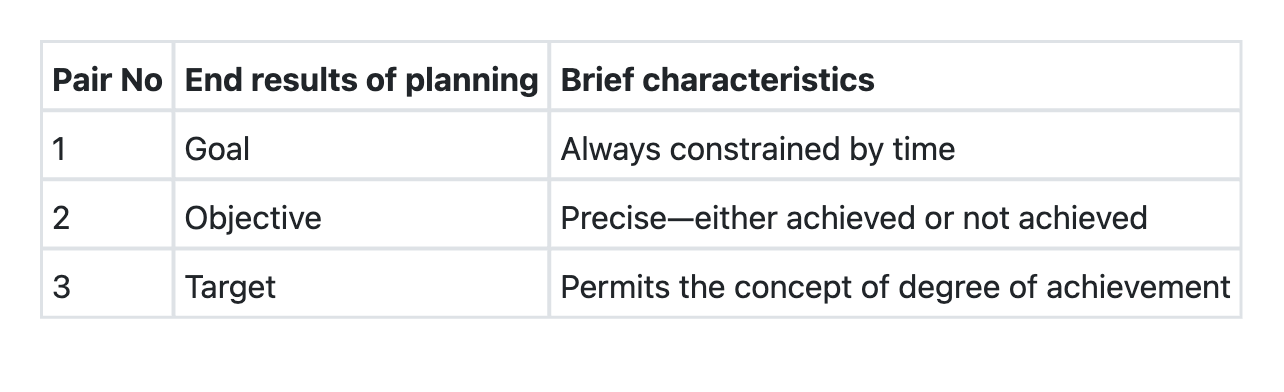
In the following table, the end results of planning are qualified by brief characteristics. How many of the pairs given above are correctly matched?
Consider the following steps of a planning cycle : 1. Assigning priorities among the problems 2. Evaluation 3. Selecting best programme 4. Operating the programme Which among the following is the correct sequence of steps?
Which of the following statements are correct for incidence rate? 1. It is useful for taking action to control a disease. 2. Rising incidence rates may indicate ineffectiveness of the current control programmes. 3. Fluctuation in incidence rate may indicate a change in aetiology of disease. Select the answer using the code given below.
Consider the following definition : "A high level of infection beginning early in life and affecting most of the child population, leading to a state of equilibrium such that the adult population shows evidence of the disease much less commonly than the children." Which one of the following terms best fits this definition?
UPSC-CMS 2024 - Community Medicine UPSC-CMS Practice Questions and MCQs
Question 1: Which types of cancer are associated with exposure to ionizing radiation? 1. Leukaemia 2. Lung cancer 3. Breast cancer 4. Lymphoma Select the correct answer using the code given below.
- A. 1, 2 and 3 (Correct Answer)
- B. 1, 2 and 4
- C. 1, 3 and 4
- D. 2, 3 and 4
Explanation: ***1, 2 and 3*** - **Leukemia**, particularly acute myeloid leukemia (AML) and acute lymphoblastic leukemia (ALL), is one of the most strongly established radiation-induced cancers, with clear dose-response relationships observed in atomic bomb survivors and therapeutic radiation patients. - **Lung cancer** risk increases significantly with ionizing radiation exposure, especially from inhaled radioactive particles (radon), uranium mining, and external radiation exposure in atomic bomb survivors. - **Breast cancer** has a well-documented association with ionizing radiation, particularly with exposure during childhood and adolescence. Evidence comes from atomic bomb survivors, tuberculosis fluoroscopy studies, and therapeutic chest radiation (e.g., for Hodgkin lymphoma). Women exposed to radiation before age 30 show the highest risk. *1, 2 and 4* - While leukemia and lung cancer are correctly included, this option incorrectly includes lymphoma instead of breast cancer. - **Lymphoma's** association with ionizing radiation is less consistent and weaker compared to breast cancer. The evidence for radiation-induced lymphoma is limited and not as well-established as for the three solid tumors and leukemia listed above. *1, 3 and 4* - This option correctly includes leukemia and breast cancer but incorrectly excludes lung cancer, which has strong epidemiological evidence from radon exposure studies and atomic bomb survivor data. - Lymphoma is included but has weaker evidence than lung cancer for radiation association. *2, 3 and 4* - This option incorrectly excludes leukemia, which is historically the most strongly documented and earliest-appearing cancer following radiation exposure. - Leukemia was the first cancer type conclusively linked to ionizing radiation in atomic bomb survivors.
Question 2: Injectable medroxyprogesterone IP 150 mg/mL contraceptive injection is available in Family Health Programme of the Government of India under the name
- A. Saheli
- B. Sahiba
- C. Sayana Press
- D. Antara (Correct Answer)
Explanation: ***Antara*** - **Antara** is the brand name under which the **injectable contraceptive medroxyprogesterone acetate (DMPA)**, 150 mg/mL, is available in the Family Health Programme of the Government of India. - It is a **long-acting reversible contraceptive (LARC)** providing contraception for three months with a single injection. *Saheli* - **Saheli** is the brand name for **Centchroman (Ormeloxifene)**, a non-steroidal oral contraceptive pill used once a week in India. - It is **not an injectable contraceptive** and has a different mechanism of action than medroxyprogesterone. *Sahiba* - **Sahiba** is not a recognized brand name for a contraceptive product available within the Indian Government's Family Health Programme. - This option is a **distractor** and does not correspond to any known contraceptive. *Sayana Press* - **Sayana Press** is a brand name for **depot medroxyprogesterone acetate (DMPA) subcutaneous injection**, often used in self-administration programs in some countries. - While it contains MPA, the specific program and formulation mentioned in the question (150 mg/mL intramuscular) under the Indian Government's FHP is represented by **Antara**.
Question 3: As per the Open Vial Policy, partially used multidose vials of which of the following vaccines can be used over more than one immunization session? 1. BCG vaccine 2. DPT vaccine 3. Hepatitis B vaccine 4. Measles vaccine Select the correct answer using the code given below.
- A. 1, 2 and 4
- B. 2 and 3 only (Correct Answer)
- C. 1, 3 and 4
- D. 1 and 2 only
Explanation: **2 and 3 only** - The **Open Vial Policy (OVP)** allows for the continued use of partially used **DPT (Diphtheria, Pertussis, Tetanus)** and **Hepatitis B vaccines** in multidose vials over multiple immunization sessions. - This policy is based on the vaccine's stability, **preservative content**, and the low risk of contamination when handled correctly. *1, 2 and 4* - This option incorrectly includes the **BCG vaccine** and **Measles vaccine**. - **BCG** and **Measles vaccines** are **live attenuated vaccines** that come in single-dose vials or require specific handling for same-day use once reconstituted, and are **not covered by the OVP** for use over multiple sessions. *1, 3 and 4* - This option incorrectly includes the **BCG vaccine** and **Measles vaccine** which are **not eligible** for extended use under the OVP. - Both BCG and Measles vaccines are **sensitive to heat and light** and easily contaminated once reconstituted. *1 and 2 only* - This option incorrectly includes the **BCG vaccine** and excludes the **Hepatitis B vaccine**. - As previously stated, **BCG vaccine is excluded** from the OVP, while **Hepatitis B vaccine** is explicitly included due to its inactivated nature and preservative content.
Question 4: The statement, "Health is a dynamic equilibrium between man and environment and disease a maladjustment of the human organism to environment" explains which one of the following concepts of health?
- A. Ecological (Correct Answer)
- B. Holistic
- C. Psychosocial
- D. Biomedical
Explanation: ***Ecological*** - This concept views health as a **dynamic balance** between the individual and their physical, social, and cultural **environment**. - Disease is understood as an **imbalance or maladjustment** to these environmental factors. *Holistic* - The holistic concept emphasizes the interconnectedness of all aspects of an individual—**physical, mental, spiritual, and social**—rather than focusing on environmental interactions. - It suggests that health is achieved when there is harmony within these interconnected aspects. *Psychosocial* - This concept specifically highlights the influence of **psychological (thoughts, emotions)** and **social (family, community)** factors on health and disease. - While environment is a component, it doesn't primarily define health as an equilibrium with the broader environment. *Biomedical* - The biomedical concept defines health as the **absence of disease** and focuses on the **pathophysiological mechanisms** of illness. - It primarily views disease as a deviation from normal biological functioning, without significant emphasis on environmental equilibrium.
Question 5: The table given below shows three broad components under which the objectives of the National Health Policy, 2017 can be grouped, along with examples of goals/objectives under each component. How many of the pairs shown in the table are correctly matched? Select the correct answer using the code given below.
- A. Only one of the pairs (Correct Answer)
- B. Only two of the pairs
- C. All of the pairs
- D. None of the pairs
Explanation: ***Only one of the pairs*** - According to the **National Health Policy 2017**, only **Pair 1** is correctly matched. - Pair 1 correctly matches 'Health status and programme impact' with the objective of **increasing life expectancy at birth from 67.5 to 70 years by 2025**. - This objective directly reflects an improvement in the overall health status of the population and is a stated goal in NHP 2017. *Only two of the pairs* - This option is incorrect because only one pair is accurately matched according to the National Health Policy 2017. - While Pair 2 mentions an immunization target, the specific pairing of component and objective may not align with NHP 2017's classification. *All of the pairs* - This option is incorrect because not all pairs shown in the table are correctly matched with their respective broad components as per the **National Health Policy 2017**. - Only the first pair accurately reflects the policy's stated objectives for that particular broad component. *None of the pairs* - This option is incorrect because **Pair 1 is correctly matched**. - The goal to increase life expectancy from 67.5 to 70 years by 2025 is a direct indicator of improved health status and is accurately categorized under 'Health status and programme impact' in NHP 2017.
Question 6: Consider the following management methods/techniques : 1. System analysis 2. Organizational design 3. Personnel management 4. Information systems Which of the above methods/techniques are based on behavioural sciences?
- A. 1, 2 and 3 (Correct Answer)
- B. 1, 2 and 4
- C. 2, 3 and 4
- D. 1, 3 and 4
Explanation: ***1, 2 and 3*** - **System analysis** in management context involves understanding human behavior within organizational systems, analyzing workflows, and interpersonal dynamics to optimize processes and structures. When applied to organizational management, it incorporates behavioral principles. - **Organizational design** is fundamentally rooted in behavioral sciences, focusing on structuring roles, relationships, and hierarchies to enhance human interaction, motivation, and performance based on principles from organizational psychology and sociology. - **Personnel management** directly deals with human resource management, applying behavioral science principles including motivation theory, leadership styles, group dynamics, employee relations, and organizational behavior. *1, 2 and 4* - This option incorrectly includes **information systems**, which are primarily technology-focused and rooted in computer science and data management rather than behavioral sciences. - While information systems may influence organizational behavior, their core methodologies are not based on behavioral science principles. *2, 3 and 4* - This option incorrectly includes **information systems** while excluding **system analysis**. - Information systems are technology-based rather than behavioral science-based. *1, 3 and 4* - This option incorrectly includes **information systems**, which are technology-focused rather than behavioral science-based. - It also excludes **organizational design**, which is a fundamental behavioral science application in management, focusing on how structure affects human behavior and organizational effectiveness.
Question 7: In the following table, the end results of planning are qualified by brief characteristics. How many of the pairs given above are correctly matched?
- A. All of the pairs
- B. None of the pairs
- C. Only two of the pairs
- D. Only one of the pairs (Correct Answer)
Explanation: ***Only one of the pairs (Correct Answer)*** - Only Pair No. 2 is correctly matched in the table - An **objective** is correctly characterized as "precise—either achieved or not achieved" - Objectives are specific, measurable statements that are binary in nature (achieved or not achieved) - The other pairs (Goal and Target) contain inaccuracies in their given characteristics *All of the pairs (Incorrect)* - Not all pairs accurately describe the end results of planning - Specifically, the characteristics given for "Goal" and "Target" are not entirely correct - Goals are generally broader and may not always be strictly time-constrained as described *None of the pairs (Incorrect)* - This is incorrect as at least one pair is correctly defined - The definition of "Objective" as "precise—either achieved or not achieved" is accurate - Eliminating all pairs would be incorrect *Only two of the pairs (Incorrect)* - Only one pair (Objective) is correctly matched, not two - Goals are generally broader and may not always be strictly time-constrained in the way described in the table - Targets are often precise and quantifiable, similar to objectives, rather than permitting a "degree of achievement" as suggested
Question 8: Consider the following steps of a planning cycle : 1. Assigning priorities among the problems 2. Evaluation 3. Selecting best programme 4. Operating the programme Which among the following is the correct sequence of steps?
- A. 1 → 3 → 4 → 2 (Correct Answer)
- B. 2 → 3 → 4 → 1
- C. 3 → 4 → 1 → 2
- D. 1 → 2 → 3 → 4
Explanation: ***1 → 3 → 4 → 2*** - The planning cycle begins with **identifying and prioritizing problems**, as this guides all subsequent decisions. - After prioritizing, the next logical step is to **select the best program** or intervention to address the identified problems. Following this, the chosen program is **operated** or implemented, and finally, its effectiveness is **evaluated**. *2 → 3 → 4 → 1* - This sequence incorrectly places **evaluation** at the beginning, before problems have been identified or prioritized. - **Prioritizing problems** (step 1) must occur early in the cycle to set the foundation for action, not after initial program selection and operation. *3 → 4 → 1 → 2* - This option incorrectly suggests **selecting a program** before **prioritizing problems**, which is illogical as program selection should be driven by identified needs. - **Prioritizing problems** (step 1) happens too late in this sequence, as it should precede program selection (step 3). *1 → 2 → 3 → 4* - This sequence is incorrect because **evaluation** (step 2) must occur after the program has been **operated** (step 4) to assess its outcomes. - The order of **selecting the best program** (step 3) and **operating the program** (step 4) is reversed, as selection logically precedes operation.
Question 9: Which of the following statements are correct for incidence rate? 1. It is useful for taking action to control a disease. 2. Rising incidence rates may indicate ineffectiveness of the current control programmes. 3. Fluctuation in incidence rate may indicate a change in aetiology of disease. Select the answer using the code given below.
- A. 2 and 3 only
- B. 1, 2 and 3 (Correct Answer)
- C. 1 and 3 only
- D. 1 and 2 only
Explanation: ***1, 2 and 3*** - All three statements about **incidence rate** are correct. Incidence rate measures the rate at which new cases of a disease occur in a population at risk during a specified period. - **Statement 1 is correct**: Incidence rate is fundamental for **public health action and disease control**. It identifies when and where new cases are occurring, enabling targeted interventions and resource allocation. - **Statement 2 is correct**: **Rising incidence rates during control programmes** clearly indicate that current measures are ineffective or inadequate. This serves as a critical feedback mechanism for evaluating and modifying disease control strategies. - **Statement 3 is correct**: **Fluctuations in incidence rate may indicate changes in disease etiology**. The word "may" is key - while fluctuations can result from detection or reporting changes, they can also signal genuine etiological shifts such as emergence of new pathogen variants, changes in virulence, or alterations in environmental risk factors. Monitoring incidence trends is specifically used to detect such etiological changes. *1 and 2 only* - This option incorrectly excludes Statement 3. Fluctuations in incidence rate **can indeed indicate etiological changes**, which is why epidemiologists monitor incidence trends to detect emerging variants, changes in transmission patterns, or new risk factors. - The statement uses "may indicate" (not "always indicates"), making it epidemiologically accurate. *2 and 3 only* - This option incorrectly excludes Statement 1. The **incidence rate is essential for disease control action** - it is the primary metric used to identify disease burden, track trends, and guide intervention strategies. - Without monitoring incidence, public health authorities cannot effectively plan or implement control measures. *1 and 3 only* - This option incorrectly excludes Statement 2. A **rising incidence rate** is a clear indicator of control programme failure or inadequacy, making it crucial for programme evaluation and modification. - Ignoring this relationship would mean missing vital feedback on intervention effectiveness.
Question 10: Consider the following definition : "A high level of infection beginning early in life and affecting most of the child population, leading to a state of equilibrium such that the adult population shows evidence of the disease much less commonly than the children." Which one of the following terms best fits this definition?
- A. Hyperendemic
- B. Hypoendemic
- C. Holoendemic (Correct Answer)
- D. Pandemic
Explanation: ***Holoendemic*** - This term describes a situation where an infection is **highly prevalent** early in life, affecting most children, leading to a state of **equilibrium** in adulthood where the disease is less common. - This pattern is often observed with diseases like **malaria** in endemic regions, where early exposure leads to acquired immunity. *Hyperendemic* - Refers to a disease that is **persistently present** at a **high level** of incidence and/or prevalence in a specific population, affecting all age groups, not specifically children. - While reflecting high prevalence, it doesn't emphasize the early-life infection leading to adult equilibrium as strongly as holoendemic. *Hypoendemic* - This term describes a disease with a **low level of incidence and prevalence** within a population. - It implies infrequent disease occurrence, which is the opposite of the high initial infection rate described in the definition. *Pandemic* - A **widespread epidemic** of an infectious disease that has spread across a large region, multiple continents, or even worldwide. - This term describes the geographical extent of a disease outbreak, not its specific pattern of age-related prevalence or immunity within a single population.