UPSC-CMS 2022 — Pediatrics
3 Previous Year Questions with Answers & Explanations
To prevent neonatal tetanus in an infant born to a woman who has not been given Tetanus Toxoid (TT) appropriately during pregnancy, what should ideally be done?
All cases of severe measles and all cases of measles in areas with high case fatality rate need to be treated with which of the following vitamins?
In a newborn, the Apgar score has been recorded at 1 minute of birth. Which one of the following best reflects the Apgar score of this newborn infant on a scale of 0 to 10?
UPSC-CMS 2022 - Pediatrics UPSC-CMS Practice Questions and MCQs
Question 1: To prevent neonatal tetanus in an infant born to a woman who has not been given Tetanus Toxoid (TT) appropriately during pregnancy, what should ideally be done?
- A. Injection Tetanus Immunoglobulin (TIG) has to be administered to the infant within 6 hours of birth
- B. Give one dose of TT to the mother and one dose of TIG to the infant after 72 hours of birth
- C. Give one dose of TT to the mother immediately
- D. Give one dose of TT to the mother and one dose of TIG to the infant within 6 hours of birth (Correct Answer)
Explanation: ***Give one dose of TT to the mother and one dose of TIG to the infant within 6 hours of birth*** - When a mother has not been adequately immunized during pregnancy, **both maternal and neonatal interventions** are required for comprehensive protection against neonatal tetanus. - **TIG (Tetanus Immunoglobulin) to the infant** provides immediate passive immunity, critical for protection in the first weeks when the risk of tetanus from umbilical stump infection is highest. - **TT to the mother** initiates active immunization, providing protection for future pregnancies and enables some antibody transfer through breast milk. - This **dual approach** addresses both immediate and ongoing protection needs, following current **WHO and IAP guidelines**. *Injection Tetanus Immunoglobulin (TIG) has to be administered to the infant within 6 hours of birth* - While TIG to the infant is essential for **immediate passive protection**, this option misses the opportunity to begin maternal immunization. - Giving TT to the mother simultaneously is important for **future pregnancy protection** and should not be omitted. - The isolated approach is incomplete compared to the comprehensive strategy. *Give one dose of TT to the mother and one dose of TIG to the infant after 72 hours of birth* - Administering **TIG after 72 hours** may be too late to prevent neonatal tetanus, as umbilical stump contamination can occur immediately after birth. - **Early intervention within 6 hours** is critical for effective prophylaxis, as the incubation period can be as short as 3-10 days. - Delayed administration significantly reduces prophylactic effectiveness. *Give one dose of TT to the mother immediately* - A single dose of **Tetanus Toxoid (TT)** to the mother at birth will not provide timely antibodies to protect the current infant, as active immunity takes 2-4 weeks to develop. - The infant requires **immediate passive immunity via TIG** due to the absent maternal antibody transfer during pregnancy. - Maternal vaccination alone, without neonatal TIG, leaves the infant unprotected during the critical neonatal period.
Question 2: All cases of severe measles and all cases of measles in areas with high case fatality rate need to be treated with which of the following vitamins?
- A. Vitamin K
- B. Vitamin A (Correct Answer)
- C. Vitamin C
- D. Vitamin D
Explanation: ***Vitamin A*** - **Vitamin A supplementation** is recommended for severe measles cases, especially in areas with high case fatality rates. - It helps to reduce morbidity and mortality by improving immune function and supporting the integrity of epithelial tissues. *Vitamin K* - **Vitamin K** is primarily involved in **blood clotting** and bone metabolism. - There is no established role for Vitamin K supplementation in the treatment or prognosis of measles. *Vitamin C* - **Vitamin C** is an **antioxidant** and supports immune function, but its role in measles management is not supported by strong evidence or recommendations. - While beneficial for overall immunity, it is not specifically indicated for severe measles as a life-saving intervention. *Vitamin D* - **Vitamin D** plays a crucial role in **bone health** and modulating the immune system. - Like Vitamin C, it has general immune benefits but is not a specific or recommended treatment for severe measles or its complications.
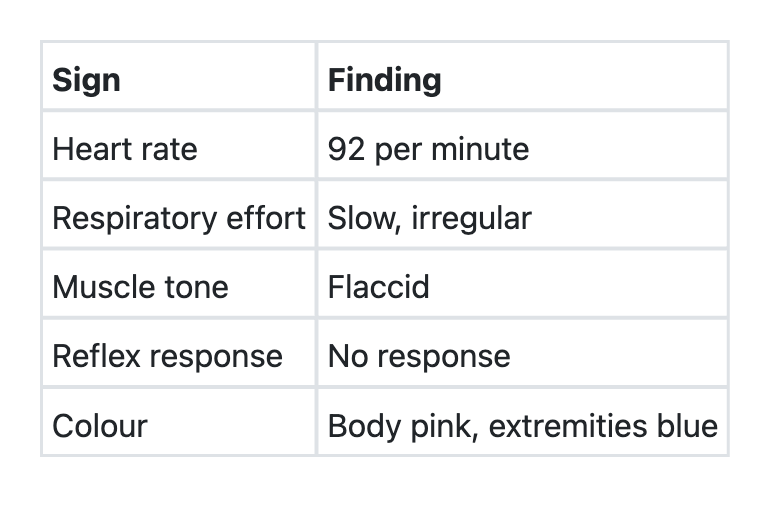
Question 3: In a newborn, the Apgar score has been recorded at 1 minute of birth. Which one of the following best reflects the Apgar score of this newborn infant on a scale of 0 to 10?
- A. 3 (Correct Answer)
- B. 2
- C. 0
- D. 5
Explanation: ***3*** - The Apgar score is calculated based on five criteria: **Appearance**, **Pulse**, **Grimace**, **Activity**, and **Respiration** (APGAR). Each criterion is scored 0, 1, or 2. - Based on the given findings: - **Heart rate (Pulse)**: 92/min scores **1** (below 100/min). - **Respiratory effort (Respiration)**: Slow, irregular scores **1**. - **Muscle tone (Activity)**: Flaccid scores **0**. - **Reflex response (Grimace)**: No response scores **0**. - **Colour (Appearance)**: Body pink, extremities blue (acrocyanosis) scores **1**. - Summing these scores (1 + 1 + 0 + 0 + 1) gives a total Apgar score of **3**. *2* - This score would mean that the newborn has a **more severe depression** in vital signs compared to the actual findings. - A score of 2 would require at least one of the 1-point criteria to be a 0-point criterion or combination of a 0-point criterion become 1. *0* - An Apgar score of 0 would indicate that the infant has **no vital signs** (no heart rate, no respiratory effort, no muscle tone, no reflex response, and completely blue/pale). - This is not consistent with a heart rate of 92/min, slow/irregular respirations, and body pink color. *5* - An Apgar score of 5 would imply a **much healthier** newborn with better scores in most categories. - This would require findings such as a heart rate over 100 bpm, good crying, some flexion of extremities, or an all-pink appearance, which are not present here.