Biochemistry
1 questionsConsider the protein content of the following food items (in terms of grams per 100 grams of food) : 1. Cow milk 2. Meat 3. Soya bean 4. Sugar What is the correct descending order (highest to lowest) of protein content?
UPSC-CMS 2022 - Biochemistry UPSC-CMS Practice Questions and MCQs
Question 91: Consider the protein content of the following food items (in terms of grams per 100 grams of food) : 1. Cow milk 2. Meat 3. Soya bean 4. Sugar What is the correct descending order (highest to lowest) of protein content?
- A. 2 → 3 → 4 → 1
- B. 3 → 2 → 1 → 4 (Correct Answer)
- C. 2 → 1 → 3 → 4
- D. 3 → 1 → 2 → 4
Explanation: ***Correct Option: 3 → 2 → 1 → 4*** - **Soya bean** has the highest protein content at approximately **36-40 grams per 100 grams**, making it one of the richest plant-based protein sources - **Meat** (chicken, beef) follows with **20-30 grams of protein per 100 grams** depending on the cut and type - **Cow milk** contains approximately **3.2-3.5 grams of protein per 100 grams** - **Sugar** is a pure carbohydrate with **0 grams of protein** *Incorrect Option: 2 → 3 → 4 → 1* - Places meat before soya bean, but soya bean has higher protein content than most meats - Incorrectly places cow milk last (milk has more protein than sugar) *Incorrect Option: 2 → 1 → 3 → 4* - Incorrectly places soya bean third, when it should be first as the highest protein source - Underestimates the exceptional protein content of soya beans *Incorrect Option: 3 → 1 → 2 → 4* - Incorrectly places cow milk before meat - Meat has significantly more protein (~20-30g) compared to milk (~3-3.5g)
Community Medicine
4 questionsWhich of the following are correct in respect of incidence rate? 1. It is a sum total of new and old cases. 2. It refers to a specified period of time. 3. It refers to a defined population. 4. It must include the unit of time in final expression.
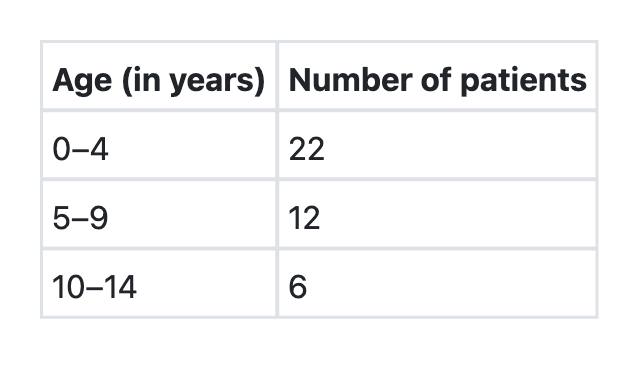
Forty patients with diarrhoeal diseases were studied. Their age distribution is given in the table below : What is the mean age of the patients in this study?
Which of the following international agencies focuses on sustainable development programming that includes health as a key component?
Which of the following statements is true about 'End TB Strategy'?
UPSC-CMS 2022 - Community Medicine UPSC-CMS Practice Questions and MCQs
Question 91: Which of the following are correct in respect of incidence rate? 1. It is a sum total of new and old cases. 2. It refers to a specified period of time. 3. It refers to a defined population. 4. It must include the unit of time in final expression.
- A. 2. It refers to a specified period of time. (Correct Answer)
- B. 1. It is a sum total of new and old cases.
- C. 4. It must include the unit of time in final expression.
- D. 3. It refers to a defined population.
Explanation: ***Statement 2: It refers to a specified period of time*** (Most Distinctive) - Incidence rate MUST be measured over a defined time interval (e.g., 1 year, 6 months) - This temporal component is the **key distinguishing feature** from point prevalence - Essential for calculating the rate at which new cases develop **Note:** Statements 3 and 4 are also technically correct about incidence rate: **Statement 3: It refers to a defined population** - Also correct - Incidence rate requires a clearly defined **population at risk** as denominator - However, this alone is not unique to incidence (prevalence also uses defined populations) **Statement 4: It must include the unit of time in final expression** - Also correct - Incidence **rate** is expressed per unit time: "cases per 1,000 person-years" - This distinguishes it from cumulative incidence (a proportion) - The time component IS part of the rate expression *Statement 1: It is a sum total of new and old cases* ✗ - This describes **prevalence**, not incidence - Incidence counts only **NEW cases** during the observation period - Existing (old) cases are excluded **Clarification:** While statement 2 is traditionally considered the most distinctive feature, epidemiologically statements 3 and 4 are also accurate characteristics of incidence rate. If the question asks "which are correct" (plural), technically 2, 3, and 4 would all be correct.
Question 92: Forty patients with diarrhoeal diseases were studied. Their age distribution is given in the table below : What is the mean age of the patients in this study?
- A. 5 years (Correct Answer)
- B. 4 years
- C. 6 years
- D. 2 years
Explanation: ***5 years*** - To calculate the **mean age** from grouped data, first find the midpoint of each age range. - The midpoints are: **2** for 0-4 years (22 patients), **7** for 5-9 years (12 patients), and **12** for 10-14 years (6 patients). - Multiply each midpoint by the number of patients in that range: (2 × 22) + (7 × 12) + (12 × 6) = 44 + 84 + 72 = **200**. - Divide the sum of these products by the total number of patients (**40**) to get the mean age: **200 / 40 = 5 years**. *2 years* - This is the **midpoint** of the first age group (0-4 years), not the mean of the entire dataset. - While 22 patients (the majority) fall in this age group, the mean must account for the **weighted distribution** across all age groups. - This would only be correct if all 40 patients were in the 0-4 years age group. *4 years* - This answer suggests an **incorrect calculation** of the weighted mean or an error in summing the products. - It does not match the correct weighted mean formula: Σ(midpoint × frequency) / total frequency. - May result from miscalculating the sum (200) or the total number of patients. *6 years* - This value is higher than the calculated mean and likely results from a **mathematical error**. - The correct calculation yields 5 years, not 6 years. - This might arise from rounding errors or incorrect midpoint selection.
Question 93: Which of the following international agencies focuses on sustainable development programming that includes health as a key component?
- A. The United Nations Children's Fund (UNICEF)
- B. The United Nations Population Fund (UNFPA)
- C. The United States Agency for International Development (USAID)
- D. The United Nations Development Programme (UNDP) (Correct Answer)
Explanation: ***The United Nations Development Programme (UNDP)*** - The **UNDP** is a global development network that advocates for change and connects countries to knowledge, experience, and resources to help people build a better life, with **health** being a critical aspect of their broader **sustainable development** goals. - Its strategic plan often integrates health outcomes as essential components of achieving poverty reduction, democratic governance, and environmental sustainability. *The United Nations Children's Fund (UNICEF)* - **UNICEF** primarily focuses on the **rights and well-being of children** worldwide, addressing issues such as child survival, development, protection, and education. - While health is a major component of its work, its mandate is specifically centered on children, rather than broad sustainable development for all populations. *The United Nations Population Fund (UNFPA)* - **UNFPA** is the lead UN agency for delivering a world where every pregnancy is wanted, every birth is safe, and every young person's potential is fulfilled, focusing predominantly on **sexual and reproductive health** and rights. - Its scope is more targeted towards population dynamics, sexual and reproductive health, and gender equality, though these are linked to sustainable development, they are not its primary overarching mission in the same way as UNDP. *The United States Agency for International Development (USAID)* - **USAID** is the primary agency of the United States government responsible for administering civilian **foreign aid and development assistance**, with a focus on promoting U.S. foreign policy interests. - While it heavily invests in health programs globally, it is a bilateral agency representing U.S. interests rather than an international multilateral agency like those within the broader UN system with a specific mandate for sustainable development programming.
Question 94: Which of the following statements is true about 'End TB Strategy'?
- A. The milestone for 2025 is to reduce the TB deaths by 35% compared to 2015.
- B. The strategy identifies four barriers to achieve progress in fight against TB.
- C. The strategy goes beyond patient care to promote TB prevention. (Correct Answer)
- D. The targets are to be achieved by 2035.
Explanation: ***The strategy goes beyond patient care to promote TB prevention.*** - The **End TB Strategy** emphasizes an expanded approach that includes not only **diagnosis and treatment** but also **proactive prevention** of tuberculosis. - This holistic strategy aims to tackle the root causes and transmission of TB, moving beyond traditional clinical management to include **public health interventions** and social determinants. *The milestone for 2025 is to reduce the TB deaths by 35% compared to 2015.* - The **milestone for 2025** set by the End TB Strategy is to reduce **TB deaths by 75%** compared to 2015, not 35%. - Similarly, the 2025 milestone for reducing the **TB incidence rate is 50%**, compared to 2015. *The targets are to be achieved by 2035.* - The ultimate targets of the End TB Strategy are set for **2030 and 2035**, with goals to end the TB epidemic by 2030 and achieving zero TB deaths, disease, and suffering by 2035. - The **2035 target** is to achieve a **95% reduction in TB deaths** and a **90% reduction in TB incidence rate** compared to 2015. *The strategy identifies four barriers to achieve progress in fight against TB.* - The End TB Strategy identifies **three key pillars** for action: integrated, patient-centered care and prevention; bold policies and supportive systems; and intensified research and innovation. - It does not explicitly define "four barriers" but rather outlines these three comprehensive pillars to address challenges.
Internal Medicine
2 questionsWhich of the following statements are correct in respect of haemophilia? 1. It is hereditary bleeding disorder. 2. It has a higher incidence among Asians. 3. It affects females occasionally and mildly.
Which one of the following is the commonest extra-salivary gland manifestation of mumps in adults?
UPSC-CMS 2022 - Internal Medicine UPSC-CMS Practice Questions and MCQs
Question 91: Which of the following statements are correct in respect of haemophilia? 1. It is hereditary bleeding disorder. 2. It has a higher incidence among Asians. 3. It affects females occasionally and mildly.
- A. 1 and 3 only (Correct Answer)
- B. 2 and 3 only
- C. 1 and 2 only
- D. 1, 2 and 3
Explanation: ***1 and 3 only*** - Haemophilia is a well-known **hereditary bleeding disorder**, primarily affecting males, caused by a deficiency in certain clotting factors [1]. - While haemophilia mainly affects males, females can be carriers and, in rare instances, experience mild to moderate symptoms, especially due to **extreme X-inactivation**. *2 and 3 only* - The statement that it has a higher incidence among Asians is **incorrect**; haemophilia incidence is generally consistent across ethnic groups, approximately 1 in 5,000 live male births worldwide [2]. - While females can be affected, their involvement is typically mild and occasional, making statement 3 correct. *1 and 2 only* - Haemophilia is indeed a **hereditary bleeding disorder** (statement 1 is correct) [1]. - However, the claim of higher incidence among Asians is **unsupported** by epidemiological data, rendering statement 2 incorrect. *1, 2 and 3* - While haemophilia is a **hereditary bleeding disorder** and can affect females, the assertion of a higher incidence among Asians is **false** [2]. - Its global incidence rates do not show a significant racial or ethnic predilection.
Question 92: Which one of the following is the commonest extra-salivary gland manifestation of mumps in adults?
- A. Orchitis (Correct Answer)
- B. Pancreatitis
- C. Polyarthritis
- D. Hydrocephalus
Explanation: **Orchitis** - **Orchitis**, the inflammation of the testes, is the most common extra-salivary gland manifestation of mumps in **post-pubertal males** and can lead to **testicular atrophy** and infertility. - The incidence of orchitis in adult males with mumps can be as high as 30–50%. *Pancreatitis* - While mumps can cause **pancreatitis**, it is less common than orchitis, occurring in only about 2-5% of cases [1]. - Mumps-induced pancreatitis is usually mild and self-limiting [1]. *Polyarthritis* - **Polyarthritis** is a rare complication of mumps, typically resolving without long-term sequelae. - It is much less frequently observed compared to orchitis, especially in adults. *Hydrocephalus* - **Hydrocephalus** is an extremely rare and severe complication of mumps, often associated with mumps **meningoencephalitis**. - This complication involves an abnormal accumulation of cerebrospinal fluid, which is highly uncommon following mumps infection.
Pediatrics
2 questionsTo prevent neonatal tetanus in an infant born to a woman who has not been given Tetanus Toxoid (TT) appropriately during pregnancy, what should ideally be done?
All cases of severe measles and all cases of measles in areas with high case fatality rate need to be treated with which of the following vitamins?
UPSC-CMS 2022 - Pediatrics UPSC-CMS Practice Questions and MCQs
Question 91: To prevent neonatal tetanus in an infant born to a woman who has not been given Tetanus Toxoid (TT) appropriately during pregnancy, what should ideally be done?
- A. Injection Tetanus Immunoglobulin (TIG) has to be administered to the infant within 6 hours of birth
- B. Give one dose of TT to the mother and one dose of TIG to the infant after 72 hours of birth
- C. Give one dose of TT to the mother immediately
- D. Give one dose of TT to the mother and one dose of TIG to the infant within 6 hours of birth (Correct Answer)
Explanation: ***Give one dose of TT to the mother and one dose of TIG to the infant within 6 hours of birth*** - When a mother has not been adequately immunized during pregnancy, **both maternal and neonatal interventions** are required for comprehensive protection against neonatal tetanus. - **TIG (Tetanus Immunoglobulin) to the infant** provides immediate passive immunity, critical for protection in the first weeks when the risk of tetanus from umbilical stump infection is highest. - **TT to the mother** initiates active immunization, providing protection for future pregnancies and enables some antibody transfer through breast milk. - This **dual approach** addresses both immediate and ongoing protection needs, following current **WHO and IAP guidelines**. *Injection Tetanus Immunoglobulin (TIG) has to be administered to the infant within 6 hours of birth* - While TIG to the infant is essential for **immediate passive protection**, this option misses the opportunity to begin maternal immunization. - Giving TT to the mother simultaneously is important for **future pregnancy protection** and should not be omitted. - The isolated approach is incomplete compared to the comprehensive strategy. *Give one dose of TT to the mother and one dose of TIG to the infant after 72 hours of birth* - Administering **TIG after 72 hours** may be too late to prevent neonatal tetanus, as umbilical stump contamination can occur immediately after birth. - **Early intervention within 6 hours** is critical for effective prophylaxis, as the incubation period can be as short as 3-10 days. - Delayed administration significantly reduces prophylactic effectiveness. *Give one dose of TT to the mother immediately* - A single dose of **Tetanus Toxoid (TT)** to the mother at birth will not provide timely antibodies to protect the current infant, as active immunity takes 2-4 weeks to develop. - The infant requires **immediate passive immunity via TIG** due to the absent maternal antibody transfer during pregnancy. - Maternal vaccination alone, without neonatal TIG, leaves the infant unprotected during the critical neonatal period.
Question 92: All cases of severe measles and all cases of measles in areas with high case fatality rate need to be treated with which of the following vitamins?
- A. Vitamin K
- B. Vitamin A (Correct Answer)
- C. Vitamin C
- D. Vitamin D
Explanation: ***Vitamin A*** - **Vitamin A supplementation** is recommended for severe measles cases, especially in areas with high case fatality rates. - It helps to reduce morbidity and mortality by improving immune function and supporting the integrity of epithelial tissues. *Vitamin K* - **Vitamin K** is primarily involved in **blood clotting** and bone metabolism. - There is no established role for Vitamin K supplementation in the treatment or prognosis of measles. *Vitamin C* - **Vitamin C** is an **antioxidant** and supports immune function, but its role in measles management is not supported by strong evidence or recommendations. - While beneficial for overall immunity, it is not specifically indicated for severe measles as a life-saving intervention. *Vitamin D* - **Vitamin D** plays a crucial role in **bone health** and modulating the immune system. - Like Vitamin C, it has general immune benefits but is not a specific or recommended treatment for severe measles or its complications.
Pharmacology
1 questionsWhat is the shelf life of Dukoral (wc-rBS) oral vaccine used for cholera prevention, when stored at a temperature of 2 °C to 8 °C?
UPSC-CMS 2022 - Pharmacology UPSC-CMS Practice Questions and MCQs
Question 91: What is the shelf life of Dukoral (wc-rBS) oral vaccine used for cholera prevention, when stored at a temperature of 2 °C to 8 °C?
- A. 2 years (Correct Answer)
- B. 3 years
- C. 6 months
- D. 5 years
Explanation: ***2 years***- Dukoral (wc-rBS) oral vaccine, when stored correctly at **2 °C to 8 °C**, maintains its efficacy and stability for **2 years**. - This is the manufacturer-specified shelf life that ensures the vaccine remains potent and safe for use. - The vaccine contains inactivated whole-cell V. cholerae and recombinant cholera toxin B subunit, with a validated 2-year stability period. *3 years*- A 3-year shelf life is an **overestimation** for Dukoral under standard refrigerated storage conditions. - Beyond the validated 2-year period, the vaccine's potency cannot be guaranteed. - This could lead to administration of potentially ineffective vaccine. *6 months*- A 6-month shelf life is significantly **underestimated** for Dukoral, indicating a lack of understanding of vaccine stability. - Such a short duration would lead to premature discarding of usable vaccine and increased waste. - Most modern refrigerated vaccines have longer shelf lives than this. *5 years*- A 5-year shelf life is a significant **overestimation** for Dukoral (wc-rBS). - This duration exceeds the manufacturer's validated stability data for this oral vaccine. - Using vaccine beyond its validated shelf life poses risks of reduced immunogenicity.