Which of the following are correct in respect of incidence rate? 1. It is a sum total of new and old cases. 2. It refers to a specified period of time. 3. It refers to a defined population. 4. It must include the unit of time in final expression.
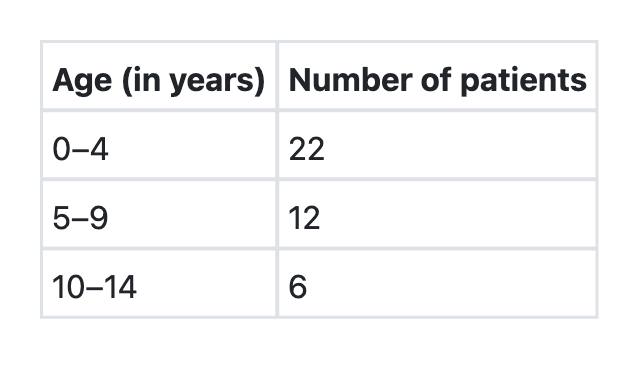
Forty patients with diarrhoeal diseases were studied. Their age distribution is given in the table below : What is the mean age of the patients in this study?
Which of the following international agencies focuses on sustainable development programming that includes health as a key component?
Which of the following statements is true about 'End TB Strategy'?
Which of the following is the most important modifiable risk factor for coronary heart disease?
Consider the phases of a family life cycle: 1. Contraction 2. Dissolution 3. Extension 4. Formation. What is the correct order of the phases from first to last?
Which of the following services are provided to pregnant women under the Integrated Child Development Scheme (ICDS)?
Which of the following are the principal causes of infant mortality in India? 1. Acute respiratory infections 2. Congenital anomalies 3. Childhood cancers 4. Diarrhoeal diseases
Throughout history, humans have been adapting environment to the genes more than adapting genes to the environment. Adapting environment to the genes is called
In a town, a study was carried out to determine the role of cigarette smoking in causation of lung cancer. It was found that a total of 7000 people in the town were smokers. Of them, 70 developed lung cancer. In the same town, 3000 people were non-smokers. Of them, 3 developed lung cancer. Given these numbers, what would be the attributable risk to cigarette smoking for lung cancer?
UPSC-CMS 2022 - Community Medicine UPSC-CMS Practice Questions and MCQs
Question 11: Which of the following are correct in respect of incidence rate? 1. It is a sum total of new and old cases. 2. It refers to a specified period of time. 3. It refers to a defined population. 4. It must include the unit of time in final expression.
- A. 2. It refers to a specified period of time. (Correct Answer)
- B. 1. It is a sum total of new and old cases.
- C. 4. It must include the unit of time in final expression.
- D. 3. It refers to a defined population.
Explanation: ***Statement 2: It refers to a specified period of time*** (Most Distinctive) - Incidence rate MUST be measured over a defined time interval (e.g., 1 year, 6 months) - This temporal component is the **key distinguishing feature** from point prevalence - Essential for calculating the rate at which new cases develop **Note:** Statements 3 and 4 are also technically correct about incidence rate: **Statement 3: It refers to a defined population** - Also correct - Incidence rate requires a clearly defined **population at risk** as denominator - However, this alone is not unique to incidence (prevalence also uses defined populations) **Statement 4: It must include the unit of time in final expression** - Also correct - Incidence **rate** is expressed per unit time: "cases per 1,000 person-years" - This distinguishes it from cumulative incidence (a proportion) - The time component IS part of the rate expression *Statement 1: It is a sum total of new and old cases* ✗ - This describes **prevalence**, not incidence - Incidence counts only **NEW cases** during the observation period - Existing (old) cases are excluded **Clarification:** While statement 2 is traditionally considered the most distinctive feature, epidemiologically statements 3 and 4 are also accurate characteristics of incidence rate. If the question asks "which are correct" (plural), technically 2, 3, and 4 would all be correct.
Question 12: Forty patients with diarrhoeal diseases were studied. Their age distribution is given in the table below : What is the mean age of the patients in this study?
- A. 5 years (Correct Answer)
- B. 4 years
- C. 6 years
- D. 2 years
Explanation: ***5 years*** - To calculate the **mean age** from grouped data, first find the midpoint of each age range. - The midpoints are: **2** for 0-4 years (22 patients), **7** for 5-9 years (12 patients), and **12** for 10-14 years (6 patients). - Multiply each midpoint by the number of patients in that range: (2 × 22) + (7 × 12) + (12 × 6) = 44 + 84 + 72 = **200**. - Divide the sum of these products by the total number of patients (**40**) to get the mean age: **200 / 40 = 5 years**. *2 years* - This is the **midpoint** of the first age group (0-4 years), not the mean of the entire dataset. - While 22 patients (the majority) fall in this age group, the mean must account for the **weighted distribution** across all age groups. - This would only be correct if all 40 patients were in the 0-4 years age group. *4 years* - This answer suggests an **incorrect calculation** of the weighted mean or an error in summing the products. - It does not match the correct weighted mean formula: Σ(midpoint × frequency) / total frequency. - May result from miscalculating the sum (200) or the total number of patients. *6 years* - This value is higher than the calculated mean and likely results from a **mathematical error**. - The correct calculation yields 5 years, not 6 years. - This might arise from rounding errors or incorrect midpoint selection.
Question 13: Which of the following international agencies focuses on sustainable development programming that includes health as a key component?
- A. The United Nations Children's Fund (UNICEF)
- B. The United Nations Population Fund (UNFPA)
- C. The United States Agency for International Development (USAID)
- D. The United Nations Development Programme (UNDP) (Correct Answer)
Explanation: ***The United Nations Development Programme (UNDP)*** - The **UNDP** is a global development network that advocates for change and connects countries to knowledge, experience, and resources to help people build a better life, with **health** being a critical aspect of their broader **sustainable development** goals. - Its strategic plan often integrates health outcomes as essential components of achieving poverty reduction, democratic governance, and environmental sustainability. *The United Nations Children's Fund (UNICEF)* - **UNICEF** primarily focuses on the **rights and well-being of children** worldwide, addressing issues such as child survival, development, protection, and education. - While health is a major component of its work, its mandate is specifically centered on children, rather than broad sustainable development for all populations. *The United Nations Population Fund (UNFPA)* - **UNFPA** is the lead UN agency for delivering a world where every pregnancy is wanted, every birth is safe, and every young person's potential is fulfilled, focusing predominantly on **sexual and reproductive health** and rights. - Its scope is more targeted towards population dynamics, sexual and reproductive health, and gender equality, though these are linked to sustainable development, they are not its primary overarching mission in the same way as UNDP. *The United States Agency for International Development (USAID)* - **USAID** is the primary agency of the United States government responsible for administering civilian **foreign aid and development assistance**, with a focus on promoting U.S. foreign policy interests. - While it heavily invests in health programs globally, it is a bilateral agency representing U.S. interests rather than an international multilateral agency like those within the broader UN system with a specific mandate for sustainable development programming.
Question 14: Which of the following statements is true about 'End TB Strategy'?
- A. The milestone for 2025 is to reduce the TB deaths by 35% compared to 2015.
- B. The strategy identifies four barriers to achieve progress in fight against TB.
- C. The strategy goes beyond patient care to promote TB prevention. (Correct Answer)
- D. The targets are to be achieved by 2035.
Explanation: ***The strategy goes beyond patient care to promote TB prevention.*** - The **End TB Strategy** emphasizes an expanded approach that includes not only **diagnosis and treatment** but also **proactive prevention** of tuberculosis. - This holistic strategy aims to tackle the root causes and transmission of TB, moving beyond traditional clinical management to include **public health interventions** and social determinants. *The milestone for 2025 is to reduce the TB deaths by 35% compared to 2015.* - The **milestone for 2025** set by the End TB Strategy is to reduce **TB deaths by 75%** compared to 2015, not 35%. - Similarly, the 2025 milestone for reducing the **TB incidence rate is 50%**, compared to 2015. *The targets are to be achieved by 2035.* - The ultimate targets of the End TB Strategy are set for **2030 and 2035**, with goals to end the TB epidemic by 2030 and achieving zero TB deaths, disease, and suffering by 2035. - The **2035 target** is to achieve a **95% reduction in TB deaths** and a **90% reduction in TB incidence rate** compared to 2015. *The strategy identifies four barriers to achieve progress in fight against TB.* - The End TB Strategy identifies **three key pillars** for action: integrated, patient-centered care and prevention; bold policies and supportive systems; and intensified research and innovation. - It does not explicitly define "four barriers" but rather outlines these three comprehensive pillars to address challenges.
Question 15: Which of the following is the most important modifiable risk factor for coronary heart disease?
- A. Obesity
- B. Age
- C. Cigarette smoking (Correct Answer)
- D. Sedentary habits
Explanation: ***Cigarette smoking*** - **Cigarette smoking** is considered the most significant modifiable risk factor for coronary heart disease due to its direct and severe impact on **endothelial function** and **atherosclerosis**. - It causes vasoconstriction, increases **blood pressure**, lowers **HDL cholesterol**, and promotes **thrombosis**. *Obesity* - **Obesity** is a significant modifiable risk factor, often linked to other conditions like **hypertension** and **diabetes**, which increase CHD risk. - However, its impact is generally considered less direct and severe than that of active smoking. *Sedentary habits* - **Sedentary habits** contribute to CHD risk by promoting obesity, **insulin resistance**, and unfavorable lipid profiles. - While important, the direct and immediate harm caused by sedentary habits is typically less pronounced compared to smoking. *Age* - **Age** is a major risk factor for coronary heart disease, with risk increasing significantly as one gets older. - However, age is a **non-modifiable** risk factor, meaning it cannot be changed, unlike the factors listed in the other options.
Question 16: Consider the phases of a family life cycle: 1. Contraction 2. Dissolution 3. Extension 4. Formation. What is the correct order of the phases from first to last?
- A. 2 → 1 → 3 → 4
- B. 1 → 2 → 3 → 4
- C. 1 → 3 → 1 → 2
- D. 4 → 3 → 1 → 2 (Correct Answer)
Explanation: ***4 → 3 → 1 → 2*** - The family life cycle typically begins with **formation** (union of individuals), followed by **extension** (addition of members like children). - It then moves to **contraction** (children leaving home) and finally **dissolution** (death of one or both parents). *2 → 1 → 3 → 4* - This order places **dissolution** and **contraction** before **formation** and **extension**, which is incorrect as it reverses the natural progression of family development. - The family unit must first be formed and grow before it can contract or dissolve. *1 → 2 → 3 → 4* - This sequence begins with **contraction**, implying the family is already shrinking before it has fully formed or extended, which goes against the established phases of family life. - It inaccurately places **extension** at a later stage after contraction and dissolution have supposedly begun. *1 → 3 → 1 → 2* - This option incorrectly repeats **contraction** and does not include the initial **formation** phase, making it an incomplete and misordered representation of the family life cycle. - The sequence is illogical as it suggests repeated contraction without a clear beginning or end.
Question 17: Which of the following services are provided to pregnant women under the Integrated Child Development Scheme (ICDS)?
- A. Health check-up
- B. Nutrition and health education
- C. Immunization against tetanus
- D. Supplementary nutrition (Correct Answer)
Explanation: ***Supplementary nutrition*** - **Supplementary nutrition** is the most direct and primary tangible service provided under ICDS specifically targeting pregnant women as beneficiaries. - Under ICDS, pregnant women receive **300 calories and 10-12 grams of protein** for at least 90 days during pregnancy to bridge the calorie and protein gap in their diets. - This is a core service directly provided at Anganwadi centers, ensuring better health outcomes for both mother and developing fetus. - Among all ICDS services for pregnant women, supplementary nutrition is the **most distinctive and substantial direct benefit** that pregnant women receive. *Health check-up* - While health check-ups are part of ICDS package services, they are primarily conducted by ANMs and medical officers from the health system. - Anganwadi Workers facilitate identification, weight monitoring, and referrals, but the comprehensive health examinations are delivered through convergence with the health department rather than as a direct standalone ICDS service. *Nutrition and health education* - Nutrition and health education is indeed provided under ICDS to pregnant women and mothers. - However, it is an **enabling/educational service** rather than a direct tangible provision like supplementary nutrition. - The question likely seeks the most characteristic direct service, which is supplementary nutrition. *Immunization against tetanus* - Immunization services including tetanus toxoid are part of the integrated ICDS-health system approach. - However, vaccines are administered by health workers (ANMs), not by Anganwadi Workers themselves. - ICDS role is primarily facilitative through awareness generation and referral linkages to health facilities.
Question 18: Which of the following are the principal causes of infant mortality in India? 1. Acute respiratory infections 2. Congenital anomalies 3. Childhood cancers 4. Diarrhoeal diseases
- A. 2, 3 and 4
- B. 1, 2 and 4 (Correct Answer)
- C. 1, 2 and 3
- D. 1, 3 and 4
Explanation: ***1, 2 and 4*** - **Acute respiratory infections (ARIs)** and **diarrhoeal diseases** are major contributors due to prevalent infections and inadequate sanitation. - **Congenital anomalies** represent a significant cause, indicating the importance of prenatal care and early diagnosis. *2, 3 and 4* - This option incorrectly includes **childhood cancers** as a principal cause. While tragic, **childhood cancers** contribute to a smaller proportion of infant deaths compared to infectious diseases and congenital issues in India. - **Acute respiratory infections** are a critical component of infant mortality, and their exclusion makes this option incomplete. *1, 2 and 3* - This option incorrectly excludes **diarrhoeal diseases**, which are a leading cause of infant mortality in India due to factors like poor hygiene and contaminated water. - While **acute respiratory infections** and **congenital anomalies** are key, the omission of diarrhoeal diseases makes this answer incomplete. *1, 3 and 4* - This option incorrectly includes **childhood cancers** as a principal cause of infant mortality. - It also omits **congenital anomalies**, which are a significant and well-documented cause of infant deaths in India.
Question 19: Throughout history, humans have been adapting environment to the genes more than adapting genes to the environment. Adapting environment to the genes is called
- A. euthenics (Correct Answer)
- B. euphenics
- C. eugenics
- D. acculturation
Explanation: ***Euthenics*** - **Euthenics** is the study of improving human functioning and well-being by improving **environmental conditions**. - This concept focuses on **adapting the environment** (e.g., nutrition, sanitation, housing) to suit existing human genetic predispositions. *Euphenics* - **Euphenics** involves improving human characteristics through the **alteration of the genes** or treating conditions that arise from genetic defects. - This field includes interventions like **gene therapy** or medical treatments to counteract genetic disorders. *Eugenics* - **Eugenics** is a set of beliefs and practices aiming to **improve the genetic quality** of the human population, typically by encouraging reproduction among those with "desirable" traits and discouraging it among those with "undesirable" traits. - Historically, it has been associated with **socially coercive policies** and is now largely discredited due to its unethical implications. *Acculturation* - **Acculturation** is the process of cultural and psychological change that results from contact between different cultures, leading to the **adoption of new cultural traits**. - It describes changes individuals or groups undergo when exposed to a new culture, not the direct manipulation of genes or environment for genetic improvement.
Question 20: In a town, a study was carried out to determine the role of cigarette smoking in causation of lung cancer. It was found that a total of 7000 people in the town were smokers. Of them, 70 developed lung cancer. In the same town, 3000 people were non-smokers. Of them, 3 developed lung cancer. Given these numbers, what would be the attributable risk to cigarette smoking for lung cancer?
- A. 30%
- B. 10%
- C. 60%
- D. 90% (Correct Answer)
Explanation: **90%** - The **attributable risk** (AR) is calculated as the incidence in the exposed group minus the incidence in the unexposed group, divided by the incidence in the exposed group, all multiplied by 100%. - Incidence in smokers (Ie) = 70 cases / 7000 smokers = 0.01. Incidence in nonsmokers (Io) = 3 cases / 3000 nonsmokers = 0.001. AR = ((0.01 - 0.001) / 0.01) * 100% = (0.009 / 0.01) * 100% = 0.9 * 100% = **90%**. *30%* - This percentage is incorrect; it does not align with the formal calculation of **attributable risk** based on the given incidence rates in exposed and unexposed groups. - A value of 30% would imply a much smaller difference in incidence between smokers and non-smokers relative to the incidence in smokers. *10%* - This value might be obtained if the calculation confused **attributable risk** with the proportion of cases in the unexposed group or some other miscalculation. - It significantly underestimates the proportion of lung cancer in smokers directly attributable to their smoking status. *60%* - This answer is incorrect as it does not result from the appropriate application of the **attributable risk formula**. - The discrepancy between the incidence rate in smokers (0.01) and non-smokers (0.001) is much higher than what would lead to a 60% attributable risk.