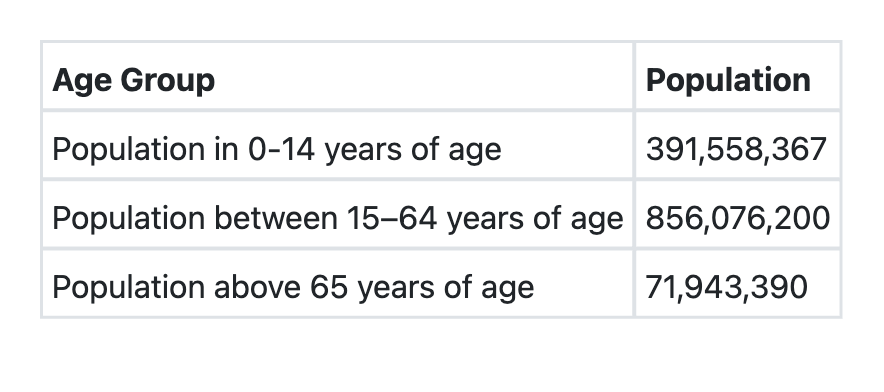
Consider the following data for a country: What shall be the dependency ratio of this country?
Predictive accuracy of a screening test depends on the following EXCEPT:
How much of Zinc supplement is recommended by WHO and UNICEF for infants less than 6 months of age after an episode of acute diarrhoea?
Which one of the following statements regarding sequential administration of Inactivated Polio Vaccine (IPV) and Oral Polio Vaccine (OPV) is NOT correct?
All of the following are global targets for WHO Global Action Plan (2013–2020) for Prevention and Control of NCDs, EXCEPT:
Under the Employees State Insurance (ESI) Scheme, extended sickness benefit is provided in which of the following infectious diseases? 1. Tuberculosis 2. Leprosy 3. Chronic empyema Select the correct answer using the code given below:
In the context of NCD prevention and control in India, the extent of relative reduction in household use of solid fuels as a primary source of energy for cooking by 2025 is targeted at:
Consider the following criteria which may indicate elimination of lymphatic filariasis in a community: 1. When lymphatic filariasis ceases to be a public health problem in the community 2. When the number of microfilaria carriers declines to 1.5 % within the community 3. When children born in the community after the initiation of elimination programme are free from circulating antigenaemia Which of the criteria stated above hold true?
Hold over time of cold chain equipment depends on all of the following factors EXCEPT:
Which of the following statements regarding Physical Quality of Life Index (PQLI) are correct? 1. It consolidates infant mortality, life expectancy at age one, and literacy 2. It does not measure economic growth but measures the result of economic policies 3. For each component, the performance of individual countries is placed on a scale of 0-100 Select the correct answer using the code given below:
UPSC-CMS 2020 - Community Medicine UPSC-CMS Practice Questions and MCQs
Question 11: Consider the following data for a country: What shall be the dependency ratio of this country?
- A. 42.4 %
- B. 78.6 %
- C. 66.2 %
- D. 54.1 % (Correct Answer)
Explanation: ***54.1 %*** - The **dependency ratio** measures the proportion of dependents (children 0-14 and elderly 65+) to the working-age population (15-64). - Calculation: ((391,558,367 + 71,943,390) / 856,076,200) × 100 = (463,501,757 / 856,076,200) × 100 = **54.14%**. *42.4 %* - This value is significantly **lower** than the calculated dependency ratio of 54.1%. - Would indicate a much smaller **dependent population** relative to the working-age group. *66.2 %* - This percentage is **higher** than the mathematically correct dependency ratio calculation. - Would suggest a larger proportion of **dependents** than actually exists in the given data. *78.6 %* - This value is significantly **overestimated** compared to the calculated dependency ratio. - Such a high ratio would indicate an unrealistic proportion of **non-working population** to working-age adults.
Question 12: Predictive accuracy of a screening test depends on the following EXCEPT:
- A. Specificity of screening test
- B. Disease prevalence
- C. Disease incidence (Correct Answer)
- D. Sensitivity of screening test
Explanation: ***Disease incidence*** - **Disease incidence** refers to the rate at which new cases of a disease occur in a population over a specified period. While related to disease prevalence, it is not a direct factor in calculating the predictive accuracy of a screening test. - Predictive accuracy, specifically **positive predictive value (PPV)** and **negative predictive value (NPV)**, relies on the test's inherent properties (sensitivity and specificity) and the **prevalence** of the disease, not its incidence. *Specificity of screening test* - **Specificity** is crucial for predictive accuracy as it determines the probability that a test correctly identifies those *without* the disease. - A test with high specificity will have fewer **false positives**, which directly impacts the positive predictive value. *Disease prevalence* - **Disease prevalence** profoundly influences the predictive accuracy of a screening test. The **positive predictive value** increases with higher disease prevalence. - In populations with low disease prevalence, even highly sensitive and specific tests can yield a large number of **false positives**. *Sensitivity of screening test* - **Sensitivity** is a key determinant of predictive accuracy, as it measures the proportion of *true positives* correctly identified by the test. - A test with high sensitivity helps ensure that most individuals *with* the disease are detected, which affects both **positive and negative predictive values**.
Question 13: How much of Zinc supplement is recommended by WHO and UNICEF for infants less than 6 months of age after an episode of acute diarrhoea?
- A. 20 mg per day for 10–14 days
- B. 10 mg per day for 10–14 days (Correct Answer)
- C. 6 mg per day for 7 days
- D. 5 mg per day for 7 days
Explanation: **10 mg per day for 10–14 days** - For infants less than 6 months of age, **WHO and UNICEF** recommend **10 mg of elemental zinc per day** for 10-14 days following an acute diarrheal episode. - This dosage helps to reduce the severity and duration of the current diarrheal episode and prevents future episodes for several months. *20 mg per day for 10–14 days* - This dosage is recommended for **children 6 months of age and older**, not for infants under 6 months. - Providing 20 mg elemental zinc to infants under 6 months could lead to **zinc toxicity** or other adverse effects. *6 mg per day for 7 days* - This recommendation is below the **standard therapeutic dose** for infants, which may not be sufficient to achieve the desired clinical benefit. - The duration of **7 days** is also shorter than the generally recommended 10-14 days. *5 mg per day for 7 days* - Similar to 6 mg, this dose is **insufficient** for effective treatment of acute diarrhea in infants. - The shortened duration of 7 days further reduces its potential therapeutic impact, increasing the risk of **recurrence or prolonged symptoms**.
Question 14: Which one of the following statements regarding sequential administration of Inactivated Polio Vaccine (IPV) and Oral Polio Vaccine (OPV) is NOT correct?
- A. Intestinal mucosal immunity is lost due to IPV administration (Correct Answer)
- B. The combined schedules of IPV and OPV appear to reduce or prevent Vaccine Associated Paralytic Polio (VAPP)
- C. It will be cost effective in developing countries for Polio prevention
- D. IPV and OPV together may optimize both the humoral and mucosal immunogenicity of Polio vaccine
Explanation: ***Intestinal mucosal immunity is lost due to IPV administration*** - This statement is **incorrect** and is the answer to this "NOT correct" question. - IPV (given parenterally) does NOT cause "loss" of pre-existing mucosal immunity; rather, it **fails to stimulate intestinal mucosal immunity** because it doesn't reach the gut mucosa. - IPV primarily induces **systemic humoral immunity** with high levels of serum antibodies, providing excellent protection against paralytic polio but minimal intestinal immunity. - The absence of mucosal immunity means IPV recipients can still be infected and shed wild poliovirus in their intestines if exposed, though they remain protected from paralysis. *The combined schedules of IPV and OPV appear to reduce or prevent Vaccine Associated Paralytic Polio (VAPP)* - This statement is **correct**. VAPP is a rare complication (1 in 2.4 million doses) associated with OPV due to reversion of the live attenuated virus. - Using IPV first (which contains killed virus and cannot cause VAPP) followed by OPV reduces VAPP risk because the initial doses carry no reversion risk. - This sequential strategy maintains the benefits of OPV (mucosal immunity) while minimizing VAPP occurrence. *It will be cost effective in developing countries for Polio prevention* - This statement is **correct**, though context-dependent. Sequential IPV-OPV schedules represent a balance between optimal immunogenicity and practical implementation. - While IPV alone is more expensive than OPV, using **limited IPV doses followed by OPV** (as recommended by WHO) is cost-effective because it reduces VAPP while maintaining the transmission-blocking benefits of OPV. - Many developing countries have successfully implemented fractional-dose IPV in sequential schedules, making this approach feasible and cost-effective for polio eradication programs. *IPV and OPV together may optimize both the humoral and mucosal immunogenicity of Polio vaccine* - This statement is **correct** and represents the scientific rationale for sequential schedules. - **IPV provides robust systemic humoral immunity** (high serum IgG antibodies), protecting against paralytic disease and viremia. - **OPV stimulates strong intestinal mucosal immunity** (secretory IgA), preventing viral replication and shedding in the gut, thereby interrupting transmission. - Sequential administration leverages the complementary strengths of both vaccines for comprehensive individual and community protection.
Question 15: All of the following are global targets for WHO Global Action Plan (2013–2020) for Prevention and Control of NCDs, EXCEPT:
- A. A 30% relative reduction in mean population intake of salt/sodium
- B. A 25% relative reduction in risk of premature mortality from cardiovascular diseases, cancer, diabetes and chronic respiratory diseases
- C. At least 10 % relative reduction in the harmful use of alcohol
- D. A 15% relative reduction in healthcare costs related to NCDs (Correct Answer)
Explanation: ***A 15% relative reduction in healthcare costs related to NCDs*** - While reducing healthcare costs is an important outcome of NCD prevention, it was **not explicitly stated as one of the nine global targets** in the WHO Global Action Plan (2013–2020) for the Prevention and Control of NCDs. - The targets primarily focused on **risk factor reduction and mortality reduction**, rather than direct cost reduction percentages. *A 30% relative reduction in mean population intake of salt/sodium* - This is one of the **specified global targets** of the WHO NCD Global Action Plan, aiming to reduce a significant dietary risk factor for cardiovascular diseases. - High sodium intake is a major contributor to **hypertension**, a leading risk factor for NCDs. *A 25% relative reduction in risk of premature mortality from cardiovascular diseases, cancer, diabetes and chronic respiratory diseases* - This represents the **overarching mortality reduction target** for the key NCDs, making it a central goal of the WHO action plan. - Reducing premature mortality is a direct measure of the **effectiveness of NCD prevention and control strategies**. *At least 10 % relative reduction in the harmful use of alcohol* - This is another **identified global target** within the WHO NCD Global Action Plan, recognizing alcohol as a major modifiable risk factor for NCDs. - Harmful alcohol use contributes to various NCDs, including **liver disease, cardiovascular disease, and certain cancers**.
Question 16: Under the Employees State Insurance (ESI) Scheme, extended sickness benefit is provided in which of the following infectious diseases? 1. Tuberculosis 2. Leprosy 3. Chronic empyema Select the correct answer using the code given below:
- A. 1, 2 and 3
- B. 2 and 3 only
- C. 1 and 2 only (Correct Answer)
- D. 1 and 3 only
Explanation: ***1 and 2 only*** - Under the **Employees' State Insurance (ESI) Central Rules, 1950**, extended sickness benefit is provided for specified long-term diseases requiring prolonged treatment. - The diseases covered include **Tuberculosis** and **Leprosy**, both of which require extended treatment periods and justify enhanced support. - **Chronic empyema is NOT included** in the list of diseases eligible for extended sickness benefit under the ESI Scheme. - Other diseases covered include mental illness and malignant diseases (cancer). *1, 2 and 3* - This option is incorrect because **chronic empyema** is not listed among the diseases eligible for extended sickness benefit under ESI regulations. - While empyema may require medical care, it does not qualify for the specific extended sickness benefit provision. *2 and 3 only* - This option is incorrect as it omits **Tuberculosis**, which is a major disease specifically listed for extended sickness benefit under the ESI Scheme. - It also incorrectly includes chronic empyema, which is not covered. *1 and 3 only* - This option is incorrect because it includes **chronic empyema**, which is not eligible for extended sickness benefit. - While Tuberculosis is correctly included, the combination is inaccurate per ESI regulations.
Question 17: In the context of NCD prevention and control in India, the extent of relative reduction in household use of solid fuels as a primary source of energy for cooking by 2025 is targeted at:
- A. 50 % (Correct Answer)
- B. 40 %
- C. 60 %
- D. 30 %
Explanation: ***50 %*** - The **WHO Global Action Plan for Prevention and Control of NCDs 2013-2020** includes voluntary global targets, which India has adopted through its **National Action Plan for NCDs**. - Target 5 of this action plan addresses environmental risk factors and aims for a **50% relative reduction** in household use of solid fuels as a primary source of energy for cooking by 2025. - This target is aligned with efforts to improve **indoor air quality** and reduce the burden of **respiratory and cardiovascular NCDs** associated with solid fuel combustion and household air pollution. *40 %* - While significant, a **40% reduction** is less ambitious than the established national target for solid fuel use reduction adopted from WHO's voluntary global targets. - This figure does not correspond to the specific goal outlined in India's NCD prevention strategies for 2025 regarding solid fuels. *60 %* - A **60% reduction** would be a more aggressive target, exceeding the current official target set for 2025 in the context of NCD prevention. - While desirable for public health impact, it is not the officially stated target adopted by India from the WHO Global Action Plan for solid fuel use reduction by 2025. *30 %* - A **30% reduction** represents a less ambitious target and would likely be insufficient to achieve the desired public health impact on NCDs related to indoor air pollution. - This figure falls short of the adopted national health policy goals for household solid fuel reduction by 2025 under the NCD action framework.
Question 18: Consider the following criteria which may indicate elimination of lymphatic filariasis in a community: 1. When lymphatic filariasis ceases to be a public health problem in the community 2. When the number of microfilaria carriers declines to 1.5 % within the community 3. When children born in the community after the initiation of elimination programme are free from circulating antigenaemia Which of the criteria stated above hold true?
- A. 1, 2 and 3 (Correct Answer)
- B. 1 and 3 only
- C. 1 and 2 only
- D. 2 and 3 only
Explanation: ***1, 2 and 3*** - All three criteria reflect the **WHO framework for elimination of lymphatic filariasis** as a public health problem. - **Criterion 1**: Represents the overarching goal that the disease burden and transmission have been reduced such that it no longer poses a significant public health threat in the community. - **Criterion 2**: A **microfilaria carrier rate < 1-1.5%** indicates substantial reduction in active infection and transmission potential in the population. - **Criterion 3**: **Transmission Assessment Survey (TAS)** criteria include demonstrating that children born after program initiation are free from circulating filarial antigen (< 2% antigen prevalence in 6-7 year age group), confirming **interruption of transmission**. - Together, these criteria provide epidemiological, clinical, and transmission-based evidence of elimination. *1 and 3 only* - This option incorrectly excludes the **decline in microfilaria carrier prevalence** as a criterion. - Reduction in **microfilaremia prevalence** is a critical epidemiological indicator showing decreased infection reservoir and reduced transmission potential in the community. *1 and 2 only* - This option incorrectly excludes the criterion related to **children being free from circulating antigenaemia**. - The **TAS (Transmission Assessment Survey)** uses antigen testing in children as the primary tool to verify interruption of transmission, making this criterion essential for confirming elimination. *2 and 3 only* - This option excludes the overarching criterion that **lymphatic filariasis ceases to be a public health problem**. - While specific measurable criteria (2 and 3) are important, the overall assessment that the disease no longer constitutes a public health problem remains a fundamental elimination indicator.
Question 19: Hold over time of cold chain equipment depends on all of the following factors EXCEPT:
- A. Condition of icepack lining
- B. Types of vaccines kept (Correct Answer)
- C. Ambient temperature
- D. Quantity of vaccines kept
Explanation: ***Types of vaccines kept*** - The **type of vaccine** stored does not directly influence how long the cold chain equipment can maintain its temperature. - The physical parameters of the equipment and its contents, not the biological nature of the vaccines, determine the hold-over time. *Condition of icepack lining* - The **integrity and condition of icepack lining** are crucial as damaged linings can lead to faster melting of ice, reducing the hold-over time. - A good lining ensures optimal insulation and prolonged effectiveness of the icepacks in maintaining cold temperatures. *Ambient temperature* - **Higher ambient temperatures** will naturally cause the cold chain equipment to warm up more quickly, thus reducing its hold-over time. - Conversely, lower ambient temperatures will extend the period for which the equipment can maintain the required temperature range. *Quantity of vaccines kept* - An **increased quantity of vaccines (or other contents)** within the cold chain equipment can influence the hold-over time, particularly if they are not pre-cooled. - The thermal mass of the contents can either help maintain temperature if pre-cooled or absorb cold if warmer, affecting the equilibrium and duration of optimal temperature.
Question 20: Which of the following statements regarding Physical Quality of Life Index (PQLI) are correct? 1. It consolidates infant mortality, life expectancy at age one, and literacy 2. It does not measure economic growth but measures the result of economic policies 3. For each component, the performance of individual countries is placed on a scale of 0-100 Select the correct answer using the code given below:
- A. 1 and 2 only
- B. 1 and 3 only
- C. 2 and 3 only
- D. 1, 2 and 3 (Correct Answer)
Explanation: ***1, 2 and 3*** - The **Physical Quality of Life Index (PQLI)** indeed consolidates **infant mortality**, **life expectancy at age one**, and **literacy rate** as its three core components, reflecting key aspects of well-being. - PQLI specifically aims to measure the **outcomes of economic policies** on human well-being rather than economic growth itself, making it a valuable tool for assessing social progress. The PQLI scales each component from **0 to 100**, where 0 represents the worst performance (e.g., highest infant mortality) and 100 represents the best (e.g., lowest infant mortality), allowing for standardized comparison across countries. *1 and 2 only* - This option incorrectly omits the third correct statement regarding the **0-100 scaling** of individual components, which is a fundamental aspect of how the PQLI is calculated and interpreted. - While statements 1 and 2 are accurate individually, they do not encompass all the correct information provided in the question's premise. *1 and 3 only* - This option omits the correct statement that PQLI measures the **results of economic policies** rather than economic growth, which is a crucial distinguishing characteristic of the index. - While statements 1 and 3 are correct, they do not fully capture all the accurate descriptions of the PQLI. *2 and 3 only* - This option incorrectly excludes the first statement, which correctly identifies the three core components of the PQLI: **infant mortality**, **life expectancy at age one**, and **literacy**. - Without including the components, the understanding of PQLI is incomplete, despite accurately describing other features.