UPSC-CMS 2020 — Community Medicine
30 Previous Year Questions with Answers & Explanations
Consider the following statements regarding needle stick injuries: 1. Injured part should be washed under running water 2. Dominant index finger is the commonest site for needle stick injury 3. All needle stick injuries should be reported 4. Hepatitis/HIV testing should be done after needle stick injury Which of the statements given above are correct?
Pearl index for contraceptive effectiveness is calculated in terms of which of the following? 1. Pregnancy rate 2. Abortion rate 3. Hundred woman years 4. Thousand woman years Select the correct answer using the code given below:
Which of the following measures can help reduce the risk of systemic hypertension? 1. Reduction in dietary intake of common salt 2. Maintaining healthy body weight 3. Increasing potassium rich foods in the diet Select the correct answer using the code given below:
Keeping biological determinants in perspective, consider the following statements: 1. Presence of a normal karyotype is the first requisite for human health 2. Genetic screening can play an important role in prevention of wide spectrum of diseases 3. If an individual is allowed to live in healthy relationship with the environment, the person's genetic potentialities can transform into phenotypic realities Which of the above statements is/are correct?
Poor hand hygiene of a mess worker in a university college mess led to Hepatitis A cases in the hostel inmates. What type of epidemic will this exposure present with? 1. Propagated 2. Common source-continuous exposure 3. Common source-point exposure Select the correct answer using the code given below:
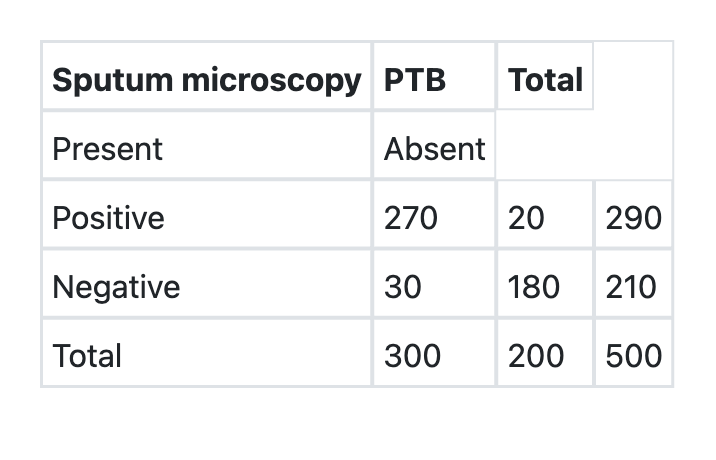
What is the specificity of sputum microscopy in detection of Pulmonary Tuberculosis (PTB) as per the information given below?
In a cohort of 500 women attending antenatal clinic, 70 % had ultrasonography (USG). This cohort was followed up at delivery. Of the women who had USG, 70 delivered low birth weight (LBW) babies; whereas of the women, who did not undergo USG, 50 delivered LBW babies. The incidence of LBW babies among women who had USG is:
Which one of the following is NOT a function of Epidemiology?
Which one of the following is NOT a contagious disease?
Pentavalent vaccine provides protection against which of the following diseases?
UPSC-CMS 2020 - Community Medicine UPSC-CMS Practice Questions and MCQs
Question 1: Consider the following statements regarding needle stick injuries: 1. Injured part should be washed under running water 2. Dominant index finger is the commonest site for needle stick injury 3. All needle stick injuries should be reported 4. Hepatitis/HIV testing should be done after needle stick injury Which of the statements given above are correct?
- A. 1, 2 and 3
- B. 1, 3 and 4 (Correct Answer)
- C. 1, 2 and 4
- D. 2, 3 and 4
Explanation: ***1, 3 and 4*** - All **needle stick injuries** expose healthcare workers to potential bloodborne pathogens, making immediate action, reporting, and testing crucial for **risk assessment** and **post-exposure prophylaxis**. - **Washing the injured part** helps reduce pathogen load, reporting ensures proper investigation and documentation, and testing helps monitor for infection and guide treatment. *1, 2 and 3* - While statements 1 and 3 are correct, statement 2, claiming the **dominant index finger** is the commonest site, is generally incorrect; the **non-dominant hand** is often at higher risk during procedures. - Furthermore, statement 4 regarding **Hepatitis/HIV testing** is a critical component of post-exposure management that is omitted from this option. *1, 2 and 4* - Statements 1 and 4 are correct, but as noted, statement 2 about the **dominant index finger** being the commonest site is typically false, with **non-dominant hand** injuries being more frequent. - This option also incorrectly omits the essential step of **reporting all needle stick injuries**, which is vital for surveillance and appropriate follow-up. *2, 3 and 4* - This option incorrectly includes the statement that the **dominant index finger** is the commonest site for needle stick injury. - It also fails to include the crucial first step of immediately **washing the injured part** under running water, which is fundamental to initial management.
Question 2: Pearl index for contraceptive effectiveness is calculated in terms of which of the following? 1. Pregnancy rate 2. Abortion rate 3. Hundred woman years 4. Thousand woman years Select the correct answer using the code given below:
- A. 2 and 3
- B. 1 only
- C. 1 and 3 (Correct Answer)
- D. 1, 2 and 4
Explanation: ***1 and 3*** - The **Pearl Index** is a common method for measuring the **effectiveness of contraception**. - It calculates the number of pregnancies per **100 women-years** of exposure to a particular contraceptive method. *2 and 3* - While abortions can occur in cases of contraceptive failure, the **Pearl Index** specifically focuses on the **pregnancy rate**, not the abortion rate. - The denominator of **hundred woman-years** is correct, but abortion rate is not a direct component of the Pearl Index calculation. *1 only* - The **pregnancy rate** is indeed a key component of the Pearl Index, but it must be expressed in a standardized unit, which is typically **hundred woman-years**. - Simply stating "pregnancy rate" without the context of exposure time is insufficient for the Pearl Index. *1, 2 and 4* - The **Pearl Index** does not directly incorporate the **abortion rate**. - Its standard denomination is **hundred woman-years**, not thousand woman-years.
Question 3: Which of the following measures can help reduce the risk of systemic hypertension? 1. Reduction in dietary intake of common salt 2. Maintaining healthy body weight 3. Increasing potassium rich foods in the diet Select the correct answer using the code given below:
- A. 2 and 3 only
- B. 1 and 2 only
- C. 1, 2 and 3 (Correct Answer)
- D. 1 and 3 only
Explanation: ***1, 2 and 3*** - **Reduction in dietary intake of common salt** (sodium) is crucial as excessive sodium leads to fluid retention and increased blood volume, directly contributing to **hypertension**. WHO recommends <5g/day salt intake. - **Maintaining healthy body weight** (controlling BMI) significantly reduces the risk of hypertension, as obesity is a major independent risk factor. Even 5-10% weight loss can substantially lower blood pressure. - **Increasing potassium-rich foods** helps counteract the effects of sodium, promoting sodium excretion and relaxing blood vessel walls, thereby lowering blood pressure. Recommended intake is 3.5-5g/day. *2 and 3 only* - This option is incorrect because **reducing salt intake** (measure 1) is a fundamental and highly effective strategy for preventing and managing hypertension. - Excluding salt reduction from the recommended measures would disregard a cornerstone of cardiovascular health proven by DASH diet trials. *1 and 2 only* - This option is flawed because **increasing potassium-rich foods** (measure 3) is a recognized dietary intervention that contributes to blood pressure control. - Potassium helps counterbalance sodium effects, and its omission makes this answer incomplete. *1 and 3 only* - This option is incorrect as it excludes **maintaining healthy body weight** (measure 2), which is a critical and well-established lifestyle modification for preventing and managing hypertension. - Obesity is a significant risk factor, and weight management is essential for blood pressure control.
Question 4: Keeping biological determinants in perspective, consider the following statements: 1. Presence of a normal karyotype is the first requisite for human health 2. Genetic screening can play an important role in prevention of wide spectrum of diseases 3. If an individual is allowed to live in healthy relationship with the environment, the person's genetic potentialities can transform into phenotypic realities Which of the above statements is/are correct?
- A. 2 and 3 only (Correct Answer)
- B. 1 and 2 only
- C. 1, 2 and 3
- D. 1 and 3 only
Explanation: ***Correct: 2 and 3 only*** **Statement 2 - Genetic screening (CORRECT):** - Genetic screening is a powerful tool in preventive medicine - **Newborn screening** identifies conditions like PKU, congenital hypothyroidism, enabling early intervention - **Carrier screening** prevents diseases like thalassemia and sickle cell disease - **Predictive testing** (e.g., BRCA1/2) allows risk-based prevention strategies - Enables **primary and secondary prevention** across a wide spectrum of genetic conditions **Statement 3 - Gene-environment interaction (CORRECT):** - Fundamental principle of **genetics and public health** - An individual's genetic potential requires a **healthy environment** for optimal expression - **Phenotypic realities** emerge from the interplay between genotype and environmental factors - Supports the concept of **positive health** and health promotion - Underscores importance of favorable living conditions, nutrition, and social determinants **Statement 1 - Normal karyotype as first requisite (INCORRECT):** - This is **too absolute** and medically inaccurate - Many chromosomal variations compatible with healthy life (Turner syndrome, Klinefelter syndrome) - Severe diseases can occur despite **normal karyotype** (multifactorial diseases, acquired conditions) - Health is multifactorial - not determined by karyotype alone - Normal karyotype is favorable but not an absolute "first requisite" *Incorrect: 1 and 2 only* - Statement 1 is incorrect, invalidating this option *Incorrect: 1, 2 and 3* - Statements 2 and 3 are correct, but inclusion of incorrect statement 1 makes this option wrong *Incorrect: 1 and 3 only* - Statement 1 is incorrect, invalidating this option
Question 5: Poor hand hygiene of a mess worker in a university college mess led to Hepatitis A cases in the hostel inmates. What type of epidemic will this exposure present with? 1. Propagated 2. Common source-continuous exposure 3. Common source-point exposure Select the correct answer using the code given below:
- A. 1 only
- B. 1 and 3
- C. 2 only (Correct Answer)
- D. 1 and 2
Explanation: ***2 only*** - A mess worker with **ongoing poor hand hygiene** represents a **continuous common source exposure**. The worker continues to handle food over days or weeks with persistent poor hygiene, leading to **repeated contamination** and cases occurring over an extended period rather than clustered around a single incubation period. This produces a plateau-like epidemic curve characteristic of continuous exposure. *1 only* - **Propagated epidemic** occurs through **person-to-person transmission** (e.g., measles, chickenpox), where each case can generate new cases, creating successive waves with progressively larger peaks. Hepatitis A from a food handler is a **common source outbreak**, not propagated, as cases trace back to contaminated food rather than spreading between inmates. *1 and 3* - Option 1 (propagated) is incorrect as explained above. Option 3 (**common source-point exposure**) would apply if there was a **single, brief contamination event** (e.g., one contaminated meal), resulting in cases appearing within one incubation period with a sharp peak. The scenario describes **persistent poor hygiene** suggesting ongoing contamination, not a single point event. *1 and 2* - Option 1 (propagated) is incorrect as this is a common source outbreak from contaminated food, not person-to-person transmission.
Question 6: What is the specificity of sputum microscopy in detection of Pulmonary Tuberculosis (PTB) as per the information given below?
- A. 94 %
- B. 10 %
- C. 90 % (Correct Answer)
- D. 36 %
Explanation: ***90 %*** - Specificity is calculated as the number of **true negatives** divided by the sum of true negatives and **false positives**. - From the table: True Negatives = 180 (PTB Absent, Sputum Negative) and False Positives = 20 (PTB Absent, Sputum Positive). - Specificity = (180 / (180 + 20)) × 100 = (180 / 200) × 100 = **90%**. - This represents the ability of the test to correctly identify those **without the disease**. *36 %* - This value does not correspond to any standard diagnostic test metric such as sensitivity, specificity, positive predictive value, or negative predictive value based on the provided data. - It might be a miscalculation or a different ratio not typically used in this context. *94 %* - This value does not match any standard calculation from the given 2×2 table. - It may represent a misinterpretation of the data or an incorrect calculation. *10 %* - This value represents the **false positive rate** (1 - specificity). - Calculated as: False Positives / Total without disease = 20 / 200 = 10%. - It is the complement of specificity, not specificity itself.
Question 7: In a cohort of 500 women attending antenatal clinic, 70 % had ultrasonography (USG). This cohort was followed up at delivery. Of the women who had USG, 70 delivered low birth weight (LBW) babies; whereas of the women, who did not undergo USG, 50 delivered LBW babies. The incidence of LBW babies among women who had USG is:
- A. 25 %
- B. 10 %
- C. 20 % (Correct Answer)
- D. 15 %
Explanation: ***20 %*** - Total women are 500, and 70% had USG, which equals 350 women. - Of these 350 women, 70 delivered **low birth weight (LBW)** babies. Therefore, the incidence is (70/350) * 100% = **20%**. *25 %* - This option would imply a higher number of LBW babies among those who had USG than the actual data. - It does not align with the calculation based on the given figures (70 LBW babies out of 350 women who had USG). *10 %* - This option represents a lower incidence and does not correspond to the calculation of (70/350) * 100%. - This value might be obtained if the total number of women with USG was incorrectly assumed to be 700. *15 %* - This option is incorrect as it does not match the calculated incidence of LBW babies among women who underwent USG. - This would mean only 52.5 LBW babies were born, which contradicts the information given that 70 delivered LBW babies.
Question 8: Which one of the following is NOT a function of Epidemiology?
- A. Searching for the causes and risk factors
- B. Identifying syndromes
- C. To study historically the rise and fall of disease in the population
- D. Making a clinical diagnosis (Correct Answer)
Explanation: ***Making a clinical diagnosis*** - **Epidemiology** focuses on **population-level health patterns** and determinants of disease, not individual patient diagnosis. - Making a **clinical diagnosis** is the role of a healthcare provider based on a patient's symptoms, physical examination, and diagnostic tests. *Searching for the causes and risk factors* - A primary function of epidemiology is to **identify potential causes** and **risk factors** for diseases within populations. - This involves investigating associations between **exposures** and **health outcomes**. *Identifying syndromes* - Epidemiologists help identify new or unrecognized **patterns of disease** presentation that may constitute a **syndrome**. - This involves observing **clusters of symptoms** or conditions in a population. *To study historically the rise and fall of disease in the population* - **Historical epidemiology** tracks changes in disease incidence, prevalence, and mortality over time. - This function helps understand disease trends and the **impact of public health interventions**.
Question 9: Which one of the following is NOT a contagious disease?
- A. Malaria (Correct Answer)
- B. Trachoma
- C. Leprosy
- D. Scabies
Explanation: ***Malaria*** - Malaria is caused by **Plasmodium parasites** transmitted through the bite of infected Anopheles mosquitoes. It is not spread directly from person to person. - Transmission requires a **vector** (mosquito), making it a non-contagious infectious disease. *Trachoma* - Trachoma is a contagious bacterial infection caused by **Chlamydia trachomatis**, spread through direct contact with eye and nose discharge of an infected person. - It can also be transmitted via **fomites** like contaminated towels or clothing, or through eye-seeking flies. *Leprosy* - Leprosy, caused by **Mycobacterium leprae**, is a chronic infectious disease that is considered contagious, although with low infectivity. - It is primarily transmitted through **nasal droplets** during close and prolonged contact with an untreated infected person. *Scabies* - Scabies is a contagious skin infestation caused by the **mite Sarcoptes scabiei**, which burrows into the outer layer of the skin. - It is easily spread through **direct, prolonged skin-to-skin contact** with an infected person.
Question 10: Pentavalent vaccine provides protection against which of the following diseases?
- A. Diphtheria, Pertussis, Tuberculosis, Measles and Hepatitis B
- B. Diphtheria, Pertussis, Tetanus, Hepatitis B and Hib (Correct Answer)
- C. Diphtheria, Pertussis, Tetanus, Hepatitis B and Rubella
- D. Diphtheria, Pertussis, Measles, Hepatitis B and Hib
Explanation: ***Diphtheria, Pertussis, Tetanus, Hepatitis B and Hib*** - The **Pentavalent vaccine** is a combination vaccine that provides protection against five common childhood diseases. - These five diseases are **Diphtheria**, **Pertussis** (whooping cough), **Tetanus**, **Hepatitis B**, and infections caused by **Haemophilus influenzae type b (Hib)**. *Diphtheria, Pertussis, Tuberculosis, Measles and Hepatitis B* - While it includes **Diphtheria**, **Pertussis**, and **Hepatitis B**, this option incorrectly lists **Tuberculosis** and **Measles** as components. - The vaccine for Tuberculosis is **BCG**, and Measles is part of the MMR vaccine, not the pentavalent vaccine. *Diphtheria, Pertussis, Tetanus, Hepatitis B and Rubella* - This option correctly identifies **Diphtheria**, **Pertussis**, **Tetanus**, and **Hepatitis B** but incorrectly includes **Rubella**. - **Rubella** is typically part of the **MMR vaccine**, not the pentavalent vaccine. *Diphtheria, Pertussis, Measles, Hepatitis B and Hib* - This option correctly includes **Diphtheria**, **Pertussis**, **Hepatitis B**, and **Hib**, but incorrectly lists **Measles**. - **Measles** is administered as part of the **MMR vaccine**, not as a component of the pentavalent vaccine.