Community Medicine
7 questionsAsymptomatic carriers of pathogenic organisms are called:
A cohort study was conducted among 200 men aged 20–30 years in Rampur village. Out of 200, 120 men were tobacco users and rest 80 didn’t take any form of tobacco. At the end of one year, 40 men among tobacco users and 10 men among non-tobacco users developed tuberculosis. The incidence of tuberculosis among tobacco users is:
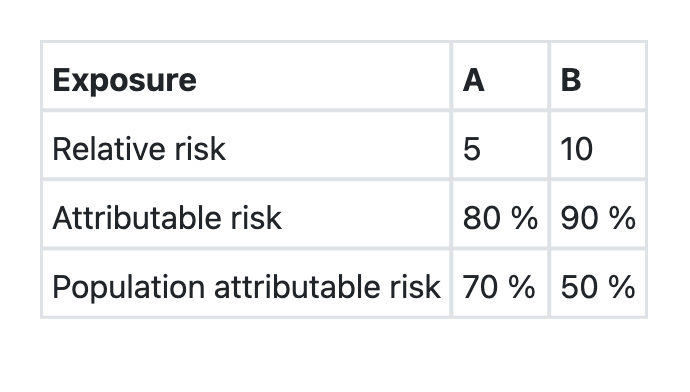
The data regarding two exposures A and B, associated with a disease X in a community is given below: Which one of the following assertions and the reasons given is correct?
Which of the following types of study designs will be most appropriate to find out the association between mobile phone radiation exposure and cancer?
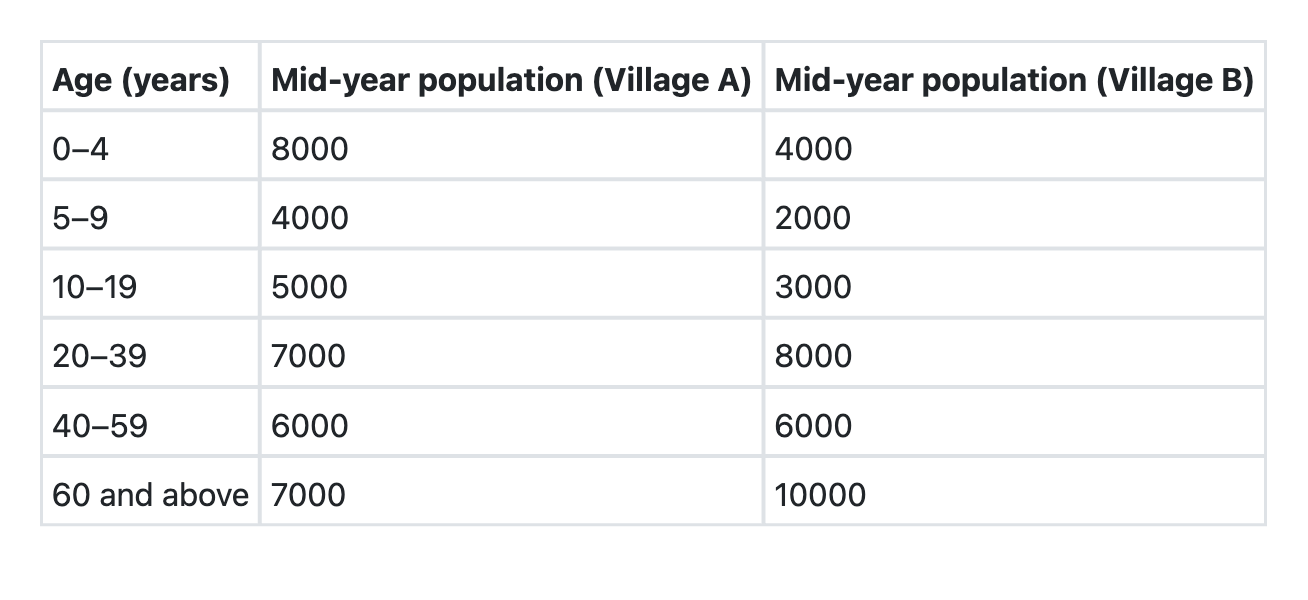
The villages A and B have the following age compositions: Which of the following is the best indicator for comparing the death rates of these two villages?
Which of the following is/are suggested by rising incidence rates of any disease? 1. Need for a new disease control programme 2. Improvement in reporting practices 3. Change in the etiology of the disease Select the correct answer using the codes given below:
What constitutes the denominator in ‘Total Dependency Ratio’?
UPSC-CMS 2018 - Community Medicine UPSC-CMS Practice Questions and MCQs
Question 11: Asymptomatic carriers of pathogenic organisms are called:
- A. Incubatory carriers
- B. Healthy carrier (Correct Answer)
- C. Pseudo carriers
- D. Convalescent carriers
Explanation: ***Healthy carrier*** - A **healthy carrier** harbors a **pathogenic organism** without showing any symptoms of the disease itself. - These individuals can **transmit the infection** to others, making them important in the spread of disease. *Incubatory carriers* - **Incubatory carriers** are individuals who are in the **incubation period** of a disease. - They can transmit the pathogen **before symptomatic onset** but will eventually develop symptoms. *Pseudo carriers* - This term is **not standard terminology** in epidemiology to describe asymptomatic carriers. - It might refer to individuals who carry a non-pathogenic organism or who test positive falsely. *Convalescent carriers* - **Convalescent carriers** are individuals who have **recovered from a disease** but continue to shed the pathogen. - They have already experienced the symptoms of the illness and are in the recovery phase.
Question 12: A cohort study was conducted among 200 men aged 20–30 years in Rampur village. Out of 200, 120 men were tobacco users and rest 80 didn’t take any form of tobacco. At the end of one year, 40 men among tobacco users and 10 men among non-tobacco users developed tuberculosis. The incidence of tuberculosis among tobacco users is:
- A. 33.3 per 100 men/ year (Correct Answer)
- B. 30.0 per 100 men/ year
- C. 12.5 per 100 men/ year
- D. 25.0 per 100 men / year
Explanation: ***33.3 per 100 men/year*** - **Incidence of tuberculosis among tobacco users** is calculated as (Number of new cases among tobacco users / Total number of tobacco users) × 100. - In this study, (40 / 120) × 100 = **33.3 per 100 men/year**. - This is the correct application of the **incidence rate formula** for the exposed group. *30.0 per 100 men/year* - This figure does not correspond to any standard epidemiological calculation for this study. - It may result from mathematical error or confusion with other rates. - The correct calculation for tobacco users yields 33.3, not 30.0. *12.5 per 100 men/year* - This value represents the **incidence among non-tobacco users** (10/80 × 100 = 12.5). - This answers a different question - the incidence in the unexposed group. - The question specifically asks for incidence among **tobacco users**, not non-users. *25.0 per 100 men/year* - This represents the **overall incidence** in the entire cohort: (40 + 10) / (120 + 80) × 100 = 50/200 × 100 = 25.0. - This is the total population incidence, not specific to tobacco users. - The question asks for incidence among tobacco users specifically, which requires using tobacco users as the denominator.
Question 13: The data regarding two exposures A and B, associated with a disease X in a community is given below: Which one of the following assertions and the reasons given is correct?
- A. Cannot decide, as the precedence of exposure in the community has not been mentioned
- B. Preference to control exposure A, because it has a higher population attributable risk (Correct Answer)
- C. Preference to control exposure B, because it has a higher attributable risk
- D. Preference to control exposure B as it has a higher relative risk
Explanation: ***Preference to control exposure A, because it has a higher population attributable risk*** - **Population Attributable Risk (PAR)** quantifies how much of the disease incidence in the *total population* can be attributed to a specific exposure. When deciding on public health interventions, controlling the exposure with the highest PAR will have the **greatest impact on reducing the disease burden** in the community. - In this case, exposure A has a PAR of 70%, meaning 70% of disease X cases in the community can be prevented by eliminating exposure A, while exposure B has a PAR of 50%. Therefore, prioritizing preventive measures for exposure A is more effective from a public health perspective. *Cannot decide, as the precedence of exposure in the community has not been mentioned* - The decision on which exposure to control is primarily based on its **potential impact on public health**, which is best reflected by the Population Attributable Risk (PAR). - The "precedence of exposure" (e.g., which exposure came first or is more fundamental) is not typically the primary factor for public health priority setting when quantitative measures like PAR are available. *Preference to control exposure B, because it has a higher attributable risk* - **Attributable Risk (AR)**, also known as the attributable fraction among the exposed, indicates the proportion of disease among *exposed individuals* that is due to the exposure. While B has a higher AR (90% vs. 80%), this metric does not account for the prevalence of the exposure in the overall population. - A high AR for an exposure that is rare in the population might have less overall public health impact than a lower AR for a very common exposure, which is why PAR is a better guide for population-level interventions. *Preference to control exposure B as it has a higher relative risk* - **Relative Risk (RR)** indicates the strength of the association between an exposure and a disease (i.e., how many times more likely exposed individuals are to develop the disease compared to unexposed individuals). Exposure B has a higher RR (10 vs. 5). - While a higher RR signifies a stronger association, it does not tell you the overall impact on the *community*. An exposure with a very high RR but low prevalence might contribute less to the total disease burden in the population than an exposure with a moderate RR but high prevalence, which is again why PAR is preferred for public health decision-making.
Question 14: Which of the following types of study designs will be most appropriate to find out the association between mobile phone radiation exposure and cancer?
- A. Cross-sectional
- B. Case-series
- C. Single-arm interventional
- D. Case-control (Correct Answer)
Explanation: ***Case-control*** - **Among the given options**, case-control studies are most appropriate for investigating the association between mobile phone radiation exposure and cancer. - **Case-control studies** are efficient for investigating rare outcomes like cancer, by comparing exposure histories between individuals with the disease (cases) and those without (controls). - This design allows for studying factors potentially linked to disease despite **long latency periods**. - However, note that **cohort studies** would be even more ideal for this research question as they better establish temporal relationships and minimize recall bias, which is why major studies like the INTERPHONE study used cohort designs. But cohort studies are not among the options provided. *Cross-sectional* - **Cross-sectional studies** assess exposure and outcome simultaneously, making it difficult to establish temporal relationship or causation. - They are suitable for estimating prevalence but not for investigating etiology of diseases with long latency periods like cancer. *Case-series* - A **case series** describes characteristics of a group of patients with a particular disease, but lacks a comparison group. - It cannot establish an association between exposure and outcome, as there is no control for confounding factors. *Single-arm interventional* - A **single-arm interventional study** involves administering an intervention to a single group and observing the outcome, primarily for evaluating efficacy or safety of new treatments. - It is not designed to investigate associations between environmental exposures (like mobile phone radiation) and disease, as it lacks a control group and focuses on interventions rather than observational epidemiology.
Question 15: The villages A and B have the following age compositions: Which of the following is the best indicator for comparing the death rates of these two villages?
- A. Crude death rate
- B. Specific death rate
- C. Proportional mortality rate
- D. Age standardized death rate (Correct Answer)
Explanation: ***Age standardized death rate*** - This method adjusts for differences in the **age structures** of the two populations, providing a more accurate comparison of underlying mortality risks. - Since the question clearly shows significant differences in the age compositions of Village A and Village B, age standardization is essential to avoid misleading conclusions drawn from crude rates. *Crude death rate* - The crude death rate is the total number of deaths in a period divided by the total population, which **does not account for age differences**. - Comparing crude death rates between populations with different age structures can be misleading because older populations naturally have higher death rates. *Specific death rate* - Specific death rates refer to death rates for particular **age groups, causes, or other characteristics**. - While useful for detailed analysis, it doesn't provide a single, summary measure for comparing the overall mortality burden between two populations with differing age structures. *Proportional mortality rate* - This rate indicates the **proportion of deaths due to a specific cause** out of all deaths. - It does not measure the risk of dying in a population and is not suitable for comparing overall mortality burden between two communities, especially when age structures vary significantly.
Question 16: Which of the following is/are suggested by rising incidence rates of any disease? 1. Need for a new disease control programme 2. Improvement in reporting practices 3. Change in the etiology of the disease Select the correct answer using the codes given below:
- A. 2 and 3 only
- B. 1, 2 and 3 (Correct Answer)
- C. 1 and 3 only
- D. 1 only
Explanation: ***1, 2 and 3*** - **Rising incidence rates** can suggest multiple scenarios in epidemiology: **Statement 1 - Need for a new disease control programme**: A true increase in incidence indicates rising disease burden, which may necessitate public health intervention through disease control programs, surveillance strengthening, or prevention strategies. **Statement 2 - Improvement in reporting practices**: Enhanced surveillance systems, better diagnostic capabilities, increased healthcare access, or improved physician awareness can lead to more cases being detected and reported. This creates an *apparent* rise in incidence without a true increase in disease occurrence (surveillance artifact). **Statement 3 - Change in the etiology of the disease**: While etiology (causation) itself typically doesn't change, this statement refers to changes in **risk factors, exposure patterns, environmental conditions, or pathogen characteristics** (such as emergence of more virulent strains, antimicrobial resistance, or vector behavior changes) that can genuinely increase disease incidence. All three statements represent valid interpretations of rising incidence rates in epidemiological practice. *2 and 3 only* - This incorrectly excludes the public health implication that rising incidence may warrant new disease control programs, which is a fundamental principle of public health response. *1 and 3 only* - This overlooks the critical role of **surveillance artifacts** where improved reporting practices can increase observed incidence without true disease increase—a common phenomenon in epidemiology. *1 only* - This is too restrictive, failing to recognize that rising incidence can result from multiple factors including improved detection systems and genuine changes in disease transmission dynamics or risk factor exposure.
Question 17: What constitutes the denominator in ‘Total Dependency Ratio’?
- A. Mid year population
- B. Population 15–45 years of age
- C. Population 15–64 years of age (Correct Answer)
- D. Population less than 14 and more than 65 years of age
Explanation: ***Population 15–64 years of age*** - The **total dependency ratio** is calculated by dividing the sum of the dependent population (ages 0-14 and 65+) by the **working-age population** (15-64 years). - This age group traditionally represents the population that is generally considered to be economically productive and supporting the dependent populations. *Mid year population* - The **mid-year population** is the total population count at the midpoint of a year, used as the denominator for many public health rates, but not specifically for the dependency ratio. - While it's the base for many demographic calculations, it does not specifically represent the **working-age group** for dependency calculations. *Population 15–45 years of age* - This age range defines a **subset of the working-age population** but is too narrow, as it excludes economically productive individuals between 46 and 64 years old. - Using this range would artificially **inflate the dependency ratio** by undercounting the contributing working population. *Population less than 14 and more than 65 years of age* - This age group represents the **dependent population** (young children and retirees) and forms the numerator of the total dependency ratio. - Including them in the denominator would be incorrect as they are the very groups whose **reliance on the working-age population** is being measured.
Pediatrics
2 questionsWhich sign is most important in deciding severe pneumonia in a child?
Varicella-Zoster Immunoglobulin (VZIG) is NOT recommended for which of the exposed susceptible individuals?
UPSC-CMS 2018 - Pediatrics UPSC-CMS Practice Questions and MCQs
Question 11: Which sign is most important in deciding severe pneumonia in a child?
- A. Fast breathing
- B. Nasal flaring
- C. Grunting
- D. Chest indrawing (Correct Answer)
Explanation: ***Chest indrawing*** - **Chest indrawing** (or retractions) indicates increased work of breathing due to reduced lung compliance or airway obstruction, a key sign of severe pneumonia in children. - It signifies that accessory muscles are engaged to pull the chest wall inward with each breath, demonstrating significant respiratory distress. *Fast breathing* - **Fast breathing** (tachypnea) is a general sign of respiratory distress and a criterion for diagnosing pneumonia, but it alone does not differentiate severe from non-severe pneumonia. - While present in pneumonia, it doesn't indicate the same level of respiratory effort or severity as chest indrawing. *Nasal flaring* - **Nasal flaring** is an effort to decrease airway resistance by widening the nostrils during inspiration, indicating increased work of breathing. - It's a sign of respiratory distress that can occur in both moderate and severe pneumonia, but it is not as specific to severe disease as chest indrawing. *Grunting* - **Grunting** is an expiratory sound produced by partial closure of the glottis to maintain positive end-expiratory pressure, preventing alveolar collapse. - While a sign of moderate to severe respiratory distress, especially in neonates, it does not carry the same weight as chest indrawing for classifying severe pneumonia in older children by WHO guidelines.
Question 12: Varicella-Zoster Immunoglobulin (VZIG) is NOT recommended for which of the exposed susceptible individuals?
- A. HIV/AIDS positive
- B. Newborn
- C. Healthy sibling (Correct Answer)
- D. Pregnant women
Explanation: ***Correct: Healthy sibling*** - VZIG is administered to **susceptible individuals** upon exposure to **Varicella-Zoster Virus (VZV)** to prevent or attenuate the infection - A **healthy sibling** with a **competent immune system** would typically mount an adequate immune response to the virus - VZIG is therefore **NOT indicated** for immunocompetent individuals as they can handle the infection naturally - VZIG is reserved for **high-risk populations** where varicella could cause severe complications *Incorrect: HIV/AIDS positive* - Individuals with **HIV/AIDS** are considered **immunocompromised** and are at **higher risk** for severe varicella infection and complications - VZIG **IS recommended** for these patients after exposure to VZV to provide **passive immunity** and reduce disease severity - This is particularly important in patients with CD4 counts <200 cells/μL *Incorrect: Newborn* - **Newborns** whose mothers developed varicella **5 days before to 2 days after delivery** are at high risk for severe, disseminated neonatal varicella - **VZIG IS recommended** for these neonates to offer immediate protection against the virus - Also indicated for premature infants <28 weeks or <1000g who are exposed, regardless of maternal immunity *Incorrect: Pregnant women* - **Pregnant women** who are **non-immune to varicella** and exposed to VZV are at risk for both **maternal complications** (varicella pneumonia) and **fetal abnormalities** (congenital varicella syndrome) - **VZIG IS recommended** for susceptible pregnant women exposed to varicella to reduce the risk of severe maternal disease - Should be administered within **10 days** of exposure, preferably within 96 hours
Pharmacology
1 questionsA pregnant woman in 2nd trimester of pregnancy from North Eastern State has been diagnosed with uncomplicated P. falciparum. She should be treated with:
UPSC-CMS 2018 - Pharmacology UPSC-CMS Practice Questions and MCQs
Question 11: A pregnant woman in 2nd trimester of pregnancy from North Eastern State has been diagnosed with uncomplicated P. falciparum. She should be treated with:
- A. Chloroquine and Primaquine
- B. Artesunate and Sulphadoxine
- C. Artemether and Lumefantrine (Correct Answer)
- D. Artesunate, Sulphadoxine and Pyrimethamine
Explanation: ***Artemether and Lumefantrine*** - This combination is a **fixed-dose artemisinin-based combination therapy (ACT)** specifically recommended by WHO for treating uncomplicated *P. falciparum* malaria in the **second and third trimesters of pregnancy**. - ACTs are highly effective against *P. falciparum* and have a favorable safety profile compared to other antimalarials during this period of pregnancy. *Chloroquine and Primaquine* - **Chloroquine** is primarily used for treatment of *P. vivax* and *P. ovale* malaria, as *P. falciparum* has widespread resistance. - **Primaquine** is contraindicated in pregnancy due to the risk of **hemolysis** in the fetus if there is G6PD deficiency and is used for radical cure of *P. vivax* and *P. ovale*. *Artesunate and Sulphadoxine* - While **artesunate** is an artemisinin derivative, **sulphadoxine** is often combined with pyrimethamine (as SP, sulphadoxine-pyrimethamine) for intermittent preventive treatment in pregnancy (IPTp) but is not the first-line for *uncomplicated P. falciparum* treatment in the second trimester, especially with increasing resistance. - This combination lacks the **lumefantrine** component, which provides a longer duration of action and higher efficacy when combined with artemether. *Artesunate, Sulphadoxine and Pyrimethamine* - The combination of **sulphadoxine-pyrimethamine (SP)** alone or with artesunate can be used for intermittent preventive treatment in pregnancy (IPTp), but it is generally *not* the first-line treatment for **uncomplicated P. falciparum malaria** in the 2nd trimester due to resistance concerns and the superior efficacy of Artemether-Lumefantrine. - **Pyrimethamine** is a folate antagonist and generally avoided in significant doses during pregnancy if alternatives are available, although it is part of SP for IPTp.