UPSC-CMS 2016 — Pathology
2 Previous Year Questions with Answers & Explanations
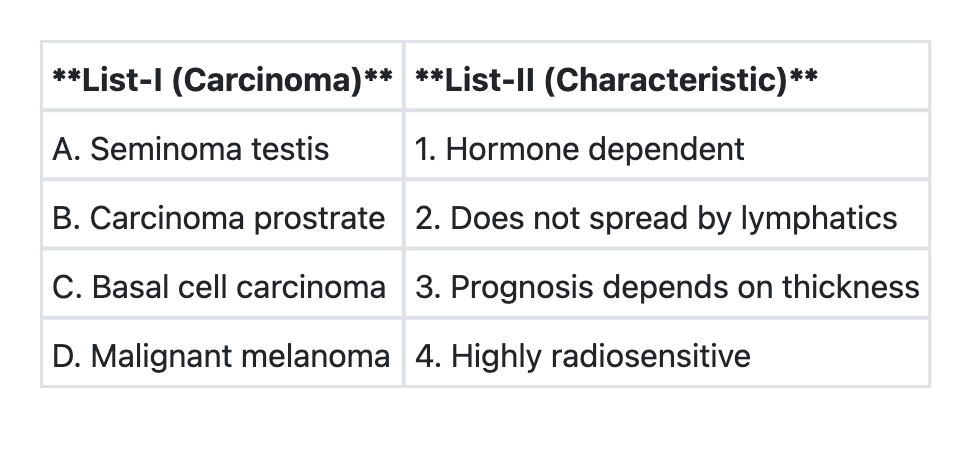
Match List-I with List-II and select the correct answer using the code given below the Lists:
Presence of signet-ring cells in a cellular or myxomatous stroma is diagnostic of:
UPSC-CMS 2016 - Pathology UPSC-CMS Practice Questions and MCQs
Question 1: Match List-I with List-II and select the correct answer using the code given below the Lists:
- A. A→4 B→1 C→2 D→3 (Correct Answer)
- B. A→3 B→2 C→1 D→4
- C. A→3 B→1 C→2 D→4
- D. A→4 B→2 C→1 D→3
Explanation: ***A→4 B→1 C→2 D→3*** - This option correctly matches each carcinoma with its characteristic feature. **Seminoma testis** is **highly radiosensitive** (A→4), making radiation therapy an effective treatment modality with excellent cure rates. **Carcinoma of the prostate** is **hormone-dependent** (B→1), relying on androgens for growth, which is why androgen deprivation therapy is a key treatment [1]. **Basal cell carcinoma** is a locally invasive tumor that **does not significantly spread by lymphatics** (C→2), which contributes to its excellent prognosis despite being the most common skin cancer [2, 4]. **Malignant melanoma** has a prognosis that depends on **Breslow thickness** (D→3), which measures the depth of invasion and is the most important prognostic factor. *A→4 B→2 C→1 D→3* - This option incorrectly states that **carcinoma of the prostate does not spread by lymphatics** (B→2) and that **basal cell carcinoma is hormone-dependent** (C→1). Prostate cancer commonly metastasizes to pelvic lymph nodes via lymphatic spread [1], and BCC is not influenced by hormones. *A→3 B→2 C→1 D→4* - This option incorrectly matches **seminoma testis** with prognosis depending on thickness (A→3) and **malignant melanoma** with being highly radiosensitive (D→4). Seminoma is radiosensitive (not melanoma), and melanoma's prognosis depends on Breslow thickness (not seminoma). *A→3 B→1 C→2 D→4* - This option correctly identifies that **prostate cancer is hormone-dependent** (B→1) and **basal cell carcinoma has limited lymphatic spread** (C→2), but incorrectly associates **seminoma testis** with prognosis depending on thickness (A→3) and **malignant melanoma** with being highly radiosensitive (D→4). These last two matches are reversed. **References:** [1] Kumar V, Abbas AK, et al.. Robbins and Cotran Pathologic Basis of Disease. 9th ed. The Lower Urinary Tract and Male Genital System, pp. 993-994. [2] Kumar V, Abbas AK, et al.. Robbins and Cotran Pathologic Basis of Disease. 9th ed. The Skin, pp. 1157-1160. [3] Cross SS. Underwood's Pathology: A Clinical Approach. 6th ed. Disorders Involving Inflammatory And Haemopoietic Cells, pp. 643-644.
Question 2: Presence of signet-ring cells in a cellular or myxomatous stroma is diagnostic of:
- A. Gynandroblastoma
- B. Krukenberg tumour (Correct Answer)
- C. Hilus cell tumour
- D. Struma ovarii
Explanation: ***Krukenberg tumour*** - **Krukenberg tumours** are characterized by mucin-filled **signet-ring cells** within a fibrous or myxomatous stroma. [1] - They represent metastatic adenocarcinomas, commonly originating from the **gastrointestinal tract**, particularly the stomach. [1] *Gynandroblastoma* - This is a rare **sex cord-stromal tumour** of the ovary that contains both female **(granulosa/theca cells)** and male **(Sertoli/Leydig cells)** components. - It does not typically feature signet-ring cells. *Hilus cell tumour* - **Hilus cell tumours** are **Leydig cell tumours** found in the ovarian hilum, characterized by cells containing **Reinke crystals**. - These tumours are associated with **androgen production** and virilization, and do not contain signet-ring cells. *Struma ovarii* - **Struma ovarii** is a specialized form of **ovarian teratoma** in which **thyroid tissue** is the predominant component (more than 50%). - While it can be functional and cause hyperthyroidism, it is not characterized by the presence of signet-ring cells. **References:** [1] Kumar V, Abbas AK, et al.. Robbins and Cotran Pathologic Basis of Disease. 9th ed. The Gastrointestinal Tract, p. 779.