Community Medicine
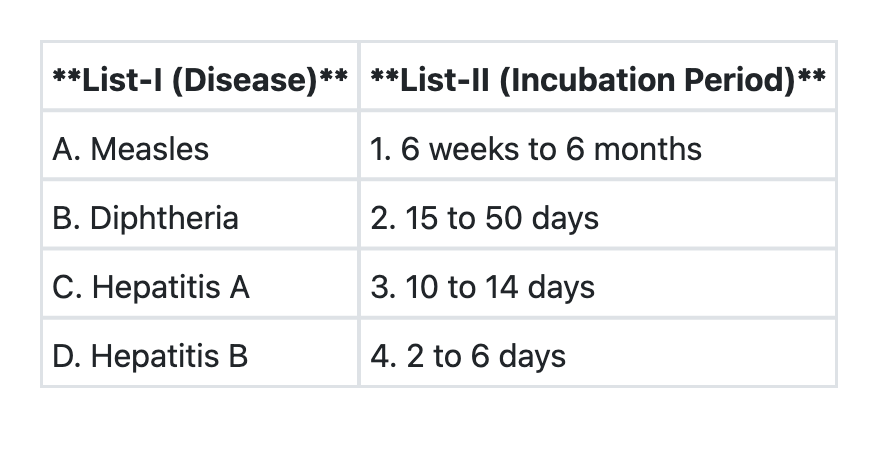
6 questionsMatch List-I with List-II and select the correct answer using the code given below the Lists:
Throat swab positive and Schick test negative indicate that the person is:
Consider the following definitions: 'Effectiveness measures the extent to which predetermined objectives are achieved. Efficiency measures how well the resources are utilized.' In view of these definitions, which of the following assertions are true? 1. Percentage of bed occupancy measures effectiveness 2. Immunization coverage rate measures efficiency 3. Cost per patient treated measures efficiency 4. Reduction in mortality measures effectiveness Select the correct answer using the code given below:
With reference to the Revised National Tuberculosis Control Programme, consider the following statements: 1. Active case finding is pursued under this Programme. 2. Microscopy centres are established in the districts for every one lakh population and in hilly and tribal areas for every 50,000 population. Which of these statements is/are correct?
Districts are classified into different categories regarding neonatal tetanus risk. Which one of the following correctly describes 'Neonatal Tetanus Elimination' status?
Influenza vaccine is recommended for: 1. Elderly 2. Persons with underlying chronic diseases 3. HIV infected 4. General population Select the correct answer using the code given below:
UPSC-CMS 2016 - Community Medicine UPSC-CMS Practice Questions and MCQs
Question 51: Match List-I with List-II and select the correct answer using the code given below the Lists:
- A. A→3 B→4 C→2 D→1
- B. A→3 B→4 C→1 D→2 (Correct Answer)
- C. A→4 B→3 C→1 D→2
- D. A→4 B→3 C→2 D→1
Explanation: ***A→3 B→4 C→1 D→2 (Correct Answer)*** - **Measles (A)** has an incubation period of **10 to 14 days (3)** - This is the classic incubation period before the prodromal phase begins with cough, coryza, and conjunctivitis. - **Diphtheria (B)** has an incubation period of **2 to 6 days (4)** - This short incubation period is followed by the characteristic pseudomembrane formation. - **Hepatitis A (C)** has an incubation period of **15 to 50 days (1)** - Average is 28-30 days for this fecal-oral transmitted hepatitis. - **Hepatitis B (D)** has an incubation period of **6 weeks to 6 months (2)** - This prolonged incubation period (45-180 days) is characteristic of parenterally transmitted hepatitis. *A→3 B→4 C→2 D→1* - This incorrectly swaps the incubation periods of Hepatitis A and Hepatitis B. Hepatitis B has the longer incubation period (6 weeks to 6 months), not Hepatitis A. *A→4 B→3 C→1 D→2* - This incorrectly assigns Measles an incubation of 2-6 days (too short) and Diphtheria 10-14 days (too long). The correct periods are reversed for these two diseases. *A→4 B→3 C→2 D→1* - This option has multiple errors: wrong incubation periods for both Measles and Diphtheria, and also swaps the Hepatitis A and B incubation periods.
Question 52: Throat swab positive and Schick test negative indicate that the person is:
- A. Hypersensitive to diphtheria
- B. Immune to diphtheria (Correct Answer)
- C. Susceptible to diphtheria
- D. Suffering from diphtheria
Explanation: ***Immune to diphtheria*** - A **negative Schick test** indicates the presence of sufficient **antitoxin antibodies** in the individual's blood, conferring **immunity** against diphtheria toxin. - A positive throat swab combined with a negative Schick test indicates the person is a **healthy carrier** (or **immune carrier**) – harboring *Corynebacterium diphtheriae* but protected from developing disease due to existing immunity. - Such carriers pose a **public health concern** as they can transmit the organism to susceptible individuals, despite being personally protected. *Hypersensitive to diphtheria* - **Hypersensitivity** to diphtheria is not assessed by the Schick test; a negative result indicates protective immunity, not an allergic or hypersensitivity reaction. - The Schick test specifically measures the ability to neutralize diphtheria toxin through antitoxin antibodies, not immune hypersensitivity. *Susceptible to diphtheria* - **Susceptibility to diphtheria** would be indicated by a **positive Schick test**, meaning there is insufficient antitoxin to neutralize the injected toxin, resulting in a local inflammatory reaction at the test site. - The given scenario states a **negative Schick test**, which definitively rules out susceptibility. *Suffering from diphtheria* - While a **positive throat swab** indicates the presence of *Corynebacterium diphtheriae*, a **negative Schick test** means the individual has protective immunity and is **not suffering from clinical disease**. - Active diphtheria presents with characteristic symptoms (pseudomembrane, bull neck, etc.), which would not occur in an immune individual despite bacterial colonization.
Question 53: Consider the following definitions: 'Effectiveness measures the extent to which predetermined objectives are achieved. Efficiency measures how well the resources are utilized.' In view of these definitions, which of the following assertions are true? 1. Percentage of bed occupancy measures effectiveness 2. Immunization coverage rate measures efficiency 3. Cost per patient treated measures efficiency 4. Reduction in mortality measures effectiveness Select the correct answer using the code given below:
- A. 2 and 3 only
- B. 1 and 2
- C. 2, 3 and 4
- D. 3 and 4 only (Correct Answer)
Explanation: ***Correct: 3 and 4 only*** **Analysis of each assertion:** - **Assertion 1 (Percentage of bed occupancy measures effectiveness)** - FALSE - Bed occupancy rate reflects how well bed resources are being utilized - This is an **efficiency** measure, not effectiveness - **Assertion 2 (Immunization coverage rate measures efficiency)** - FALSE - Immunization coverage measures the proportion of target population vaccinated, indicating achievement of a public health objective - This is an **effectiveness** measure, not efficiency - **Assertion 3 (Cost per patient treated measures efficiency)** - TRUE ✓ - This directly measures how well resources (money, staff, supplies) are utilized per unit output - This is an **efficiency** measure - **Assertion 4 (Reduction in mortality measures effectiveness)** - TRUE ✓ - This directly reflects achievement of predetermined health objectives (saving lives) - This is an **effectiveness** measure **Therefore, only assertions 3 and 4 are correct.** *Incorrect: 2 and 3 only* - While assertion 3 is correct (efficiency), assertion 2 is incorrect because immunization coverage rate measures effectiveness, not efficiency *Incorrect: 1 and 2* - Assertion 1 is incorrect because bed occupancy measures efficiency, not effectiveness - Assertion 2 is incorrect because immunization coverage measures effectiveness, not efficiency *Incorrect: 2, 3 and 4* - Assertion 2 is incorrect because immunization coverage rate measures effectiveness, not efficiency - While assertions 3 and 4 are correct, including assertion 2 makes this option wrong
Question 54: With reference to the Revised National Tuberculosis Control Programme, consider the following statements: 1. Active case finding is pursued under this Programme. 2. Microscopy centres are established in the districts for every one lakh population and in hilly and tribal areas for every 50,000 population. Which of these statements is/are correct?
- A. 1 only
- B. 2 only (Correct Answer)
- C. Both 1 and 2
- D. Neither 1 nor 2
Explanation: ***2 only*** - The Revised National Tuberculosis Control Programme (**RNTCP**) primarily follows a **passive case finding** approach under the DOTS strategy, where symptomatic patients self-report to health facilities. Active case finding is NOT the standard approach; it is only pursued in specific high-risk groups (TB contacts, HIV patients, etc.) as targeted interventions, not as the general programme strategy. - Statement 2 is **CORRECT**: RNTCP guidelines mandate the establishment of **Designated Microscopy Centres (DMC)** at specified population densities - one per **1 lakh population** in plains and one per **50,000 population** in hilly and tribal areas to ensure accessibility for sputum smear microscopy. *1 only* - Statement 1 is **INCORRECT** because RNTCP does not pursue active case finding as its primary strategy. The programme is based on **passive case finding** where patients with symptoms approach health facilities voluntarily. - Active case finding is limited to specific high-risk populations and is not the general approach under RNTCP. *Both 1 and 2* - This option is incorrect because statement 1 is inaccurate. RNTCP follows **passive case finding** (DOTS strategy), not active case finding as the primary programme approach. - While statement 2 is correct about microscopy centres, combining it with an incorrect statement makes this option wrong. *Neither 1 nor 2* - This option is incorrect because statement 2 is accurate regarding the establishment of microscopy centres at the specified population ratios. - Rejecting both statements would mean ignoring the correct information about diagnostic infrastructure under RNTCP.
Question 55: Districts are classified into different categories regarding neonatal tetanus risk. Which one of the following correctly describes 'Neonatal Tetanus Elimination' status?
- A. Incidence rate between 1 to 2/1000 births, three doses of TT vaccine coverage 70%, attended deliveries more than 75%
- B. Incidence rate 0.5 to 1/1000 births, three doses of TT vaccine coverage between 70% and 80%, attended deliveries between 65% and 70%
- C. Incidence rate more than 2/1000 births, two doses of TT vaccine coverage less than 70%, attended deliveries between 60% and 70%
- D. Incidence rate less than 0.1/1000 births, two doses of TT vaccine coverage more than 90%, attended deliveries more than 75% (Correct Answer)
Explanation: ***Incidence rate less than 0.1/1000 births, two doses of TT vaccine coverage more than 90%, attended deliveries more than 75%*** - **Neonatal Tetanus Elimination (NTE)** is defined by the World Health Organization (WHO) as achieving **less than 1 case of neonatal tetanus per 1,000 live births** in every district of a country. - India has set more stringent operational criteria for district classification, with **high performance districts** achieving rates below 0.1 per 1,000 live births. - Elimination status is achieved through **high tetanus toxoid (TT) vaccination coverage** in pregnant women (>90% with at least two doses) and a **high proportion of institutional/attended deliveries** (>75%) by skilled birth attendants. - These combined interventions ensure that most newborns are protected through maternal antibodies and delivered in hygienic conditions. *Incidence rate between 1 to 2/1000 births, three doses of TT vaccine coverage 70%, attended deliveries more than 75%* - An incidence rate of 1 to 2 cases per 1,000 live births indicates **failure to achieve elimination status**, as it exceeds the WHO threshold of <1 per 1,000 live births. - **TT vaccine coverage of only 70%** is insufficient for elimination; the program requires >90% coverage to generate herd immunity and maternal protection. - While attended deliveries >75% is adequate, the combination of high incidence and low vaccine coverage indicates this district is still at risk. *Incidence rate 0.5 to 1/1000 births, three doses of TT vaccine coverage between 70% and 80%, attended deliveries between 65% and 70%* - An incidence rate between 0.5 and 1 per 1,000 live births is **borderline but still above the elimination threshold**. - **TT vaccine coverage of 70-80%** and **attended delivery rates of 65-70%** are suboptimal and need significant improvement. - This represents a moderate-risk district that requires intensified efforts in both immunization and safe delivery practices. *Incidence rate more than 2/1000 births, two doses of TT vaccine coverage less than 70%, attended deliveries between 60% and 70%* - An incidence rate exceeding 2 cases per 1,000 live births clearly indicates a **high-risk district**, far from achieving elimination. - **Low TT vaccine coverage (<70%)** leaves a large proportion of pregnant women and their newborns unprotected. - **Suboptimal attended delivery rates (60-70%)** mean many births occur in unhygienic conditions, increasing tetanus risk through umbilical stump contamination.
Question 56: Influenza vaccine is recommended for: 1. Elderly 2. Persons with underlying chronic diseases 3. HIV infected 4. General population Select the correct answer using the code given below:
- A. 2 and 3 only
- B. 4
- C. 1 and 2 only
- D. 1, 2 and 3 (Correct Answer)
Explanation: ***1, 2 and 3*** - **Influenza vaccine** is broadly recommended for individuals at higher risk of complications, which explicitly includes the **elderly**, persons with **underlying chronic diseases**, and the **HIV-infected**. - These groups often experience more severe illness, hospitalizations, and mortality from influenza infection. *2 and 3 only* - This option correctly identifies **persons with underlying chronic diseases** and the **HIV-infected** as recommendation groups. - However, it incorrectly excludes the **elderly**, who are a primary target group for influenza vaccination due to age-related immune senescence. *4* - While influenza vaccination is increasingly encouraged for the general population due to community benefits, the question asks for groups where it is specifically recommended for individual protection, focusing on those at higher risk. - This option is too broad and doesn't highlight the specific at-risk groups mentioned. *1 and 2 only* - This option correctly includes the **elderly** and **persons with underlying chronic diseases**. - However, it incorrectly omits the **HIV-infected**, who are also a priority group for influenza vaccination due to their immunocompromised status.
Pediatrics
1 questionsWith reference to mumps, consider the following statements: 1. The average age of incidence of mumps is higher than that of measles and chicken pox. 2. The mumps disease tends to be more severe in adults than in children. Which of the statements given above is/are correct?
UPSC-CMS 2016 - Pediatrics UPSC-CMS Practice Questions and MCQs
Question 51: With reference to mumps, consider the following statements: 1. The average age of incidence of mumps is higher than that of measles and chicken pox. 2. The mumps disease tends to be more severe in adults than in children. Which of the statements given above is/are correct?
- A. Both 1 and 2 (Correct Answer)
- B. 2 only
- C. Neither 1 nor 2
- D. 1 only
Explanation: ***Both 1 and 2*** - The **average age of incidence** for **mumps** is typically higher than that of **measles** and **chickenpox** in developed countries, largely due to successful vaccination programs altering transmission patterns. - While mumps is often benign in children, it tends to be **more severe in adults**, with a higher risk of complications such as **orchitis**, **meningitis**, and **pancreatitis**. *2 only* - This option correctly identifies that mumps is generally **more severe in adults**; however, it fails to acknowledge the shift in the average age of incidence. - The statement that the **average age of incidence of mumps is higher** than that of measles and chickenpox is also correct. *Neither 1 nor 2* - This option is incorrect because both statements accurately reflect facts about mumps. - Statement 1 is true as mumps epidemiology has changed over time with vaccination, and Statement 2 is true regarding the increased severity in adults. *1 only* - This option correctly states that the **average age of incidence of mumps is higher** than that of measles and chickenpox but omits the fact that the disease is also **more severe in adults**. - The severity of mumps in adults is a well-documented clinical observation.
Pharmacology
1 questionsConsider the following statements: 1. The duration of immunity is longer when live vaccine is administered as compared to the administration of killed vaccine. 2. In the case of killed vaccine, single dose is sufficient whereas multiple doses are always required in the case of live vaccines. Which of these statements is/are correct?
UPSC-CMS 2016 - Pharmacology UPSC-CMS Practice Questions and MCQs
Question 51: Consider the following statements: 1. The duration of immunity is longer when live vaccine is administered as compared to the administration of killed vaccine. 2. In the case of killed vaccine, single dose is sufficient whereas multiple doses are always required in the case of live vaccines. Which of these statements is/are correct?
- A. 1 only (Correct Answer)
- B. 2 only
- C. Both 1 and 2
- D. Neither 1 nor 2
Explanation: ***1 only*** - **Live attenuated vaccines** stimulate a more robust, long-lasting immune response, often mimicking natural infection, leading to **longer duration of immunity** compared to killed vaccines. - This is because live vaccines can replicate in the host, providing a continuous antigenic stimulus that enhances the breadth and memory of the immune response. *2 only* - This statement is incorrect because **killed vaccines** typically require **multiple doses** (prime and booster shots) to achieve and maintain adequate protective immunity. - In contrast, **live vaccines** often achieve sufficient immunity with a **single dose** due to their ability to replicate and elicit a strong cellular and humoral response. *Both 1 and 2* - This option is incorrect as statement 2 is false. Live vaccines generally provide longer immunity, and killed vaccines usually require multiple doses, while live vaccines often need only one. *Neither 1 nor 2* - This option is incorrect because statement 1 is accurate regarding the longer duration of immunity provided by live vaccines.
Physiology
1 questionsThe immunoglobulins that can be transported across the placenta include:
UPSC-CMS 2016 - Physiology UPSC-CMS Practice Questions and MCQs
Question 51: The immunoglobulins that can be transported across the placenta include:
- A. IgA only
- B. Neither IgG nor IgA
- C. IgG only (Correct Answer)
- D. Both IgG and IgA
Explanation: ***IgG only*** - **IgG** is the only class of immunoglobulin that can actively be transported across the **placental barrier** from mother to fetus, providing passive immunity. - This transport is mediated by specialized receptors (FcRn) on placental cells, ensuring the fetus receives protection against pathogens. *IgA only* - **IgA** is primarily found in **mucosal secretions** (e.g., breast milk, tears, saliva) and plays a crucial role in mucosal immunity. - It does not significantly cross the placenta and therefore does not contribute to fetal immunity in utero. *Neither IgG nor IgA* - This statement is incorrect because **IgG** is well-established as being transported across the placenta. - Such an absence of maternal antibodies would leave the fetus highly vulnerable to infections during development and early life. *Both IgG and IgA* - While **IgG** readily crosses the placenta, **IgA** does not, making this option incorrect. - The primary route for IgA transfer to the infant is through **breast milk** after birth, providing crucial immunity for the newborn's gastrointestinal tract.
Psychiatry
1 questionsThe following are manifestations of psychosis except:
UPSC-CMS 2016 - Psychiatry UPSC-CMS Practice Questions and MCQs
Question 51: The following are manifestations of psychosis except:
- A. Manic depressive psychosis
- B. Psychoneurosis (Correct Answer)
- C. Schizophrenia
- D. Paranoia
Explanation: ***Psychoneurosis*** - **Psychoneurosis** is an older term referring to **neurotic disorders**, which involve distress but do not typically feature classic psychotic symptoms like **hallucinations**, **delusions**, or **disorganized thought**. - Individuals with neurotic disorders usually retain a grasp of reality and insight into their condition, distinguishing them from psychosis. *Manic depressive psychosis* - This is an archaic term for **bipolar disorder**, which can indeed involve psychotic features during severe manic or depressive episodes. - During these episodes, individuals may experience **hallucinations** or **delusions** consistent with their mood state. *Schizophrenia* - **Schizophrenia** is a chronic and severe mental disorder characterized by profound disruptions in thinking, perception, emotion, and behavior. - Its hallmark features include **delusions**, **hallucinations**, disorganized speech, and grossly disorganized or catatonic behavior, all of which are classic manifestations of psychosis. *Paranoia* - **Paranoia** involves intense anxious or fearful thoughts and beliefs, often centering on persecution, conspiracy, or threat. - Severe paranoia can develop into **paranoid delusions**, which are fixed false beliefs that are characteristic of psychotic disorders, such as **paranoid schizophrenia** or delusional disorder.