In the estimation of statistical probability, Z score is applicable to:
Consider the following vectors: 1. Aedes mosquito 2. Flea 3. Ticks 4. Itchmite Transovarian transmission is demonstrated in
The most sensitive indicator of the health status of a community is the:
Chemoprophylaxis is an example of:
A rapid mass screening method that can be employed by a paramedical worker for detecting malnutrition in pre-school (age: 1 to 5 years) children is:
The most important single determinant of infant mortality is:
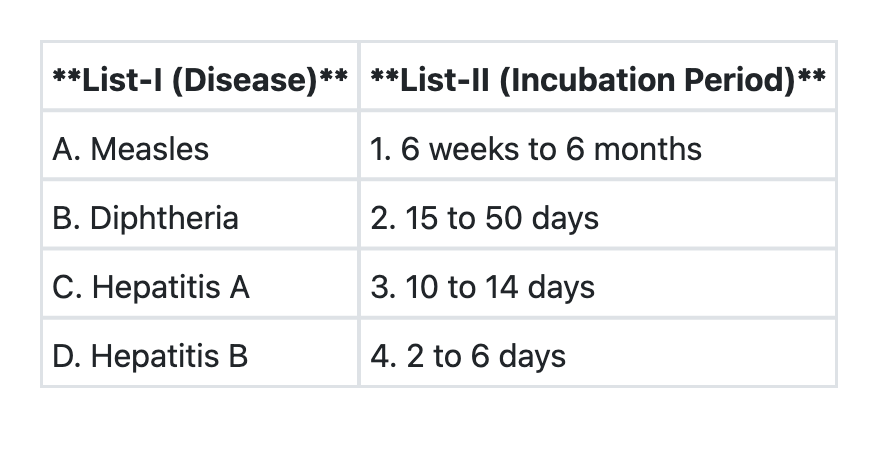
Match List-I with List-II and select the correct answer using the code given below the Lists:
Throat swab positive and Schick test negative indicate that the person is:
Consider the following definitions: 'Effectiveness measures the extent to which predetermined objectives are achieved. Efficiency measures how well the resources are utilized.' In view of these definitions, which of the following assertions are true? 1. Percentage of bed occupancy measures effectiveness 2. Immunization coverage rate measures efficiency 3. Cost per patient treated measures efficiency 4. Reduction in mortality measures effectiveness Select the correct answer using the code given below:
With reference to the Revised National Tuberculosis Control Programme, consider the following statements: 1. Active case finding is pursued under this Programme. 2. Microscopy centres are established in the districts for every one lakh population and in hilly and tribal areas for every 50,000 population. Which of these statements is/are correct?
UPSC-CMS 2016 - Community Medicine UPSC-CMS Practice Questions and MCQs
Question 11: In the estimation of statistical probability, Z score is applicable to:
- A. Poisson distribution
- B. Normal distribution (Correct Answer)
- C. Skewed distribution
- D. Binomial distribution
Explanation: ***Normal distribution*** - The **Z-score** (or standard score) is a measure of how many **standard deviations** an element is from the mean. It is specifically used when working with **normally distributed data**. - It allows for the comparison of scores from different normal distributions by standardizing them to a common scale. *Poisson distribution* - This distribution deals with the **number of events** occurring in a fixed interval of time or space, given a known average rate, and is not typically used with Z-scores directly. - It is a **discrete probability distribution**, unlike the continuous nature required for direct Z-score application. *Skewed distribution* - A skewed distribution has an **asymmetrical shape**, where points cluster more on one side of the mean. - Z-scores can be calculated for skewed distributions, but their interpretation as probabilities (e.g., using a standard normal table) is **not valid** because the data do not follow a bell-shaped curve. *Binomial distribution* - This distribution describes the **number of successes** in a fixed number of independent Bernoulli trials. - It is a **discrete probability distribution** and generally, Z-scores are not directly applied to it, although for a large number of trials, it can be approximated by a normal distribution.
Question 12: Consider the following vectors: 1. Aedes mosquito 2. Flea 3. Ticks 4. Itchmite Transovarian transmission is demonstrated in
- A. 1 and 3 (Correct Answer)
- B. 2 and 4
- C. 1 and 2
- D. 3 and 4
Explanation: ***1 and 3*** - **Aedes mosquito** (*Aedes aegypti*, *Aedes albopictus*) demonstrates well-established transovarian transmission for multiple arboviruses including **dengue**, **Zika**, **chikungunya**, and **yellow fever**. This mechanism allows the virus to persist in mosquito populations even without vertebrate hosts. - **Ticks** (e.g., *Ixodes*, *Dermacentor*, *Amblyomma* species) are classic examples of transovarian transmission, transmitting pathogens like **Rickettsia** (Rocky Mountain spotted fever, tick typhus), **Babesia**, **Crimean-Congo hemorrhagic fever virus**, and **Kyasanur Forest disease virus**. This is a key epidemiological feature distinguishing tick-borne diseases. *2 and 4* - **Fleas** primarily transmit **plague** (*Yersinia pestis*) horizontally through infected flea bites or contaminated feces. While some rickettsiae (*R. typhi*, *R. felis*) can show limited transovarian transmission in fleas, this is not a prominent or classically emphasized feature compared to mosquitoes and ticks. - **Itchmite** (*Sarcoptes scabiei*) causes **scabies** by direct skin infestation and is not a vector for other pathogens. It does not demonstrate transovarian transmission of disease agents. *1 and 2* - While **Aedes mosquitoes** demonstrate prominent transovarian transmission, **fleas** do not typically exhibit this as a major transmission mode for their primary pathogens. *3 and 4* - **Ticks** exhibit transovarian transmission, but **itchmite** is a direct parasite, not a disease vector with transovarian transmission capability.
Question 13: The most sensitive indicator of the health status of a community is the:
- A. Crude death rate
- B. Infant mortality rate (Correct Answer)
- C. Maternal mortality rate
- D. Child mortality rate
Explanation: ***Infant mortality rate*** - The **infant mortality rate (IMR)** is widely considered the most sensitive indicator of a community's health status, reflecting the overall living conditions, public health interventions, and access to quality healthcare. - A high IMR often points to underlying issues such as **poor maternal health**, **inadequate nutrition**, **infectious diseases**, and limited access to healthcare. *Crude death rate* - The crude death rate includes all deaths in a population, making it less sensitive to specific health challenges or disparities that affect vulnerable groups. - It can be influenced by the **age structure** of a population; an older population will naturally have a higher crude death rate, even if its healthcare system is excellent. *Maternal mortality rate* - While an important indicator of the health of women and the quality of obstetric care, the maternal mortality rate focuses solely on deaths related to pregnancy and childbirth. - It does not encompass the broader spectrum of health issues affecting the entire population, including children, men, and non-reproductive women. *Child mortality rate* - The child mortality rate (deaths between 1 and 5 years of age) is a valuable indicator, but it is less sensitive than the infant mortality rate. - Many of the factors contributing to child mortality are also reflected in infant mortality, but the neonatal period and early infancy are particularly vulnerable and responsive to public health interventions.
Question 14: Chemoprophylaxis is an example of:
- A. Early detection
- B. Specific protection (Correct Answer)
- C. Health promotion
- D. Rehabilitation
Explanation: ***Specific protection*** - **Chemoprophylaxis** involves administering drugs to prevent the development of a specific disease, thus providing **specific protection** against it. - This falls under the level of **primary prevention**, aimed at preventing disease onset. *Early detection* - This refers to identifying a disease at an early stage, such as through **screening programs** like mammography or pap smears. - Chemoprophylaxis aims to prevent the disease from occurring, not to detect it after it has begun. *Health promotion* - This involves promoting good health through general measures like **health education**, **nutritional counseling**, and encouraging physical activity. - While it contributes to overall well-being, it is not a direct, specific disease prevention method like chemoprophylaxis. *Rehabilitation* - This stage of prevention focuses on restoring function and preventing disability after a disease or injury has occurred, such as through **physical therapy** or occupational therapy. - Chemoprophylaxis is implemented *before* the disease manifests, not after.
Question 15: A rapid mass screening method that can be employed by a paramedical worker for detecting malnutrition in pre-school (age: 1 to 5 years) children is:
- A. Body Mass Index
- B. Height for age
- C. Weight for age
- D. Mid-arm circumference (Correct Answer)
Explanation: ***Mid-arm circumference*** - **Mid-upper arm circumference (MUAC)** is a simple, quick, and effective anthropometric measure that can be used by paramedical workers for rapid screening of malnutrition in pre-school children. - It is particularly useful in community settings as it requires minimal training and readily available tools, making it ideal for **mass screening** in resource-limited environments. *Body Mass Index* - **Body Mass Index (BMI)** calculation requires both height and weight, which can be more challenging to accurately measure in young, uncooperative children during rapid field screenings. - While useful for assessing nutritional status, BMI charts can be complex, making them less suitable for rapid use by paramedical workers for mass screening. *Height for age* - **Height for age** is a key indicator for assessing **stunting (chronic malnutrition)** but requires accurate measurement of height, which can be difficult in young children, especially infants and toddlers who cannot stand independently. - Its primary use is for long-term monitoring of growth rather than a quick, immediate screening tool for acute malnutrition or overall nutritional status in a rapid mass campaign. *Weight for age* - **Weight for age** is an indicator for determining **underweight**, reflecting both acute and chronic malnutrition, but it requires accurate weighing scales and meticulous recording. - Although it is a standard anthropometric index, its application in rapid mass screening might be limited by the availability of reliable weighing scales and the time required for accurate measurements in a large population.
Question 16: The most important single determinant of infant mortality is:
- A. Interval between births
- B. Order of birth
- C. Birth weight (Correct Answer)
- D. Age of the mother
Explanation: ***Birth weight*** - **Low birth weight** (less than 2500 grams) is the single most important predictor of **infant mortality** and morbidity. - Infants with low birth weight are at a significantly higher risk for **respiratory distress syndrome**, infections, and developmental problems. *Interval between births* - While **short birth intervals** (less than 18-24 months) are associated with increased risks for both mother and child, their impact on infant mortality is secondary to birth weight. - Short intervals can lead to **maternal depletion** and prematurity, but birth weight remains the most direct determinant. *Order of birth* - **High birth order** (e.g., 5th child or more) can be associated with increased infant mortality in some contexts, often linked to socioeconomic factors or maternal depletion. - However, it does not have the same direct and powerful statistical correlation with infant survival as birth weight. *Age of the mother* - **Maternal age extremes** (very young or advanced maternal age) are associated with increased risks of adverse pregnancy outcomes, including preterm birth and low birth weight. - The impact of maternal age on infant mortality is largely mediated through its influence on conditions like birth weight, making birth weight the more immediate determinant.
Question 17: Match List-I with List-II and select the correct answer using the code given below the Lists:
- A. A→3 B→4 C→2 D→1
- B. A→3 B→4 C→1 D→2 (Correct Answer)
- C. A→4 B→3 C→1 D→2
- D. A→4 B→3 C→2 D→1
Explanation: ***A→3 B→4 C→1 D→2 (Correct Answer)*** - **Measles (A)** has an incubation period of **10 to 14 days (3)** - This is the classic incubation period before the prodromal phase begins with cough, coryza, and conjunctivitis. - **Diphtheria (B)** has an incubation period of **2 to 6 days (4)** - This short incubation period is followed by the characteristic pseudomembrane formation. - **Hepatitis A (C)** has an incubation period of **15 to 50 days (1)** - Average is 28-30 days for this fecal-oral transmitted hepatitis. - **Hepatitis B (D)** has an incubation period of **6 weeks to 6 months (2)** - This prolonged incubation period (45-180 days) is characteristic of parenterally transmitted hepatitis. *A→3 B→4 C→2 D→1* - This incorrectly swaps the incubation periods of Hepatitis A and Hepatitis B. Hepatitis B has the longer incubation period (6 weeks to 6 months), not Hepatitis A. *A→4 B→3 C→1 D→2* - This incorrectly assigns Measles an incubation of 2-6 days (too short) and Diphtheria 10-14 days (too long). The correct periods are reversed for these two diseases. *A→4 B→3 C→2 D→1* - This option has multiple errors: wrong incubation periods for both Measles and Diphtheria, and also swaps the Hepatitis A and B incubation periods.
Question 18: Throat swab positive and Schick test negative indicate that the person is:
- A. Hypersensitive to diphtheria
- B. Immune to diphtheria (Correct Answer)
- C. Susceptible to diphtheria
- D. Suffering from diphtheria
Explanation: ***Immune to diphtheria*** - A **negative Schick test** indicates the presence of sufficient **antitoxin antibodies** in the individual's blood, conferring **immunity** against diphtheria toxin. - A positive throat swab combined with a negative Schick test indicates the person is a **healthy carrier** (or **immune carrier**) – harboring *Corynebacterium diphtheriae* but protected from developing disease due to existing immunity. - Such carriers pose a **public health concern** as they can transmit the organism to susceptible individuals, despite being personally protected. *Hypersensitive to diphtheria* - **Hypersensitivity** to diphtheria is not assessed by the Schick test; a negative result indicates protective immunity, not an allergic or hypersensitivity reaction. - The Schick test specifically measures the ability to neutralize diphtheria toxin through antitoxin antibodies, not immune hypersensitivity. *Susceptible to diphtheria* - **Susceptibility to diphtheria** would be indicated by a **positive Schick test**, meaning there is insufficient antitoxin to neutralize the injected toxin, resulting in a local inflammatory reaction at the test site. - The given scenario states a **negative Schick test**, which definitively rules out susceptibility. *Suffering from diphtheria* - While a **positive throat swab** indicates the presence of *Corynebacterium diphtheriae*, a **negative Schick test** means the individual has protective immunity and is **not suffering from clinical disease**. - Active diphtheria presents with characteristic symptoms (pseudomembrane, bull neck, etc.), which would not occur in an immune individual despite bacterial colonization.
Question 19: Consider the following definitions: 'Effectiveness measures the extent to which predetermined objectives are achieved. Efficiency measures how well the resources are utilized.' In view of these definitions, which of the following assertions are true? 1. Percentage of bed occupancy measures effectiveness 2. Immunization coverage rate measures efficiency 3. Cost per patient treated measures efficiency 4. Reduction in mortality measures effectiveness Select the correct answer using the code given below:
- A. 2 and 3 only
- B. 1 and 2
- C. 2, 3 and 4
- D. 3 and 4 only (Correct Answer)
Explanation: ***Correct: 3 and 4 only*** **Analysis of each assertion:** - **Assertion 1 (Percentage of bed occupancy measures effectiveness)** - FALSE - Bed occupancy rate reflects how well bed resources are being utilized - This is an **efficiency** measure, not effectiveness - **Assertion 2 (Immunization coverage rate measures efficiency)** - FALSE - Immunization coverage measures the proportion of target population vaccinated, indicating achievement of a public health objective - This is an **effectiveness** measure, not efficiency - **Assertion 3 (Cost per patient treated measures efficiency)** - TRUE ✓ - This directly measures how well resources (money, staff, supplies) are utilized per unit output - This is an **efficiency** measure - **Assertion 4 (Reduction in mortality measures effectiveness)** - TRUE ✓ - This directly reflects achievement of predetermined health objectives (saving lives) - This is an **effectiveness** measure **Therefore, only assertions 3 and 4 are correct.** *Incorrect: 2 and 3 only* - While assertion 3 is correct (efficiency), assertion 2 is incorrect because immunization coverage rate measures effectiveness, not efficiency *Incorrect: 1 and 2* - Assertion 1 is incorrect because bed occupancy measures efficiency, not effectiveness - Assertion 2 is incorrect because immunization coverage measures effectiveness, not efficiency *Incorrect: 2, 3 and 4* - Assertion 2 is incorrect because immunization coverage rate measures effectiveness, not efficiency - While assertions 3 and 4 are correct, including assertion 2 makes this option wrong
Question 20: With reference to the Revised National Tuberculosis Control Programme, consider the following statements: 1. Active case finding is pursued under this Programme. 2. Microscopy centres are established in the districts for every one lakh population and in hilly and tribal areas for every 50,000 population. Which of these statements is/are correct?
- A. 1 only
- B. 2 only (Correct Answer)
- C. Both 1 and 2
- D. Neither 1 nor 2
Explanation: ***2 only*** - The Revised National Tuberculosis Control Programme (**RNTCP**) primarily follows a **passive case finding** approach under the DOTS strategy, where symptomatic patients self-report to health facilities. Active case finding is NOT the standard approach; it is only pursued in specific high-risk groups (TB contacts, HIV patients, etc.) as targeted interventions, not as the general programme strategy. - Statement 2 is **CORRECT**: RNTCP guidelines mandate the establishment of **Designated Microscopy Centres (DMC)** at specified population densities - one per **1 lakh population** in plains and one per **50,000 population** in hilly and tribal areas to ensure accessibility for sputum smear microscopy. *1 only* - Statement 1 is **INCORRECT** because RNTCP does not pursue active case finding as its primary strategy. The programme is based on **passive case finding** where patients with symptoms approach health facilities voluntarily. - Active case finding is limited to specific high-risk populations and is not the general approach under RNTCP. *Both 1 and 2* - This option is incorrect because statement 1 is inaccurate. RNTCP follows **passive case finding** (DOTS strategy), not active case finding as the primary programme approach. - While statement 2 is correct about microscopy centres, combining it with an incorrect statement makes this option wrong. *Neither 1 nor 2* - This option is incorrect because statement 2 is accurate regarding the establishment of microscopy centres at the specified population ratios. - Rejecting both statements would mean ignoring the correct information about diagnostic infrastructure under RNTCP.