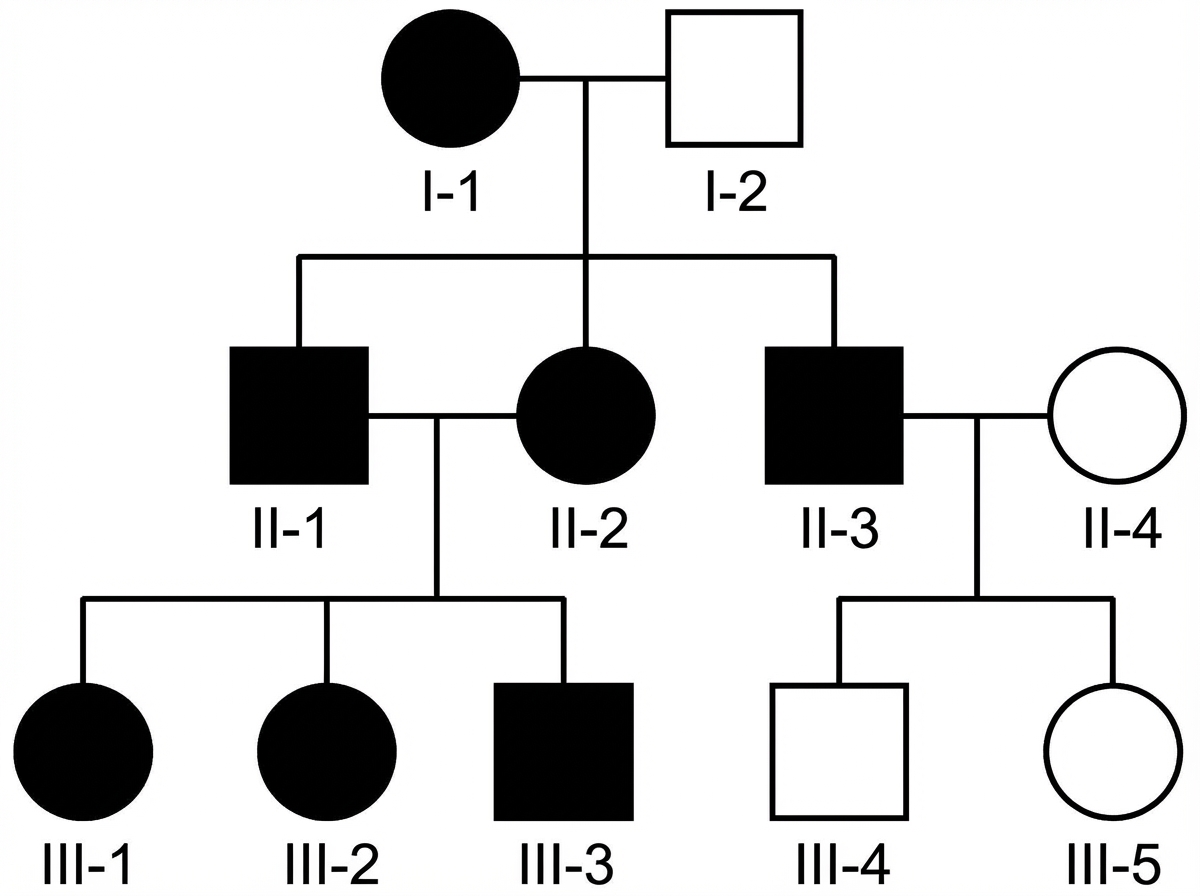
The pedigree chart shown in the image demonstrates a specific pattern of inheritance. Which of the following conditions is most likely to follow this pattern of inheritance?
A male patient presents with fever, cough, and hemoptysis. Bronchoalveolar lavage (BAL) fluid examination shows septate hyphae with acute angle (dichotomous) branching under microscopy. What is the most likely diagnosis?
A 45-year-old female presents with a 2-year history of progressive unilateral hearing loss, tinnitus, and unsteadiness. An MRI scan reveals a well-defined tumor located in the cerebellopontine angle (CPA). A surgical resection is performed, and subsequent histopathological examination of the tumor tissue is given below. Based on these histopathological findings, what is the most likely diagnosis?
A 15-year-old tall boy with long limbs presents to the OPD. On ocular examination, bilateral ectopia lentis is noted. Which gene is most likely affected in this inherited disorder?
A 25-year old patient who had a Road traffic accident was initially conscious but later became unconscious and subsequently died. On postmortem examination, multiple petechial hemorrhages are seen in the corpus callosum, what is the probable diagnosis?
A patient presents with morning stiffness and tests positive for anti-CCP antibodies. Which of the following histological features is most characteristic of the underlying disease?
Patient presents with dry cough, dyspnea and stridor. HPE of hilar LN shows stellate granulomas with giant cells and circular lamellated concretions on histopathology. Which of the following is the most likely diagnosis?
NEET-PG 2025 - Pathology NEET-PG Practice Questions and MCQs
Question 11: The pedigree chart shown in the image demonstrates a specific pattern of inheritance. Which of the following conditions is most likely to follow this pattern of inheritance?
- A. Kearns-Sayre syndrome (Correct Answer)
- B. Marfan syndrome
- C. Duchenne muscular dystrophy
- D. Huntington's disease
Explanation: ***Kearns-Sayre syndrome*** - This condition is caused by large-scale deletions in **mitochondrial DNA (mtDNA)**, leading to a pattern of **maternal inheritance** (non-Mendelian) [1]. - Mitochondrial disorders are passed exclusively from the mother, affecting all offspring, which defines this specific inheritance pattern [1]. *Duchenne muscular dystrophy* - This follows an **X-linked recessive** pattern of inheritance, where the defective gene is located on the X chromosome [2]. - It primarily affects males, with mothers typically being asymptomatic carriers, clearly distinguishing it from mitochondrial inheritance [2]. *Huntington's disease* - This is an **autosomal dominant** disorder, meaning it is caused by a mutation on a non-sex chromosome and can be passed from either parent [3]. - It affects both males and females equally, with a 50% chance of transmission regardless of the child's sex [3]. *Marfan syndrome* - This is an **autosomal dominant** condition resulting from a mutation in the **FBN1 gene** (nuclear DNA) [3]. - The inheritance does not rely exclusively on the maternal line, as expected in an autosomal dominant Mendelian disorder [3]. **References:** [1] Kumar V, Abbas AK, et al.. Robbins and Cotran Pathologic Basis of Disease. 9th ed. Genetic Disorders, p. 181. [2] Kumar V, Abbas AK, et al.. Robbins and Cotran Pathologic Basis of Disease. 9th ed. Genetic Disorders, p. 151. [3] Kumar V, Abbas AK, et al.. Robbins and Cotran Pathologic Basis of Disease. 9th ed. Genetic Disorders, pp. 149-150.
Question 12: A male patient presents with fever, cough, and hemoptysis. Bronchoalveolar lavage (BAL) fluid examination shows septate hyphae with acute angle (dichotomous) branching under microscopy. What is the most likely diagnosis?
- A. Mucormycosis
- B. Aspergillosis (Correct Answer)
- C. Histoplasmosis
- D. Candidiasis
Explanation: ***Aspergillosis*** - The characteristic finding of **septate hyphae** displaying uniform **acute angle (dichotomous) branching** (typically 45°) in the **Bronchoalveolar lavage (BAL)** fluid is the defining microscopic feature of *Aspergillus* infection [1], [2]. - The clinical picture of fever, cough, and **hemoptysis** suggests an invasive pulmonary fungal infection, which *Aspergillus* commonly causes, especially in immunocompromised hosts [1], [2]. *Mucormycosis* - This diagnosis is characterized by **broad, non-septate (aseptate) hyphae** that exhibit irregular branching, typically at a **wide angle (90°)**. - The absence of septae and the differing angle of branching rule out mucormycosis based on the microscopic findings. *Histoplasmosis* - *Histoplasma capsulatum* appears in tissue and BAL primarily as **small, oval, budding yeast forms** (2–4 µm) that are often **intracellular** within macrophages. - It is not a hyphal infection in tissue form and therefore does not show septate hyphae with dichotomous branching. *Candidiasis* - *Candida* is identified by the presence of both **budding yeast cells** and **pseudohyphae** (links of elongated yeast cells) [2]. - Although true septate hyphae can occasionally be seen, it lacks the highly characteristic, uniform **acute-angle dichotomous branching** that is specific to *Aspergillus*. **References:** [1] Kumar V, Abbas AK, et al.. Robbins and Cotran Pathologic Basis of Disease. 9th ed. Infectious Diseases, pp. 396-397. [2] Cross SS. Underwood's Pathology: A Clinical Approach. 6th ed. Common Clinical Problems From Respiratory Tract Disease, pp. 318-319.
Question 13: A 45-year-old female presents with a 2-year history of progressive unilateral hearing loss, tinnitus, and unsteadiness. An MRI scan reveals a well-defined tumor located in the cerebellopontine angle (CPA). A surgical resection is performed, and subsequent histopathological examination of the tumor tissue is given below. Based on these histopathological findings, what is the most likely diagnosis?
- A. Meningioma
- B. Neurofibroma
- C. Ependymoma
- D. Schwannoma (Correct Answer)
Explanation: ***Schwannoma*** - The clinical presentation (unilateral hearing loss, tinnitus, CPA mass) is highly characteristic of a **Vestibular Schwannoma** (Acoustic Neuroma), which is the most common tumor of the CPA [2]. - The histopathology image shows the classic biphasic pattern of Schwannoma: cellular **Antoni A tissue** (with hyperchromatic nuclei arranged in palisades forming **Verocay bodies**) alternating with hypocellular, myxoid **Antoni B tissue** [1]. *Ependymoma* - Ependymomas typically arise from the ependymal lining of the **ventricular system** (e.g., fourth ventricle), making their primary location rarely the CPA outside the brainstem. - Histologically, they feature characteristic arrangements like **perivascular pseudorosettes** (tumor cells arranged around blood vessels) or true rosettes, which are absent in this image [3]. *Meningioma* - While meningioma is the second most common CPA tumor, its histology is defined by the formation of **concentric cellular whorls** and often includes laminated calcifications known as **psammoma bodies** [2]. - Meningiomas originate from arachnoidal cells and do not exhibit the distinct **Antoni A and B** tissue architecture seen in the provided slide. *Neurofibroma* - Neurofibromas are characterized by a diverse cellular population (Schwann cells, fibroblasts, mast cells) and lack the highly organized nuclear palisading and **Verocay bodies** seen in the image [1]. - They generally present as a looser, more haphazard proliferation of spindle cells within a prominent, often myxoid stroma, without clear distinction between **Antoni A and B** areas [1]. **References:** [1] Kumar V, Abbas AK, et al.. Robbins and Cotran Pathologic Basis of Disease. 9th ed. Peripheral Nerves and Skeletal Muscles, p. 1250. [2] Cross SS. Underwood's Pathology: A Clinical Approach. 6th ed. Common Clinical Manifestations Of Central And Peripheral Nervous System Disease, pp. 727-728. [3] Kumar V, Abbas AK, et al.. Robbins and Cotran Pathologic Basis of Disease. 9th ed. The Central Nervous System, pp. 1312-1313.
Question 14: A 15-year-old tall boy with long limbs presents to the OPD. On ocular examination, bilateral ectopia lentis is noted. Which gene is most likely affected in this inherited disorder?
- A. FBN1 (Fibrillin-1) (Correct Answer)
- B. COL5A
- C. PAX6
- D. TGF-β R2
Explanation: ***FBN1 (Fibrillin-1)*** - The clinical triad of tall stature/long limbs (**Marfanoid habitus**) and **ectopia lentis** (lens dislocation) is characteristic of **Marfan syndrome** [1]. - Marfan syndrome is caused by an autosomal dominant mutation in the **FBN1 gene** on chromosome 15, which codes for the connective tissue protein **Fibrillin-1** [1]. *COL5A* - Mutations in **COL5A** (Type V collagen) are typically associated with the Classical type of **Ehlers-Danlos syndrome (EDS)**. - Clinical features of EDS primarily include **skin hyperextensibility** and **joint hypermobility**, which are not the most prominent features in this presentation. *PAX6* - The **PAX6 gene** is a master gene for eye development, and its mutation primarily causes **Aniridia** (absence of the iris) or other widespread ocular developmental defects. - Although ophthalmological findings are present, aniridia is not the key ocular finding, making PAX6 mutation an incorrect association. *TGF-β R2* - Mutations in **TGF-β R2** are linked to **Loeys-Dietz syndrome**, which involves severe **aortic root dilation** and craniocervical instability [1]. - While Loeys-Dietz syndrome presents with Marfanoid skeletal features, **ectopia lentis** is rare or absent, differentiating it from Marfan syndrome (FBN1) [1]. **References:** [1] Kumar V, Abbas AK, et al.. Robbins and Cotran Pathologic Basis of Disease. 9th ed. Genetic Disorders, pp. 153-154.
Question 15: A 25-year old patient who had a Road traffic accident was initially conscious but later became unconscious and subsequently died. On postmortem examination, multiple petechial hemorrhages are seen in the corpus callosum, what is the probable diagnosis?
- A. Diffuse axonal injury (Correct Answer)
- B. Epidural hematoma
- C. Subdural hematoma
- D. Contusion
Explanation: ***Diffuse axonal injury*** - The characteristic finding of **multiple petechial hemorrhages** (microhemorrhages) specifically in deep structures like the **corpus callosum** and brainstem is the pathological hallmark of **Diffuse Axonal Injury** (DAI) [1]. - DAI results from severe acceleration/deceleration (shearing) forces during trauma, leading to widespread axonal disruption, which explains the progression from initial consciousness to coma [1]. *EDH* - Epidural Hematoma (EDH) involves an arterial bleed, typically from the **middle meningeal artery**, causing a hematoma external to the dura mater [1]. - Although EDH often presents with a clinical **lucid interval**, the post-mortem findings are limited to the hematoma collection external to the brain substance, not deep parenchymal petechiae [1]. *SDH* - Subdural hematoma (SDH) is caused by the tearing of **bridging veins** and collects between the dura and arachnoid mater. - While SDH can cause delayed deterioration due to haematoma expansion, the specific microscopic deep white matter hemorrhages described are the defining feature of **DAI**, not SDH. *Contusion* - Cerebral contusions present as focal areas of hemorrhagic necrosis, typically at the site of impact (coup) or opposite side (contrecoup), commonly affecting the frontal and temporal poles [1]. - Unlike DAI, contusions are macroscopic hemorrhagic lesions visible on gross examination, not the characteristic microscopic petechial hemorrhages in deep white matter structures like the corpus callosum [1]. **References:** [1] Kumar V, Abbas AK, et al.. Robbins and Cotran Pathologic Basis of Disease. 9th ed. The Central Nervous System, pp. 1262-1264.
Question 16: A patient presents with morning stiffness and tests positive for anti-CCP antibodies. Which of the following histological features is most characteristic of the underlying disease?
- A. Subepidermal blister with IgA deposits
- B. Tophi with monosodium urate crystals
- C. Non-caseating granulomas
- D. Pannus formation and erosive joint damage (Correct Answer)
Explanation: ***Pannus formation and erosive joint damage*** - **Anti-CCP antibodies** along with morning stiffness heavily suggest **Rheumatoid Arthritis (RA)**, whose defining feature is the proliferation of hyperplastic synovial tissue known as the **pannus** [1]. - The **pannus** invades and destroys the adjacent articular cartilage and subchondral bone, leading to characteristic joint **erosions** [1] and deformities [3]. *Non-caseating granulomas* - These histological findings are characteristic of systemic inflammatory conditions such as **Sarcoidosis** or certain types of inflammatory bowel disease like **Crohn's disease**. - Granulomas are distinct structures involving epithelioid macrophages and do not represent the primary destructive pathology in RA [1]. *Subepidermal blister with IgA deposits* - This pathology is specific to the skin disease **Dermatitis Herpetiformis**, often associated with Celiac disease. - It involves IgA deposition in the dermal papillae, which is completely irrelevant to the underlying joint pathology of RA. *Tophi with monosodium urate crystals* - These structures are the histological hallmarks of chronic **Gout**, resulting from the deposition of precipitated **monosodium urate** crystals usually surrounded by foreign-body giant cells [2]. - Gouty arthritis is clinically and immunologically distinct from RA, lacking anti-CCP antibody positivity. **References:** [1] Cross SS. Underwood's Pathology: A Clinical Approach. 6th ed. Common Clinical Problems From Osteoarticular And Connective Tissue Disease, pp. 677-678. [2] Kumar V, Abbas AK, et al.. Robbins and Cotran Pathologic Basis of Disease. 9th ed. Bones, Joints, and Soft Tissue Tumors, pp. 1218-1220. [3] Kumar V, Abbas AK, et al.. Robbins and Cotran Pathologic Basis of Disease. 9th ed. Bones, Joints, and Soft Tissue Tumors, p. 1214.
Question 17: Patient presents with dry cough, dyspnea and stridor. HPE of hilar LN shows stellate granulomas with giant cells and circular lamellated concretions on histopathology. Which of the following is the most likely diagnosis?
- A. GPA
- B. Hypersensitivity pneumonitis
- C. Tuberculosis
- D. Sarcoidosis (Correct Answer)
Explanation: ***Sarcoidosis*** - The histopathological finding of **stellate granulomas** (non-caseating) in the lymph node, combined with **circular lamellated concretions** (**Schaumann bodies**), is highly characteristic, if not pathognomonic, of **Sarcoidosis**. - The presentation of hilar lymphadenopathy (inferred from HPE of hilar LN) with dry cough and dyspnea is the most common manifestation of pulmonary sarcoidosis [1]. *Tuberculosis* - **Tuberculosis** typically results in granulomas that display **caseating necrosis** (cheese-like), a feature absent from the description of stellate granulomas. - Although TB causes hilar lymphadenopathy, it does not typically produce **Schaumann bodies** or exhibit the distinct, non-necrotizing stellate granuloma morphology. *GPA* - **Granulomatosis with Polyangiitis (GPA)** is characterized by **necrotizing vasculitis** and widespread **necrotizing granulomatous inflammation** involving the upper and lower respiratory tracts. - GPA granulomas are generally large and necrotizing, and they do not contain the specific organization or inclusion bodies like **Schaumann bodies** seen in sarcoidosis. *Hypersensitivity pneumonitis* - This condition involves scattered, often poorly formed, **non-necrotizing granulomas** typically located in the lung interstitium (centrilobular distribution). - Unlike sarcoidosis, generalized hilar lymph node involvement and the presence of classical **Schaumann bodies** or well-defined stellate granulomas are rare in Hypersensitivity Pneumonitis. **References:** [1] Kumar V, Abbas AK, et al.. Robbins and Cotran Pathologic Basis of Disease. 9th ed. The Lung, pp. 700-701.