Community Medicine
4 questionsA diabetic patient with COVID-19 dies in the hospital. Which type of surveillance does this death report fall under?
An urban city has a population of 70,00,000, with 30 % residing in slum areas. According to NUHM (National Urban Health Mission) norms, how many Urban Primary Health Centres (UPHCs) are required for the slum population?
Which mosquito larva has no siphon and rests parallel to the water surface?
In a district-level survey, the introduction of breast cancer screening showed an increased 5-year survival rate, but autopsy data revealed no change in mortality. What type of bias does this represent?
NEET-PG 2025 - Community Medicine NEET-PG Practice Questions and MCQs
Question 51: A diabetic patient with COVID-19 dies in the hospital. Which type of surveillance does this death report fall under?
- A. Sentinel surveillance
- B. Syndromic surveillance
- C. Passive surveillance (Correct Answer)
- D. Active surveillance
Explanation: ***Passive surveillance*** - This type involves health facilities (like hospitals) routinely sending reports of diseases or deaths to public health authorities without active prompting or investigation from the authorities. - The hospital staff, having recorded the death, is responsible for initiating the report, making this a classic example of **passive case reporting**. *Active surveillance* - This requires public health staff to **actively seek out cases**, often by visiting healthcare facilities, reviewing records, or interviewing healthcare providers and patients. - It is typically more resource-intensive and used for specific **outbreak investigations** or diseases targeted for elimination. *Sentinel surveillance* - This system relies on a **pre-selected, limited network** of reporting sites (e.g., specific hospitals or clinics) to collect high-quality data on specific diseases or conditions. - It is used to monitor trends when comprehensive reporting across all facilities is impractical, often used for conditions like **Influenza-like Illness (ILI)**. *Syndromic surveillance* - This involves the early detection of potential outbreaks by collecting and analyzing pre-diagnostic health data based on **clusters of symptoms (syndromes)**—like chief complaints in the Emergency Department. - It focuses on nonspecific indicators (e.g., fever and cough) for timely detection, primarily used for **bioterrorism preparedness** or rapid onset epidemics.
Question 52: An urban city has a population of 70,00,000, with 30 % residing in slum areas. According to NUHM (National Urban Health Mission) norms, how many Urban Primary Health Centres (UPHCs) are required for the slum population?
- A. 42 (Correct Answer)
- B. 52
- C. 22
- D. 32
Explanation: ***Option: 42 (Correct Answer)*** - The slum population is calculated as 30% of 70,00,000, which equals **21,00,000** (2.1 million). - The **NUHM norm** mandates one Urban Primary Health Centre (UPHC) for a population of **50,000** in urban slum areas. - Required UPHCs = 21,00,000 ÷ 50,000 = **42 UPHCs**. *Option: 22 (Incorrect)* - This figure would imply a required population coverage of approximately **1 UPHC per 95,455** people (21,00,000 ÷ 22 ≈ 95,455). - This significantly exceeds the threshold set by the NUHM for vulnerable slum populations (50,000). - This calculation represents a major **under-provision** of primary healthcare infrastructure contrary to public health guidelines for urban poor. *Option: 32 (Incorrect)* - This number would result from using a population norm of about **1 UPHC per 65,625** people (21,00,000 ÷ 32 ≈ 65,625). - This is higher than the standard **50,000** norm for UPHCs in slums. - Using this higher figure would reduce the accessibility and availability of health services required for high-density **slum populations**. *Option: 52 (Incorrect)* - This calculation uses the **lower limit** of the NUHM range: **1 UPHC per 40,000** population (21,00,000 ÷ 40,000 = 52.5 ≈ 52). - While the NUHM range is 40,000-50,000, the standard practice uses **50,000** as the coverage target (resulting in **42 UPHCs**). - Using 40,000 would provide more facilities but the standard norm for calculation purposes is 50,000.
Question 53: Which mosquito larva has no siphon and rests parallel to the water surface?
- A. Aedes
- B. Mansonia
- C. Anopheles (Correct Answer)
- D. Culex
Explanation: ***Anopheles*** - **Anopheles** larvae lack a **siphon** (breathing tube) and breathe through spiracles located on the dorsal surface of the abdomen. - This absence of a siphon causes them to rest **parallel** to the water surface, which is a key identifying feature for species differentiation. *Aedes* - **Aedes** larvae possess a **siphon**, which is relatively shorter and stouter compared to *Culex*. - They hang down from the water surface at an angle, utilizing the siphon for air intake, not lying parallel to the surface. *Culex* - **Culex** larvae possess a long, distinct **siphon** (breathing tube) at the posterior end of the abdomen. - Due to the siphon, they rest at an **angle** (typically 45-60 degrees) to the water surface for breathing. *Mansonia* - **Mansonia** larvae have a modified, sharp **siphon** used to pierce the submerged **stems of aquatic plants** for oxygen extraction. - They remain attached to these plants underwater and do not float on or rest parallel to the water surface.
Question 54: In a district-level survey, the introduction of breast cancer screening showed an increased 5-year survival rate, but autopsy data revealed no change in mortality. What type of bias does this represent?
- A. Berksonian bias
- B. Detection bias
- C. Survival bias
- D. Lead time bias (Correct Answer)
Explanation: **Correct: Lead time bias** - Screening detects the disease at an earlier, pre-symptomatic stage (the **lead time**), which falsely lengthens the measured survival duration (from diagnosis to death) - The increased 5-year survival rate is an artifact of earlier diagnosis rather than improved treatment - The unchanged mortality (autopsy data) confirms that the **time of death was not actually postponed** by the screening—patients simply lived with the diagnosis longer *Incorrect: Survival bias* - Also known as **prevalence-incidence bias**, this occurs when only long-term survivors of a disease are selected for a study, causing an overestimation of prognosis - It does not specifically describe the phenomenon where starting the survival clock sooner (via screening) inflates the apparent survival without affecting the ultimate outcome *Incorrect: Berksonian bias* - This is a type of **selection bias** observed in hospital-based studies, where both the exposure and disease independently increase the likelihood of **hospital admission** - This leads to an unrepresentative control group in case-control studies - Not related to the screening-survival time relationship *Incorrect: Detection bias* - A form of **information bias** where systematic differences in how thoroughly different groups are monitored leads to higher diagnosis rates in the more closely watched group - While screening involves detection, the specific error of early diagnosis shifting the survival start time without changing actual mortality is precisely **lead time bias**, not detection bias
ENT
1 questionsA 72-year-old female smoker presents with a long history of hoarseness and difficulty swallowing. Laryngoscopy and biopsy confirm a large, advanced squamous cell carcinoma that involves both vocal cords and extends into the subglottic region and the thyroid cartilage. The tumor is not amenable to radiation therapy alone. Based on the extent and location of the tumor, which of the following surgical procedures is most appropriate to ensure complete tumor removal with adequate margins and control the disease?
NEET-PG 2025 - ENT NEET-PG Practice Questions and MCQs
Question 51: A 72-year-old female smoker presents with a long history of hoarseness and difficulty swallowing. Laryngoscopy and biopsy confirm a large, advanced squamous cell carcinoma that involves both vocal cords and extends into the subglottic region and the thyroid cartilage. The tumor is not amenable to radiation therapy alone. Based on the extent and location of the tumor, which of the following surgical procedures is most appropriate to ensure complete tumor removal with adequate margins and control the disease?
- A. Emergency tracheostomy
- B. Submental tracheostomy
- C. Partial laryngectomy
- D. Total laryngectomy (Correct Answer)
Explanation: ***Total laryngectomy*** - This procedure is the standard of care for **advanced laryngeal carcinoma (T3/T4a)** when there is extensive involvement, including the **thyroid cartilage invasion** and extension into the **subglottic region**. - Given the tumor's size, bilateral cord involvement, and lack of response to primary radiation, total laryngectomy is required to achieve complete tumor removal with **negative surgical margins**. *Partial laryngectomy* - This technique is generally restricted to **early-stage tumors (T1 or T2)** confined to one part of the larynx without substantial cartilage or subglottic spread. - Attempting a partial resection on a large, bilateral tumor with **cartilage invasion** would result in positive margins and an unacceptable risk of local recurrence. *Emergency tracheostomy* - This is a procedure performed solely to relieve **acute airway obstruction**, which may occur in advanced laryngeal cancer, but it is not a curative treatment for the malignancy itself. - It addresses the symptom (airway compromise) but fails to remove the **squamous cell carcinoma** that is threatening the patient's life. *Submental tracheostomy* - A tracheostomy is an airway management procedure, not a definitive oncologic surgery for removing a large laryngeal tumor. - A standard tracheostomy (for airway placement) is sometimes needed, but placing it specifically in the **submental region** is not the standard location for a permanent tracheostoma following curative total laryngectomy.
Forensic Medicine
1 questionsA 16-year-old girl and a 23-year-old boy undergo medical examination following allegations of rape made by the girl's parents. The girl states the sexual act was consensual, and no injuries are found on examination. According to the law, what is the legal status of the consent in this case?
NEET-PG 2025 - Forensic Medicine NEET-PG Practice Questions and MCQs
Question 51: A 16-year-old girl and a 23-year-old boy undergo medical examination following allegations of rape made by the girl's parents. The girl states the sexual act was consensual, and no injuries are found on examination. According to the law, what is the legal status of the consent in this case?
- A. No punishment since there are no injuries
- B. Parents must prove that the act was non-consensual
- C. Consent is invalid as the girl is under 18 years (Correct Answer)
- D. No punishment since the act was consensual
Explanation: ***Consent is invalid as the girl is under 18 years*** - Under the **Protection of Children from Sexual Offences (POCSO) Act, 2012**, the age of consent for sexual activity is established as **18 years**. - Since the girl is 16, she is legally a **minor**, and her subjective consent, even if freely given, is **legally void** for sexual acts. *No punishment since the act was consensual* - Consent given by a person under the statutory age (18 years) is legally **irrelevant** and does not mitigate the offense under the **POCSO Act**. - The sexual act committed by the 23-year-old boy is automatically classified as a **sexual offence** due to the victim's age, irrespective of self-reported consent. *No punishment since there are no injuries* - The criteria for a sexual offence under **POCSO** depend on the age of the victim and the nature of the act, not the presence or absence of **physical injuries**. - Lack of signs of struggle or injury merely indicates absence of force, but does not validate the **minor's consent**. *Parents must prove that the act was non-consensual* - The legal status of consent here is determined by **statute (POCSO)**, which automatically invalidates a minor's consent based on age. - The **burden of proof** does not fall on the parents to prove non-consent; rather, the state prosecutes based on the victim being a minor.
Microbiology
1 questionsA patient presents with a history of chronic meningitis. Laboratory findings show Gram-positive, filamentous branching bacteria, Positive ZN stain, Growth on paraffin bait culture. Which of the following is the most likely causative organism?
NEET-PG 2025 - Microbiology NEET-PG Practice Questions and MCQs
Question 51: A patient presents with a history of chronic meningitis. Laboratory findings show Gram-positive, filamentous branching bacteria, Positive ZN stain, Growth on paraffin bait culture. Which of the following is the most likely causative organism?
- A. Actinomyces israelii
- B. Mycobacterium tuberculosis
- C. Cryptococcus neoformans
- D. Nocardia asteroides (Correct Answer)
Explanation: ***Nocardia asteroides*** - This organism is characterized by **Gram-positive, filamentous, branching bacteria** which are also typically **weakly acid-fast** (Positive ZN stain), differentiating it from Actinomyces. - The ability to utilize paraffin as a sole carbon source and grow on **paraffin bait culture** is a classical diagnostic method specifically employed for identifying **Nocardia** species, fitting the clinical picture of chronic meningitis (Nocardiosis). *Actinomyces israelii* - Although it is a **Gram-positive, filamentous, branching bacterium**, *Actinomyces* is strictly **anaerobic** and is typically **non-acid fast** (ZN negative), which contradicts the lab finding. - It commonly causes chronic suppurative infections like lumpy jaw, often involving **sulfur granules**, and is not diagnosed via paraffin culture methods. *Mycobacterium tuberculosis* - This organism is a major cause of **chronic meningitis** and is **strongly acid-fast** (ZN positive), but its morphology is that of a simple rod (**bacillus**), not a **filamentous branching** structure. - It requires specific media like **Lowenstein-Jensen (LJ) medium** for culture and is not known to grow on paraffin bait. *Cryptococcus neoformans* - This is an encapsulated **yeast (fungus)**, not a bacterium, and therefore does not show **filamentous branching** or Gram-positive bacterial morphology. - Diagnosis is typically made via **India ink stain** or detection of **Cryptococcal antigen** in CSF, not ZN staining or paraffin bait culture.
Pathology
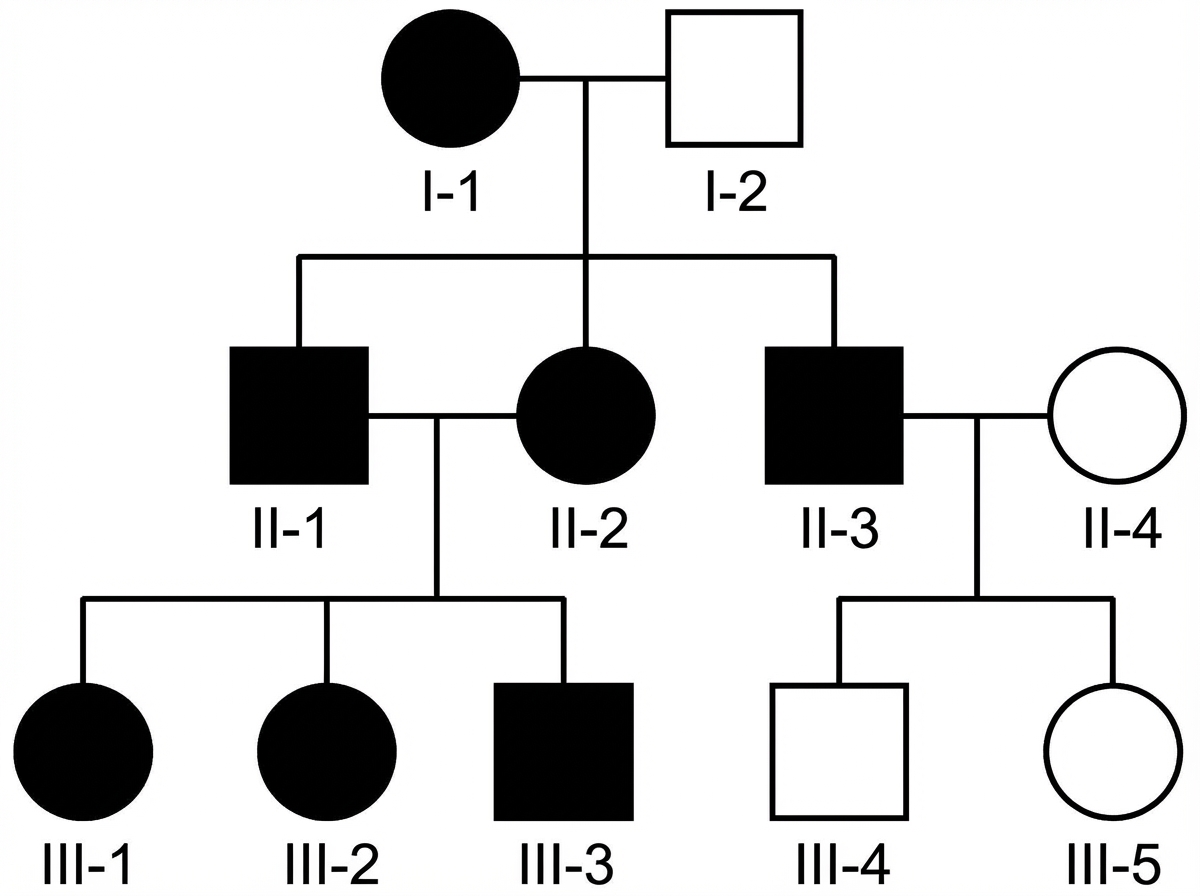
1 questionsThe pedigree chart shown in the image demonstrates a specific pattern of inheritance. Which of the following conditions is most likely to follow this pattern of inheritance?
NEET-PG 2025 - Pathology NEET-PG Practice Questions and MCQs
Question 51: The pedigree chart shown in the image demonstrates a specific pattern of inheritance. Which of the following conditions is most likely to follow this pattern of inheritance?
- A. Kearns-Sayre syndrome (Correct Answer)
- B. Marfan syndrome
- C. Duchenne muscular dystrophy
- D. Huntington's disease
Explanation: ***Kearns-Sayre syndrome*** - This condition is caused by large-scale deletions in **mitochondrial DNA (mtDNA)**, leading to a pattern of **maternal inheritance** (non-Mendelian) [1]. - Mitochondrial disorders are passed exclusively from the mother, affecting all offspring, which defines this specific inheritance pattern [1]. *Duchenne muscular dystrophy* - This follows an **X-linked recessive** pattern of inheritance, where the defective gene is located on the X chromosome [2]. - It primarily affects males, with mothers typically being asymptomatic carriers, clearly distinguishing it from mitochondrial inheritance [2]. *Huntington's disease* - This is an **autosomal dominant** disorder, meaning it is caused by a mutation on a non-sex chromosome and can be passed from either parent [3]. - It affects both males and females equally, with a 50% chance of transmission regardless of the child's sex [3]. *Marfan syndrome* - This is an **autosomal dominant** condition resulting from a mutation in the **FBN1 gene** (nuclear DNA) [3]. - The inheritance does not rely exclusively on the maternal line, as expected in an autosomal dominant Mendelian disorder [3]. **References:** [1] Kumar V, Abbas AK, et al.. Robbins and Cotran Pathologic Basis of Disease. 9th ed. Genetic Disorders, p. 181. [2] Kumar V, Abbas AK, et al.. Robbins and Cotran Pathologic Basis of Disease. 9th ed. Genetic Disorders, p. 151. [3] Kumar V, Abbas AK, et al.. Robbins and Cotran Pathologic Basis of Disease. 9th ed. Genetic Disorders, pp. 149-150.
Pharmacology
2 questionsA woman diagnosed with migraine has a family history of coronary artery disease. What is the drug of choice for migraine prophylaxis?
A patient is started on hydrochlorothiazide for hypertension and later develops renal stones. Which metabolic effect of hydrochlorothiazide is most likely responsible?
NEET-PG 2025 - Pharmacology NEET-PG Practice Questions and MCQs
Question 51: A woman diagnosed with migraine has a family history of coronary artery disease. What is the drug of choice for migraine prophylaxis?
- A. Topiramate
- B. Ergotamine
- C. Amitriptyline
- D. Propranolol (Correct Answer)
Explanation: ***Propranolol*** - **Propranolol** is a first-line drug for migraine prophylaxis, particularly favored in patients with co-existing conditions like hypertension, anxiety, or, as in this case, risk factors for **Coronary Artery Disease (CAD)**. - As a non-selective beta-blocker, it provides effective migraine prevention while potentially offering **cardioprotective benefits**, making it the safest and best choice here. *Topiramate* - **Topiramate** is also a first-line prophylactic agent, but it is often preferred when patients need to avoid weight gain or have co-existing seizure disorders. - It has no particular advantage over propranolol in lowering cardiac risk and is associated with common side effects such as cognitive impairment (**'fogginess'**) and **nephrolithiasis**. *Ergotamine* - **Ergotamine preparations** are severe vasoconstrictors and are used primarily for the **acute termination** of migraine attacks, not for long-term prophylaxis. - They are absolutely **contraindicated** in patients with established or high risk of **Coronary Artery Disease** (CAD) due to the risk of **myocardial infarction** and stroke. *Amitriptyline* - **Amitriptyline** (a TCA) is used for prophylaxis, especially in patients with co-existing **insomnia** or chronic **tension headaches**. - While effective, TCAs can have potential **cardiac side effects** (e.g., QTc prolongation, orthostatic hypotension) which makes **propranolol** a medically safer choice for patients with a family history of CAD.
Question 52: A patient is started on hydrochlorothiazide for hypertension and later develops renal stones. Which metabolic effect of hydrochlorothiazide is most likely responsible?
- A. Hypocitraturia
- B. Hypocalciuria
- C. Hypomagnesemia
- D. Hyperuricemia (Correct Answer)
Explanation: ***Hyperuricemia*** * Hydrochlorothiazide causes **hyperuricemia** by competing with uric acid for secretion in the proximal tubule, leading to decreased uric acid excretion. * Elevated serum uric acid levels increase the risk of **uric acid stone formation**, which is a well-recognized adverse effect of thiazide diuretics. * This is why thiazides can precipitate gout attacks and increase uric acid stone risk. *Hypocalciuria* * HCTZ causes **decreased urinary calcium excretion** (hypocalciuria) by enhancing calcium reabsorption in the DCT. * This effect is **stone-PROTECTIVE**, not causative - thiazides are actually used therapeutically to prevent recurrent calcium stones. * This would NOT explain stone formation in this patient. *Hypomagnesemia* * While HCTZ can cause magnesium loss, hypomagnesemia is not a primary mechanism for stone formation with thiazide use. * Magnesium is actually a stone inhibitor, so low levels could theoretically contribute, but this is not the main mechanism. *Hypocitraturia* * HCTZ does not typically cause significant citrate wasting or hypocitraturia. * Hypocitraturia is more characteristic of **carbonic anhydrase inhibitors** and chronic metabolic acidosis, not thiazide diuretics.