Anesthesiology
1 questionsA patient undergoing surgery receives a muscle relaxant and soon develops flushing and rashes over the neck and anterior chest. Which of the following muscle relaxants is most commonly associated with this reaction?
NEET-PG 2025 - Anesthesiology NEET-PG Practice Questions and MCQs
Question 141: A patient undergoing surgery receives a muscle relaxant and soon develops flushing and rashes over the neck and anterior chest. Which of the following muscle relaxants is most commonly associated with this reaction?
- A. Vecuronium
- B. Pancuronium
- C. Cisatracurium
- D. Atracurium (Correct Answer)
Explanation: ***Atracurium*** - The characteristic reaction described (flushing and rashes over the neck and chest) is often termed an **anaphylactoid reaction** due to **direct non-immunological histamine release** from mast cells. - Among the non-depolarizing muscle relaxants, **atracurium** and mivacurium are the most common causes of significant, dose-dependent histamine release, leading to cutaneous vasodilation (flushing) and potential hypotension. *Cisatracurium* - Although cisatracurium is an isomer of atracurium, it is associated with a **significantly lower incidence** of **histamine release** and provides better cardiovascular stability. - It is often favored over atracurium for patients with severe cardiovascular disease. *Vecuronium* - Vecuroniumbelongs to the **aminosteroid class** (e.g., rocuronium, vecuronium, pancuronium) of muscle relaxants, which are generally associated with **minimal-to-negligible risk** of **histamine release**. - It is preferred for its high degree of **cardiovascular stability** (minimal effect on heart rate or blood pressure). *Pancuronium* - Pancuronium, another **aminosteroid**, has a very low potential for histamine release, thus not typically causing flushing or rash. - Its main side effect is a **vagolytic action** (antimuscarinic effect) that often causes significant **tachycardia** and hypertension.
Community Medicine
3 questionsWhich of the following is the correct sequence of steps in a Randomized Controlled Trial (RCT)?
According to the population strategy for prevention of coronary artery disease, what is the recommended dietary cholesterol intake limit per day?
A new community intervention is initiated to reduce perinatal sepsis. Researchers allocate 20 Primary Health Centres (PHCs) to receive standard care and 20 PHCs to receive a community-based intervention. What type of study design is this?
NEET-PG 2025 - Community Medicine NEET-PG Practice Questions and MCQs
Question 141: Which of the following is the correct sequence of steps in a Randomized Controlled Trial (RCT)?
- A. Follow-up → Manipulation → Assessment → Randomisation
- B. Manipulation → Assessment → Follow-up → Randomisation
- C. Randomisation → Manipulation → Follow-up → Assessment (Correct Answer)
- D. Assessment → Randomisation → Follow-up → Manipulation
Explanation: **Randomisation → Manipulation → Follow-up → Assessment** is the correct sequence for conducting a Randomized Controlled Trial (RCT). - **Randomisation** is the essential first step that ensures baseline comparability between intervention and control groups, eliminating selection bias - **Manipulation** (intervention/treatment application) follows randomization - **Follow-up** involves monitoring participants over the study period - **Assessment** (outcome measurement) is performed at the end to evaluate the intervention's effect *Follow-up → Manipulation → Assessment → Randomisation* - Incorrect because randomization must occur before any intervention is applied - Starting with follow-up contradicts the fundamental RCT design *Manipulation → Assessment → Follow-up → Randomisation* - Fundamentally flawed as applying intervention before randomization introduces selection bias - This violates the core principle of RCTs (random allocation must precede intervention) *Assessment → Randomisation → Follow-up → Manipulation* - Incorrect sequence as assessment (outcome measurement) is the final stage, not the first - Manipulation must follow randomization, not come after follow-up
Question 142: According to the population strategy for prevention of coronary artery disease, what is the recommended dietary cholesterol intake limit per day?
- A. 100 mg / 1000 kcal (Correct Answer)
- B. 500 mg / 1000 kcal
- C. 200 mg / 1000 kcal
- D. 400 mg / 1000 kcal
Explanation: ***100 mg / 1000 kcal*** - The **population strategy** or public health approach aims to shift the entire risk distribution in the population. - A recommended target for **dietary cholesterol** intake for the general population is often set at less than **100 mg per 1000 kcal** (or <300 mg/day absolute limit). *200 mg / 1000 kcal* - While lower than average intake, setting the limit at **200 mg / 1000 kcal** might not be stringent enough for achieving optimal **population-wide reduction** in **CAD risk**. - This limit may be closer to recommendations for individuals with pre-existing risk factors, but not the general population strategy goal. *400 mg / 1000 kcal* - An intake of **400 mg / 1000 kcal** is considered high and would exceed the recommended limits for **primary prevention** of **coronary artery disease (CAD)**. - High cholesterol intake is directly linked to increased **serum LDL levels** in many individuals. *500 mg / 1000 kcal* - **500 mg / 1000 kcal** significantly exceeds public health recommendations and is associated with a high risk of hypercholesterolemia and subsequent development of **atherosclerosis**. - The goal of the population strategy is to move the average consumption far below this level to benefit the whole community.
Question 143: A new community intervention is initiated to reduce perinatal sepsis. Researchers allocate 20 Primary Health Centres (PHCs) to receive standard care and 20 PHCs to receive a community-based intervention. What type of study design is this?
- A. Cross-sectional study
- B. Cluster-randomized control trial (Correct Answer)
- C. Case-control study
- D. Quasi-experimental study
Explanation: ***Cluster-randomized control trial*** - A **Cluster-randomized control trial (C-RCT)** involves randomizing groups of individuals (clusters), such as entire PHCs or communities, rather than individual participants, to intervention or control arms. - Since whole **groups (20 PHCs)** are allocated to standard care or the intervention, it fits the definition of a C-RCT, which is often essential when an intervention cannot be delivered individually due to its nature (e.g., community-based programs). *Quasi-experimental study* - This design involves an intervention but lacks true **randomization** of participants or clusters, or it lacks a control group. - While both include control and intervention groups, the described scenario implies randomization (allocation), which makes a C-RCT a more specific and accurate fit than a general quasi-experimental design. *Cross-sectional study* - This design measures exposure and outcome simultaneously at a single point in time to determine **prevalence**. - It does not involve tracking groups over time or applying an **intervention**, which are key components of the described scenario. *Case-control study* - This is an observational study where individuals with a disease (cases) are compared to individuals without the disease (controls) to determine prior **exposure**. - This design is retrospective and does not involve the prospective application of a new **community intervention** as described in the question.
Forensic Medicine
1 questionsA man kills his office colleague and later claims he was experiencing delusions of persecution and other psychotic features at the time of the act. He now asserts that he is not guilty by reason of insanity. What is the most appropriate next step under medico-legal protocol?
NEET-PG 2025 - Forensic Medicine NEET-PG Practice Questions and MCQs
Question 141: A man kills his office colleague and later claims he was experiencing delusions of persecution and other psychotic features at the time of the act. He now asserts that he is not guilty by reason of insanity. What is the most appropriate next step under medico-legal protocol?
- A. He should be sent directly to jail
- B. Refer for psychiatric evaluation to assess criminal responsibility (Correct Answer)
- C. Prescribe antipsychotic medication immediately
- D. Enroll in an anger management program
Explanation: ***Refer for psychiatric evaluation to assess criminal responsibility*** - When a defendant claims 'not guilty by reason of insanity' (based on **McNaughten's rules**), a court-ordered psychiatric evaluation is mandatory to assess their mental state **at the time of the offense**. - The psychiatric evaluation determines whether the accused had the capacity to understand the nature and consequences of their act or know that it was wrong (Section 84, IPC). - The evaluation also assesses **fitness to stand trial (FST)**, meaning whether they currently understand the charges and can assist their counsel (Section 329, CrPC). - The most appropriate medico-legal next step is this comprehensive psychiatric assessment, which addresses both criminal responsibility and fitness for trial. *Enroll in an anger management program* - This program targets behavioral issues, not the underlying severe mental illness (psychosis, delusions of persecution) that affects the defendant's **criminal responsibility**. - It ignores the legal requirement to formally assess the insanity defense claim through psychiatric evaluation. - Anger management is inappropriate when psychotic features are claimed. *He should be sent directly to jail* - A claim of **insanity** requires a formal judicial inquiry supported by psychiatric evidence before any conviction or sentencing. - Section 84 of IPC provides that acts done by persons of unsound mind are not offenses if they lack the capacity to know the nature of the act or that it was wrong. - He must first undergo psychiatric evaluation, then be found guilty AND criminally responsible before incarceration can occur. *Prescribe antipsychotic medication immediately* - While the individual may need treatment, prescribing medication is premature before a definitive **diagnosis** is established through formal psychiatric evaluation. - The primary medico-legal requirement is **assessment for criminal responsibility** and fitness to stand trial, not immediate treatment. - Treatment may be initiated later based on the psychiatric evaluation findings and court authorization.
Internal Medicine
3 questionsA patient presents with palpitations and an irregularly irregular pulse. He presents within 2 hours of symptom onset, and has no history of diabetes or other comorbidities. What is the most appropriate initial management?
A patient presents with sudden onset aphasia and right sided arm weakness for past 4 hours. Which of the following investigations will be done to determine etiology of this case presentation?
A patient presents with salt wasting, craving, hyperkalemia, metabolic acidosis, and skin pigmentation. What is the most likely diagnosis?
NEET-PG 2025 - Internal Medicine NEET-PG Practice Questions and MCQs
Question 141: A patient presents with palpitations and an irregularly irregular pulse. He presents within 2 hours of symptom onset, and has no history of diabetes or other comorbidities. What is the most appropriate initial management?
- A. Control ventricular rate with verapamil
- B. TEE for starting anticoagulation
- C. Wait and watch
- D. Cardioversion (Correct Answer)
Explanation: ***Cardioversion*** - Since the patient presented within **<12 hours** of symptom onset (paroxysmal AF) and is hemodynamically stable, particularly without comorbidities, urgent rhythm control via **cardioversion (electrical or pharmacological)** is the optimal management to restore sinus rhythm [1]. - The very early presentation (within 2 hours) and the absence of significant comorbidities suggest a good chance for maintenance of sinus rhythm without immediate concern for complex thrombus formation. *TEE for starting anticoagulation* - **Transesophageal echocardiography (TEE)** is performed to rule out left atrial appendage thrombus before cardioversion if the duration of AF is **unknown or >48 hours**, or if anticoagulation has been inadequate (less than 3 weeks). - In this case, since the onset is clearly <48 hours and the patient is low risk without comorbidities, we prioritize immediate rhythm control over a mandatory TEE. *Control ventricular rate with verapamil* - **Rate control** (e.g., using calcium channel blockers like Verapamil or beta-blockers) is the primary goal for patients with **chronic** or **permanent** atrial fibrillation, or for those whose symptoms started **>48 hours** ago. - For new-onset AF with a short duration, **rhythm control** (cardioversion) is preferred [1]. *Wait and watch* - **Wait and watch** is inappropriate as **atrial fibrillation (AF)** is associated with a high risk of systemic embolization and stroke, necessitating prompt management (either rhythm or rate control). - Immediate intervention is required to prevent complications and potentially restore sinus rhythm, especially given the very early presentation.
Question 142: A patient presents with sudden onset aphasia and right sided arm weakness for past 4 hours. Which of the following investigations will be done to determine etiology of this case presentation?
- A. Transthoracic echocardiography
- B. MRI brain
- C. Carotid doppler
- D. Transesophageal echocardiography (Correct Answer)
Explanation: ***Transesophageal echocardiography*** - The patient presents with **sudden onset focal neurological deficits** (aphasia and hemiparesis), highly suggestive of an acute stroke, likely ischemic [2]. - TEE is superior to TTE for visualizing potential **cardiac sources of embolism**, such as intracardiac thrombi (especially in the left atrial appendage), patent foramen ovale (PFO), or aortic arch plaques, which are common etiologies in cryptogenic stroke [1], [4]. *Transthoracic echocardiography* - TTE is the initial, non-invasive cardiac evaluation but may miss smaller defects or clots, particularly in the **left atrial appendage** or smaller PFOs, due to poor resolution. - While useful for overall cardiac function, it has **lower sensitivity** than TEE for detecting specific high-risk embolic sources. *Carotid doppler* - This test assesses **carotid artery stenosis**, which is a common cause of ipsilateral stroke [1]. - It primarily determines large vessel disease in the neck, but the clinical presentation (sudden onset) and age may also suggest a **cardioembolic source** warranting cardiac investigation. *MRI brain* - MRI brain is the standard imaging modality used to **confirm the stroke** (especially DWI in the acute stage) and localize the lesion [1], [3]. - However, it determines the **consequence of the stroke** (location and extent of damage) rather than the underlying **etiology** (the source of the embolus or infarct), which is the focus of this question [1], [4].
Question 143: A patient presents with salt wasting, craving, hyperkalemia, metabolic acidosis, and skin pigmentation. What is the most likely diagnosis?
- A. Addison's disease (Correct Answer)
- B. Pheochromocytoma
- C. Cushing's syndrome
- D. Conn's syndrome
Explanation: ***Addison's disease*** - The features (salt wasting, hyperkalemia, metabolic acidosis, and skin pigmentation) are hallmarks of **primary adrenal insufficiency** (Addison's disease) [1], [2]. - **Skin pigmentation** (due to increased ACTH/MSH) and **salt wasting** (due to cortisol and aldosterone deficiency) are key differentiating points [2]. *Cushing's syndrome* - This condition is caused by **excess glucocorticoids** and typically presents with central obesity, moon facies, hypertension, and hypokalemia [3]. - It is characterized by **fluid retention** and suppressed ACTH (in secondary/tertiary causes), entirely opposite to the salt wasting seen here [3]. *Conn's syndrome* - Conn's syndrome is **primary hyperaldosteronism**, leading to sodium retention, **hypertension**, **hypokalemia**, and metabolic alkalosis [1]. - The presentation includes **hypokalemia** and **alkalosis**, which directly contradict the hyperkalemia and acidosis noted in the patient. *Pheochromocytoma* - This is a catecholamine-secreting tumor leading to episodic or sustained **hypertension**, palpitations, headaches, and sweating. - It primarily affects the cardiovascular system and does not cause the **salt wasting** or **hyperkalemia** profile seen in this patient.
Radiology
1 questionsWhich is the earliest imaging modality used to detect ankylosing spondylitis?
NEET-PG 2025 - Radiology NEET-PG Practice Questions and MCQs
Question 141: Which is the earliest imaging modality used to detect ankylosing spondylitis?
- A. X ray
- B. MRI sacroiliac joint (Correct Answer)
- C. Bone scan
- D. CT sacroiliac joint
Explanation: ***MRI sacroiliac joint*** - **Most sensitive modality** for detecting early ankylosing spondylitis - Detects **bone marrow edema** and active sacroiliitis before structural changes appear - Shows **inflammatory changes** in cartilage, synovium, and entheses - Can identify disease **years before X-ray changes** become apparent - STIR and T1-weighted sequences with contrast are particularly useful *Incorrect: X-ray* - Detects only **late structural changes** (erosions, sclerosis, fusion) - Takes **several years** for radiographic sacroiliitis to develop - Low sensitivity in early disease stages - Still used for initial screening due to availability and cost *Incorrect: Bone scan* - Shows **non-specific** increased uptake in sacroiliac joints - Lower sensitivity and specificity compared to MRI - Cannot differentiate inflammatory from mechanical causes - Largely replaced by MRI in current practice *Incorrect: CT sacroiliac joint* - Better than X-ray for detecting **bony erosions** and structural detail - Still detects structural rather than inflammatory changes - Higher radiation exposure than X-ray - Less sensitive than MRI for early disease
Surgery
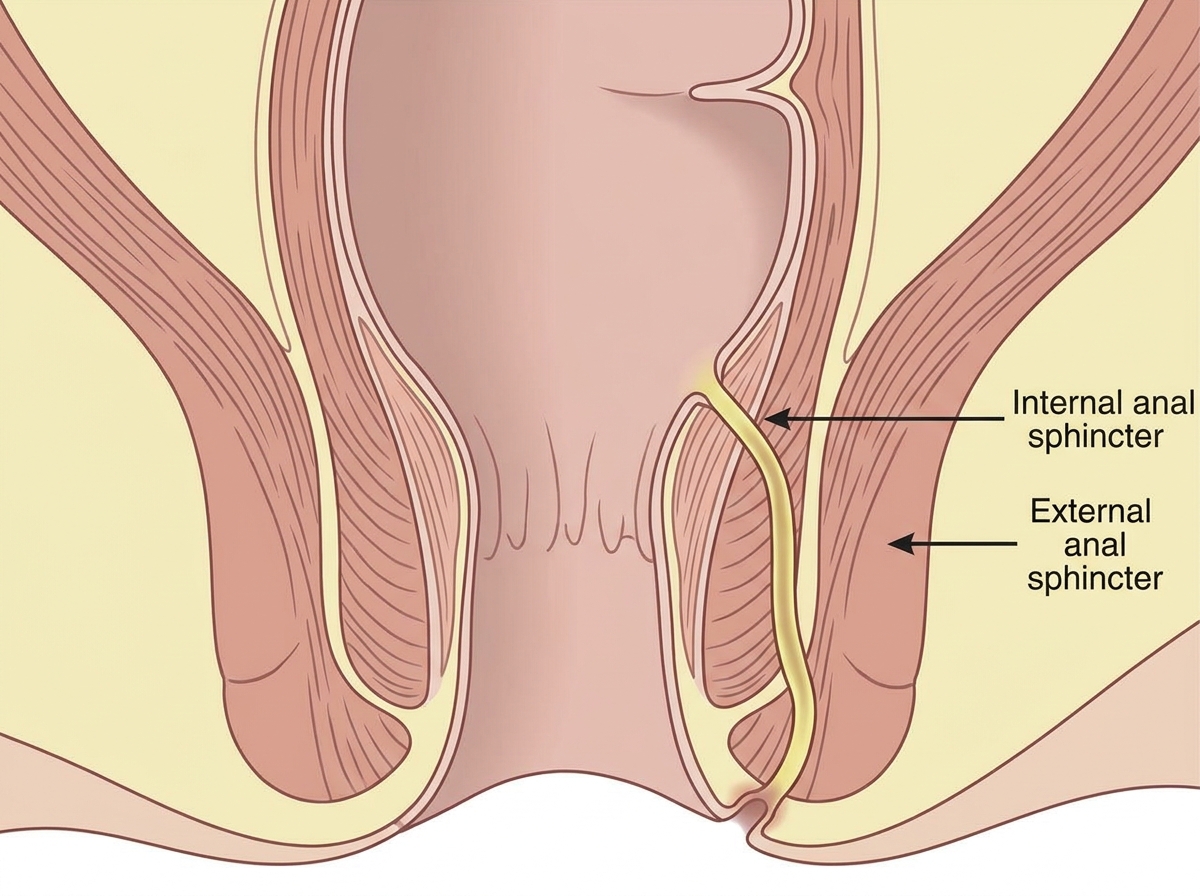
1 questionsIdentify the fistula according to Park's classification?
NEET-PG 2025 - Surgery NEET-PG Practice Questions and MCQs
Question 141: Identify the fistula according to Park's classification?
- A. Extra-sphincteric
- B. Trans-sphincteric high
- C. Supra-sphincteric
- D. Intersphincteric (Correct Answer)
Explanation: ***Intersphincteric*** - This type of fistula tract is confined entirely to the space **between the internal and external anal sphincters**, as clearly depicted in the image. - It represents the **most common** variety of anal fistula, accounting for about 70% of cases in Park's classification. *Supra-sphincteric* - A supra-sphincteric fistula passes through the intersphincteric space, hooks **above the puborectalis muscle**, and then descends through the ischiorectal fossa. - The illustrated tract does not traverse cephalad to the **external anal sphincter** or the puborectalis muscle. *Extra-sphincteric* - This rare type runs **outside both the internal and external anal sphincters** and often penetrates the levator ani muscle to connect the rectum to the perianal skin. - The tract shown is contained **within the muscle planes** of the anal canal, ruling out an extra-sphincteric course. *Trans-sphincteric high* - Trans-sphincteric fistulas pass **through the external anal sphincter** (usually involving the lower or middle third) to reach the ischiorectal fossa. - The depicted track runs strictly **between** the internal and external layers without crossing the external sphincter.