Obstetrics and Gynecology
3 questionsA 46-year-old woman presents with complaints of irregular menstrual cycles and heavy vaginal bleeding for several months. Transvaginal ultrasound reveals an endometrial thickness of 16 mm. What is the most appropriate next step in management?
In managing shoulder dystocia during vaginal delivery, which of the following is the correct sequence of maneuvers?
A 36-year-old woman presents with secondary amenorrhea for the past 8 months. Laboratory investigations reveal FSH of 36 IU/L and AMH of 0.05 ng/mL. What is the most likely diagnosis?
NEET-PG 2025 - Obstetrics and Gynecology NEET-PG Practice Questions and MCQs
Question 101: A 46-year-old woman presents with complaints of irregular menstrual cycles and heavy vaginal bleeding for several months. Transvaginal ultrasound reveals an endometrial thickness of 16 mm. What is the most appropriate next step in management?
- A. Perform an endometrial biopsy (Correct Answer)
- B. Hysterectomy
- C. Start combined oral contraceptive pills
- D. Observe and reassess after a few months
Explanation: ***Perform an endometrial biopsy*** - A thickened **endometrium (16 mm)** in a perimenopausal woman (46 years old) with **Abnormal Uterine Bleeding (AUB)** significantly increases the risk of endometrial pathology, including **endometrial hyperplasia** or **carcinoma**. - **Endometrial biopsy** is the most appropriate next step, as it provides a definitive tissue diagnosis required to guide subsequent, targeted treatment. *Hysterectomy* - Hysterectomy is a definitive treatment and is typically reserved only after a histological diagnosis of a high-grade abnormality, such as **endometrial cancer**, has been confirmed. - It is premature to proceed with such an invasive surgery before obtaining a tissue diagnosis. *Start combined oral contraceptive pills* - Hormonal therapy like COCPs is used to manage functional causes of AUB (e.g., anovulation), but it should be initiated only after **malignancy is ruled out** by biopsy, as it can mask symptoms of cancer. - A 16 mm endometrial thickness mandates tissue sampling due to the high index of suspicion for premalignant or malignant change. *Observe and reassess after a few months* - Delayed evaluation in this setting significantly increases the risk of diagnosing **endometrial carcinoma** at an advanced stage. - Any woman over 45 years presenting with AUB must undergo investigation, and observation is not acceptable given the pathological **endometrial thickness**.
Question 102: In managing shoulder dystocia during vaginal delivery, which of the following is the correct sequence of maneuvers?
- A. Gaskin → McRoberts → Rubin → Zavanelli
- B. Zavanelli → Gaskin → Rubin → McRoberts
- C. McRoberts → Rubin → Gaskin → Zavanelli (Correct Answer)
- D. Rubin → McRoberts → Zavanelli → Gaskin
Explanation: ***McRoberts → Rubin → Gaskin → Zavanelli*** - This sequence represents the general escalation of maneuvers, starting with the **McRoberts maneuver** and suprapubic pressure, which are the first-line and most effective steps. - Management proceeds logically from simple positional changes/minimal invasiveness (**Rubin's internal rotation, Gaskin position**) to the highly invasive, **last-resort Zavanelli maneuver** (cephalic replacement). *Zavanelli → Gaskin → Rubin → McRoberts* - This sequence is incorrect because the **Zavanelli maneuver** (cephalic replacement) is the absolute last step, only considered after all other maneuvers have failed due to its high associated morbidity. - The crucial and simple first-line maneuver, the **McRoberts maneuver**, is incorrectly placed as the final step in this order. *Rubin → McRoberts → Zavanelli → Gaskin* - The **McRoberts maneuver** is typically performed first along with suprapubic pressure, as it often provides adequate space and disimpaction before internal rotation techniques like Rubin. - The **Zavanelli maneuver** must always be attempted after non-invasive positional changes like the **Gaskin maneuver** (on all fours) have been tried and failed. *Gaskin → McRoberts → Rubin → Zavanelli* - The **McRoberts maneuver** is universally the first physical maneuver attempted after calling for help and assessing the need for episiotomy, so it generally precedes the **Gaskin maneuver**. - While effective, the Gaskin maneuver (assuming the all-fours position) requires repositioning the mother and is usually attempted after the simpler positional change of McRoberts fails.
Question 103: A 36-year-old woman presents with secondary amenorrhea for the past 8 months. Laboratory investigations reveal FSH of 36 IU/L and AMH of 0.05 ng/mL. What is the most likely diagnosis?
- A. Hypothalamic amenorrhea
- B. Polycystic ovary syndrome (PCOS)
- C. Hyperprolactinemia
- D. Premature ovarian insufficiency (POI) (Correct Answer)
Explanation: ***Premature ovarian insufficiency (POI)*** - This diagnosis is defined by secondary amenorrhea before the age of 40 associated with **hypergonadotropic hypogonadism**. - The combination of severely elevated **FSH (36 IU/L)** and extremely low **AMH (0.05 ng/mL)** strongly indicates primary ovarian failure and depletion of the ovarian reserve. *Polycystic ovary syndrome (PCOS)* - PCOS is associated with normal or slightly low FSH levels and an elevated **LH:FSH ratio**. - Affected women usually have **normal or high AMH** levels due to an increased pool of small antral follicles, opposite of the findings here. *Hyperprolactinemia* - Amenorrhea is mediated by the inhibitory effect of prolactin on GnRH, leading to **hypogonadotropic hypogonadism** (low or normal FSH and LH). - The primary biochemical finding would be high **serum prolactin**, which doesn't match the high FSH observed. *Hypothalamic amenorrhea* - This is a form of **hypogonadotropic hypogonadism**, characterized by low **FSH** and **LH** levels due to impaired GnRH release. - It is inconsistent with the patient's markedly elevated FSH level, which signifies a problem originating in the ovary, not the hypothalamus.
Ophthalmology
4 questionsAn elderly patient presents with white, dandruff-like deposits on the anterior lens surface, seen during slit-lamp examination. What is the most likely diagnosis?
Which condition is treated using an Intacs ring, as shown in the image?
The essential foundational components of binocular single vision are:
Which of the following is true about orbital cellulitis?
NEET-PG 2025 - Ophthalmology NEET-PG Practice Questions and MCQs
Question 101: An elderly patient presents with white, dandruff-like deposits on the anterior lens surface, seen during slit-lamp examination. What is the most likely diagnosis?
- A. Iris cyst
- B. Persistent pupillary membrane
- C. Pigment dispersion syndrome
- D. Pseudoexfoliation syndrome (Correct Answer)
Explanation: ***Pseudoexfoliation syndrome*** - The pathognomonic finding of **white, dandruff-like material** deposited on the **anterior lens capsule** (often forming a characteristic clear central zone and peripheral zone separated by a clear space) is indicative of Pseudoexfoliation syndrome. - This material is an **abnormal fibrillar glycoprotein** that can block the trabecular meshwork, elevating intraocular pressure and predisposing the patient to **pseudoexfoliation glaucoma**. *Iris cyst* - An iris cyst appears as a localized, non-transilluminating mass or elevation within the iris stroma or attached to the pupil margin. - It does not present as diffuse **dandruff-like material** covering the lens surface, which is the hallmark of pseudoexfoliation. *Persistent pupillary membrane* - This is a **congenital anomaly** where remnants of the embryonic **tunica vasculosa lentis** persist, appearing as fine strands bridging the pupil or extending from the iris collar to the lens. - They are typically dark, thread-like structures, and are not the widespread **white deposits** usually seen in elderly patients with PEX. *Pigment dispersion syndrome* - This condition involves the dispersion of **iris pigment**, which classically manifests as a **Krukenberg spindle** (vertical pigment line on the corneal endothelium) and dense pigment deposits in the trabecular meshwork. - The deposits are visually **brown/black (pigmentary)**, not white/gray as described in PEX, and they primarily affect the corneal endothelium and trabecular meshwork.
Question 102: Which condition is treated using an Intacs ring, as shown in the image?
- A. Keratoconus (Correct Answer)
- B. Glaucoma
- C. Cataract
- D. Corneal ulcer
Explanation: ***Keratoconus*** - The image displays **Intacs**, which are intracorneal ring segments specifically designed to treat **keratoconus** by flattening the steep cornea. - This procedure provides structural support to the weakened, cone-shaped cornea, thereby improving uncorrected and best-corrected visual acuity by reducing **myopia** and **astigmatism**. *Cataract* - Cataract treatment involves the surgical removal of the opacified natural lens, typically through **phacoemulsification**. - An **intraocular lens (IOL)** is implanted in place of the natural lens, not a ring within the corneal stroma as shown. *Corneal ulcer* - A corneal ulcer is an active infection of the cornea and is treated primarily with intensive **topical antimicrobial** therapy (antibiotics, antifungals, or antivirals). - Placing a foreign body like an Intacs ring is contraindicated in an active infection and would worsen the condition. *Glaucoma* - The goal of glaucoma treatment is to lower **intraocular pressure (IOP)** to prevent optic nerve damage. - This is managed with medications (eye drops), **laser procedures** (e.g., trabeculoplasty), or **filtration surgery** (e.g., trabeculectomy), none of which involve corneal ring implants.
Question 103: The essential foundational components of binocular single vision are:
- A. a. Stereopsis b. Fusion
- B. a. SMP b. Stereopsis
- C. a. SMP b. Fusion (Correct Answer)
- D. a. Fusion b. SMP
Explanation: ***a. SMP b. Fusion*** - **Simultaneous Macular Perception (SMP)** is the foundational first grade of Binocular Single Vision (BSV), where both eyes perceive images simultaneously on corresponding retinal points. - **Fusion** is the second essential grade, where the brain actively merges these two simultaneously perceived images into a single unified percept. - These two components form the **essential foundation** for BSV. Stereopsis (Grade 3) is a higher function that depends on intact SMP and Fusion. - Together, SMP and Fusion represent the core sensory and motor mechanisms that enable binocular vision. *a. Stereopsis b. Fusion* - This option omits **SMP**, which is the primary prerequisite for all binocular functions. - Without SMP, the brain cannot perceive images from both eyes simultaneously, making fusion impossible. - Stereopsis cannot develop without the foundational presence of SMP. *a. SMP b. Stereopsis* - This option skips **Fusion** (Grade 2), which is the critical intermediate step between SMP and stereopsis. - Fusion is essential for merging the two images before depth perception (stereopsis) can occur. - The progression must follow: SMP → Fusion → Stereopsis. *a. Fusion b. SMP* - While containing the correct components, this reverses the physiological sequence. - **SMP must occur first** before fusion can take place—you cannot fuse images that aren't simultaneously perceived. - The correct hierarchy is SMP (Grade 1) followed by Fusion (Grade 2).
Question 104: Which of the following is true about orbital cellulitis?
- A. Treated effectively with topical antibiotics
- B. Ethmoid sinusitis is the most common etiology (Correct Answer)
- C. It is present anterior to the orbital septum
- D. Presents with proptosis, orbital swelling, normal pupil, and extraocular movements
Explanation: ***Ethmoid sinusitis is the most common etiology*** - Orbital cellulitis most frequently results from the spread of infection from adjacent structures, with the **ethmoid sinus** being the most common source due to the thin **lamina papyracea** separating it from the orbit. - It is almost always a serious complication of **acute bacterial sinusitis**, necessitating urgent aggressive management. *It is present anterior to the orbital septum* - Cellulitis **anterior to the orbital septum** is termed **preseptal** or **periorbital cellulitis**, which is a less severe condition. - Orbital cellulitis is characterized by infection and inflammation extending **posterior to the orbital septum**, affecting the deep orbital soft tissues. *Treated effectively with topical antibiotics* - Topical antibiotics are wholly inadequate for managing such a severe, deep-seated infection with risk of intracranial spread. - Treatment for orbital cellulitis requires immediate initiation of **systemic broad-spectrum intravenous antibiotics**. *Presents with proptosis, orbital swelling, normal pupil, and extraocular movements* - Orbital cellulitis typically causes severe pain, **proptosis**, **chemosis**, and crucially, **restricted and painful extraocular movements** (ophthalmoplegia). - The presence of restricted Extraocular Movements (EOM) and often an **Afferent Pupillary Defect (APD)** differentiates orbital cellulitis from preseptal cellulitis.
Pharmacology
1 questionsBy what primary mechanism does hydrochlorothiazide help prevent the formation of calcium stones?
NEET-PG 2025 - Pharmacology NEET-PG Practice Questions and MCQs
Question 101: By what primary mechanism does hydrochlorothiazide help prevent the formation of calcium stones?
- A. It directly dissolves existing calcium stones by altering urinary pH and increasing their solubility.
- B. It increases the urinary excretion of citrate, which acts as a chelating agent.
- C. It increases calcium reabsorption in the distal convoluted tubule, leading to a decrease in urinary calcium excretion. (Correct Answer)
- D. It increases the filtration of calcium at the glomerulus, thereby reducing serum calcium levels.
Explanation: ***It increases calcium reabsorption in the distal convoluted tubule, leading to a decrease in urinary calcium excretion.*** - By inhibiting the **sodium-chloride cotransporter (NCC)** in the **distal convoluted tubule (DCT)**, thiazides indirectly enhance calcium reabsorption via the basolateral Na+/Ca2+ exchanger. - This pharmacological effect causes **hypocalciuria**, which reduces the supersaturation of calcium oxalate/phosphate in the urine, thereby preventing stone formation. *It increases the urinary excretion of citrate, which acts as a chelating agent.* - While citrate is a powerful inhibitor of stones, thiazides are **not** primarily known to substantially increase urinary citrate excretion. - Other measures, such as oral **potassium citrate**, are used specifically to increase urinary citrate levels in stone formers. *It increases the filtration of calcium at the glomerulus, thereby reducing serum calcium levels.* - Thiazides actually tend to cause a slight **increase** in serum calcium (due to enhanced reabsorption in the DCT and bone effects), a condition known as thiazide-induced hypercalcemia. - Their mechanism of stone prevention is focused on reducing **urinary** calcium, not primarily filtering more calcium. *It directly dissolves existing calcium stones by altering urinary pH and increasing their solubility.* - Thiazides are primarily **preventative** medications for stone formation; they do not have a role in directly dissolving existing calcium stones. - The dissolution of some stones (like uric acid stones) is usually achieved by urinary alkalinization (e.g., using **potassium citrate**), which is not the main action of HCTZ.
Radiology
1 questionsHistory of pulsatile mass in the neck. Digital angiography image shown. Not filling on carotid compression. But refilling on releasing pressure. What is the diagnosis?
NEET-PG 2025 - Radiology NEET-PG Practice Questions and MCQs
Question 101: History of pulsatile mass in the neck. Digital angiography image shown. Not filling on carotid compression. But refilling on releasing pressure. What is the diagnosis?
- A. Haemangioma
- B. Carotid Aneurysm
- C. Carotid Body tumour (Correct Answer)
- D. AV fistula
Explanation: ***Carotid Body tumour*** - The angiography image shows a classic **"splaying"** or **"lyre sign"** of the carotid bifurcation (Common Carotid Artery splitting into Internal and External Carotid Arteries), which is **pathognomonic for a Carotid Body Tumour** (Paraganglioma). - The tumor is **highly vascular** (tumour blush on angiography) and receives its blood supply from the **External Carotid Artery (ECA)**, thus explaining the pulsatile nature. - **Fontaine test positive**: The described finding of "not filling on carotid compression but refilling on releasing pressure" is characteristic of a carotid body tumor, as temporary compression reduces flow but the highly vascular tumor refills from collateral circulation when pressure is released. - Carotid body tumors are **paragangliomas** arising from chemoreceptor cells at the carotid bifurcation. *Carotid Aneurysm* - A carotid artery aneurysm would appear as a **localized, saccular, or fusiform dilatation** of the carotid vessel lumen on angiography, not demonstrating the splaying of the bifurcation. - While also pulsatile, its filling on angiography would be purely arterial flow within the dilated vessel, not a pathological tumor blush. - Would not show the characteristic lyre sign. *AV fistula* - An Arteriovenous (AV) fistula would typically show **early venous opacification** (rapid shunting of contrast from artery to vein), which is not the primary finding here. - The mass is described as a localized tumor mass causing splaying of the bifurcation, not the flow-related abnormalities typical of a fistula. - Would present with continuous bruit rather than pulsatile mass. *Haemangioma* - A large, highly vascular haemangioma in the neck might be pulsatile but typically presents as a less defined mass and does **not characteristically cause the splaying of the carotid bifurcation** seen in a Carotid Body Tumour. - While both can show a tumor blush, the **location** (at carotid bifurcation) and **specific radiological presentation** (lyre sign) strongly favor the Carotid Body Tumour (a type of **paraganglioma**).
Surgery
1 questionsWhat is correct regarding this suture?
NEET-PG 2025 - Surgery NEET-PG Practice Questions and MCQs
Question 101: What is correct regarding this suture?
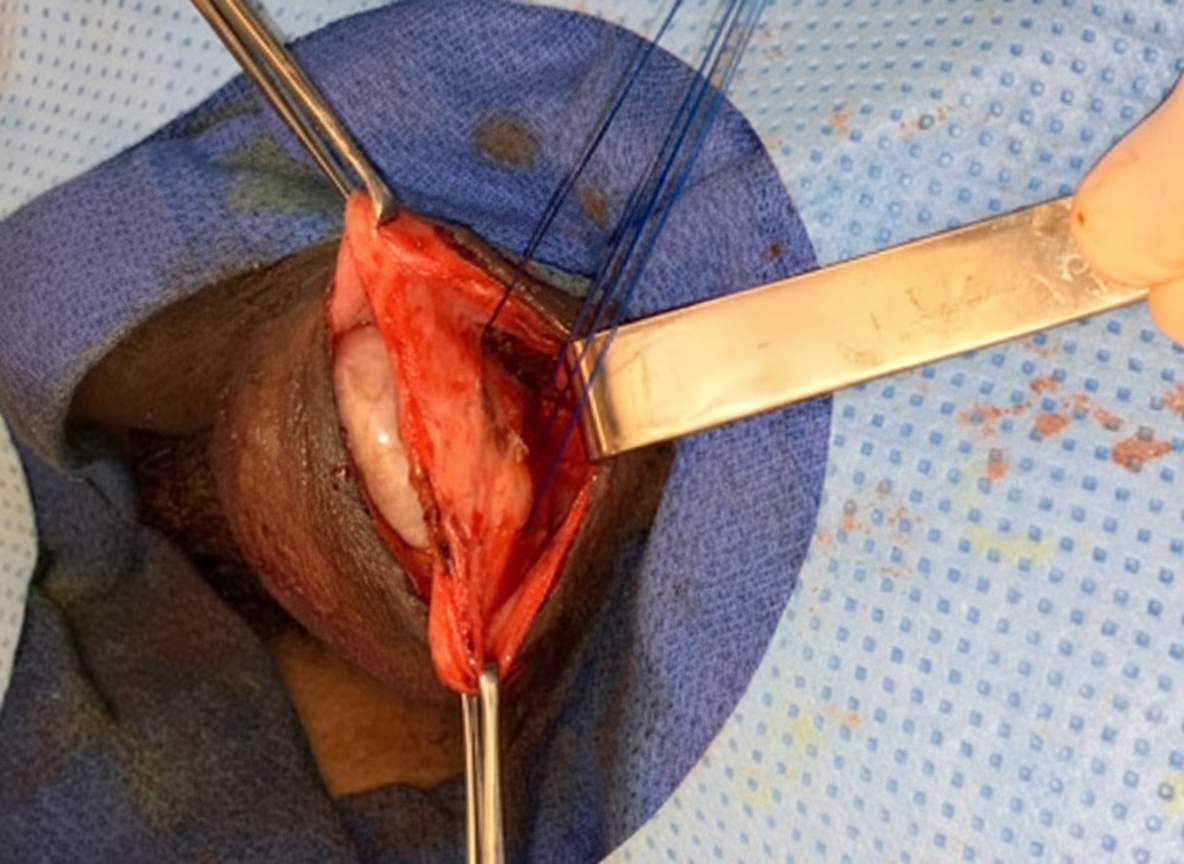
- A. Collagen derived
- B. Non absorbable
- C. Monofilament (Correct Answer)
- D. Braided multifilament
Explanation: ***Monofilament*** - **Monofilament** sutures consist of a single strand, which minimizes tissue drag and reduces the risk of harboring **bacteria** and subsequent wound infection. - This structure is typical for materials like **Prolene** (Polypropylene) and **Nylon**, prized for their low friction and use in delicate or contaminated fields. *Non absorbable* - This describes the **fate** of the suture (remaining permanently in the body) but not its structure; non-absorbable sutures can be either **monofilament** (e.g., Nylon) or multifilament (e.g., Silk). - While many important sutures are non-absorbable, it is a property independent of whether the suture is single-stranded. *Braided multifilament* - This refers to sutures made of multiple intertwined strands, which is the structural opposite of a **monofilament**. - Multifilament sutures typically offer better knot security but have increased tissue drag and potential for **capillarity** (wicking action). *Collagen derived* - This refers to the material source, specifically **catgut** (made from sheep or cow intestine), which is an absorbable natural material. - Catgut is absorbable and rapidly loses its tensile strength; 'monofilament' describes the physical form and is not exclusive to this biologic material.