Identify the marked structure in the given image.

A 38-year-old patient presents with chest pain and hoarseness of voice for the past month. Based on the radiographic image below, what is the most likely diagnosis?

Identify the condition shown in the plain abdominal radiograph.
Identify the diagnosis using the MRI provided.
NEET-PG 2024 - Radiology NEET-PG Practice Questions and MCQs
Question 11: Identify the marked structure in the given image.
- A. Electrode
- B. Coil (Correct Answer)
- C. Magnet
- D. Processor
Explanation: ***Coil*** - The marked structure appears to be a **cochlear implant's internal coil**, which is common in X-ray imaging of these devices. - The **cochlear implant internal coil** is crucial for transmitting processed sound signals via electromagnetic induction to the electrode array within the cochlea. *Electrode* - An **electrode array** is typically a thin, flexible wire with multiple contacts inserted into the cochlea, which is not what the arrow is pointing to directly. - While electrodes are part of a cochlear implant, the marked structure's shape and position are more consistent with the **internal coil** that connects to the electrode array. *Magnet* - A **magnet** is present in a cochlear implant system, typically in both the external processor and internal receiver, to hold these two components together through the skin. - Magnets usually appear as dense, circular structures in X-rays, often seen more anteriorly or superiorly to the coil for external component alignment. *Processor* - The **processor** for a cochlear implant is an external device worn behind the ear, not an implanted component visible on an X-ray. It processes sound and sends it to the internal coil. - The structures seen in the X-ray are **implanted components** of the cochlear implant, not the external sound processor.
Question 12: A 38-year-old patient presents with chest pain and hoarseness of voice for the past month. Based on the radiographic image below, what is the most likely diagnosis?
- A. Saccular aneurysm of distal arch
- B. Aortic dissection of the arch (Correct Answer)
- C. Coarctation of the aorta
- D. Stenosis of the aorta
Explanation: ***Aortic dissection of the arch*** - The image suggests a dissection flap within the **aortic arch**, creating a true and false lumen, which is characteristic of an aortic dissection. - Chest pain and **hoarseness of voice** (due to recurrent laryngeal nerve compression by the expanding aorta) are classic symptoms of aortic dissection affecting the aortic arch. - Aortic dissection involves an **intimal tear** with blood entering the media, creating separate lumens, which differentiates it from a simple aneurysm. *Saccular aneurysm of distal arch* - A **saccular aneurysm** would appear as a focal, out-pouching dilatation of the aorta, without evidence of an intimal flap or separate lumens seen in the image. - While an aneurysm can cause symptoms like chest pain or hoarseness, the imaging features specifically point to dissection rather than a simple saccular aneurysm. *Coarctation of the aorta* - **Coarctation of the aorta** is a congenital narrowing of the aorta, typically distal to the left subclavian artery, which would appear as a localized constriction, not a dissection. - While it can manifest with chest pain, hoarseness is not a typical symptom, and classic imaging would show a "shelf-like" indentation or rib notching on X-ray. *Stenosis of the aorta* - **Aortic stenosis** usually refers to narrowing of the aortic valve or a focal narrowing of the aorta. The image displays a complex abnormality of the aortic wall and lumen, not simple stenosis. - While severe aortic stenosis can cause chest pain (angina), hoarseness is not a common associated symptom.
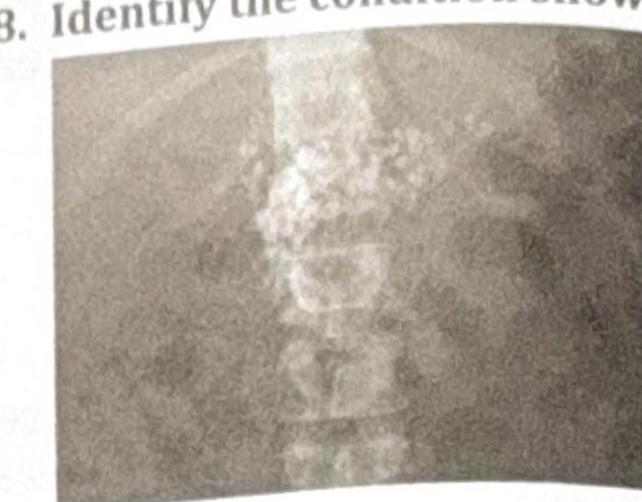
Question 13: Identify the condition shown in the plain abdominal radiograph.
- A. Pancreatic calcification (Correct Answer)
- B. Mesenteric calcification
- C. Horseshoe kidney
- D. Jejunal fecolith
Explanation: ***Pancreatic calcification*** - The radiograph displays **multiple, punctate, and amorphous calcifications** clustered in the upper abdomen, characteristic of **chronic pancreatitis**. - These calcifications represent **calcium deposits within the pancreatic ducts and parenchyma**, a hallmark sign of chronic inflammation and damage to the pancreas. *Mesenteric calcification* - **Mesenteric calcifications** are typically more scattered and linear, often following the distribution of blood vessels or lymph nodes within the mesentery, which is not seen here. - They are generally less dense and less granular than the calcifications observed in the image. *Horseshoe kidney* - A **horseshoe kidney** is a congenital anomaly where the kidneys are fused at their lower poles, forming a U-shape, and is typically located lower in the abdomen, often overlying the spine. - This condition presents with the characteristic **renal outlines** and not diffuse calcifications as shown. *Jejunal fecolith* - A **jejunal fecolith** would appear as a singular or a few discrete, dense, and typically rounded or oval radio-opacities within the lumen of the jejunum. - The diffuse, scattered pattern of calcifications displayed in the image is inconsistent with a fecolith, which is usually composed of inspissated fecal material.
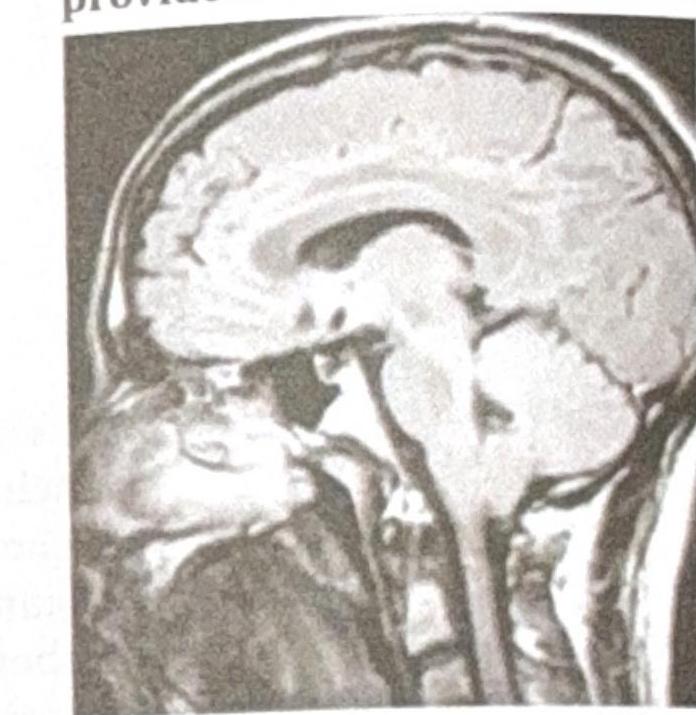
Question 14: Identify the diagnosis using the MRI provided.
- A. Chiari type 1 malformation (Correct Answer)
- B. Dandy-Walker malformation
- C. Vein of Galen malformation
- D. Agenesis of the corpus callosum
Explanation: ***Chiari type 1 malformation*** - The sagittal MRI image clearly shows the **cerebellar tonsils prolapsing below the foramen magnum** into the cervical spinal canal, which is the hallmark of a Chiari type 1 malformation. - This condition can lead to symptoms like headaches, neck pain, and neurological deficits due to compression of the brainstem and spinal cord. *Dandy-Walker malformation* - This malformation involves the **agenesis or hypoplasia of the cerebellar vermis** and persistent cystic dilation of the fourth ventricle, creating a large posterior fossa cyst. - The image does not show an enlarged posterior fossa with a cystic fourth ventricle or a severely hypoplastic vermis. *Vein of Galen malformation* - This is a **rare congenital vascular malformation** involving a direct arteriovenous shunt without an intervening capillary bed, typically presenting as an enlarged vein of Galen. - The provided image is a sagittal view demonstrating cerebellar tonsillar herniation, not a prominent or malformed vein of Galen. *Agenesis of the corpus callosum* - This condition is characterized by the **partial or complete absence of the corpus callosum**, the band of white matter connecting the two cerebral hemispheres. - On sagittal MRI, this would show absence of the corpus callosum and typically radial gyral patterns, which are not seen in this image.