Anatomy
1 questionsIdentify the uterus shown in the image?

NEET-PG 2024 - Anatomy NEET-PG Practice Questions and MCQs
Question 81: Identify the uterus shown in the image?
- A. Bicornuate (Correct Answer)
- B. Didelphys
- C. Arcuate
- D. Septate
- E. Unicornuate
Explanation: ***Bicornuate*** - The image displays a uterus with two distinct uterine horns that are partially fused at the fundus, creating a **heart-shaped external indentation**. - This morphology is characteristic of a **bicornuate uterus**, which results from incomplete fusion of the paramesonephric (Müllerian) ducts. *Didelphys* - A **uterus didelphys** would show two completely separate uteri, each with its own cervix and often a separate vagina. - The image clearly shows a single cervix and a single vaginal canal, with only the upper uterine body being divided. *Arcuate* - An **arcuate uterus** has a small, concave indentation at the fundus, but the overall shape is typically that of a normal uterus with a mild deformity. - The image shows a much more significant division of the uterine cavity than seen in an arcuate uterus. *Septate* - A **septate uterus** has a normal external contour but contains an internal septum that divides the uterine cavity into two parts. - The image demonstrates both internal and external division with a heart-shaped fundal indentation, which distinguishes bicornuate from septate uterus. *Unicornuate* - A **unicornuate uterus** results from failure of one Müllerian duct to develop, creating a single elongated uterine horn. - The image shows two uterine horns, not a single horn, ruling out this diagnosis.
OB/GYN
3 questionsWhat is the typical time between fertilization and implantation?
A pregnant woman with a known case of asthma is experiencing postpartum hemorrhage (PPH). Which drug is contraindicated?
In fertility-preserving prolapse surgery, which bony landmark is used for suspension?
NEET-PG 2024 - OB/GYN NEET-PG Practice Questions and MCQs
Question 81: What is the typical time between fertilization and implantation?
- A. 2 days
- B. 8 days (Correct Answer)
- C. 14 days
- D. 16 days
Explanation: ***8 days*** - **Fertilization** typically occurs in the **fallopian tube**, and the resulting **zygote** then undergoes several cell divisions while migrating towards the uterus. - Implantation, the process by which the **blastocyst embeds into the uterine wall**, usually begins around day 6 post-fertilization and is completed by day 8-10. *2 days* - At 2 days post-fertilization, the embryo is typically in the **2-cell to 4-cell stage** and is still located within the fallopian tube, far from the implantation site. - This stage is too early for implantation to occur, as the embryo has not yet reached the **blastocyst stage** or the uterus. *14 days* - By 14 days post-fertilization, implantation would have long been completed, and the initial stages of **trophoblast development** and formation of the **placenta** would be underway. - This time frame represents a more advanced stage of pregnancy, whereas implantation is an early event. *16 days* - Sixteen days post-fertilization is well past the window for initial implantation; at this point, significant embryonic development has occurred, and the woman might even be experiencing early signs of **pregnancy**, such as a missed period. - Implantation is a much earlier process, concluding by day 10 at the latest.
Question 82: A pregnant woman with a known case of asthma is experiencing postpartum hemorrhage (PPH). Which drug is contraindicated?
- A. Methyl ergometrine
- B. Carboprost (Correct Answer)
- C. Misoprostol
- D. Oxytocin
Explanation: ***Carboprost*** - **Carboprost** is a **prostaglandin F2-alpha analog** that causes strong uterine contractions but also leads to **bronchoconstriction** and increased airway resistance. - Due to its potent bronchoconstrictive effects, **carboprost** is **absolutely contraindicated in patients with asthma** as it can precipitate a severe asthmatic attack. *Methyl ergometrine* - **Methyl ergometrine** is an **ergot alkaloid** that causes sustained uterine contractions and is effective for PPH. - It is contraindicated in patients with **hypertension** or **pre-eclampsia** due to its vasoconstrictive properties, but not typically in asthma. *Misoprostol* - **Misoprostol** is a **prostaglandin E1 analog** used for PPH management, causing uterine contractions. - It is generally safe for use in patients with asthma as it does not have significant bronchoconstrictive side effects. *Oxytocin* - **Oxytocin** is a first-line uterotonic agent for PPH, working by causing rhythmic uterine contractions. - It is generally considered safe in patients with asthma and is not known to exacerbate respiratory conditions.
Question 83: In fertility-preserving prolapse surgery, which bony landmark is used for suspension?
- A. Sacral promontory
- B. Ischial spine (Correct Answer)
- C. Pubic symphysis
- D. Ischial tuberosity
Explanation: ***Ischial spine*** - The **ischial spine** serves as a crucial anatomical landmark for **suspension in fertility-preserving prolapse surgery**, particularly for procedures like sacrospinous ligament fixation. - Fixation to the ischial spine helps in supporting the vaginal apex or uterus, maintaining the natural vaginal axis and reducing the risk of recurrence. *Sacral promontory* - The **sacral promontory** is used in sacrocolpopexy or sacrohysteropexy, which traditionally involves mesh fixation and may not be ideal for **fertility preservation** due to potential future pregnancy complications or mesh-related issues. - While it provides strong support, its use might reduce vaginal elasticity and increase risk for future deliveries. *Pubic symphysis* - The **pubic symphysis** is primarily involved in procedures for **stress urinary incontinence** (e.g., tension-free vaginal tape) and is not a primary point for suspending the uterus or vaginal apex in prolapse surgery. - Using it for prolapse repair could alter the normal anatomical relationship and lead to dyspareunia or chronic pain. *Ischial tuberosity* - The **ischial tuberosity** is a bony prominence that provides attachment for various ligaments and muscles of the pelvis and perineum but is **too inferior and lateral** to be effectively used for uterine or vaginal vault suspension. - Its location makes it unsuitable for achieving appropriate apical support in prolapse surgery.
Obstetrics and Gynecology
5 questionsThe flexion point in ventouse (vacuum) delivery is located at:
Identify the instrument shown in the image below:

Which of the following is not a contraindication for External Cephalic Version (ECV)?
A 30-year-old female, G2L2, with a history of cervical elongation presents for surgical consultation. What is the surgery of choice?
A pregnant woman presents with an IUD in place, and the thread is clearly visible. She wishes to continue the pregnancy. What is the most appropriate next step?
NEET-PG 2024 - Obstetrics and Gynecology NEET-PG Practice Questions and MCQs
Question 81: The flexion point in ventouse (vacuum) delivery is located at:
- A. 3 cm posterior to the anterior fontanelle
- B. 3 cm anterior to the posterior fontanelle (Correct Answer)
- C. 6 cm anterior to the posterior fontanelle
- D. Midway between the anterior and posterior fontanelle
Explanation: ***3 cm anterior to the posterior fontanelle*** - This is the **correct location of the flexion point** (also described as approximately 6 cm posterior to the anterior fontanelle along the sagittal suture). - This position optimizes the **flexion-traction axis** during vacuum extraction, ensuring that the fetal head descends through the birth canal in the most favorable attitude with maximum flexion. - Correct placement of the vacuum cup at this site provides a **mechanical advantage**, leveraging the natural pivot point of the fetal head for effective delivery and bringing the **occiput** down first. *3 cm posterior to the anterior fontanelle* - This location is **too far anterior**, only 3 cm from the anterior fontanelle, and does not correspond to the true flexion point. - Placing the cup here would result in **suboptimal flexion** and poor mechanical advantage during traction. - This may lead to **cup slippage**, increased rate of failed vacuum delivery, and potential scalp injury. *6 cm anterior to the posterior fontanelle* - Since the distance between fontanelles is approximately 9 cm, this position would be equivalent to 3 cm posterior to the anterior fontanelle (too anterior). - This is **not the correct flexion point** and would result in the same problems as placing the cup too far anterior. *Midway between the anterior and posterior fontanelle* - While this location (approximately 4.5 cm from either fontanelle) might seem intuitive, it does not precisely correspond to the optimal **flexion point** for vacuum extraction. - The true flexion point is slightly more posterior, at **3 cm anterior to the posterior fontanelle**, which optimizes the mechanism of labor.
Question 82: Identify the instrument shown in the image below:
- A. Simpson
- B. Wrigley
- C. Pipers
- D. Kielland (Correct Answer)
Explanation: ***Kielland*** - Kielland forceps are distinguished by their **lack of pelvic curve** and the presence of a sliding lock mechanism designed for **rotation of the fetal head**. - They are primarily used for **rotational delivery** when the fetal head is in malposition, often in the mid-pelvis. *Simpson* - Simpson forceps have a distinct **cephalic curve** for grasping the fetal head and a **pelvic curve** to conform to the birth canal. - They are commonly used for **outlet and low-cavity deliveries** where minimal rotation is needed. *Wrigley* - Wrigley forceps are a type of **outlet forceps** with a very short shanks and blades, making them suitable only when the fetal head is on the **perineum**. - They are designed for situations where the head is already visible without separating the labia. *Pipers* - Pipers forceps are specifically designed for **delivery of the after-coming head in breech presentations**. - They feature a long, curved shank that allows placement from below the maternal pelvis to grasp the fetal head in this particular presentation.
Question 83: Which of the following is not a contraindication for External Cephalic Version (ECV)?
- A. Placenta previa
- B. Twin pregnancy
- C. PROM (Premature Rupture of Membranes)
- D. Primigravida (Correct Answer)
Explanation: ***Primigravida*** - Being a **primigravida** (first pregnancy) is not a contraindication for ECV, though it might be associated with a slightly lower success rate compared to multiparous women due to a less pliable uterus. - While it may indicate a potentially more challenging ECV due to higher uterine tone, it does not preclude the procedure if other conditions are favorable. *Placenta previa* - **Placenta previa** is a contraindication because the manipulation of the uterus during ECV could dislodge the placenta, leading to **severe hemorrhage** and potential fetal compromise. - This condition involves the placenta covering the cervical opening, making any uterine intervention risky. *Twin pregnancy* - **Twin pregnancy** is a contraindication as ECV is generally not recommended in multiple gestations due to increased complexity and risk of complications. - The risk of **umbilical cord entanglement**, disruption of twin positioning, and potential harm to either fetus makes ECV unsafe in twin pregnancies. *PROM (Premature Rupture of Membranes)* - **Premature Rupture of Membranes (PROM)** is a contraindication due to the increased risk of uterine infection and **cord prolapse** during manipulation. - Once membranes are ruptured, the natural cushioning provided by the amniotic fluid is lost, making ECV potentially traumatic for both the mother and the fetus.
Question 84: A 30-year-old female, G2L2, with a history of cervical elongation presents for surgical consultation. What is the surgery of choice?
- A. Fothergill (Correct Answer)
- B. McCall
- C. Lefort
- D. Hysterectomy
Explanation: **Fothergill** - The Fothergill operation, or **Manchester procedure**, is a surgical technique used for **cervical elongation** and **genital prolapse**, specifically involving suspension of the cardinal ligaments and cervical amputation. - This procedure addresses both the elongated cervix and associated pelvic organ prolapse without removing the uterus, making it suitable for women who wish to retain their uterus. *McCall* - The McCall culdoplasty is primarily performed to correct **vaginal vault prolapse** and is typically done during a hysterectomy or for post-hysterectomy prolapse. - It involves plicating the uterosacral ligaments to provide support to the vaginal vault; it does not directly address cervical elongation. *Lefort* - The Lefort colpocleisis is a **partial vaginal closure** procedure performed for severe pelvic organ prolapse in elderly women who are no longer sexually active. - This operation reduces symptoms of prolapse but closes off a significant portion of the vagina, making it unsuitable for sexually active patients or those desiring uterine preservation for fertility. *Hysterectomy* - A hysterectomy involves the **surgical removal of the uterus**, which would address cervical elongation by default as the cervix is part of the uterus. - However, for a 30-year-old female who may wish to retain reproductive function or avoid an extensive surgery if other options are available, hysterectomy is usually not the first-line choice for isolated cervical elongation.
Question 85: A pregnant woman presents with an IUD in place, and the thread is clearly visible. She wishes to continue the pregnancy. What is the most appropriate next step?
- A. Leave the IUD inside
- B. Remove gently (Correct Answer)
- C. MTP (Medical Termination of Pregnancy)
- D. Cesarean section
Explanation: ***Remove gently*** - When the **IUD thread is visible**, gentle removal is recommended if the woman wishes to **continue the pregnancy**, as this significantly reduces the risk of miscarriage and infection. - Leaving an **IUD in situ** during pregnancy increases risks of **septic miscarriage**, **preterm delivery**, and **chorioamnionitis**. *Leave the IUD inside* - Leaving an **IUD in place** during pregnancy increases the risks of **septic miscarriage**, **chorioamnionitis**, and **preterm labor**. - The presence of the IUD can also lead to **placental complications** and difficulties with fetal development. *MTP (Medical Termination of Pregnancy)* - MTP is an option for unintended pregnancies but is not the most appropriate first step when the patient explicitly **wishes to continue the pregnancy**. - MTP would be considered if the patient chose to terminate, but the question states she wants to continue. *Cesarean section* - **Cesarean section** is a mode of delivery and is not an appropriate initial intervention for an early pregnancy with an **IUD in situ**. - The removal of an IUD from an early pregnancy does not necessitate a cesarean section.
Pathology
1 questionsIdentify the pathological condition shown in the image:

NEET-PG 2024 - Pathology NEET-PG Practice Questions and MCQs
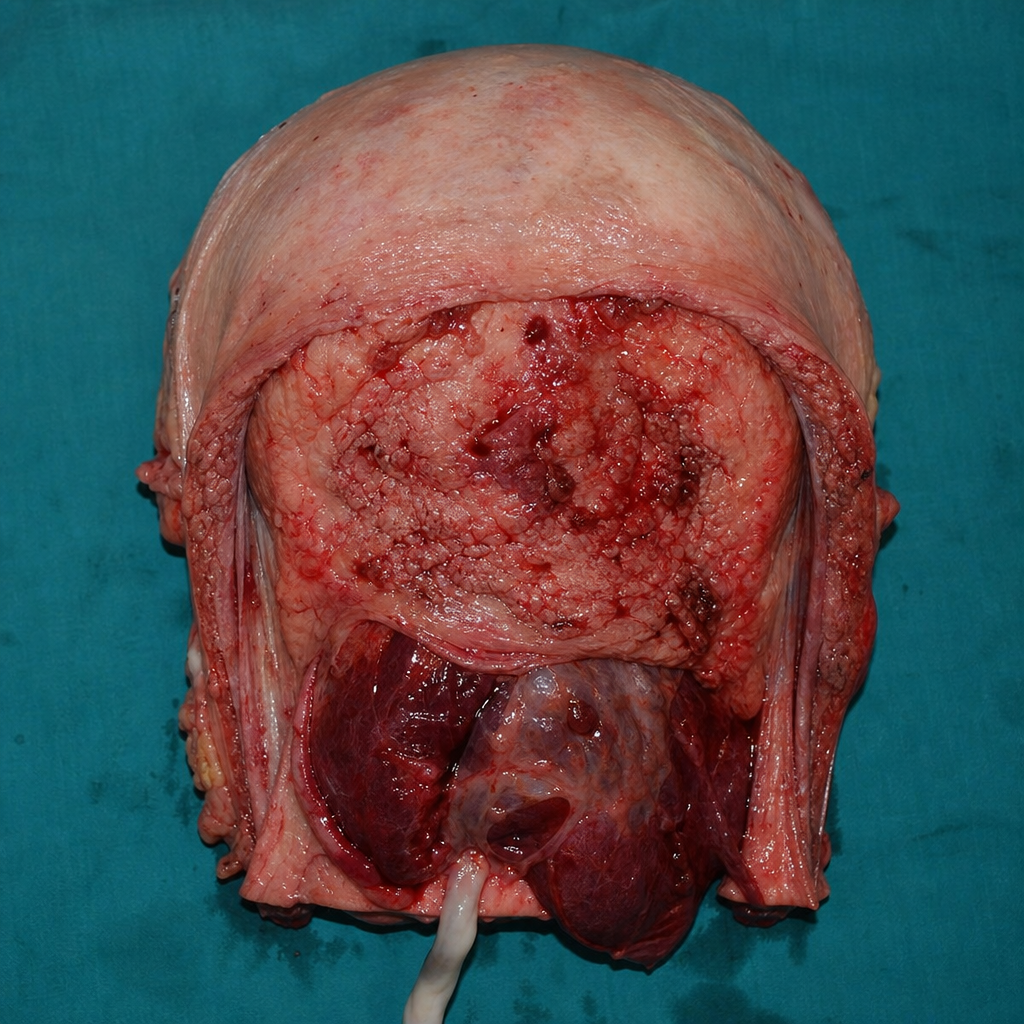
Question 81: Identify the pathological condition shown in the image:
- A. Intramural fibroid
- B. Adenomyoma (Correct Answer)
- C. Endometriosis
- D. Myomatous polyp
Explanation: ***Adenomyoma*** - The image distinctly shows **endometrial glands and stroma** embedded within the **myometrium** (smooth muscle layer of the uterus), which is the hallmark of adenomyoma [1]. - This condition is essentially a localized form of **adenomyosis**, presenting as a mass [1]. *Intramural fibroid* - An intramural fibroid (leiomyoma) is a **benign tumor of smooth muscle cells**, typically showing a proliferation of uniform spindle cells with characteristic swirling patterns [2]. - It would lack the presence of **endometrial glands and stroma** within the lesion [2]. *Endometriosis* - Endometriosis involves the presence of **endometrial tissue outside the uterus**, such as on the ovaries, peritoneum, or bowel. - While it involves similar tissue, its location is **extrauterine**, whereas the image depicts a lesion within the uterine wall. *Myomatous polyp* - A myomatous polyp (or submucosal fibroid) is a **fibroid that protrudes into the uterine cavity**, often covered by endometrial tissue [2]. - The image does not show a polypoid growth extending into the cavity but rather glandular tissue directly within the muscle wall. **References:** [1] Cross SS. Underwood's Pathology: A Clinical Approach. 6th ed. Common Clinical Problems From Female Genital Tract Disease, pp. 475-476. [2] Kumar V, Abbas AK, et al.. Robbins and Cotran Pathologic Basis of Disease. 9th ed. The Female Genital Tract, pp. 1024-1025.