Biochemistry
1 questionsAn adult male presented with a protruding abdomen, diarrhea, visual symptoms, and neurological manifestations. His LDL is low. Based on the peripheral smear finding shown in the image, what is the likely diagnosis?

NEET-PG 2024 - Biochemistry NEET-PG Practice Questions and MCQs
Question 241: An adult male presented with a protruding abdomen, diarrhea, visual symptoms, and neurological manifestations. His LDL is low. Based on the peripheral smear finding shown in the image, what is the likely diagnosis?
- A. Abetalipoproteinemia (Correct Answer)
- B. EDTA changes
- C. Uremia
- D. Burns
- E. Liver disease
Explanation: ***Abetalipoproteinemia*** - The image shows **acanthocytes (spur cells)**, characterized by irregularly spaced, blunt projections, which are a hallmark of **abetalipoproteinemia** due to abnormal lipid metabolism and membrane defects. - The clinical presentation of a **protruding abdomen (steatorrhea/malabsorption)**, **diarrhea**, **visual symptoms (retinopathy)**, **neurological manifestations (ataxia, peripheral neuropathy)**, and **low LDL** all strongly point to abetalipoproteinemia, a disorder affecting the synthesis of B-apolipoprotein and chylomicrons. *EDTA changes* - **EDTA changes** typically manifest as **rouleaux formation**, platelet satellite formation, or cell shrinkage, with red blood cell morphology generally remaining normal in terms of spur cell formation. - These changes are **artifactual** and are not associated with the patient's systemic symptoms like malabsorption, neurological issues, or specific lipid profile findings. *Uremia* - While **uremia** can cause various red blood cell abnormalities, including **burr cells (echinocytes)** with regularly spaced, pointed projections, it generally does not cause the irregularly shaped **acanthocytes** seen in the image. - The systemic symptoms of uremia would primarily involve **renal dysfunction (e.g., elevated BUN, creatinine)**, which are not mentioned, and not specifically the **visual or malabsorption symptoms** seen here. *Burns* - Severe **burns** can lead to red blood cell fragmentation, causing **schistocytes** or **microspherocytes** due to heat-induced damage. - Burns are not typically associated with the formation of **acanthocytes** or the constellation of symptoms (malabsorption, neurological, visual) and lipid profile (low LDL) described in this patient. *Liver disease* - Advanced **liver disease (cirrhosis)** can cause **spur cell anemia** with acanthocytes due to altered cholesterol-to-phospholipid ratio in RBC membranes. - However, the key distinguishing feature is the **low LDL** in this patient, which is characteristic of abetalipoproteinemia, whereas liver disease typically does not present with specifically **low LDL** as a prominent feature. - Additionally, the constellation of **visual symptoms (retinopathy)** and **neurological manifestations** with malabsorption are more consistent with the fat-soluble vitamin deficiency (A, E, K) seen in abetalipoproteinemia rather than isolated liver pathology.
Dermatology
1 questionsIdentify the diagnosis based on the dermatology immunofluorescence (IF) image provided.

NEET-PG 2024 - Dermatology NEET-PG Practice Questions and MCQs
Question 241: Identify the diagnosis based on the dermatology immunofluorescence (IF) image provided.
- A. Pemphigus vulgaris
- B. Pemphigus foliaceus
- C. Bullous pemphigoid
- D. Dermatitis herpetiformis (Correct Answer)
Explanation: ***Dermatitis herpetiformis*** - The immunofluorescence image shows **granular IgA deposits** at the **dermal papillae region**, which is characteristic of dermatitis herpetiformis. - This condition is strongly associated with **celiac disease** and presents with intensely pruritic papules and vesicles. *Pemphigus vulgaris* - Immunofluorescence in pemphigus vulgaris typically shows a **fishnet pattern** of IgG deposits throughout the **epidermis**, reflecting antibodies against desmoglein 3 and 1. - This pattern is an intercellular deposition, not granular at the dermal papillae. *Pemphigus foliaceus* - Similar to pemphigus vulgaris, pemphigus foliaceus also exhibits **intercellular IgG deposits** in the epidermis, but it is usually more superficial, targeting desmoglein 1. - The image does not show this intercellular epidermal staining. *Bullous pemphigoid* - Bullous pemphigoid is characterized by **linear IgG and C3 deposits along the dermal-epidermal junction** (basement membrane zone). - The image distinctly shows granular IgA, not linear IgG/C3, and specifically in the dermal papillae.
Internal Medicine
4 questionsWhich of the following statements is correct about Paroxysmal Nocturnal Hemoglobinuria (PNH)?
A patient presents with pulmonary hemorrhage and is P-ANCA positive. What is the most likely diagnosis?
Which of the following is typically observed in the investigation results for a patient with iron deficiency anemia (IDA)?
An adult female presents with pallor and fatigue. Blood investigations show low hemoglobin ( Hb ), low serum iron, low ferritin, low transferrin saturation, and increased total iron-binding capacity (TIBC). What is the likely diagnosis?
NEET-PG 2024 - Internal Medicine NEET-PG Practice Questions and MCQs
Question 241: Which of the following statements is correct about Paroxysmal Nocturnal Hemoglobinuria (PNH)?
- A. Sucrose lysis test is used for the confirmation
- B. Flow cytometry is the best investigation (Correct Answer)
- C. The most common cause of death is heart failure
- D. It is an inherited disorder
Explanation: ***Flow cytometry is the best investigation*** - **Flow cytometry** is the gold standard for diagnosing PNH as it directly detects the absence of **GPI-anchored proteins (CD55 and CD59)** on the surface of red blood cells, granulocytes, and monocytes. - This method is highly sensitive and specific, allowing for the precise quantification of PNH clones even when present in small numbers. *Sucrose lysis test is used for the confirmation* - The **sucrose lysis test** (or sugar-water test) was an older screening test for PNH, but it is **not specific or sensitive enough** for confirmation. - It works by inducing complement activation on PNH cells in low ionic strength sucrose solution [1], but it has a high rate of false positives and negatives. *The most common cause of death is heart failure* - The most common cause of death in patients with PNH is **thrombosis**, particularly in unusual sites such as hepatic, cerebral, or abdominal veins, due to the prothrombotic state caused by the disease. - While heart complications can occur, they are not the leading cause of mortality. *It is an inherited disorder* - PNH is an **acquired clonal disorder** of hematopoietic stem cells, not an inherited genetic disorder [1]. - It results from a somatic mutation in the **PIG-A gene** in a hematopoietic stem cell, leading to the deficiency of GPI-anchored proteins.
Question 242: A patient presents with pulmonary hemorrhage and is P-ANCA positive. What is the most likely diagnosis?
- A. Churg-Strauss syndrome
- B. Microscopic polyangiitis (Correct Answer)
- C. Wegener granulomatosis
- D. Polyarteritis nodosa (PAN)
Explanation: ***Microscopic polyangiitis*** - This condition is characterized by **pulmonary hemorrhage** (often manifesting as diffuse alveolar hemorrhage) and **P-ANCA positivity**, which is typically associated with antibodies against **myeloperoxidase (MPO)**. [1] - It is a **small-vessel vasculitis** that frequently affects the kidneys (glomerulonephritis) and lungs without granuloma formation. *Churg-Strauss syndrome* - While Churg-Strauss syndrome (now known as **Eosinophilic Granulomatosis with Polyangiitis**, EGPA) can be P-ANCA positive, it is typically associated with a history of **asthma**, **allergic rhinitis**, and **eosinophilia**. [1] - Pulmonary involvement often includes **infiltrates** and nodules, but diffuse alveolar hemorrhage with severe pulmonary hemorrhage is less common as the primary presentation compared to MPA. *Wegener granulomatosis* - Wegener granulomatosis (now known as **Granulomatosis with Polyangiitis**, GPA) primarily presents with **upper and lower respiratory tract granulomatous inflammation** and **glomerulonephritis**. - It is typically associated with **C-ANCA positivity** (antibodies against proteinase 3, PR3), not P-ANCA. *Polyarteritis nodosa (PAN)* - Polyarteritis nodosa is a **medium-vessel vasculitis** that typically affects the **kidneys, gastrointestinal tract, skin, and nervous system**. [1] - It is classically **ANCA-negative** and does not typically cause pulmonary hemorrhage or diffuse alveolar hemorrhage.
Question 243: Which of the following is typically observed in the investigation results for a patient with iron deficiency anemia (IDA)?
- A. Increased serum ferritin
- B. Decreased transferrin saturation (Correct Answer)
- C. Increased serum iron
- D. Normal total iron-binding capacity (TIBC)
- E. Increased mean corpuscular volume (MCV)
Explanation: ***Decreased transferrin saturation*** - In **iron deficiency anemia**, there is insufficient iron to bind to **transferrin**, leading to a reduction in the percentage of transferrin that is iron-bound. - This reflects the body's struggle to supply iron for erythropoiesis due to depleted iron stores. *Increased serum ferritin* - **Serum ferritin** is a key indicator of the body's iron stores; in **iron deficiency anemia**, these stores are depleted, leading to a *decreased* rather than increased serum ferritin level. - An increased serum ferritin is typically seen in conditions of **iron overload** or **inflammation**. *Increased serum iron* - **Serum iron** measures the iron circulating in the blood, and in **iron deficiency anemia**, iron levels are *low* due to inadequate intake or excessive loss. - An increased serum iron level would contradict the diagnosis of iron deficiency. *Normal total iron-binding capacity (TIBC)* - **Total iron-binding capacity (TIBC)** typically *increases* in iron deficiency anemia as the liver produces more transferrin in an attempt to capture any available iron. - A normal TIBC would not reflect the compensatory mechanisms seen in iron deficiency. *Increased mean corpuscular volume (MCV)* - **Iron deficiency anemia** is a **microcytic anemia**, characterized by *decreased* MCV due to inadequate hemoglobin synthesis within red blood cells. - An increased MCV is seen in **macrocytic anemias** such as vitamin B12 or folate deficiency, not in iron deficiency.
Question 244: An adult female presents with pallor and fatigue. Blood investigations show low hemoglobin ( Hb ), low serum iron, low ferritin, low transferrin saturation, and increased total iron-binding capacity (TIBC). What is the likely diagnosis?
- A. Iron Deficiency Anemia (IDA) (Correct Answer)
- B. Anemia of Chronic Disease
- C. Hemolytic Anemia
- D. Thalassemia
- E. Sideroblastic Anemia
Explanation: ***Iron Deficiency Anemia (IDA)*** - The unique constellation of **low hemoglobin**, **low serum iron**, **low ferritin**, **low transferrin saturation**, and **increased total iron-binding capacity (TIBC)** is the hallmark of Iron Deficiency Anemia. - **Ferritin** is a direct measure of iron stores, and its low level confirms depletion, while **increased TIBC** signifies the body's attempt to absorb more iron due to deficiency. *Anemia of Chronic Disease* - While also presenting with **low hemoglobin** and often **low serum iron**, Anemia of Chronic Disease is characterized by **normal or increased ferritin** (as ferritin is an acute phase reactant) and **decreased TIBC**. - There is a functional iron deficiency, but iron stores are typically adequate, and inflammation plays a central role. *Hemolytic Anemia* - Hemolytic anemia is characterized by the premature destruction of red blood cells, leading to **low hemoglobin** but typically **normal or elevated serum iron** and ferritin due to iron release from lysed red cells. - Key indicators, such as **elevated bilirubin**, **lactate dehydrogenase (LDH)**, and **reticulocytosis**, are absent in the given scenario. *Thalassemia* - Thalassemia is a genetic disorder causing defective hemoglobin synthesis, resulting in **microcytic hypochromic anemia** with **low hemoglobin**. - However, thalassemia typically presents with **normal to high serum iron** and ferritin levels, as iron absorption may be increased, and there's no primary iron deficiency. *Sideroblastic Anemia* - Sideroblastic anemia is characterized by defective heme synthesis with iron accumulation in mitochondria, forming characteristic ring sideroblasts on bone marrow examination. - Laboratory findings typically show **normal to increased serum iron**, **increased ferritin**, and **increased transferrin saturation**, distinguishing it from iron deficiency anemia.
Pathology
2 questionsIdentify the diagnosis from the given image

An elderly male patient presented with clinical symptoms and signs consistent with possible multiple myeloma. Electrophoresis shows an M spike, and immunofixation findings are shown below. Which of the following statements best corresponds to the findings?

NEET-PG 2024 - Pathology NEET-PG Practice Questions and MCQs
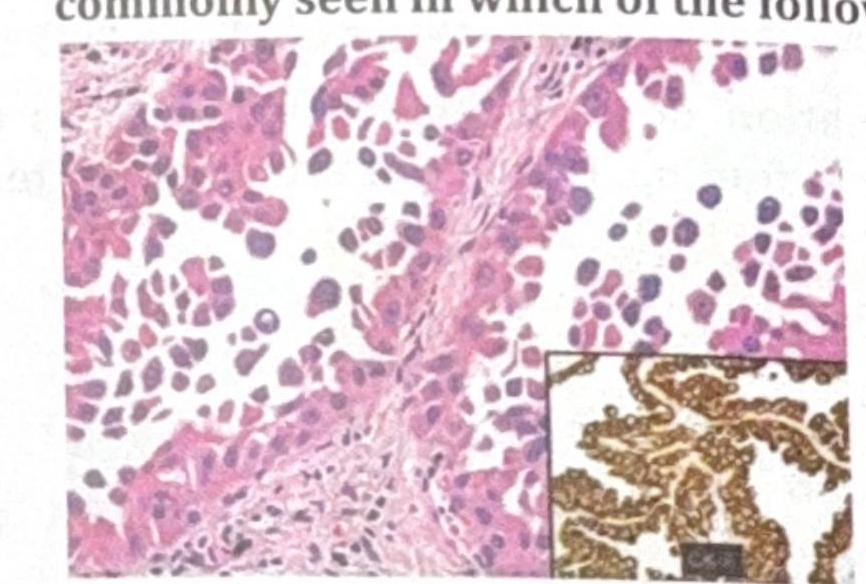
Question 241: Identify the diagnosis from the given image
- A. TB
- B. Malakoplakia (Correct Answer)
- C. BCC
- D. Drug induced lesion
Explanation: ***Malakoplakia*** - The image displays characteristic **Michaelis-Gutmann bodies**, which are concentrically laminated calcified inclusions found within macrophages (**Von Hansemann cells**). These are pathognomic for malakoplakia. - **Von Hansemann cells** are large, foamy macrophages with abundant cytoplasm, also visible in the image, mixed with lymphocytes and plasma cells. *TB* - Tuberculosis (TB) typically presents with **granulomatous inflammation** characterized by caseating necrosis, epithelioid macrophages, Langhans giant cells, and lymphocytes [2]. These features are not apparent in the image. - While TB can involve macrophages, the distinct Michaelis-Gutmann bodies seen here are not a feature of tuberculous granulomas [1]. *BCC* - Basal cell carcinoma (BCC) is a malignant epithelial tumor characterized by nests of basaloid cells with peripheral palisading, clear clefts, and often stromal retraction. This biopsy shows inflammatory cells and calcified inclusions, not epithelial malignancy. - BCC would show atypical epithelial cells and features of a neoplastic process, which are distinctly different from the inflammatory infiltrate and inclusion bodies in the image. *Drug induced lesion* - Drug-induced lesions are highly variable and context-dependent, but they do not typically present with the specific histopathological features of Michaelis-Gutmann bodies within macrophages. - The image depicts a specific and recognizable inflammatory pattern with unique inclusions, which points to a distinct disease entity rather than a non-specific drug reaction. **References:** [1] Cross SS. Underwood's Pathology: A Clinical Approach. 6th ed. (Basic Pathology) introduces the student to key general principles of pathology, both as a medical science and as a clinical activity with a vital role in patient care. Part 2 (Disease Mechanisms) provides fundamental knowledge about the cellular and molecular processes involved in diseases, providing the rationale for their treatment. Part 3 (Systematic Pathology) deals in detail with specific diseases, with emphasis on the clinically important aspects., pp. 198-200. [2] Kumar V, Abbas AK, et al.. Robbins and Cotran Pathologic Basis of Disease. 9th ed. Infectious Diseases, p. 360.
Question 242: An elderly male patient presented with clinical symptoms and signs consistent with possible multiple myeloma. Electrophoresis shows an M spike, and immunofixation findings are shown below. Which of the following statements best corresponds to the findings?
- A. Multiple myeloma with increased IgM
- B. Multiple myeloma with increased IgG (Correct Answer)
- C. Multiple myeloma with increased IgA
- D. Waldenström macroglobulinemia
Explanation: ***Multiple myeloma with increased IgG*** - The immunofixation image shows a distinct, *monoclonal band (M spike)* in the **IgG lane (G)**, corresponding to the initial electrophoresis (ELP) M spike [1]. There is also a corresponding band in the **kappa light chain (K)** lane [1]. - The presence of a dominant band in IgG, along with a matching light chain (either kappa or lambda), indicates an **IgG monoclonal gammopathy**, which is characteristic of the most common type of multiple myeloma [1]. *Multiple myeloma with increased IgM* - This option would correspond to a strong, monoclonal band in the **IgM lane (M)**, which is not the case here. The 'M' lane in the image shows a faint/normal band, not an increased M spike. - Increased IgM monoclonal protein (M spike) is characteristic of **Waldenström macroglobulinemia**, not typically multiple myeloma [2]. *Multiple myeloma with increased IgA* - If the patient had IgA multiple myeloma, there would be a prominent monoclonal band in the **IgA lane (A)**, which is not observed in this immunofixation result. The 'A' lane shows a considerably smaller band compared to IgG. - IgA multiple myeloma is a less common subtype than IgG myeloma and would present with an IgA M spike [1]. *Waldenström macroglobulinemia* - Waldenström macroglobulinemia is characterized by a monoclonal gammopathy of the **IgM type**, which would present as a distinct M spike in the IgM lane [2]. - The immunofixation clearly shows an **IgG M spike**, ruling out Waldenström macroglobulinemia based on the type of monoclonal gammopathy [2]. **References:** [1] Kumar V, Abbas AK, et al.. Robbins and Cotran Pathologic Basis of Disease. 9th ed. Diseases of White Blood Cells, Lymph Nodes, Spleen, and Thymus, pp. 608-609. [2] Kumar V, Abbas AK, et al.. Robbins and Cotran Pathologic Basis of Disease. 9th ed. Diseases of White Blood Cells, Lymph Nodes, Spleen, and Thymus, pp. 606-607.
Pediatrics
1 questionsA child presents with recurrent infections. Mediastinal imaging reveals an absent thymus gland, and further investigations show low ADA (adenosine deaminase) levels. What is the most likely diagnosis?
NEET-PG 2024 - Pediatrics NEET-PG Practice Questions and MCQs
Question 241: A child presents with recurrent infections. Mediastinal imaging reveals an absent thymus gland, and further investigations show low ADA (adenosine deaminase) levels. What is the most likely diagnosis?
- A. Severe Combined Immunodeficiency (SCID) (Correct Answer)
- B. DiGeorge syndrome
- C. X-linked agammaglobulinemia
- D. Hyper-IgM syndrome
- E. Wiskott-Aldrich syndrome
Explanation: ***Severe Combined Immunodeficiency (SCID)*** - **Recurrent infections**, an **absent thymus gland** (indicating severe T-cell deficiency), and **low ADA levels** are classic features of SCID, specifically **ADA deficiency-SCID**. - ADA deficiency leads to the accumulation of toxic metabolites that destroy **B and T lymphocytes**, severely compromising both humoral and cellular immunity. *DiGeorge syndrome* - Characterized by **thymic hypoplasia or aplasia**, leading to T-cell deficiencies and recurrent infections, similar to the absent thymus. - However, DiGeorge syndrome is typically associated with **hypocalcemia** due to parathyroid hypoplasia, and **cardiac defects**, which are not mentioned, and **low ADA levels** are not a feature. *X-linked agammaglobulinemia* - Primarily affects **B-cell development**, leading to a severe deficiency of antibodies, resulting in recurrent bacterial infections. - **T-cell function** and the **thymus gland** are typically normal in this condition, and low ADA levels are not observed. *Hyper-IgM syndrome* - Characterized by normal or elevated levels of **IgM** but very low levels of **IgG, IgA, and IgE** due to defects in B-cell class switching. - The thymus gland is generally normal, and the primary defect lies in antibody production, not T-cell development or ADA deficiency. *Wiskott-Aldrich syndrome* - An X-linked immunodeficiency presenting with recurrent infections, but classically features the triad of **thrombocytopenia with small platelets**, **eczema**, and **immunodeficiency**. - The thymus is typically present, and **low ADA levels** are not characteristic of this syndrome.
Surgery
1 questionsWhich of the following is not seen with ileal resections?
NEET-PG 2024 - Surgery NEET-PG Practice Questions and MCQs
Question 241: Which of the following is not seen with ileal resections?
- A. Microcytic hypochromic anemia
- B. Nuclear cytological asynchrony
- C. Neurological manifestation
- D. Cognitive improvement (Correct Answer)
Explanation: ***Cognitive improvement*** - Ileal resections are associated with malabsorption of various nutrients, but they do not lead to **cognitive improvement**. In fact, nutrient deficiencies (particularly B12) can negatively impact cognitive function. - The effects of ileal resections are primarily related to **digestion** and **absorption**, causing symptoms like diarrhea, weight loss, and specific vitamin deficiencies, not enhanced brain function. - This is the **most obvious answer** to what is "not seen" with ileal resections. *Microcytic hypochromic anemia* - This type of anemia is caused by **iron deficiency**, which is **NOT a direct consequence** of ileal resection. - **Iron absorption** occurs primarily in the **duodenum and proximal jejunum**, not in the ileum. - Ileal resection typically causes **macrocytic anemia** (due to B12 deficiency), not microcytic anemia. - While microcytic anemia could occur indirectly from chronic blood loss in inflammatory bowel disease, it is not a characteristic feature of ileal resection itself. *Nuclear cytological asynchrony* - **Nuclear cytological asynchrony** (megaloblastic changes) is a **direct consequence** of **vitamin B12 deficiency**, which commonly results from terminal ileal resection. - The **terminal ileum** is the primary site for absorption of **vitamin B12** (cobalamin) bound to intrinsic factor. - This manifests as macrocytic anemia with characteristic bone marrow changes. *Neurological manifestation* - **Vitamin B12 deficiency**, resulting from impaired absorption after ileal resection, directly causes various **neurological symptoms**. - These include **peripheral neuropathy**, **subacute combined degeneration of the spinal cord** (posterior and lateral columns), paresthesias, ataxia, memory impairment, and cognitive changes. - Neurological symptoms may occur even before hematological changes become apparent.