Biochemistry
1 questionsA patient came to the hospital with severe abdominal pain, and lipase levels were elevated. On imaging, a stone is found in the common bile duct (CBD). Which enzyme is most likely elevated in this condition?
NEET-PG 2024 - Biochemistry NEET-PG Practice Questions and MCQs
Question 161: A patient came to the hospital with severe abdominal pain, and lipase levels were elevated. On imaging, a stone is found in the common bile duct (CBD). Which enzyme is most likely elevated in this condition?
- A. ALT
- B. GGT
- C. LDH
- D. AST
- E. ALP (Correct Answer)
Explanation: ***ALP (Alkaline Phosphatase)*** - **ALP** is the **most characteristic enzyme elevation** in **biliary obstruction** from a CBD stone. - ALP is found in high concentrations in the **bile duct epithelium** and hepatocytes adjacent to bile ducts, and rises dramatically with **cholestasis** and **obstructive jaundice**. - In CBD stone obstruction, ALP typically rises **3-10 times normal**, making it the hallmark biochemical marker of this condition. - While lipase is elevated due to associated pancreatitis, **ALP elevation specifically indicates the biliary obstruction**. *GGT (Gamma-Glutamyl Transferase)* - **GGT** is also elevated in **cholestasis** and **bile duct obstruction**. - GGT often rises in parallel with ALP and helps confirm the hepatobiliary origin of ALP elevation (vs. bone source). - However, **ALP is more specific** and typically shows greater magnitude of elevation in acute CBD obstruction, making it the **most likely** elevated enzyme in this clinical context. *ALT (Alanine Aminotransferase)* - **ALT** may be **mildly to moderately elevated** if there is secondary hepatocellular injury from biliary obstruction. - However, ALT primarily indicates **hepatocyte damage** rather than cholestasis, and its elevation is typically **less pronounced** than ALP in obstructive biliary disease. - The pattern in CBD obstruction is **cholestatic** (high ALP) rather than **hepatocellular** (high ALT). *AST (Aspartate Aminotransferase)* - **AST** can be elevated in various conditions including liver, heart, and muscle damage. - Like ALT, it may show mild elevation in biliary obstruction but is **not the primary marker**. - AST is less specific than ALP for diagnosing CBD stone obstruction. *LDH (Lactate Dehydrogenase)* - **LDH** is a **non-specific marker** of tissue damage found in multiple organs. - While it may be elevated, it provides little diagnostic value when specific markers like **ALP and lipase** are available. - LDH does not help differentiate biliary obstruction from other causes of abdominal pain.
Dermatology
1 questionsA patient presents with painful vesicles as shown in the image. What is the diagnosis?

NEET-PG 2024 - Dermatology NEET-PG Practice Questions and MCQs
Question 161: A patient presents with painful vesicles as shown in the image. What is the diagnosis?
- A. Chancroid
- B. Syphilis
- C. Herpes (Correct Answer)
- D. Candidiasis
Explanation: ***Herpes*** - The image shows a cluster of **small, painful vesicles on an erythematous base**, which is highly characteristic of a herpes simplex virus (HSV) infection. - These lesions typically evolve into ulcers, crust over, and heal, and are often recurrent. *Chancroid* - Chancroid presents as **painful, soft chancres** (ulcers) with irregular, undermined borders and a gray or yellow base, often accompanied by **buboes** (enlarged, tender lymph nodes). - It does not typically manifest as clusters of small vesicles. *Syphilis* - Primary syphilis presents as a **painless chancre**—a single, firm, ulcerated lesion with a clean base and raised borders. - Secondary syphilis can cause a variety of skin manifestations, but not painful vesicles. *Candidiasis* - Cutaneous candidiasis usually appears as a **red, moist rash with satellite lesions** (smaller papules or pustules spreading from the main rash), often in skin folds. - While it can be inflammatory and itchy, it does not typically form discreet painful vesicles as seen in the image.
Microbiology
6 questionsA frequent traveler presented with 4 days of continuous fever, abdominal pain, and bradycardia. What is the best diagnostic test to confirm the pathogen?
An adult patient with a military background is admitted with a rash, fever, altered sensorium, and a deficiency of the membrane attack complex. What is the most likely etiological agent?
A patient was admitted with bloody diarrhea after consumption of oysters. The organism exhibits the Kanagawa phenomenon. What is the correct organism?
Desert rheumatism is caused by:
Broad-based budding yeasts are seen in:
A female patient presents with dysuria and frequency. A coagulase-negative, novobiocin-resistant Staphylococcus species (>10^4 CFU/mL) was grown in urine culture. What does this indicate?
NEET-PG 2024 - Microbiology NEET-PG Practice Questions and MCQs
Question 161: A frequent traveler presented with 4 days of continuous fever, abdominal pain, and bradycardia. What is the best diagnostic test to confirm the pathogen?
- A. Widal test
- B. Blood culture (Correct Answer)
- C. Urine culture
- D. Stool culture
Explanation: ***Blood culture*** - **Blood culture** is the most sensitive and specific test for confirming **typhoid fever** in the first week of illness. - The presence of **continuous fever** (step-ladder pattern), **abdominal pain**, and **relative bradycardia** in a traveler strongly suggests typhoid fever caused by *Salmonella Typhi*. *Widal test* - The **Widal test** detects antibodies against *Salmonella Typhi* antigens and is often positive later in the disease course. - It has **limited sensitivity and specificity**, especially in endemic areas or with prior vaccination, leading to false positives and negatives. *Urine culture* - **Urine culture** has a low yield for *Salmonella Typhi*, as bacteria are intermittently shed in urine, usually later in the disease. - It's primarily useful for diagnosing **urinary tract infections** or in chronic carriers of typhoid. *Stool culture* - **Stool culture** yield is higher in the later stages of typhoid fever, as *Salmonella Typhi* is shed in feces. - Its sensitivity is lower than blood culture in the early acute phase when bacteremia is most prominent.
Question 162: An adult patient with a military background is admitted with a rash, fever, altered sensorium, and a deficiency of the membrane attack complex. What is the most likely etiological agent?
- A. Klebsiella pneumoniae
- B. Neisseria meningitidis (Correct Answer)
- C. Haemophilus influenzae
- D. CMV
Explanation: ***Neisseria meningitidis*** - A deficiency in the **membrane attack complex (MAC)**, particularly **C5-C9 components**, predisposes individuals to recurrent infections with encapsulated bacteria, especially *N. meningitidis*. - *N. meningitidis* is a common cause of **meningitis**, presenting with **fever, altered sensorium**, and often a **petechial rash** due to disseminated intravascular coagulation (DIC), which align with the patient's symptoms. *Klebsiella pneumoniae* - While *K. pneumoniae* can cause severe infections, including pneumonia and meningitis, it is not specifically associated with **MAC deficiency**. - Its infections more commonly manifest as **severe pneumonia** or **urinary tract infections** in immunocompromised patients. *Haemophilus influenzae* - *H. influenzae* can cause meningitis and other invasive infections, especially in children, but it is not typically linked to **MAC deficiency**. - The classic presentation involving **rash** and severe systemic symptoms as described is more characteristic of **meningococcal disease**. *CMV* - **Cytomegalovirus (CMV)** is a herpesvirus that causes a wide range of diseases, particularly in immunocompromised individuals. - However, CMV infections are primarily associated with **cellular immunity defects** rather than a deficiency in the **membrane attack complex** of the complement system.
Question 163: A patient was admitted with bloody diarrhea after consumption of oysters. The organism exhibits the Kanagawa phenomenon. What is the correct organism?
- A. Staphylococcus aureus
- B. Vibrio parahaemolyticus (Correct Answer)
- C. Campylobacter jejuni
- D. Salmonella typhi
Explanation: ***Vibrio parahaemolyticus*** - This organism is a common cause of **gastroenteritis** linked to consumption of **raw or undercooked seafood**, especially oysters, and is known for causing **bloody diarrhea**. - The **Kanagawa phenomenon** refers to the production of **thermostable direct hemolysin (TDH)** by *V. parahaemolyticus*, which is a key virulence factor causing hemolysis and is detectable by a specific agar assay. *Staphylococcus aureus* - While *S. aureus* can cause **food poisoning** through its toxins, it typically presents with **nausea, vomiting**, and **abdominal cramps**, not bloody diarrhea. - Food poisoning from *S. aureus* is usually rapid-onset (within hours) and is associated with **improperly handled foods**, particularly those requiring no cooking after preparation (e.g., salads, custards). *Campylobacter jejuni* - This bacterium is a common cause of **bacterial gastroenteritis** and can lead to **bloody diarrhea**, but it's typically acquired from **poultry** or contaminated water, not specifically oysters. - **Guillain-Barré syndrome** is a serious complication that can follow *C. jejuni* infection, which is not characteristic of *Vibrio* infections. *Salmonella typhi* - *Salmonella typhi* causes **typhoid fever**, a systemic illness characterized by **sustained fever, headache, malaise**, and can lead to a "rose spot" rash. - While it can cause gastrointestinal symptoms, **bloody diarrhea is not the predominant symptom**, and raw oyster consumption is not its typical mode of transmission; it's usually spread through contaminated food or water by asymptomatic carriers.
Question 164: Desert rheumatism is caused by:
- A. Paracoccidioides brasiliensis
- B. Candida albicans
- C. Cryptococcus neoformans
- D. Coccidioides immitis (Correct Answer)
Explanation: ***Coccidioides immitis*** - This fungus is the causative agent of **coccidioidomycosis**, also known as **Valley fever** or **desert rheumatism**, due to its prevalence in arid regions. - Infection most commonly occurs through inhalation of **arthroconidia** from disturbed soil in endemic areas. *Paracoccidioides brasiliensis* - This fungus causes **paracoccidioidomycosis** (South American blastomycosis), which is endemic to Latin America. - It typically manifests as chronic granulomatous disease affecting the lungs, skin, mucous membranes, lymph nodes, and internal organs. *Candida albicans* - This is a common opportunistic yeast responsible for various infections, from **superficial mucocutaneous candidiasis** (e.g., thrush, vaginal yeast infections) to severe invasive candidemia. - It is not associated with "desert rheumatism." *Cryptococcus neoformans* - This encapsulated yeast is a major cause of **cryptococcosis**, particularly in immunocompromised individuals. - It commonly causes **meningoencephalitis** and pulmonary disease, and is associated with bird droppings, but not "desert rheumatism."
Question 165: Broad-based budding yeasts are seen in:
- A. Histoplasmosis
- B. Blastomycosis (Correct Answer)
- C. Candidiasis
- D. Coccidioidomycosis
Explanation: ***Blastomycosis*** - This fungal infection is classically characterized by **broad-based budding yeasts** seen on microscopic examination. - The yeast cells are typically large and have a characteristic wide connection between the mother and daughter cells during budding. *Histoplasmosis* - Characterized by **small, intracellular yeasts** often seen within macrophages. - These yeasts do **not exhibit broad-based budding**. *Candidiasis* - Primarily presents as **pseudohyphae** (elongated yeast cells resembling hyphae) and budding yeasts (blastoconidia) with **narrow bases**. - **True hyphae** may also be present depending on the species and growth conditions. *Coccidioidomycosis* - In tissue, it is characterized by **spherules** containing **endospores**, not budding yeasts. - The mycelial form is found in culture or environmental samples.
Question 166: A female patient presents with dysuria and frequency. A coagulase-negative, novobiocin-resistant Staphylococcus species (>10^4 CFU/mL) was grown in urine culture. What does this indicate?
- A. UTI (Correct Answer)
- B. Commensal
- C. Contamination
- D. Repeat culture needed
Explanation: ***UTI*** - The isolation of a **coagulase-negative, novobiocin-resistant Staphylococcus** in a patient with UTI symptoms suggests **_Staphylococcus saprophyticus_**, a common cause of UTIs in young women. - A bacterial count of **>10^4 CFU/mL** is generally considered significant for diagnosing a UTI, indicating active infection rather than contamination. - _S. saprophyticus_ accounts for 10-20% of UTIs in sexually active young women and is the second most common cause after _E. coli_. *Commensal* - While some coagulase-negative staphylococci can be commensals, **_S. saprophyticus_** is an important pathogen, especially in UTIs. - The combination of **novobiocin resistance** and a significant bacterial count in a symptomatic patient strongly points away from a commensal role. *Contamination* - **Contamination** usually involves lower bacterial counts (<10^4 CFU/mL) or the isolation of multiple different organisms. - The presence of **>10^4 CFU/mL** of a pure culture of a known urinary pathogen (_S. saprophyticus_) in a symptomatic patient makes contamination unlikely. *Repeat culture needed* - Repeat cultures are indicated when initial results are equivocal (e.g., low counts, mixed flora, or asymptomatic bacteriuria). - For symptomatic UTI with **>10^4 CFU/mL** of a known pathogen, a single culture is sufficient for diagnosis and treatment initiation. - Multiple consecutive samples are primarily used for diagnosing **bacteremia** or **endocarditis**, not routine UTI.
Pediatrics
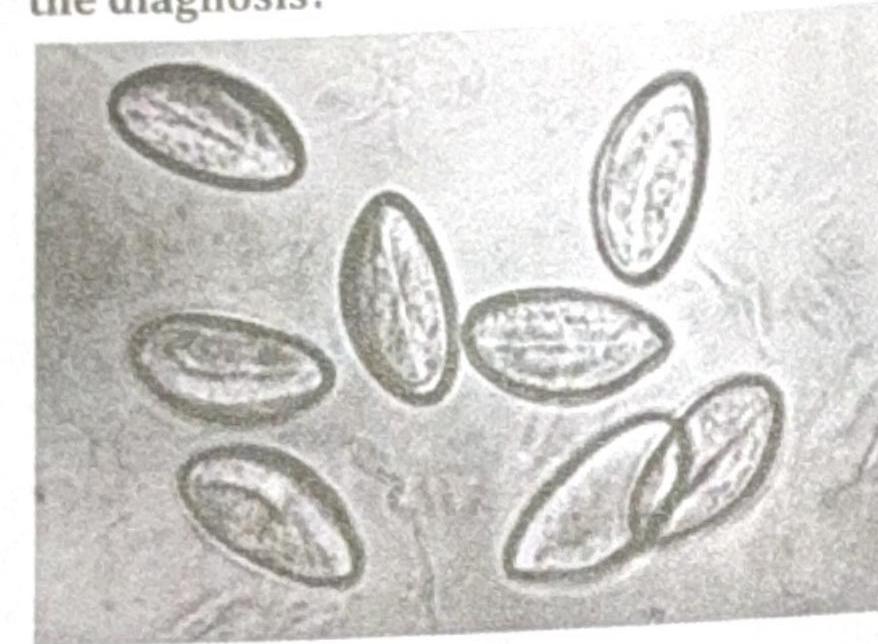
1 questionsA child presented with perianal itching. The swab specimen is shown in the image. What is the diagnosis?

NEET-PG 2024 - Pediatrics NEET-PG Practice Questions and MCQs
Question 161: A child presented with perianal itching. The swab specimen is shown in the image. What is the diagnosis?
- A. Enterobius (Correct Answer)
- B. Ascaris
- C. Trichiura
- D. Ancylostoma
Explanation: ***Enterobius*** - The image shows **D-shaped** (plano-convex) and **transparent eggs**, which are characteristic of *Enterobius vermicularis* (**pinworm** or **threadworm**). - **Perianal itching**, especially at night, is the hallmark symptom due to the female worm migrating to the perianal region to lay eggs. *Ascaris* - *Ascaris lumbricoides* eggs are typically **round to oval**, with a thick, mamillated (bumpy) outer shell, or smooth in the case of decorticated eggs, which is different from the eggs pictured. - Infection with *Ascaris* can cause pulmonary symptoms (Loeffler's syndrome) and intestinal obstruction, but not typically perianal itching. *Trichiura* - *Trichuris trichiura* (**whipworm**) eggs are distinctly **barrel-shaped** with prominent **polar plugs** at each end, which is not seen in the image. - Whipworm infection is often associated with bloody diarrhea, rectal prolapse, and growth retardation, not primarily perianal itching. *Ancylostoma* - *Ancylostoma duodenale* and *Necator americanus* (hookworms) eggs are typically **oval** with a **thin shell** and segmented embryo (morula stage) within, which lacks the distinct D-shape and transparency of the pictured eggs. - Hookworm infection primarily causes iron-deficiency anemia and can lead to cutaneous larva migrans, not perianal itching as a primary symptom.
Pharmacology
1 questionsMethotrexate use causes reduced synthesis of which of the following?
NEET-PG 2024 - Pharmacology NEET-PG Practice Questions and MCQs
Question 161: Methotrexate use causes reduced synthesis of which of the following?
- A. TMP (Correct Answer)
- B. CMP
- C. GMP
- D. AMP
- E. UMP
Explanation: ***TMP (Thymidylate)*** - Methotrexate is a **folate analog** that inhibits **dihydrofolate reductase (DHFR)**, preventing the regeneration of tetrahydrofolate (THF) from dihydrofolate. - **Tetrahydrofolate** is essential for **thymidylate synthase**, which converts dUMP to **TMP (thymidylate)** - this is the **most directly and significantly affected** nucleotide synthesis pathway. - Reduced TMP synthesis leads to impaired DNA synthesis and is the **primary mechanism** of methotrexate's cytotoxic effects. *CMP (Cytidine monophosphate)* - CMP synthesis occurs via the **de novo pyrimidine pathway** starting from carbamoyl phosphate and aspartate, forming UMP, which is then converted to CMP. - This pathway **does not require tetrahydrofolate** cofactors, so methotrexate does not significantly affect CMP synthesis directly. *GMP (Guanosine monophosphate)* - GMP is a purine nucleotide whose synthesis **does require tetrahydrofolate** derivatives (N10-formyl-THF) at two steps in the de novo purine pathway. - However, the effect on GMP is **less direct and less pronounced** than on TMP synthesis, and cells can partially compensate through salvage pathways. *AMP (Adenosine monophosphate)* - AMP is also a purine nucleotide that requires **N10-formyl-THF** cofactors during de novo synthesis (same pathway branch point as GMP). - Like GMP, it is affected but **less directly than TMP**, and salvage pathways provide alternative synthesis routes. *UMP (Uridine monophosphate)* - UMP is synthesized through the **de novo pyrimidine pathway** which does not require folate cofactors. - Methotrexate does not inhibit the enzymes (carbamoyl phosphate synthetase II, aspartate transcarbamoylase, dihydroorotase, etc.) involved in UMP synthesis.