Biochemistry
6 questionsA patient presents with symptoms of dermatitis, dementia, and cognitive decline. Which micronutrient deficiency is most likely responsible?
Which transporter helps in the improvement of insulin resistance in type 2 diabetes mellitus (DM2) with regular exercise and physical activities?
A 5-year-old girl was washing her doll with shampoo containing rotenone. Her mother noticed her in an unconscious state. Which enzyme is inhibited by the above chemical?
A patient with high triglycerides (TG) esterified with long-chain fatty acids (LCFA) presents with fatigue, and a biopsy of the muscle shows fat vacuoles. What is the most likely diagnosis?
A patient presents with xanthomas on the Achilles tendon. What is the most likely diagnosis?
What is the source of Vitamin B1 (Thiamine)?

NEET-PG 2024 - Biochemistry NEET-PG Practice Questions and MCQs
Question 141: A patient presents with symptoms of dermatitis, dementia, and cognitive decline. Which micronutrient deficiency is most likely responsible?
- A. Niacin (Correct Answer)
- B. Thiamine
- C. Tryptophan
- D. Retinol
- E. Riboflavin
Explanation: ***Niacin*** - The classic triad of symptoms known as the "3 Ds"—**dermatitis, dementia, and diarrhea**—is characteristic of **pellagra**, a severe deficiency of **niacin (vitamin B3)**. - **Cognitive decline** is a common manifestation of the neurological symptoms associated with dementia in pellagra. *Thiamine* - **Thiamine (vitamin B1)** deficiency causes **beriberi**, leading to cardiovascular (wet beriberi) or neurological (dry beriberi/Wernicke-Korsakoff syndrome) symptoms. - While **fatigue and cognitive impairment** can occur, the constellation of prominent dermatitis and severe dementia is not typical of primary thiamine deficiency. *Tryptophan* - **Tryptophan** is an **essential amino acid** and a precursor to niacin. A deficiency in tryptophan could indirectly lead to niacin deficiency. - However, the direct deficiency of tryptophan as the primary cause of the "3 Ds" is less common than a direct niacin deficiency or impaired niacin synthesis. *Retinol* - **Retinol (vitamin A)** deficiency primarily affects **vision**, leading to **night blindness** and xerophthalmia. - It also plays a role in immune function and epithelial cell integrity, but it does not cause the specific triad of dermatitis, dementia, and cognitive decline seen here. *Riboflavin* - **Riboflavin (vitamin B2)** deficiency causes **angular stomatitis, cheilosis, and glossitis** along with seborrheic dermatitis. - While it can cause skin manifestations, it does not typically present with the severe dementia and cognitive decline characteristic of pellagra.
Question 142: Which transporter helps in the improvement of insulin resistance in type 2 diabetes mellitus (DM2) with regular exercise and physical activities?
- A. GLUT 1
- B. GLUT 2
- C. GLUT 3
- D. GLUT 4 (Correct Answer)
Explanation: ***GLUT 4*** - **GLUT 4** is the **insulin-sensitive glucose transporter** predominantly found in **skeletal muscle** and **adipose tissue**. Regular exercise and physical activity increase the expression and translocation of GLUT 4 to the cell membrane, enhancing glucose uptake independent of insulin, thereby improving **insulin sensitivity** and reducing insulin resistance in DM2. - Exercise also stimulates **AMPK (AMP-activated protein kinase)**, which promotes GLUT 4 translocation to the cell surface, facilitating glucose uptake and utilization in active muscles. *GLUT 1* - **GLUT 1** is a basal glucose transporter found in nearly all cells, responsible for **basal glucose uptake** to meet basic metabolic needs, especially in **red blood cells** and the **blood-brain barrier**. - Its activity is largely **insulin-independent** and does not significantly contribute to the exercise-induced improvement in insulin sensitivity in skeletal muscle. *GLUT 2* - **GLUT 2** is primarily found in the **liver, pancreatic beta cells, kidneys, and small intestine**. It has a **low affinity** but **high capacity** for glucose transport, serving as a glucose sensor in beta cells and allowing efficient glucose uptake/release in the liver. - It plays a role in glucose homeostasis but is **not directly involved in the exercise-mediated improvement of insulin resistance** in peripheral tissues like muscle. *GLUT 3* - **GLUT 3** is a **high-affinity glucose transporter** primarily expressed in **neurons** and the **placenta**. It is crucial for providing a constant supply of glucose to the brain, even at low glucose concentrations. - Like GLUT 1 and GLUT 2, its activity is largely **insulin-independent** and does not play a significant role in improving insulin resistance through exercise in DM2.
Question 143: A 5-year-old girl was washing her doll with shampoo containing rotenone. Her mother noticed her in an unconscious state. Which enzyme is inhibited by the above chemical?
- A. NADH dehydrogenase (Correct Answer)
- B. Succinate dehydrogenase
- C. Cytochrome C
- D. Cytochrome oxidase
- E. Cytochrome b-c1 complex
Explanation: ***NADH dehydrogenase*** - **Rotenone** is a potent **inhibitor of mitochondrial complex I (NADH dehydrogenase)**, preventing the transfer of electrons from NADH to ubiquinone. - This inhibition disrupts the **electron transport chain**, leading to a halt in ATP synthesis and cellular energy failure, causing symptoms like unconsciousness. *Succinate dehydrogenase* - **Succinate dehydrogenase** (Complex II) is involved in both the **Krebs cycle and electron transport chain**, but is not directly inhibited by rotenone. - Only severe compromise of the electron transport chain can cause a secondary effect, but not direct enzyme inhibition. *Cytochrome C* - **Cytochrome C** is a mobile electron carrier in the electron transport chain, but it is not directly inhibited by rotenone. - **Cytochrome C** transfers electrons from complex III to complex IV. *Cytochrome oxidase* - **Cytochrome oxidase** (Complex IV) is responsible for the final transfer of electrons to oxygen, which is not inhibited by rotenone. - Inhibitors like **cyanide and carbon monoxide** specifically target **cytochrome oxidase**. *Cytochrome b-c1 complex* - **Cytochrome b-c1 complex** (Complex III) catalyzes electron transfer from ubiquinol to cytochrome C, but is not inhibited by rotenone. - This complex is specifically inhibited by **antimycin A**, not rotenone.
Question 144: A patient with high triglycerides (TG) esterified with long-chain fatty acids (LCFA) presents with fatigue, and a biopsy of the muscle shows fat vacuoles. What is the most likely diagnosis?
- A. Carnitine deficiency (Correct Answer)
- B. Fatty acid synthase defect
- C. Lipoprotein lipase (LPL) defect
- D. LDL defect
- E. Medium-chain acyl-CoA dehydrogenase (MCAD) deficiency
Explanation: ***Carnitine deficiency*** - **Carnitine** is essential for transporting **long-chain fatty acids (LCFAs)** into the mitochondria for beta-oxidation. - A deficiency leads to the accumulation of **LCFAs** as **triglycerides** in the cytoplasm, resulting in **fat vacuoles** in muscle and systemic fatigue due to impaired energy production. *Fatty acid synthase defect* - **Fatty acid synthase** is involved in the *de novo* synthesis of fatty acids, not their catabolism or transport. - A defect would impair fatty acid production, not lead to the accumulation of **triglycerides** from exogenous sources. *Lipoprotein lipase (LPL) defect* - **LPL** is crucial for cleaving **triglycerides** in circulating chylomicrons and VLDL, allowing fatty acids to be taken up by tissues. - A defect causes severe hypertriglyceridemia, but the primary issue in the muscle with fat vacuoles points towards a problem with intracellular fatty acid utilization rather than plasma triglyceride clearance. *LDL defect* - **LDL** is primarily responsible for transporting cholesterol to peripheral tissues. - Defects in **LDL** metabolism typically lead to hypercholesterolemia, not the accumulation of **triglycerides** or muscle fat vacuoles as described. *Medium-chain acyl-CoA dehydrogenase (MCAD) deficiency* - **MCAD** deficiency is a fatty acid oxidation disorder affecting **medium-chain fatty acids** (C6-C12), not the **long-chain fatty acids** specifically mentioned in the stem. - It typically presents with hypoketotic hypoglycemia during fasting, often in infancy or childhood, rather than the characteristic muscle fat vacuole accumulation pattern seen with **carnitine deficiency**.
Question 145: A patient presents with xanthomas on the Achilles tendon. What is the most likely diagnosis?
- A. Familial hypercholesterolemia (Correct Answer)
- B. Tangier's disease
- C. Familial hyperchylomicronemia
- D. Familial dysbetalipoproteinemia
- E. Familial combined hyperlipidemia
Explanation: ***Familial hypercholesterolemia*** - **Xanthomas** on the **Achilles tendon** are a classic clinical sign of familial hypercholesterolemia, along with significantly elevated **LDL-C levels**. - This condition is an **autosomal dominant** genetic disorder characterized by defects in the **LDL receptor** pathway, leading to impaired clearance of LDL from the blood. - **Tendon xanthomas** (especially Achilles and extensor tendons) are pathognomonic for this condition. *Tangier's disease* - Characterized by very low or absent **HDL-C (high-density lipoprotein cholesterol)** levels, leading to **cholesterol ester accumulation** in various tissues. - While it can cause lipid deposition, its hallmark is **enlarged, orange tonsils** and peripheral neuropathy, not typically Achilles tendon xanthomas. *Familial hyperchylomicronemia* - This disorder primarily involves elevated **chylomicrons** and **triglycerides**, presenting with **eruptive xanthomas** (small, red-yellow papules) but not typically tendon xanthomas. - It is often associated with **pancreatitis** and **lipemia retinalis**. *Familial dysbetalipoproteinemia* - Characterized by elevated levels of **cholesterol** and **triglycerides** due to accumulation of remnant lipoproteins (IDL). - While it can cause **xanthomas**, these are typically **palmar xanthomas** (xanthoma striata palmaris) and **tuberoeruptive xanthomas**, less commonly Achilles tendon xanthomas. *Familial combined hyperlipidemia* - Most common familial lipid disorder, characterized by elevated **LDL-C** and/or **triglycerides** with variable phenotype. - While it causes premature coronary artery disease, it typically does **not** cause tendon xanthomas, which distinguishes it from familial hypercholesterolemia. - Xanthomas, if present, are usually **xanthelasma** (around eyelids) rather than tendon xanthomas.
Question 146: What is the source of Vitamin B1 (Thiamine)?
- A. A
- B. B
- C. C (Correct Answer)
- D. D
- E. E
Explanation: ***C*** - Element C appears to be a **grain-based flatbread**, which is a rich source of **thiamine (Vitamin B1)**. Whole grains, fortified cereals, and legumes are primary dietary sources of this essential vitamin. - **Thiamine** plays a crucial role in **carbohydrate metabolism** and nerve function. *A* - Element A appears to be **rice**, which is a **grain**. However, the question asks for the best source, and while rice can contain thiamine, the other option is a stronger candidate. - White rice, in particular, is often **enriched with thiamine** but naturally contains less than whole grains. *B* - Element B contains what appears to be **vegetables and salad**. While vegetables contain some thiamine, they are not typically considered the richest sources. - **Fruits and vegetables** are more commonly known for vitamins like C and A, and various minerals. *D* - Element D appears to be a **curry or stew**, likely containing lentils or other legumes. While some curries can contain thiamine, based on the image's clarity, it is not the most distinctly represented rich source compared to C. - The thiamine content in stews or curries can vary greatly depending on the **specific ingredients** used. *E* - Element E appears to be another food item in the image. While it may contain some nutrients, it is not the primary source of thiamine (Vitamin B1) among the options shown. - The **grain-based flatbread (C)** remains the richest and most reliable source of thiamine in this selection.
Pediatrics
1 questionsA patient presents with an X-ray showing cardiomegaly, along with symptoms of hypotonia, macroglossia, hepatomegaly, and floppy baby syndrome. The X ray of the infant is shown below. What is the most likely diagnosis?
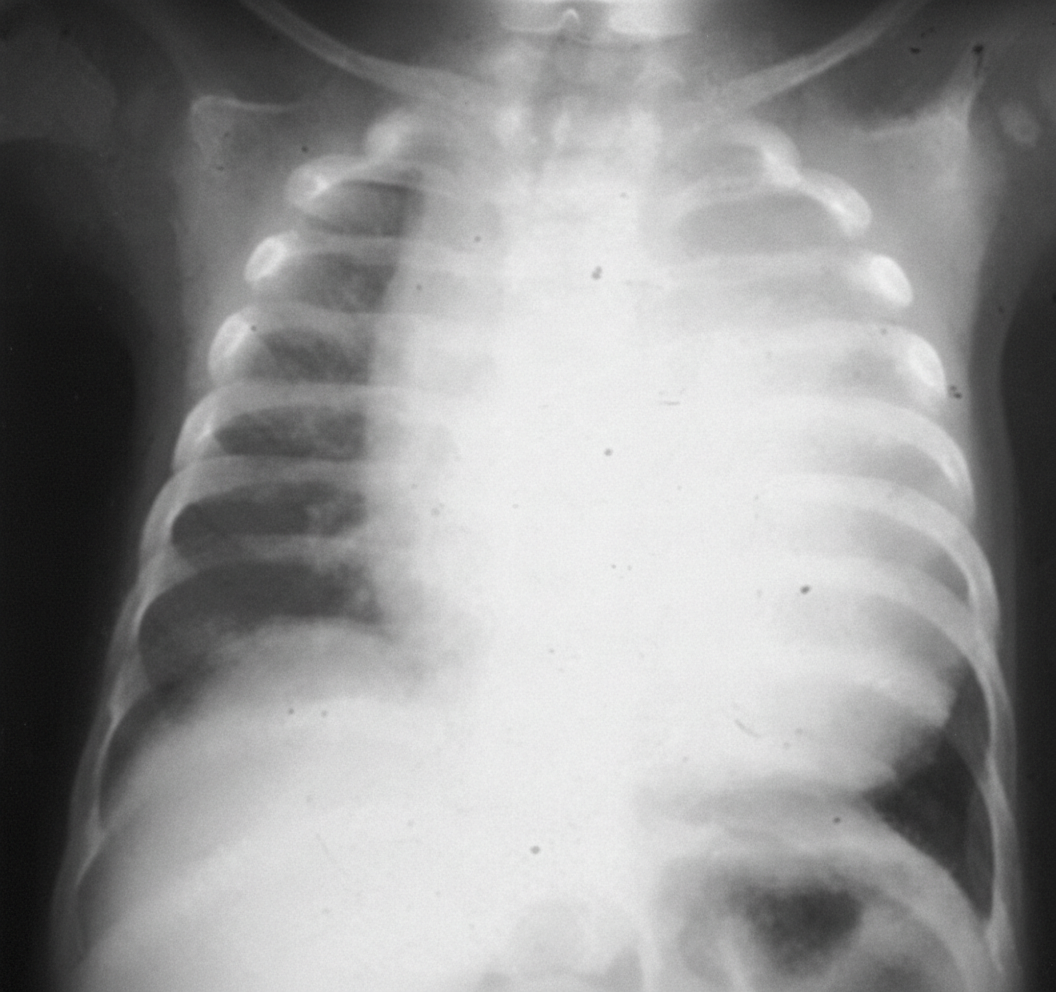
NEET-PG 2024 - Pediatrics NEET-PG Practice Questions and MCQs
Question 141: A patient presents with an X-ray showing cardiomegaly, along with symptoms of hypotonia, macroglossia, hepatomegaly, and floppy baby syndrome. The X ray of the infant is shown below. What is the most likely diagnosis?
- A. Pompe's disease (Correct Answer)
- B. Ebstein anomaly
- C. Transposition of great arteries
- D. Von Gierke's disease
- E. Congenital hypothyroidism
Explanation: ***Pompe's disease*** - Pompe's disease (Type II glycogen storage disease) is characterized by a deficiency of **alpha-glucosidase**, leading to **glycogen accumulation** in lysosomes. - This accumulation results in **cardiomegaly**, **hypotonia** ("floppy baby"), **hepatomegaly**, and **macroglossia**, which perfectly match the clinical presentation. *Ebstein anomaly* - This is a congenital heart defect involving the **tricuspid valve**, leading to its displacement into the right ventricle. - While it causes cardiomegaly, it does not typically present with the systemic features like **hypotonia, macroglossia, or hepatomegaly** described. *Transposition of great arteries* - This is a complex congenital heart defect where the **aorta and pulmonary artery are switched**, resulting in two separate circulatory systems. - It causes severe cyanosis and cardiomegaly but does not explain the widespread glycogen storage symptoms such as **hypotonia** or **hepatomegaly**. *Von Gierke's disease* - **Von Gierke's disease** (Type I glycogen storage disease) is caused by a deficiency of **glucose-6-phosphatase**. - It primarily affects the **liver and kidneys**, causing severe hypoglycemia, hepatomegaly, and **nephromegaly**, but typically not significant cardiomegaly or profound hypotonia. *Congenital hypothyroidism* - Can present with **macroglossia, hypotonia, and hepatomegaly** similar to Pompe's disease. - However, the **massive cardiomegaly** seen on X-ray is not typical of hypothyroidism, and other features like prolonged jaundice, constipation, and umbilical hernia would be more prominent.
Pharmacology
2 questionsPhenobarbitone exerts its therapeutic effect primarily through which mechanism?
Which of the following are toxic metabolites associated with methanol poisoning?
NEET-PG 2024 - Pharmacology NEET-PG Practice Questions and MCQs
Question 141: Phenobarbitone exerts its therapeutic effect primarily through which mechanism?
- A. Enhancement of GABA-A receptor function (Correct Answer)
- B. Voltage-gated sodium channel blockade
- C. Voltage-gated calcium channel blockade
- D. Potassium channel opening
- E. NMDA receptor antagonism
Explanation: ***Enhancement of GABA-A receptor function*** - **Phenobarbitone** (phenobarbital) is a barbiturate that acts primarily by **enhancing GABA-A receptor activity** - It binds to a distinct **barbiturate binding site** on the GABA-A receptor complex - This binding **prolongs the duration of chloride channel opening** in response to GABA - Results in increased **chloride ion influx**, neuronal **hyperpolarization**, and **decreased neuronal excitability** - This mechanism underlies its **anticonvulsant** and **sedative-hypnotic** properties *NMDA receptor antagonism* - While some anticonvulsants work through NMDA receptor antagonism (e.g., ketamine, felbamate), this is **not the primary mechanism** of phenobarbitone *Voltage-gated sodium channel blockade* - Sodium channel blockade is the mechanism of action for drugs like **phenytoin, carbamazepine**, and **lamotrigine** - Phenobarbitone does not significantly block sodium channels at therapeutic concentrations *Voltage-gated calcium channel blockade* - Calcium channel blockers like **ethosuximide** (T-type) and **gabapentin** (α2δ subunit) work through this mechanism - This is not the primary mechanism for phenobarbitone *Potassium channel opening* - Potassium channel openers like **retigabine** increase potassium conductance - Phenobarbitone does not primarily work through this mechanism
Question 142: Which of the following are toxic metabolites associated with methanol poisoning?
- A. Formic acid + Oxalic acid
- B. Formic acid + Lactic acid (Correct Answer)
- C. Glycolic acid + Oxalic acid
- D. Oxalic acid + Lactic acid
- E. Hippuric acid + Formic acid
Explanation: ***Formic acid + Lactic acid*** - **Methanol** is metabolized in the body into **formaldehyde** and then to **formic acid**, which is primarily responsible for its toxicity. - While not a direct derivative, **lactic acid** levels often rise significantly in severe methanol poisoning due to **hypoxia** and **metabolic acidosis** caused by formic acid-induced mitochondrial dysfunction. *Formic acid + Oxalic acid* - **Formic acid** is indeed a toxic metabolite of methanol, but **oxalic acid** is not. - **Oxalic acid** is a toxic metabolite of **ethylene glycol** poisoning, not methanol. *Glycolic acid + Oxalic acid* - Neither **glycolic acid** nor **oxalic acid** are toxic metabolites of methanol. - Both **glycolic acid** and **oxalic acid** are associated with **ethylene glycol** poisoning. *Oxalic acid + Lactic acid* - **Oxalic acid** is not a derivative of methanol poisoning. - While **lactic acid** can be elevated in methanol poisoning, its combination with oxalic acid is incorrect for methanol metabolites. *Hippuric acid + Formic acid* - **Formic acid** is correct, but **hippuric acid** is not a metabolite of methanol. - **Hippuric acid** is a metabolite of **toluene** and is used as a urinary marker for toluene exposure.
Physiology
1 questionsA woman suffered a sunburn while enjoying a vacation on the beach. Now, while taking a shower, the lukewarm water (40° C) touching her back caused her to feel pain. What types of receptors were activated by the lukewarm water, and why did she experience pain?
NEET-PG 2024 - Physiology NEET-PG Practice Questions and MCQs
Question 141: A woman suffered a sunburn while enjoying a vacation on the beach. Now, while taking a shower, the lukewarm water (40° C) touching her back caused her to feel pain. What types of receptors were activated by the lukewarm water, and why did she experience pain?
- A. Thermal nociceptors & nociceptive pain
- B. Thermal nociceptors & allodynia (Correct Answer)
- C. Innocuous thermal receptors and hyperalgesia
- D. Innocuous thermal receptors and allodynia
Explanation: ***Thermal nociceptors & allodynia*** - Sunburn causes tissue damage, leading to the sensitization of **thermal nociceptors** (e.g., TRPV1 channels), making them responsive to normally innocuous thermal stimuli. - **Allodynia** is the perception of pain from a stimulus that does not ordinarily cause pain, such as lukewarm water after a sunburn, due to increased sensitivity of the pain pathways. *Thermal nociceptors & nociceptive pain* - While thermal nociceptors are involved, **nociceptive pain** typically refers to pain caused by direct tissue damage from a noxious (harmful) stimulus. Here, the lukewarm water itself is not noxious. - The pain experienced from the lukewarm water is not due to a *new* noxious stimulus but rather an exaggerated response to a *non-noxious* one. *Innocuous thermal receptors and hyperalgesia* - **Innocuous thermal receptors** (e.g., TRPM8 for cold, TRPV3/TRPV4 for warmth) normally detect non-painful temperature changes, not pain from sunburn. - **Hyperalgesia** is an increased response to a stimulus that *is* normally painful, but applied at a lower intensity. The lukewarm water is not normally painful. *Innocuous thermal receptors and allodynia* - As mentioned, **innocuous thermal receptors** are not primarily responsible for pain transmission, even in a sensitized state, as they are not nociceptors. - While **allodynia** is an accurate description of the pain type, the primary receptors activated for the pain sensation are sensitized nociceptors, not innocuous thermal receptors.