Anatomy
5 questionsPtosis in Horner syndrome is due to paralysis of which muscle?
An absent gag reflex can result from injury to which of the following nerves?
Identify the arrow marked nerve 

Identify the labeling correctly 

The nerve passing through the arrow-marked region in the provided image has been lesioned. Which of the following is the most likely clinical presentation?

NEET-PG 2024 - Anatomy NEET-PG Practice Questions and MCQs
Question 111: Ptosis in Horner syndrome is due to paralysis of which muscle?
- A. Superior tarsal muscle (Correct Answer)
- B. Orbitalis
- C. Orbicularis oculi
- D. Sphincter pupillae
Explanation: ***Superior tarsal muscle*** * The **superior tarsal muscle** (Müller's muscle) is a sympathetically innervated smooth muscle. * Its paralysis due to sympathetic denervation in **Horner syndrome** causes partial ptosis. *Orbitalis* * The **orbitalis muscle** (Müller's muscle) is a smooth muscle that spans the inferior orbital fissure and may help in protrusion of the eyeball; it is not directly responsible for eyelid elevation. * While also sympathetically innervated, its paralysis does not directly cause ptosis but may contribute to other subtle signs or symptoms. *Orbicularis oculi* * The **orbicularis oculi muscle** is responsible for eyelid closure, not elevation. * It is innervated by the **facial nerve (CN VII)**, and its dysfunction would lead to difficulty closing the eye, not ptosis. *Sphincter pupillae* * The **sphincter pupillae muscle** constricts the pupil and is innervated by the **parasympathetic system**. * In Horner syndrome, the dilator pupillae (sympathetically innervated) is affected, leading to miosis (small pupil), not ptosis, and the sphincter pupillae function is preserved.
Question 112: An absent gag reflex can result from injury to which of the following nerves?
- A. Cranial Nerve VII (Facial) and Cranial Nerve V (Trigeminal)
- B. Cranial Nerve V (Trigeminal) and Cranial Nerve IX (Glossopharyngeal)
- C. Cranial Nerve IX (Glossopharyngeal) and Cranial Nerve X (Vagus) (Correct Answer)
- D. Cranial Nerve X (Vagus) and Cranial Nerve VII (Facial)
- E. Cranial Nerve XII (Hypoglossal) and Cranial Nerve X (Vagus)
Explanation: ***Cranial Nerve IX (Glossopharyngeal) and Cranial Nerve X (Vagus)*** - The **gag reflex** is a protective reflex that involves both sensory and motor components. - The **glossopharyngeal nerve (CN IX)** is responsible for the **afferent (sensory)** limb, detecting stimulation of the posterior pharynx. The **vagus nerve (CN X)** is responsible for the **efferent (motor)** limb, causing contraction of pharyngeal muscles. *Cranial Nerve VII (Facial) and Cranial Nerve V (Trigeminal)* - The **facial nerve (CN VII)** primarily controls muscles of **facial expression** and taste from the anterior two-thirds of the tongue. - The **trigeminal nerve (CN V)** mediates sensation to the face, mastication, and corneal reflex, but not the gag reflex. *Cranial Nerve V (Trigeminal) and Cranial Nerve IX (Glossopharyngeal)* - While **CN IX** is indeed involved in the **sensory component of the gag reflex**, the **trigeminal nerve (CN V)** is not directly involved in either the sensory or motor pathway of the gag reflex. - The trigeminal nerve's primary roles are facial sensation and mastication. *Cranial Nerve X (Vagus) and Cranial Nerve VII (Facial)* - The **vagus nerve (CN X)** is crucial for the **motor component** of the gag reflex. - However, the **facial nerve (CN VII)** is not involved in the gag reflex; its functions relate to facial movement and taste. *Cranial Nerve XII (Hypoglossal) and Cranial Nerve X (Vagus)* - While the **vagus nerve (CN X)** does provide the **motor component** of the gag reflex, the **hypoglossal nerve (CN XII)** is not involved in this reflex. - The **hypoglossal nerve (CN XII)** controls intrinsic and extrinsic muscles of the tongue, important for tongue movement and speech, but not for the pharyngeal muscle contraction required for the gag reflex.
Question 113: Identify the arrow marked nerve 
- A. Long thoracic nerve
- B. Thoracodorsal nerve
- C. Lateral pectoral nerve
- D. Medial pectoral nerve (Correct Answer)
- E. Suprascapular nerve
Explanation: ***Medial pectoral nerve*** - The arrow points to a nerve that is seen perforating the **pectoralis minor muscle**. This is a key anatomical landmark for the **medial pectoral nerve**. - This nerve supplies both the **pectoralis major** and **pectoralis minor** muscles, originating from the medial cord of the brachial plexus. *Long thoracic nerve* - The **long thoracic nerve** typically runs superficial to the serratus anterior muscle, not perforating the pectoralis minor. - Injury to this nerve results in **winged scapula** due to paralysis of the serratus anterior, which is distinct from the function of the nerve shown. *Thoracodorsal nerve* - The **thoracodorsal nerve** primarily innervates the **latissimus dorsi muscle** and typically runs along the lateral border of the scapula and axilla, not in the anterior chest wall where the pectoralis minor is located. - It arises from the **posterior cord of the brachial plexus**. *Lateral pectoral nerve* - The **lateral pectoral nerve** arises from the lateral cord and typically supplies only the **pectoralis major muscle**. - It often passes **medial to the pectoralis minor muscle** or penetrates the muscle from a more lateral aspect, but does not perforate it in the characteristic way shown for the medial pectoral nerve. *Suprascapular nerve* - The **suprascapular nerve** arises from the **upper trunk of the brachial plexus** and passes through the **suprascapular notch** beneath the superior transverse scapular ligament. - It innervates the **supraspinatus** and **infraspinatus** muscles and is located in the posterior shoulder region, not in the anterior chest wall where the structure shown is located.
Question 114: Identify the labeling correctly 
- A. A - Ascending aorta, B - Pulmonary trunk, C - Superior vena cava, D - Descending aorta (Correct Answer)
- B. A - Ascending aorta, B - Superior vena cava, C - Pulmonary trunk, D - Descending aorta
- C. A - Superior vena cava, B - Pulmonary trunk, C - Ascending aorta, D - Descending aorta
- D. A - Pulmonary trunk, B - Ascending aorta, C - Superior vena cava, D - Descending aorta
- E. A - Ascending aorta, B - Pulmonary trunk, C - Descending aorta, D - Superior vena cava
Explanation: ***A - Ascending aorta, B - Pulmonary trunk, C - Superior vena cava, D - Descending aorta*** - **A** points to the **ascending aorta**, the initial segment of the aorta emerging from the left ventricle. - **B** indicates the **pulmonary trunk**, which originates from the right ventricle and carries deoxygenated blood to the lungs. - **C** correctly identifies the **superior vena cava**, responsible for draining deoxygenated blood from the upper body into the right atrium. - **D** is correctly labeled as the **descending aorta**, the portion of the aorta that descends through the thorax and abdomen. *A - Ascending aorta, B - Superior vena cava, C - Pulmonary trunk, D - Descending aorta* - This option incorrectly identifies **B as superior vena cava** and **C as pulmonary trunk**. B is clearly emerging from the right ventricle, characteristic of the pulmonary trunk, while C is positioned where the superior vena cava would be. - The superior vena cava (C) would be located to the right and anterior to the ascending aorta, while the pulmonary trunk (B) is anterior to the ascending aorta, emerging from the right ventricle. *A - Superior vena cava, B - Pulmonary trunk, C - Ascending aorta, D - Descending aorta* - This option incorrectly labels **A as superior vena cava** and **C as ascending aorta**. A is clearly the large vessel emerging from the left side of the heart, consistent with the ascending aorta. - The ascending aorta (A) would be the largest vessel emerging from the left ventricle, and the superior vena cava (C) would be entering the right atrium. *A - Pulmonary trunk, B - Ascending aorta, C - Superior vena cava, D - Descending aorta* - This option incorrectly identifies **A as pulmonary trunk** and **B as ascending aorta**. A is the large vessel originating from the left ventricle, which is the ascending aorta. - The pulmonary trunk (B) arises from the right ventricle and is usually anterior to the ascending aorta (A). *A - Ascending aorta, B - Pulmonary trunk, C - Descending aorta, D - Superior vena cava* - This option incorrectly swaps **C and D**, labeling C as descending aorta and D as superior vena cava. C is positioned in the superior mediastinum where the superior vena cava enters the right atrium, not in the posterior mediastinum where the descending aorta would be located. - The descending aorta (D) runs posteriorly in the thorax, while the superior vena cava (C) is an anterior structure draining into the right atrium.
Question 115: The nerve passing through the arrow-marked region in the provided image has been lesioned. Which of the following is the most likely clinical presentation?
- A. Loss of sensation in the jaw area
- B. Loss of sensation on the scalp and nose
- C. Loss of sensation in the maxillary area of the face (Correct Answer)
- D. Loss of sensation in the mucosa of nasopharynx
- E. Loss of motor function to muscles of facial expression
Explanation: ***Loss of sensation in the maxillary area of the face*** - The arrow points to the **foramen rotundum**, which transmits the **maxillary nerve (V2)**, a branch of the trigeminal nerve. - Lesion of the maxillary nerve (V2) leads to sensory loss in the **maxillary region of the face**, including the cheek, upper lip, upper teeth, and palate. *Loss of sensation in the jaw area* - Sensation in the jaw area, including the lower teeth and chin, is primarily supplied by the **mandibular nerve (V3)**, which exits through the foramen ovale. - A lesion at the foramen rotundum would not directly affect V3. *Loss of sensation on the scalp and nose* - Sensation to the scalp (anterior part) and nose is primarily supplied by the **ophthalmic nerve (V1)**, which exits the skull through the superior orbital fissure. - The foramen rotundum is not involved in the passage of the ophthalmic nerve. *Loss of sensation in the mucosa of nasopharynx* - While parts of the nasopharynx mucosa receive innervation from V2, this is a very specific and limited area, and the primary and most prominent sensory loss from a V2 lesion would be in the **maxillary facial region**. - Other nerves like the glossopharyngeal nerve also contribute to nasopharyngeal sensation. *Loss of motor function to muscles of facial expression* - Motor function to muscles of facial expression is supplied by the **facial nerve (CN VII)**, not the maxillary nerve (V2). - The maxillary nerve is a purely **sensory** branch of the trigeminal nerve and has no motor function. - The facial nerve exits the skull through the stylomastoid foramen, not the foramen rotundum.
ENT
1 questionsA singer presents with difficulty singing at a high pitch. On examination, bowing of the vocal cord is observed on the right side. Which of the following muscles has likely been compromised?
NEET-PG 2024 - ENT NEET-PG Practice Questions and MCQs
Question 111: A singer presents with difficulty singing at a high pitch. On examination, bowing of the vocal cord is observed on the right side. Which of the following muscles has likely been compromised?
- A. Posterior cricoarytenoid
- B. Lateral cricoarytenoid
- C. Cricothyroid (Correct Answer)
- D. Thyroarytenoid
Explanation: ***Cricothyroid*** - The **cricothyroid muscle** is primarily responsible for **tensioning and elongating the vocal cords**, which is crucial for increasing vocal pitch. - Damage to this muscle or its innervation (superior laryngeal nerve) results in an inability to reach higher pitches and can cause **vocal cord bowing** due to reduced tension. *Posterior cricoarytenoid* - This muscle is the **primary abductor** of the vocal cords, meaning it opens the vocal cords for breathing. - Compromise would lead to difficulty breathing or a paralyzed vocal cord in the adducted position, not bowing with difficulty singing high notes. *Lateral cricoarytenoid* - The **lateral cricoarytenoid muscle** is a **vocal cord adductor** and rotator, bringing the vocal cords together to regulate voice intensity. - Dysfunction typically results in a weak and breathy voice, or difficulty bringing the cords together, not specifically difficulty with high pitch. *Thyroarytenoid* - The **thyroarytenoid muscle** (which includes the vocalis muscle) acts to **relax and shorten the vocal cords**, lowering pitch and modulating vocal cord tension. - Dysfunction would primarily lead to difficulty with lower pitches or a hoarse voice, as it prevents proper relaxation of the vocal cords.
Internal Medicine
1 questionsAn alcoholic patient presents with a wide-based gait and nystagmus after a road traffic accident (RTA). Which lobe of the cerebellum is most likely affected?
NEET-PG 2024 - Internal Medicine NEET-PG Practice Questions and MCQs
Question 111: An alcoholic patient presents with a wide-based gait and nystagmus after a road traffic accident (RTA). Which lobe of the cerebellum is most likely affected?
- A. Flocculonodular (Correct Answer)
- B. Dentate
- C. Anterior lobe
- D. Vermis
Explanation: ***Flocculonodular Lobe*** - The **flocculonodular lobe** (or vestibulocerebellum) is responsible for **balance and oculomotor control**. Its damage leads to **truncal ataxia** (wide-based gait) and **nystagmus**. [1] - This lobe is particularly vulnerable in **alcoholic patients**, as chronic alcohol exposure can cause atrophy and dysfunction. [3] *Dentate Nucleus* - The **dentate nucleus** is a deep cerebellar nucleus primarily involved in the **planning and initiation of voluntary movements**, not directly with balance or nystagmus. - Damage typically results in **intention tremor**, **dysmetria**, and **dysdiadochokinesia**, which are not the primary symptoms described. [2] *Anterior Lobe* - The **anterior lobe** (spinocerebellum) largely controls **limb coordination**. - Lesions here typically cause **ataxia of the limbs** (e.g., dysmetria, intention tremor), but are less directly associated with truncal ataxia or nystagmus as initial prominent signs compared to flocculonodular lobe damage. *Vermis* - The **vermis** is part of the spinocerebellum and plays a critical role in **truncal coordination**. - While damage here can cause **truncal ataxia**, the combination with **nystagmus** points more specifically to the flocculonodular lobe (vestibulocerebellum), which has strong connections to vestibular nuclei. [1], [3]
Orthopaedics
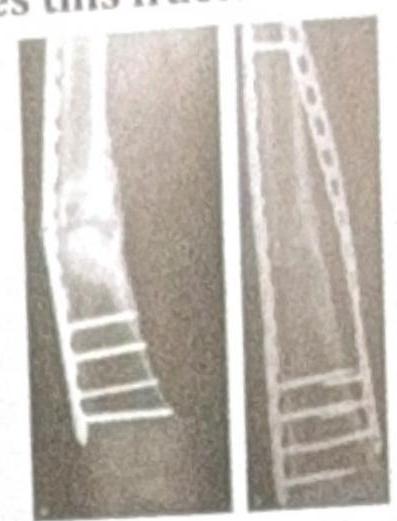
1 questionsFracture at which site affects the longitudinal growth of a bone?
NEET-PG 2024 - Orthopaedics NEET-PG Practice Questions and MCQs
Question 111: Fracture at which site affects the longitudinal growth of a bone?
- A. Epiphyseal plate (Correct Answer)
- B. Diaphysis
- C. Epiphysis
- D. Metaphysis
Explanation: ***Epiphyseal plate*** - The **epiphyseal plate**, also known as the **growth plate**, is a cartilaginous disc responsible for the **longitudinal growth** of long bones. - A fracture in this region can damage the **chondrocytes** and disrupt the normal ossification process, potentially leading to **growth arrest** or limb length discrepancies. *Diaphysis* - The **diaphysis** is the **shaft** or central part of a long bone. - While a fracture here can cause pain and instability, it typically does not directly affect the **longitudinal growth** potential of the bone. *Epiphysis* - The **epiphysis** is the end part of a long bone, initially separated from the main bone by cartilage but later fused with it. - Although it contains the epiphyseal plate in growing individuals, a fracture to the epiphysis itself (excluding the growth plate) primarily affects the **joint surface** and stability, rather than longitudinal growth directly. *Metaphysis* - The **metaphysis** is the transitional zone between the diaphysis and the epiphysis, adjacent to the growth plate. - While fractures in this area can be close to the growth plate, a metaphyseal fracture generally does not directly damage the **growth plate cartilage** to the same extent as a fracture through the plate itself, making its impact on longitudinal growth less direct or severe.
Pediatrics
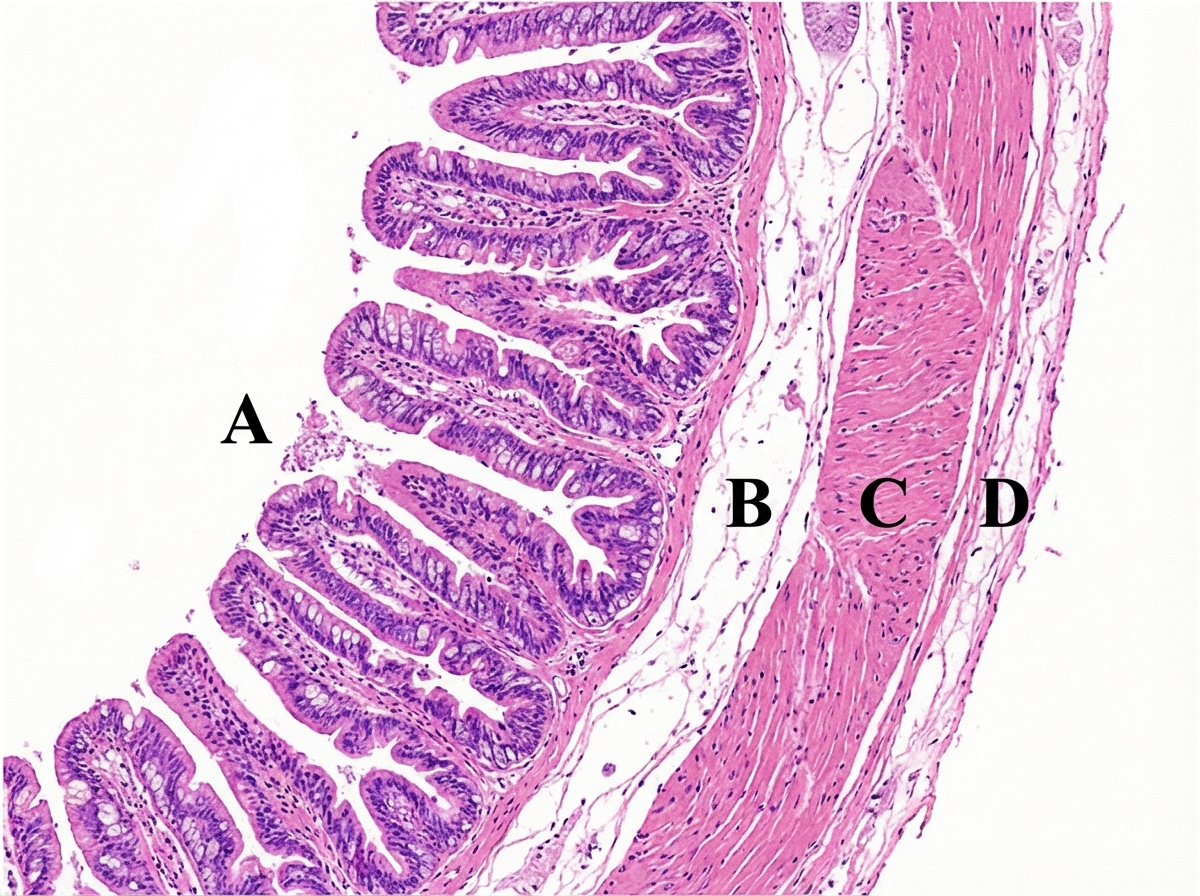
1 questionsA neonate presents with failure to pass meconium. The structure absent in the pathology lies in which of the following layers?

NEET-PG 2024 - Pediatrics NEET-PG Practice Questions and MCQs
Question 111: A neonate presents with failure to pass meconium. The structure absent in the pathology lies in which of the following layers?
- A. A, B
- B. B, C
- C. C, D (Correct Answer)
- D. A, D
- E. B, D
Explanation: ***C, D*** - The neonate's symptom of **failure to pass meconium** is characteristic of **Hirschsprung disease**, which is caused by the absence of **ganglion cells** in the distal colon. - The missing ganglion cells are typically found in the **submucosal (Meissner) plexus** and the **myenteric (Auerbach) plexus**, corresponding to layers C and D in the provided image. *A, B* - Layer A represents the **mucosa** (specifically the glandular epithelium), and layer B represents the **lamina propria** or potentially the muscularis mucosa. - These layers do not primarily house the ganglion cells implicated in Hirschsprung disease. *B, C* - Layer B is the **lamina propria** or **muscularis mucosa**, and layer C is the **submucosa**. - While the submucosa (C) contains the Meissner plexus, layer B does not contain ganglion cells relevant to this pathology. *B, D* - Layer B is the **lamina propria/muscularis mucosa**, and layer D is the **muscularis propria**. - While the myenteric plexus (associated with D) is affected in Hirschsprung disease, layer B does not contain ganglion cells, and this option incorrectly excludes the submucosal plexus (layer C), which also contains ganglion cells that are absent in this condition. *A, D* - Layer A is the **mucosa**, and layer D is the **muscularis propria** (outer muscle layer). - The mucosa (A) does not contain the ganglion cells, while the myenteric plexus (associated with D) is affected, but this option incorrectly includes A and omits the submucosal plexus (C).
Physiology
1 questionsWhich of the following prevents polyspermy?
NEET-PG 2024 - Physiology NEET-PG Practice Questions and MCQs
Question 111: Which of the following prevents polyspermy?
- A. Acrosome reaction
- B. Cortical reaction (Correct Answer)
- C. Zona reaction
- D. Capacitation
Explanation: ***Cortical reaction*** - The **cortical reaction** is the primary mechanism that prevents **polyspermy** following sperm-oocyte fusion. - Upon fusion, **cortical granules** in the oocyte cytoplasm release their contents (including proteases and peroxidases) into the **perivitelline space**. - These enzymes modify the **zona pellucida** proteins, making it impermeable to additional sperm - this modification is called the **zona reaction**. - The cortical reaction represents both the **fast block** (depolarization of oocyte membrane) and **slow block** (zona pellucida hardening) to polyspermy. *Zona reaction* - The **zona reaction** is the biochemical and structural change that occurs in the zona pellucida as a **result** of the cortical reaction. - It involves hardening and altered permeability of the zona pellucida, making it resistant to sperm penetration. - While this is the ultimate barrier to polyspermy, it is a **consequence** rather than the active mechanism - the cortical reaction is the causative event. *Acrosome reaction* - The **acrosome reaction** is essential for fertilization, allowing sperm to penetrate the zona pellucida by releasing hydrolytic enzymes. - It **facilitates** sperm entry rather than preventing additional sperm from binding. - This reaction must occur for the first sperm to fertilize the egg but plays no role in preventing polyspermy. *Capacitation* - **Capacitation** is the physiological maturation of sperm in the female reproductive tract. - It enables sperm to undergo the acrosome reaction and achieve fertilization competence. - It is a preparatory process and has no role in preventing polyspermy.